Category Archives: Myths Exposed

Apple: Price Fixing and Collusion

In this essay I discussed how price fixing and collusion occurs regularly in the ‘free market’. Here is another recent example of what I discussed.

Here are some lowlights from the article in the Wall Street Journal:

The U.S. accused Apple Inc. AAPL +0.41%and five of the nation’s largest publishers Wednesday of conspiring to raise e-book prices, in a case that could radically reorder the fast-growing business.

In a civil antitrust lawsuit, the Justice Department alleged that CEOs of the publishing companies met regularly in private dining rooms of upscale Manhattan restaurants to discuss how to respond to steep discounting of their e-books by Amazon.com Inc., AMZN +1.40%a practice they disliked. The executives also called and emailed each other to craft a solution to what one of them called “the wretched $9.99 price point,” the suit said.

The five publishers and Apple hatched an arrangement that lifted the price of many best-selling e-books to $12.99 or $14.99, according to the suit. The publishers then banded together to impose that model on Amazon, the government alleged.

As a result of this alleged conspiracy, we believe that consumers paid millions of dollars more for some of the most popular titles,” said Attorney General Eric Holder.

Three of the publishers settled with the Justice Department, agreeing to let Amazon and other retailers resume discounting of e-books. Settlement of a separate suit filed by 16 states and U.S. territories could lead to tens of millions of dollars in restitution to consumers who bought e-books at the higher prices.

A group of 16 states, led by Connecticut and Texas, filed their own suit Wednesday against Apple, Macmillan, Penguin and Simon & Schuster. The states said they have reached tentative settlement agreements with HarperCollins and Hachette. Those two publishers have agreed in principle to provide more than $51 million in restitution to e-book buyers, Connecticut Attorney General George Jepsen said.

My working conclusion is that this happens much more often than many folks think that it does. I base this on my own anecdotal experience of decades in business and management and on cases already mentioned in which I cited specific examples. It may sound trite and clique but I know from personal experience that these guys at the top have huge, inflated egos and they do work out these types of situations in their country clubs and on their golf courses. The Justice Department only pursues a small percentage of these types of activities.

As per Jeff’s recent comment, pure capitalism or socialism does not exist. I have pointed this out in this essay. To think of them as polar opposites in practice is a bit naïve in my opinion. We are individuals and collectivities and as such incorporate both of these components in our politics and economics.

I have no problem per se with selfishness or self-interest. If selfishness or self-interest is given carte blanche in economics the rich and powerful will always make sure that they stay that way at the expense of those that are not. If capitalism is the unregulated or nominally regulated practice of selfishness then what is the practical difference between it and oligarchy, dictatorship, fascism (statist), communism or any system that rules from the top by the powerful?

If practical capitalism is to have a form of democracy (as in the ideal of competition) then the best real hope for impartial rules on how the game is played can only be made by government. To the degree that the rules allow the process to be more competitive is the same degree that capitalism approximates its ideal. As Jeff points out, to the degree that corporatism (crony capitalism) determine the rules is, in my opinion, one factor in turning capitalism into simply another name for the powerful consolidating their hold on power. I have also pointed out that this happens with or without government involvement.

The idea that the government is solely or primarily the culprit may have emotional appeal to some but as far as I can tell is not factual. In a democracy we get the government we deserve. If we prohibit government from intervening in the market with regulation we are effectively handing the market over to the rich and powerful. As Jeff points out they will try to use the government to protect their power but as I have pointed out they will not stop there. They have many tactics for staying in power (as I previously illustrated) and are not above using them.

Those that would have the government stay out of market regulation are effectively playing into the hands of the rich and powerful and doing exactly what they claim the government is doing in crony capitalism – making it easier for the rich and powerful to maintain their hold on power. To ‘hope’ that competition will reign in unregulated or nominally regulated capitalism appears to me to be more like a religious ideal than a realistic practicality. Government should be in the active business of making competition in capitalism real and effective, offering constraints to the monopolizing tendencies of power. Our job as voters is to elect politicians that produce results toward this end and fire those that make big business the real constituents that they serve. If we put the fox in charge of the hen house we should not be surprised when all the hens get eaten.

Down the Rabbit Hole

Rather often I feel like listening to the Republicans is like living in Alice’s wonderland. Here are some examples:

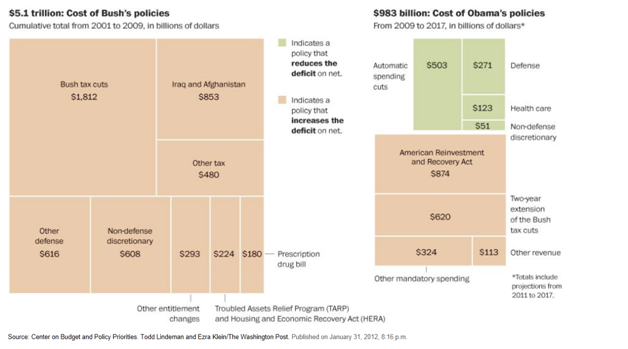
Who created more debt Bush or Obama?

The opiate truth: Obama increased the national debt vastly more than any other president.

The non-opiate truth:

The Graph – Center on Budget and Policy Priorities is non-partisan.

Here are the latest absolute numbers on the debt increase between President Bush and President Obama:

Bush debt increase: 85%

Obama debt increase: 44%

From January 20, 2001 to January 20, 2009 the national debt increased from $5,727,776,738,304.64 to $10,626,877,048,913.08. For those that still believe in arithmetic this is an 85% increase in the debt over the Bush administration’s term ((10,626,877,048,913.08 / 5,727,776,738,304.64) * 100) = 185% or an 85% increase).

From January 20, 2009 to February 3, 2012 the national debt increased from $10,626,877,048,913.08 to $15,330,778,119,850.60. This is a 44% increase in debt over President Obama’s term ((15,330,778,119,850.60 / 10,626,877,048,913.08) * 100) = 143% or a 43% increase).

Don’t take my word for it, check it out on the US Treasury Department site.

Additionally, there is the discretionary and non-discretionary part of the budget. Discretionary spending is annual spending that the congress and the president have to deal with every year; non-discretionary is mandatory, multiyear spending that has already been committed to by previous administrations (i.e., like food stamps calculated to poverty levels). The non-discretionary portion of the 2011 budget is 59%; the discretionary is 34% (reference).

What Republicans call Obama-Care has not kicked in yet but the GAO wrote a report that I have read from start to finish that claims it will take 100 billion off the budget over 10 years as compared to doing nothing (can’t cherry pick GAO reports in my opinion – ask my wife – she retired from the GAO). However, the 1 trillion dollars over 10 years of Medicare Part D that was passed by a Republican president (Bush) and Republican dominated House and Senate has already started to hit non-discretionary spending. The non-discretionary part of the budget makes up the lion’s share of the increased debt spending that you see at the end of the Bush administration. Part is this has to do with the wars, the national disasters (FEMA) and more importantly the recession. As more people go into poverty entitlements that were all previously linked to poverty numbers kick in with much higher amounts of spending – nothing to do with President Obama. This will be discussed more later in this essay.

Who created more unemployment Bush or Obama?

The opiate truth: Obama increased unemployment vastly more than any other president.

The non-opiate truth:

Bush increase in unemployment: 86%

Obama increase in unemployment: 6%

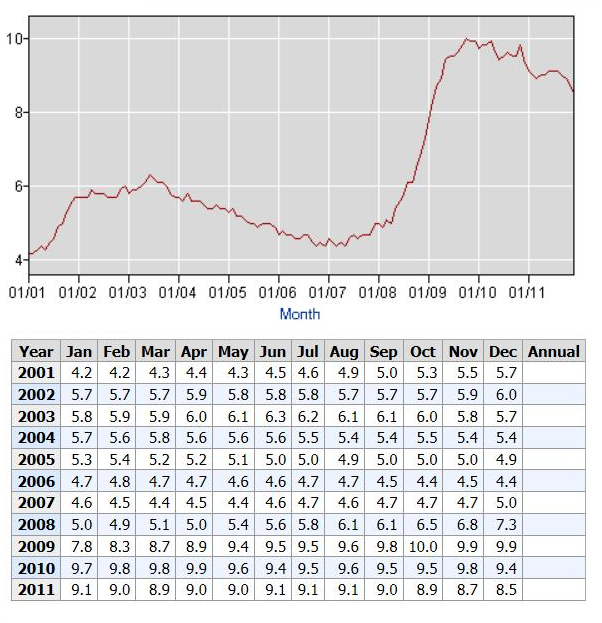
When Bush took office on January 20, 2001, the national unemployment rate was 4.2%. When he left office on January 20, 2009 and President Obama took office the national unemployment rate was 7.8%

The current unemployment rate as of January 6, 2012 is 8.3%

Doing the math, the increase during the Bush administration was (7.8 / 4.2) * 100 = 186% or a 86% increase in unemployment. For the Obama administration the math is (8.3 / 7.8) * 100 = 106% or a 6% increase in unemployment.

* Note: I have revised this based the January, 2009 unemployment number of 7.8%. President Obama took office January, 20, 2009. From the graph below you can see that the unemployment rate exploded just as he got into office. I think this explosion arguably was not due to anything President Obama did in his first few months (just 4 months later the rate was 9.4%) as the national unemployment rate does not turn on the dime but I will give the detractors the benefit of the doubt. There is still a huge difference in 86% (Bush) and 6% (Obama). If the numbers from 4 months after President Obama took office are used they work out to:

Bush administration increase in unemployment: 124%

Obama administration decrease in unemployment: 12%

Transition Date: End of May, 2009

Given this, the difference would be a 136% increase in unemployment during the Bush administration over the Obama administration.


Reference

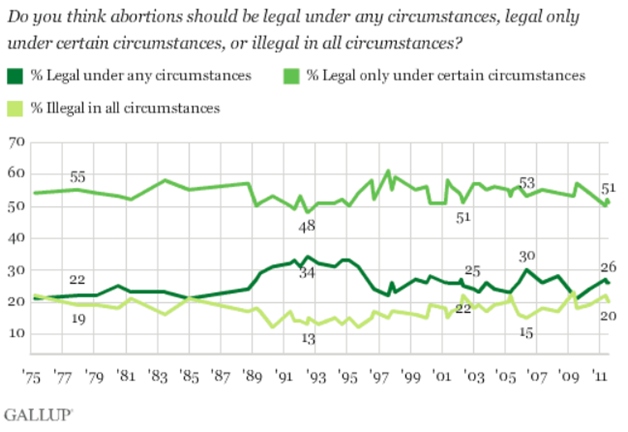
How do Americans feel about abortion?

The opiate truth: The majority of Americans are against abortion.

The non-opiate truth:

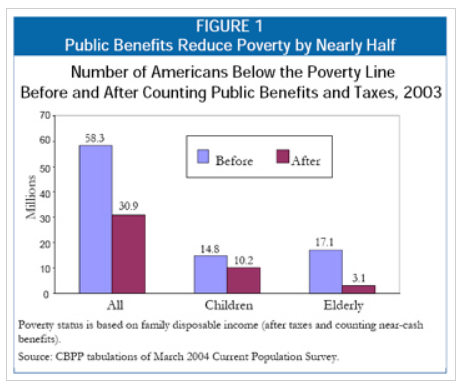
Entitlement programs?

The opiate truth: Entitlement programs do not do anything but waste taxpayers money.

The non-opiate truth:

President Obama and food stamps?

The opiate truth: President Obama is the ‘food stamp president’.

The non-opiate truth:

Food stamps have been tied to poverty levels for decades. President Obama has nothing to do with the automatic levels that kicked in due to the recession that started in the Bush administration.

Additionally, many of the entitlement programs are tied by law to the poverty line and/or adjusted income.

Introduction to the Supplemental Security Income (SSI) Program

Interesting chart…

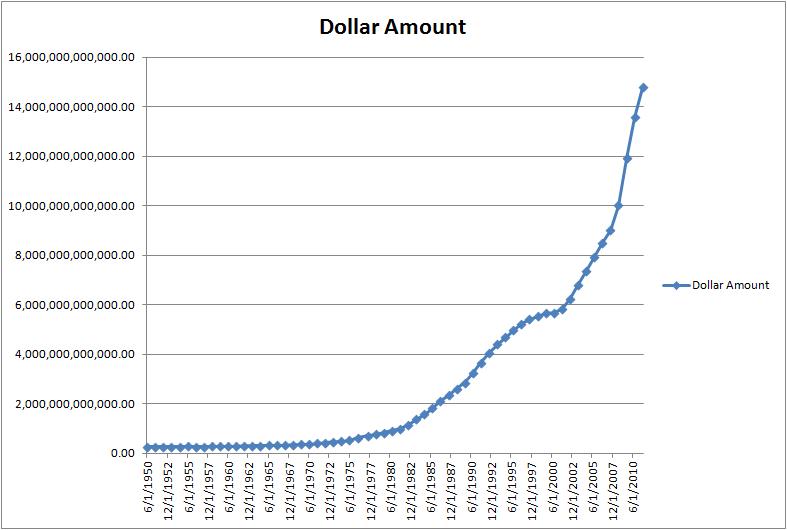
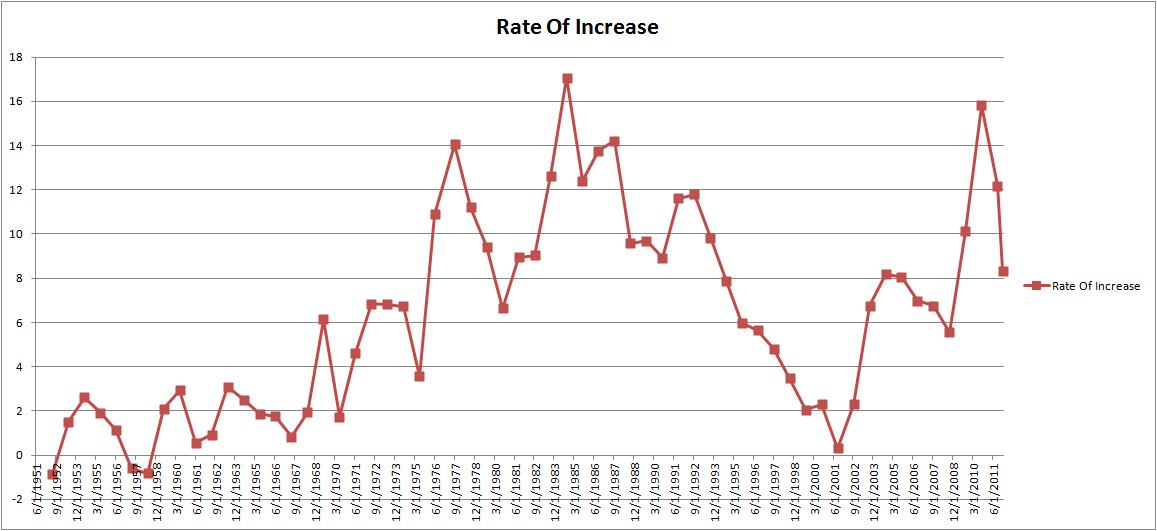
Even with all the additional expenses of non-discretionary entitlement programs kicking in during the Obama administration, the rate of increase of the national debt is still less that the Bush administration.

This is a graph of the debt since 1950 (click on the graphs to make them larger)…


This is the rate of increase of the debt since 1950…


Please note the difference from 2001 to 2009 and 2009 to 2011. This is Bush vs Obama

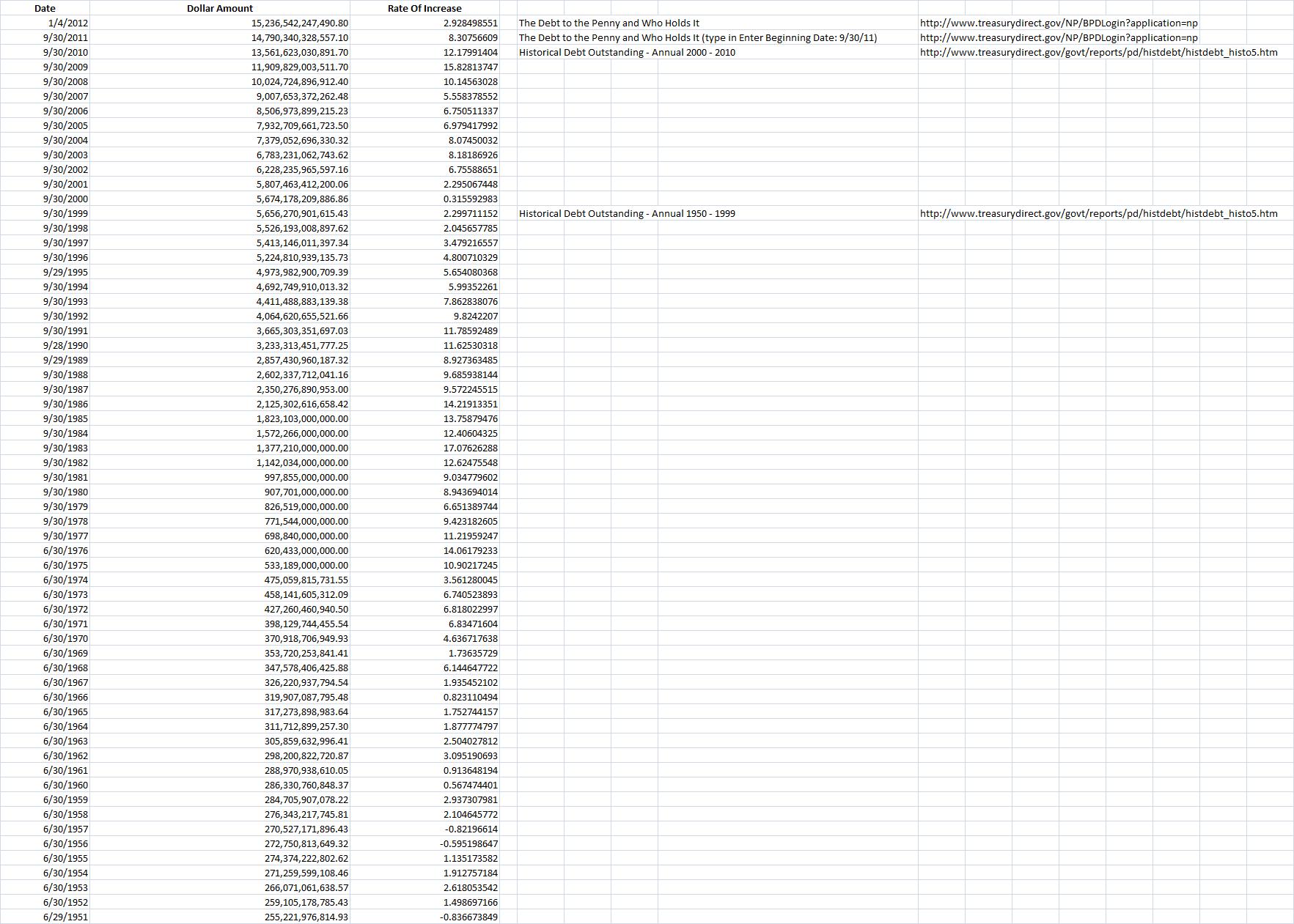
Note: The graph only uses full fiscal year data. The last fiscal year ended was September 30, 2011

Here is the data and links to the Treasury Department to verify the numbers…


The links shown above are:
Historical Debt Outstanding – Annual 2000 – 2010
Historical Debt Outstanding – Annual 1950 – 1999
The Debt to the Penny and Who Holds It
Debt Position and Activity Report
The Debt to the Penny and Who Holds It (type in Enter Beginning Date: 9/30/11)

Please, don’t vote and do drugs!

The Free Market: Capitalism and Socialism

Adam Smith, an Enlightenment thinker, thought of humans as fundamentally self-interested as contrasted to Thomas Hobbes.  Hobbes thought that selfishness worked as a kind of glue for society.  His idea was that people are selfish; fundamentally concerned only with themselves.  This meant that each person wanted to thrive based on their personal wants and needs without regard to ideals like the greater good or the plight of others.  However, as selfish people, they want security at any cost.  In order to obtain security, people subject themselves to the state, to laws.  While individuals would freely rape, murder and plunder without concerns of conscience they do not because they do not want to be on the receiving end of their brutish desires.  The free subjugation of themselves to the state is called ‘social contract’ theory.

Adam Smith lived hundreds of years after Hobbes.  He was also a social contract theorist.  He was concerned with how self-interested individuals create commerce.  In “The Wealth of Nations”, Smith writes:

“It is not from the benevolence of the butcher, the brewer, or the baker, that we expect our dinner, but from their regard to their own self-interest. We address ourselves, not to their humanity but to their self-love, and never talk to them of our own necessities but of their advantages.”[1]

He thought that when self-interested individuals compete, the process of competition resulted in the most optimum allocation of resources because competition resulted in the lowest average cost of goods or services.  In this way, he thought that self-interest served the greater good.  He thought that any time the government or monopolies intervened in this process it prevented the process from working as it should and kept costs artificially higher thus interrupting the normative operation of a free market.  It is important to note that Adam Smith’s ideals of the free market only work on the basis of competing individuals not market monopolizing corporations or governments.  Market monopolies interfere with competition and defy the ideal of a free market.

“The price of monopoly is upon every occasion the highest that can be got. The natural price, or the price of free competition, on the contrary, is the lowest which can be taken, not upon every occasion indeed, but for any considerable time together. The one is…the highest which can be squeezed out of the buyers…The other is the lowest which the sellers can commonly afford to take…. The monopoly price is most often sustained by “the exclusive privileges of corporations (65)”[2]

“Smith uses the terms “self-interest” and “private interests” always in opposite ways. For former, his most famous statements are “It is not from the benevolence of the butcher, the brewer, or the baker, that we expect our dinner, but from their regard to their own interest (20),” and, “by directing [his] industry in such a manner as its produce may be of the greatest value, he intends only his own gain, and he is in this, as in many other cases, led by an invisible hand to promote an end which was no part of his intention (351)”. Concerning “private interests,” Smith is not so sanguine; these private interests constitute the “spirit of monopoly (371)” which Smith so much detests. It should be clear by now, from what has been said before, that Smith is well aware of the dangers of avarice and especially so since the interests of capitalists diverge, in Smith’s view, so much from the interests of the general public.”[3]

Capitalism (a term he never uses), as Adam Smith thought, is depended on private property and private ownership.  The self-interested individual had complete legal and sole rights to their property.  Without private property there would be no motivation for individuals to compete and increase their property ownership, their wealth.

Socialism believes that individual interests are served better when they cooperate with each other and not compete.  Socialism believes in social ownership.  In effect, this means workers own production (also called the means of production).  Production is not owned privately but by a group.  There are many forms of socialism.  Some forms of socialism believe that the workers in a factory own the factory, but everything else in the economy is ‘free market’ and private property.  There is no government ownership is this type of socialism.  Some forms of socialism simply pay a social dividend based on factory profitability.  Some forms of socialism nationalize factories but still maintain private ownership.  Social democrats use a progressive tax system and government regulation within a private market economy.  There are also anarchist and libertarian forms of socialism.  Socialists tend to believe that when the individual is elevated above the group, normal human interaction and group identities tend to get ignored.  Language[4] is a perfect example of how humans are fundamentally collective.  People do not have ‘private languages’.  Communication is only possible by sharing a language that we individually did not make up.  People are not hermits.  We form governments, churches and social communities. 

“As soon as the land of any country has all become private property, the landlords, like all other men, love to reap where they never sowed, and demand a rent even for its natural produce. The wood of the forest, the grass of the field, and all the natural fruits of the earth, which, when land was in common, cost the laborer only the trouble of gathering them, come, even to him, to have an additional price fixed upon them. He must then pay for the license to gather them; and must give up to the landlord a portion of what his labor either collects or produces. This portion, or, what comes to the same thing, the price of this portion, constitutes the rent of land, and in the price of the greater part of commodities makes a third component part.

The real value of all the different component parts of price, it must be observed, is measured by the quantity of labor which they can, each of them, purchase or command. Labor measures the value not only of that part of price which resolves itself into labor, but of that which resolves itself into rent, and of that which resolves itself into profit.”[5]  -Adam Smith

It is important to note that a ‘pure’ socialism or capitalism has never existed on any large scale.  Every world historical economy has always been a mixture.  For example, consider the notion of rent in capitalism.

“For the purposes of economics, Smith divides society into three economic classes: the landlords, the laborers, and the merchants and manufacturers (448), or those who live by rent, those who live by wages, and those who live by profit (217). Now the interests of the first two classes are tied to the prosperity of the nation; economic expansion raises the value of land and increases the demand for labor and hence its wages. But exactly the opposite is the case with the third class, those who live by profit:

But the rate of profit does not, like rent and wages, rise with prosperity, and fall with the declension of the society. On the contrary, it is naturally low in rich, and high in poor countries, and it is always highest in the countries which are going fastest to ruin. The interest of this third order, therefore, has not the same connection with the general interest of the society as that of the other two (219).

Thus the interests of the third class run contrary to the interests of the other two; expansion actually raises the cost of labor and rent and increases competition, thereby lowering profits, so much so that the ruination of a country is actually in the best interests of the third class”[6]

It is interesting to note here that economic expansion “raises the value of land” but it is uncertain how long the values of land can go higher and how exactly the profits increase unless the property owner is the sole owner, i.e., already paid for and not obtained by a loan.  It would seem that profit is “high in poor countries”.  Adam Smith takes this an indicator of “ruination of a country”.

A property owner allows a tenant to live in their property for a fee.  The renter does not own the property and if the renter quits paying rent they are not allowed to live in the house.  Likewise, a mortgage is ‘ownership’ on paper but the bank allows a mortgagee to live in the house as long as the mortgage is paid.  In both cases, ownership is not sole or absolute – it is contingent on paying a periodic fee.  So, the landlord or the bank cooperates with the individual in the interest of capitalizing on the financial arrangement.  It should also be noted that the bank and the landlord are likely to be indebted themselves to the third class, “those who live by profit”; the financiers, that Adam Smith writes of above.  

We can see that the renter or the mortgagee is not a property owner in Adam Smith’s notion of property ownership.  However, the aspiration of the renter or mortgagee is for property ownership.  Since the aspiration of sole ownership is not reality, a group arrangement is made that allows an individual to have shelter until their aspirations can be obtained.  However, it is certainly true that most individuals today will never own their house outright.  Therefore, in reality they will live their whole lives working and cooperating in group economic, arrangements. 

In finance, leverage is the ability of an investor to increase their ‘paper’ holdings based on loans.  Again, a group economic arrangement allows investors to obtain securities that they would normally not be able to afford.  As such, the investor is obligated to a group, cooperative arrangement to leverage their holdings. The question of fees and profit is actually an ancient issue.  The Bible explicitly forbids interest or profit on loans (Exodus 22:25–27, Leviticus 25:36–37 and Deuteronomy 23:20–21).  These passages state that interest is exploitative.  In this sense, those that base their faith on these books would be in perfect agreement with the writings of Karl Marx (at least on this specific topic) and Adam Smith. Exploitation with higher and higher fees for loans on rental and mortgaged property are examples of how the wealthy class, the real property owners, has increased their wealth at the expense of those that are not wealthy.  This exploitation has been going on from the beginning.  Even Adam Smith recognized the exploitation of labor.  This excerpt is from an essay on The Wealth of Nations:

“However, in the negotiation of wages, the worker is at a distinct disadvantage. In the first place, the law prevented him from joining with his follows to bargain (71, 151). Further, the law always favors the masters over the workers (151). Workers are prevented from joining in unions to raise wages, but the masters are not forbidden to unite to lower them; indeed, the law encourages them to do so. This legal inequality particularly angered Smith, who noted that, “People of the same trade seldom meet together, even for merriment and diversion, but the conversation ends in a conspiracy against the public, or in some contrivance to raise prices (137).” But when the workers attempt to meet, it “generally end[s] in nothing, but the punishment or ruin of the ringleaders (71).” The inequality is so great that:

Whenever the legislature attempts to regulate the differences between masters and their workmen, its counselors are always the masters. When the regulation, therefore, is in favor of the workmen, it is always just and equitable; but it is sometimes otherwise when in favor of the masters (151).”[7] –Adam Smith

Socialism also recognizes the tendency for exploitation of the worker and tries to address it.

In both socialism and capitalism dues must be paid to benefit.  For Christianity[8], capitalism and socialism[9] a main tenant is “He who does not work shall not eat”.  Paying your dues is not an option in socialism or in capitalism.  Fees are required to participate in the group.  The main difference is that in capitalism, according to the ‘theory’ of Adam Smith, individualism as self-interest reigns supreme.  The ideal is that the individual worker benefits with private property ownership not the financier.  In socialism, the individual worker benefits as well but socialists want to formally recognize ownership of production in a group context – the laborer not the financier.  Depending on the type of socialism, the group could mean anything from share holders in a factory to nationalism of a factory.  In theory, the individual should benefit in both systems.  However, socialism wants to take precautions to ensure that the group of laborers benefit and capitalism viz. Adam Smith acknowledges that in some cases the financiers will benefit at the cost of the laborers.  Both systems distribute wealth in one way or another.  The fundamental problem that Marx wanted to address with socialism was how the wealthy, the financiers, ended up with all the real private property ownership while the workers, in effect, ended up as indentured slaves barely able to pay their bills.  Additionally, in both systems classes are set up in practice.

Karl Marx, the founder of communism, thought there was a higher and lower form of communism[10].  Engels and Lenin called the lower form of communism, socialism.  Socialism is not egalitarian.  Egalitarianism means everything is shared equally.  Marx described socialism like this:

“But one man is superior to another physically or mentally, and so supplies more labor in the same time, or can labor for a longer time; and labor, to serve as a measure, must be defined by its duration or intensity, otherwise it ceases to be a standard of measurement. This equal right is an unequal right for unequal labor. It recognizes no class differences, because everyone is only a worker like everyone else; but it tacitly recognizes unequal individual endowment and thus productive capacity as natural privileges. It is therefore a right of inequality, in its content, like every right. Right by its very nature can consist only in the application of an equal standard; but unequal individuals (and they would not be different individuals if they were not unequal) are measurable only by an equal standard insofar as they are brought under an equal point of view, are taken from one definite side only, for instance, in the present case, are regarded only as workers and nothing more is seen in them, everything else being ignored. Further, one worker is married, another not; one has more children than another, and so on and so forth. Thus, with an equal performance of labor, and hence an equal share in the social consumption fund, one will in fact receive more than another, one will be richer than another, and so on. To avoid all these defects, right instead of being equal would have to be unequal.”[11]

Karl Marx thought that communism would eventually replace socialism not by force but by natural progression.  Communism is egalitarian.  Communism thinks that wealth should be distributed equally among equals.  Individuals should not be singled out according to class, wealth, natural abilities, etc. but should work cooperatively for the greater good of society.  Communism does not believe in private property.  Private ownership and competition is thought to favor the rich and; necessarily, put less wealthy individuals at a competitive disadvantage.  Private property is what gives rise to a class stratified society.  In communism the ideal is one of egalitarianism; that all people are equal and should receive the benefit of their labor equally. 

For communism, individual ownership is not allowed but that does not restrain class stratification.  The administrators of shared wealth, the government, become the de facto upper class.  Wealth gets disproportionately distributed according to this class structure in communism as well.  In practice, capitalism, socialism and communism cannot claim a classless society nor can they claim that the individual is the sole beneficiary of the toil of their labor as property owners.

What follows from this is that the group or the individual is not normative for these economies but ideals.  Class is inevitable for capitalism, socialism and communism – it is utopic to think otherwise.  A class is a group comprised of individuals.  Mitt Romney is part of a class, a wealthy class.  Most of us will realistically never be in his class.  However, humans are aspirational – being human is being towards a future.  In this way capitalism offers the promise of a possibility – the possibility for success, the chance to be in the wealthy class.  For those that extol the virtues of capitalism, it does not seem to matter as much that the vast majority of these aspirations will never be fulfilled.  What matters is the place for the dream, the drama of the ideal.  As individuals, we need aspiration just after the need for food and shelter.  We need to think we are or will be a part of the wealthy class.  The goal of this aspiration is for membership in a group, a communal hope shared in capitalism.  We are ready to use our collective language, our economic group arrangements, our families, societies and affiliations to aid us in our goals – the envisioned absolute wealth of our freedom.  The dream that imagines itself as self-interested individualism is all the while prefaced, perforated and dependent on the other, the group, the community – our shared language.  This is what socialism recognized and tried to articulate in its economics.  What communism lost was the aspirational; the value we place on the desire for moving towards a future.

In reality, there never is an isolated individual that can cleanly be separated from a collectivity.  Additionally, the dream of accumulating more and more sole property ownership based on the system of self-interested individuals appears to reach practical limits as a result of the third group Adam Smith writes of, the financiers.  None of us are hermits and make up private languages as we go through our daily lives.  The notion of an Adam Smith styled individualism is what many philosophers think of as metaphysical (meta-phusis as beyond physics or beyond the physical).  The aspiration I have referred to is desire for the metaphysical individual.  It does not reflect our lived reality but necessarily participates in our sense of meaning and hope as an ideal.  Aspiration is essential for meaning.  To aspire is to see beyond the hum drum, the daily grind and meaningless repetition – perchance to dream.  How does the state, the government, figure into our aspirations?

For Adam Smith the state is the guarantor of our security.  It is responsible for the military.  It also is responsible for enforcing the law.  It holds the promise of reprisal for violations of law.   It is also responsible for public works projects and certain public institutions where profit is not possible.

“According to the system of natural liberty, the sovereign [government] has only three duties to attend to; three duties of great importance, indeed, but plain and intelligible to common understanding: first the duty of protecting the society from the violence and invasion of other independent societies; secondly, the duty of protecting, as far as possible, every member of society from the injustice or oppression of every other member of it, or the duty of establishing an exact administration of justice; and, thirdly, the duty of erecting and maintaining certain public works and certain public institutions, which it can never be for the interest of any individual, or small number of individuals, to erect and maintain; because the profit could never repay the expense to any individual or small number of individuals, though it may frequently do much more than repay it to a great society.”[12]

Contrary to popular belief, Adam Smith was not opposed to government regulation.  He spent 100 pages in the “Wealth of Nations” discussing banking regulations.  As has already been mentioned he knew the financiers in a society had a corrosive effect on society.  They had a tendency for exploitation and government regulation was needed to hold them in check.

For Adam Smith, self-interest is good for those that live by ‘rent’ and ‘wages’ but not for those that live by ‘profit’ as previously mentioned.  Smith thought those that live by profit had a destructive influence on society.  This is why Smith favored regulations for those who live by profit.  The government certainly plays an essential role for ensuring a fair market.  Of course, he recognized the issues with capricious regulations and the way they interfered with the normal market operation of efficient competition.  However, he would have never given financiers carte blanch, deregulated access to the market.  Adam Smith would have said, “I told you so” when the Gramm–Leach–Bliley Act of 1999, deregulated financial services.   It repealed part of the Glass-Steagall Act of 1933 that prohibited a single institution like a bank from acting as any combination of an investment bank, a commercial bank, and an insurance company. Basically, the repeal allowed banks to use customer deposits for risky financial ventures.  It also allowed banks to have conflicts of interest by ‘advising’ its customers to use its financial services and products without regard to more competitive and valuable investments.  Additionally, the government was implicated in these risky investments as the Federal Deposit Insurance Corporation (FDIC) backed up customer deposits.  The Dodd–Frank Wall Street Reform and Consumer Protection Act tried to restore financial oversight of banks and financial institutions and consumer protections.  One thing it did was to allow the government to liquidate these institutions that are covered by the FDIC in order to keep these institutions from having large scale failures that would jeopardize the ability of the U.S. government to bail them out.  Regulations not only provide a fair market but also protect the government from bankrupting itself from market excesses.  Adam Smith would have understood the need for this and would not be calling for deregulation as modern Republicans have been doing.

The issue here is that when individual self-interest promotes the healthy working of the market place then the government should stay of the way.  However, the government exists to make sure it protects “every member of society from the injustice or oppression of every other member of it”.  While it may be in the interest of oil companies to “drill baby drill” it may not be in the interest of the environment and therefore, other members of society to let them do it merely to increase their profits.  The government’s job is to make sure the market protects other members of society whose self-interest may be damaged by one group’s profit incentive in the market.

Adam Smith even recognized that the ‘free market’ was not a panacea that could solve all social ills.  He stated that a primary function of government was to take care of public works and public institutions where the “profit could never repay the expense” of doing the project.  It is certainly arguable that health care insurance providers and education could come under this rubric.  It is not the profit interest of health care insurance providers to cover certain risky population groups or chronic illnesses.  In order to maximize their profits it is in their interest to ‘cherry pick’ their clientele and drop clients that are a drain on the system.  It would be hard to believe that anyone could seriously argue that health care insurance providers have not had quite a long history that illustrates this point.  Additionally, while a very good private education is certainly feasible, the cost would prohibit many classes of society from being able to obtain an education.  Education for a profit certainly works for those that can pay but simply ignoring the others that cannot pay is not in the long term interest of a society.  Adam Smith argued that education is a public work when he we wrote:

 “The same thing may be said of the gross ignorance and stupidity which, in a civilized society, seem so frequently to benumb the understandings of all the inferior ranks of people. A man without the proper use of the intellectual faculties of a man, is, if possible, more contemptible than even a coward, and seems to be mutilated and deformed in a still more essential part of the character of human nature. Though the state was to derive no advantage from the instruction of the inferior ranks of people, it would still deserve its attention that they should not be altogether uninstructed. The state, however, derives no inconsiderable advantage from their instruction. The more they are instructed the less liable they are to the delusions of enthusiasm and superstition, which, among ignorant nations, frequently occasion the most dreadful disorders. An instructed and intelligent people, besides, are always more decent and orderly than an ignorant and stupid one. They feel themselves, each individually, more respectable and more likely to obtain the respect of their lawful superiors, and they are therefore more disposed to respect those superiors. They are more disposed to examine, and more capable of seeing through, the interested complaints of faction and sedition, and they are, upon that account, less apt to be misled into any wanton or unnecessary opposition to the measures of government. In free countries, where the safety of government depends very much upon the favorable judgment which the people may form of its conduct, it must surely be of the highest importance that they should not be disposed to judge rashly or capriciously concerning it.”[13]

While this may seem to promote a certain kind of equality, it is really “the duty of erecting and maintaining certain public works and certain public institutions, which it can never be for the interest of any individual or small number of individuals, to erect and maintain”.

The government is not a cancerous growth of society but just as essential as referees and rules are to games of sport.  Getting rid of government is cutting off your nose to spite your face.  It ignores the need for a market framework where fairness and protections are ensured.  It should restrain monopolies and market bubbles that would cause cost to be “the highest which can be squeezed out of the buyers”.  It is also responsible for filling in gaps that self-interest and profit cannot address.  Karl Marx and Adam Smith both addressed the inherent exploitation built into an economy.  Protecting individuals from economic exploitation is vital for an economy as socialism and Adam Smith understood.  Karl Marx went further with trying to embody elements of protections for ‘self-interested’ individuals into an economy.  Adam Smith understood the human need for aspiration, the need to dream, and tried to embody this in the economy of capitalism.

What is dreamed must pertain to me and not to an abstraction about the state or egalitarianism.  An ‘aspiration of the state’ is too abstract from the self-interested point of view.  However, the abstract notion of an ‘aspiration for the state’ is not inconsequential – it is the aim of morality or what Adam Smith termed sympathy[14] (more like what we think of as empathy).  Morality aims at egalitarianism in that it places oneself in the place of the other for Adam Smith.

“However selfish man may be supposed, there are evidently some principles in his nature, which interest him in the fortune of others, and render their happiness necessary to him, though they derive nothing from it except the pleasure of seeing it.”[15]

When I refer to morality, I am speaking specifically about the natural empathy that many people have for the suffering of others.  There are very few people that proclaim outright that if you do not work just go ahead and starve to death.  For most of us, we may think that those who do not work will not eat but few are willing to let children, elderly, handicapped or even lazy people die before our eyes.  The same holds true for health care.  We do not want to pay for others health care but the idea of just letting people die without it is abhorrent.  This is why we are willing to pay more for emergency room health care than to address the issues systemically and at a lower cost.  Most of us will not overtly proclaim that if you do not have health insurance go off somewhere and die.  Few will proudly state that if you do not have shelter go live on the street (just not my street).  While there is a certain chest beating, cathartic youthfulness about these proclamations it offends most people’s sense of responsiveness to these situations.  It may help some to think that suffering is the fault of the person suffering (as certainly may be the case for some) but pushing this very far starts to look like ‘protesting too much’ and really serves only to show that the pull of morality is felt only reacted to negatively and defensively. 

This feeling of responsibility for the suffering for others is what I mean by morality.  From the point of view of ‘my aspirations’, the suffering of the other is irrelevant.  From the ideal of pure self-interestedness there is no place for this feeling.  If the self is thought as the absolute metaphysic of individualism, the sole property owner, it does not serve the absolute interest of the self to care about the suffering of others; much less do anything about it that will not directly benefit the self.  While morality is an abstraction from the point of view of self-interestedness, it is nevertheless a notion that most are not willing to depart with.  Our self-interestedness tells us not to pay for anyone other than ourselves but the pull of morality will not let us ignore the suffering of the other.  Morality is the ghost of our group involvement.  It is the basis for the inevitability and indispensability of the state.

As I have discussed while our metaphysics of individualism compels us towards an aspirational future, our realistic, daily involvements are fundamentally based on language, community and group.  The capitalistic goal for moving into the upper class is itself a self-interested aspiration that embodies the notion of class, the group.  All this shows us that individualism is perforated with group involvement and community.  We are indebted to the other whether we acknowledge it or not.  While chest beating individualism may be fun for some, individualism, the sole property owner, is essentially a dream, a drama that gives us meaning in our ‘me-only’ self-centeredness.  However, individualism ignores the real ways in which we participate with others and are always already indebted to the other. 

Karl Marx went further than leaving the option of morality up to every self-interested individual.  Adam Smith as well understood the role of government in achieving the affluence and security of individuals in an economy, protecting them from exploitation and providing public works projects.  The communist notion of equalitarianism failed to make everything equal in terms of labor and preventing exploitation.  However, socialism attempts legal protections of groups and individuals that aim at fairness, equal opportunity, an equal playing field and protections in an economy.  It is important to note that ‘equal’ here is not some absolute ideal of equalitarianism as in communism but should be thought under the rubric of fairness.  Marx fleshed out possibilities for how this could work more than Adam Smith but Adam Smith would probably have more in common with the objectives of Karl Marx’ than many of the modern Republican, the neo-conservative, advocates of capitalism.

In any case, we are neither socialists nor capitalist; we are both.  The ideal of either is not where we live.  This is why there never has been a pure capitalism or a pure socialism.  All great economies have essential elements of both.  Beating others over the head with these labels may make some feel good but it is only a silly drama that fuels an inflated ego.  These kinds of accusations can also be used to manipulate less aware people but it is really only empty rhetoric.  The outcome of such practices is a chronic condition called hate and only hurts the hater in the long run.  I believe it is better to ‘see’ how we live and try to ‘understand’ our drives and aspirations as they show themselves without metaphysical hermeneutics, pre-cognitive dispositions and assumptions, working below the surface.  There is value in letting ourselves see and understand ourselves as we are and not in the service of some head game we play on ourselves.  In all great economies, socialism and capitalism are really only two different historical ways of thinking about the same thing – an economy that works.


[1] Adam Smith, Wealth Of Nations, [WN I.ii.2)

[2] The Forgotten Agrarian: Re-Reading Adam Smith, John C. Médaille, http://www.medaille.com/newadamsmith.htm, parenthetical numbers refer to section numbers in the cited Adam Smith work

[3] ibid

[4] Alas, you too young, free-market libertines who rail against the socialists in your rabid individualism – you too are a product of ‘group-think’ – it is called language – you just don’t know your indebtedness yet…

[5] Adam Smith, Wealth Of Nations, [WN I.vi.7-8: p 67]

[6] The Forgotten Agrarian: Re-Reading Adam Smith, John C. Médaille

[7] ibid

[8] II Thessalonians 3:10

[9] In accordance with Lenin’s understanding of the socialist state, article twelve of the 1936 Soviet Constitution states:

In the USSR work is a duty and a matter of honor for every able-bodied citizen, in accordance with the principle: “He who does not work, neither shall he eat.”

In Lenin’s writing, this was not so much directed at lazy or unproductive workers, but rather the bourgeoisie. (Marxist theory defines the bourgeoisie as the group of those who buy the labor-power of workers and engage it in the process of production, deriving profits from the surplus value thus expropriated. Once communism was realized, that is, after the abolition of property and the law of value, no-one would live off the labor of others.)

http://en.wikipedia.org/wiki/He_who_does_not_work,_neither_shall_he_eat

[10] http://www.marxists.org/archive/lenin/works/1917/staterev/ch05.htm

[11] Capital, Vol. I, Chapter 1, Section 4 (p. 78); Also see http://www.lrp-cofi.org/book/chapter3_transitiontosocialism.pdf

[12] Adam Smith, Wealth Of Nations, ([1776] 1976, 687–88)

[13] Ibid, (WN V.i.f.61: 788)

[14] Internet Encyclopedia of Philosophy, Adam Smith, http://www.iep.utm.edu/smith/   

[15] The Theory of Moral Sentiments, Adam Smith (TMS I.i.1.1)
A Rebuttal…

Here is my rebuttal of this,

http://critical-thinker.net/?p=1025

First, I would not maintain that idealizing the past is solely a conservative issue. I think you can always find cases where any group idealizes the past. However, in my opinion, the fallacy in your counter argument is of cherry picking. Admittedly, I have not done any statistical analysis of how often conservatives appeal to an idealized past in their rhetoric compared to the other cases you cite. I submit these points to reinforce my point:

Point 1 – Conservative by definition implies a history to conserve. The definition of the word contains my main premise, that conservatives root their identity, heritage and notion of truth in the past. None of the other groups you mentioned call themselves by a name that essentially, in the definition of the very word, implies identification with the past. I find this to be along the lines of a tautology, it is necessarily true that conservatism implies a past to conserve and any group that calls themselves ‘conservative’ sets up an identity with the past…

Conservatism means to conserve the past.
Therefore, a conservative wants to conserve the past.

Point 2 – I think most folks would agree with my presumption that conservatives continually hearken back to a better time that proves their ideology much more than other group’s rhetoric (including the ones you mentioned). I do not think that the numbers are the same for the cases you cite – numbers and proportionality matter. Admittedly, I have not and do not plan to try to come up with stats on this so this depends on people’s own judgment that preferably do not have a vested interest in the outcome of their judgment.

Point 3 – I think this is your admonition that conservatives idealize the past…

“I think a more accurate definition of conservative is someone who wants to conserve tried-and-true traditional institutions and who supports only gradual change, believing that such things are the way they are for good reasons.”

The “tried and true” is exactly what my contention is – the ideal of the “tried and true” may not have really been ‘tried’ or ‘true’. It certainly is an interpretation that is contestable – it may have been ‘tried’ but maybe not the way people think it was tried and the outcome may not have been the ‘true’ that common, un-researched opinions may have assigned to it. Are you suggesting that everything or even most things people think are “tried” and “true” really are – are you? It is the job of propaganda to make/create the content of the ‘tried’ and ‘true’. The reality is not necessarily either and I find typically different.

Point 4 – The graph you cite in your previous post that came from here,
http://scottgrannis.blogspot.com/2011/12/federal-finances-update.html
along with this graph,
http://data.bls.gov/timeseries/lns14000000
and these from my post,
https://www.mixermuse.com/blog/2012/01/06/all-you-need-to-know-about-politics-1-6-12-2/

all demonstrate my point. When Bush took office January 20, 2001 the unemployment was 4.2%. When President Obama took office January 20, 2009 the unemployment rate was 7.8%. Four months later in May it was 9.4%. Your GDP graphs show the almost straight line up at the end of the Bush administration as well. These straight lines up started at the end of the Bush administration and peaked just after Obama took office. They have been coming down ever since. This is the point I am making and you made it for me as well. The economy is like a cruise ship. Don’t forget the recession started as a result of 8 years of a Republican president and 6 years of Republican House and Senate control. A president cannot change the economy the day he gets into office. However, there is substantial evidence that you made and I made and others that things are turning around since Obama got into office – the proof is in the pudding. All you have to do is look at the graphs and where they occur to make my point. If you look at all the data points and do not take one point like “19.7” you will see that the debt went up just as Bush was leaving and Obama was starting. Also, look at the rate of change of spending in the graph on my blog cited above. Here is a better graph from GAO data,
http://www.gao.gov/special.pubs/longterm/debt/

I am not sure where your numbers come from on your graph but they seem a little skewed from the GAO numbers.

Another thing you have not taken into account is discretionary and non-discretionary part of the budget. Discretionary spending is annual spending that the congress and the president have to deal with every year; non-discretionary is mandatory, multiyear spending that has already been committed to by previous administrations (i.e., like food stamps calculated to poverty levels). The non-discretionary portion of the 2011 budget is 59%; the discretionary is 34%.
http://nationalpriorities.org/resources/federal-budget-101/peoples-guide/

What Republicans call Obama-Care has not kicked in yet but the GAO wrote a report that I have read from start to finish that claims it will take 100 billion off the budget over 10 years as compared to doing nothing (can’t cherry pick GAO reports in my opinion – ask my wife – she retired from the GAO). However, the 1 trillion dollars over 10 years of Medicare Part D that was passed by a Republican president (Bush) and Republican dominated House and Senate has already started to hit non-discretionary spending. The non-discretionary part of the budget makes up the lion’s share of the increased debt spending that you see at the end of the Bush administration. Part is this has to do with the wars, the national disasters (FEMA) and more importantly the recession. As more people go into poverty entitlements that were all previously linked to poverty numbers kick in with much higher amounts of spending – nothing to do with President Obama.

As you can see from your graphs and the others ones I have cited, the graphs are taking a turn for the better since President Obama took office but it will take more time than a year to turn it around and a congress that cooperates with the president to get military and entitlement spending down.

Please attach further comments to the original post cited at the top – thanks.

More Interesting Information:

•Since 2001, the U.S. has spent $7.6 trillion in security-related efforts, including: Department of Defense base-line, nuclear weapons, Homeland Security and war.
•From 2000 to 2011, security-related discretionary spending increased 96% versus non-security discretionary spending which increased 39%.
•The 2011 cost of interest on the national debt which is related to military spending is $80 billion. This is equal to the 2012 budgets of Agriculture, Commerce, Interior, Labor and Transportation combined.
•2011 spending on the Iraq War ($47.4 billion) would pay for all the public disaster funding that FEMA disbursed from Fiscal Year 1999 through Fiscal Year 2010.
•2011 spending on the Afghan War ($122 billion) is greater than the 2012 deficits of 42 states and the District of Columbia combined.

http://www.commondreams.org/newswire/2011/09/08-3

http://costofwar.com/en/publications/2011/ten-years-after-911/

and,

http://costofwar.com/en/publications/2011/ten-years-after-911/ten-year-visualization/

PS

I have not researched this data yet but plan to see if this is accurate:
Medicare Part D will add 9.4 trillion over next 75 years to the debt.
http://www.cms.gov/ReportsTrustFunds/
http://krugman.blogs.nytimes.com/2009/12/29/part-d-revisited/
Joe Scarborough reports Medicare Part D will add 7 trillion over 10 years to the debt.
Credit Default Swaps were 50 to 70 trillion during the Bush years.
I will not state that this is good data until I see reputable data sources.

Rich Envy?

In response to this post about the poor’s rich envy…

http://critical-thinker.net/?p=943

I think you may find the Economic Policy Institute has some interesting facts concerning the rich and poor.

http://www.epi.org/publication/11-telling-charts-about-2011-economy/

For example:

“In other words, the richest 5 percent of households obtained roughly 82 percent of all the nation’s gains in wealth between 1983 and 2009. The bottom 60 percent of households actually had less wealth in 2009 than in 1983, meaning they did not participate at all in the growth of wealth over this period.”
http://www.epi.org/publication/large-disparity-share-total-wealth-gain/

“In 1978, compensation of CEOs was 35 times greater than compensation of average workers. Since then, this ratio has skyrocketed, peaking at 299-to-1 in 2000. During the Great Recession, CEO pay fell relative to pay of typical workers because much of CEO compensation is directly linked to the stock market, which fell sharply in 2008 and 2009. However, the ratio bounced back during the recovery and stood at 243-to-1 in 2010. At this rate, it likely will not take long for the gap to reach its prior peak.”
http://www.epi.org/publication/ceo-ratio-average-worker/

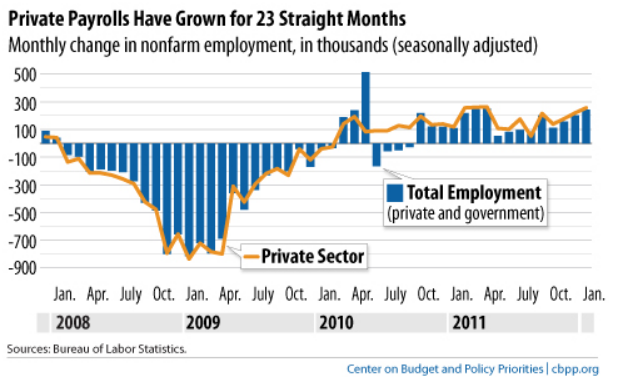
However, the unemployment situation has improved since President Obama took office – checkout the graph.
http://www.epi.org/publication/job-seekers-ratio-remains-4-1-34th-straight/

I have also tracked this data at…
https://www.mixermuse.com/blog/2012/01/06/all-you-need-to-know-about-politics-1-6-12-2/

I think what is at issue here is not the ‘envy’ factor but the relative growing disparity between the rich and the poor and the erosion of the middle class. Put another way, how far would you let it go before you thought there may be an issue – 5% very wealthy and 95% very poor as many small countries have been historically and continue to be? Would you employ the same logic of envy and wealth creation if this were the case? In other words, have you set up an absolute ideology of your stated terms or are your concerns relative to the ‘current’ situation? If the current situations in these graphs is true or were true, is this acceptable to your current ideology? If not, what would be the trigger point where you might concede a break down in your ideology? Also, do you believe that the facts cited are wrong?

Is the relative growing disparity between the rich and the poor because the rich deserve it more or the poor deserve it less (let’s not get into blame about what party is responsible yet – just want to get an idea of your belief system)?

Interesting Note:
Here are America’s Highest Paid Chief Executives…
http://www.forbes.com/lists/2011/12/ceo-compensation-11_rank.html

The Great Recession: How the Free Market Got Rigged

What happened after 30 trillion dollars of credit default swap derivatives flooded the worldwide market…

This is my understanding, based on the data cited here:
https://www.mixermuse.com/blog/2012/01/10/the-facts-how-the-republicans-created-our-current-economic-crisis/
http://mixermuse.com/blog/2010/10/14/how-george-bush-and-the-private-mortgage-market-created-the-perfect-storm/

In the latter part of the last decade, real estate pricing had been on the rise for decades and was due for a correction.

Credit default swaps (CDS) are private market derivatives that bundle up packages of mortgages. They were suppose to bundle higher risk mortgages with lower risk mortgages to level off the risk so that they could be sold for higher costs (less overall risk than the higher risk mortgages in the package). These packages are rated by rating agencies. In the Bush administration, regulation and rating agencies were closely aligned with the corporations and Wall Street. This has been thoroughly documented. Rating agencies and their agents were being wined and dined and were rewarding their comrades with lax regulatory enforcement and higher ratings on products like CDS.

CDS have very involved mathematical formulas that attempt to assess the risk of the package being sold. The ratings agencies are suppose to rate or endorse the validity of the risk assessment made by the company producing the derivative. The rating agencies were underfunded and did not really have the expertise to know how to accurately rate the CDS derivatives. Therefore, they were receiving ratings that were much higher than they should have been.

With the rapid increase of CDS, 900 billion to 30 trillion during the Bush years, more mortgages were needed to build the CDS packages. If you remember the last decade you will remember continual commercials on TV for ‘liar loans’. Private mortgages went up dramatically and were leaving the GSEs (Fannie and Freddie) in the dust. Everyone and their brother were jumping into the mortgage provider business. Housing pricing was going off the chart in an already inflated real estate market and house flipping was a favorite past time for many people. All this expansion was being funded by the need for CDS packages that were being sold like wildfire on the private market.

In the ‘free market’ the notion of value is really all about trust. When securities and derivatives are sold the buyer has to believe that the asking price is fair and worth doing the transaction. Even gold does not have an intrinsic value. It is also subject to trust as the recent rapid rise of asking price demonstrates. Capitalism which depends on the ‘free market’ depends on trust. Capitalism periodically has bubbles, runaway market segments where pricing goes up rapidly beyond any justifiable intrinsic value of the commodity being sold. When investors see other investors making money on inflated products they are inclined to jump in and trust that their investment will be rewarded with ever increasing pricing.

In a normal bubble cycle the market corrects itself, the latest investors to the ‘pyramid’ scheme lose and pricing goes down dramatically when the bubble bursts. This does not always happen. Occasionally the market develops ‘super bubbles’. This happened in the Great Depression. This also occurred in the CDS fiasco. In both cases lack of regulation and ratings agencies were key factors. For the CDS super bubble, instead of a ‘run on the banks’ there was a ‘run on the CDS’. The highly overinflated valuations of a super bubble carry with it the seeds of its own destruction. Trust gets strained and investors get more and more nervous as pricing goes up. This engenders more scrupulous requirements for risk assessment on the part of the investor. All the while, the requirement for more and more new mortgages to feed the beast is exasperating the oncoming doom. This is why the private mortgage market was leaving the GSEs in the dust.

Once the trust starts to break down, the market goes into panic sell mode. No investor wants to be left holding the bag. Housing valuations plummet. The housing market is left with very high inventories while pricing is out of whack for new home buyers. Mortgage holders are left holding all the risk consequences of highly inflated housing valuations and variable rate loans that make over-leveraged home owners absolutely incapable of making their payments or selling their house. So how is it that the homeowner takes the blame, all the risk and the consequences?

Anyone that blames the CDS super bubble of the last decade on the government has not understood the facts of what really happened. Wealthy Republicans control the purse strings of the Republican Party. They are the natural ones to benefit from the bubbles and super bubbles in the market. It is in their interest to find a straw man to blame when the bubble bursts and the individual mortgage holders are the last investors on the pyramid scheme. Housing valuations plummeted when the super bubble burst and the mortgage holders were left with the consequences. If Republicans allowed the idea that the ‘free market’ sometimes is rigged, people would demand oversight (regulation and independent ratings agencies) to level off the inequality of the market. Who do you think this would hurt? –wealthy Republicans of course. If the Republican electorate would maintain the same skepticism for the ‘free market’ they have for the government, market inequalities would be tilted more in their favor by electing politicians that exercise regulatory restraint on market excesses. Instead, the Republican electorate is made to believe that regulation kills the market and puts them out of jobs. Sure, a market can be regulated to death but that has never been the issue in this country. Our country has been highly tilted to the other side – no regulation and crony capitalism. How this problem has been made to be the Democrat’s fault is nuts. It is flagrant manipulation of the electorate by the Republican Party that creates this impression. If the electorate buys the Republican agenda and elects more Republican candidates, they will be throwing gasoline on the fire that will burn them alive. The next super bubble will make the Great Depression look like a time of affluence.

The Facts: Deregulation=Republicans=Economic Crisis

Myths about the Mortgage Meltdown

Myth 1: Clinton caused the mortgage meltdown
Myth 2: Low income lending caused the mortgage meltdown
Myth 3: Bush did not contribute to the mortgage melt down
Myth 4: The private (free market) was not the cause of the mortgage meltdown

The increase of MBS (mortgage backed securities) purchased by the GSEs (Fannie and Freddie) from 2003 through 2006 under pressure from the Bush administration to meet their 56% affordable housing requirement started PRIVATE, market speculation – a 30 trillion dollar bubble worldwide on the PRIVATE, credit default swap derivatives markets – this was the cause of the housing bubble that burst into the subsequent economic crisis. Deregulation of the financial market allowed this bubble to occur. The private (free market) speculative derivative bubble caused the meltdown not the low income housing increase and subsequent loses. The low income housing loses in the Bush years resulted in tens of billions of dollars. The private market speculation for derivatives, 30 trillion dollars, is orders of magnitudes larger than the low income housing loses during the Bush years and is the only amount large enough to bring down the markets worldwide.

To understand how all this created the perfect storm see:
https://www.mixermuse.com/blog/2012/01/11/the-great-recession-how-the-free-market-got-rigged/

Even Alan Greenspan, a Republican, admitted in his interview with Brian Naylor:

BRIAN NAYLOR: The man once known as the maestro for his direction of the nation’s economy as Fed chairman sat for four long hours yesterday, watching lawmakers who once cheered his performances turn into harsh critics. Testifying before the House Oversight Committee, Greenspan didn’t down play the severity of the crisis in the nation’s markets.
Mr. ALAN GREENSPAN (Former Chairman, Federal Reserve): We are in the midst of a once-in-a-century credit tsunami. Central banks and governments are being required to take unprecedented measures.
NAYLOR: Under questioning from Democrats on the panel, Greenspan conceded he might have been, as he put it, partially wrong in not moving to regulate trading of some derivatives that are among the root causes of the credit crisis. He also admitted his free market ideology may be flawed. This exchange with committee chairman, Democrat Henry Waxman of California, verged on the metaphysical.
Representative HENRY WAXMAN (Committee Chairman, Democrat, 30th District of California): You found a flaw in the reality…
Mr. GREENSPAN: Flaw in the model that I perceived is a critical functioning structure that defines how the world works, so to speak.
Rep. WAXMAN: In other words, you found that your view of the world, your ideology was not right. It was not working.
Mr. GREENSPAN: How it – precisely. That’s precisely the reason I was shocked, because I’ve been going for 40 years or more with very considerable evidence that it was working exceptionally well.
http://www.npr.org/templates/story/story.php?storyId=96070766

In September 2002, Greenspan, Treasury Secretary Paul O’Neill, Securities and Exchange Commission chairman Harvey Pitt, and Commodity Futures Trading Commission chairman James Newsome wrote a letter to members of Congress to note their opposition to legislation that would regulate derivatives.

They wrote:

“We believe that the [over-the-counter] derivatives markets in question have been a major contributor to our economy’s ability to respond to the stresses and challenges of the last two years. This proposal would limit this contribution, thereby increasing the vulnerability of our economy to potential future stresses….
We do not believe a public policy case exists to justify this governmental intervention. The OTC (over the counter) markets trade a wide variety of instruments. Many of these are idiosyncratic in nature….
While the derivatives markets may seem far removed from the interests and concerns of consumers, the efficiency gains that these markets have fostered are enormously important to consumers and to our economy.
Greenspan and the others urged Congress “to be aware of the potential unintended consequences” of legislation to regulate derivatives.
They got it exactly wrong. Swaps and derivatives ended up undermining, not bolstering, the economy.
http://www.motherjones.com/politics/2008/10/alan-shrugged

Proof:

Certainly, a significant event that started the collapse happened during the last few years of the Clinton administration. The Gramm–Leach–Bliley Act of 1999, known as financial services deregulation,

“It repealed part of the Glass-Steagall Act of 1933, opening up the market among banking companies, securities companies and insurance companies. The Glass-Steagall Act prohibited any one institution from acting as any combination of an investment bank, a commercial bank, and an insurance company.”

http://en.wikipedia.org/wiki/Gramm-Leach-Bliley_Act

The bill was a compromise between the Clinton Administration and the House Republicans:

“The bill then moved to a joint conference committee to work out the differences between the Senate and House versions. Democrats agreed to support the bill after Republicans agreed to strengthen provisions of the anti-redlining Community Reinvestment Act and address certain privacy concerns; the conference committee then finished its work by the beginning of November. On November 4, the final bill resolving the differences was passed by the Senate 90-8, and by the House 362-57. This legislation was signed into law by Democratic President William Jefferson “Bill” Clinton on November 12, 1999.”
http://en.wikipedia.org/wiki/Gramm-Leach-Bliley_Act

“In 2003, the two [GSEs, Fannie and Freddie] bought $81 billion in subprime securities. In 2004, they purchased $175 billion — 44 percent of the market. In 2005, they bought $169 billion, or 33 percent. In 2006, they cut back to $90 billion, or 20 percent. Generally, Freddie purchased more than Fannie and relied more heavily on the securities to meet goals.
In 1997 the GSEs owned about 12% of the total market share of these securities. In 2001 the GSEs owned about 15% of the total market share of these securities. In 2008 this percentage had grown dramatically to 40%.
In intervening years it was much more. President Bush directed his HUD director to pressure the GSEs into buying massive amounts these MBS [Mortgage Backed Securities] on the open market. This created huge market for these securities and encouraged more and more risky private sector mortgages so they could be bought, bundled and sold on the open market largely to Fannie and Freddie.
But by 2004, when HUD next revised the goals, Freddie and Fannie’s purchases of subprime-backed securities had risen tenfold. Foreclosure rates also were rising.
That year, President Bush’s HUD ratcheted up the main affordable-housing goal over the next four years, from 50 percent to 56 percent. John C. Weicher, then an assistant HUD secretary, said the institutions lagged behind even the private market and “must do more.”
For Wall Street, high profits could be made from securities backed by subprime loans. Fannie and Freddie targeted the least-risky loans. Still, their purchases provided more cash for a larger subprime market.
“That was a huge, huge mistake,” said Patricia McCoy, who teaches securities law at the University of Connecticut. “That just pumped more capital into a very unregulated market that has turned out to be a disaster.””
“In 2003, the two bought $81 billion in subprime securities. In 2004, they purchased $175 billion — 44 percent of the market. In 2005, they bought $169 billion, or 33 percent. In 2006, they cut back to $90 billion, or 20 percent. Generally, Freddie purchased more than Fannie and relied more heavily on the securities to meet goals.
“The market knew we needed those loans,” said Sharon McHale, a spokeswoman for Freddie Mac. The higher goals “forced us to go into that market to serve the targeted populations that HUD wanted us to serve,” she said.”
But because Fannie and Freddie were buying mortgage-backed securities rather than the actual subprime loans, their involvement came too late to require stiffer standards from lenders.
Fannie and Freddie “made no progress in civilizing the market,” said Sandra Fostek, a senior regulator at HUD.
William C. Apgar Jr., who was an assistant HUD secretary under Clinton, said he regrets allowing the companies to count subprime securities as affordable.
“It was a mistake,” he said. “In hindsight, I would have done it differently.””
http://www.washingtonpost.com/wp-dyn/content/article/2008/06/09/AR2008060902626.html

Conclusion: Even though Fannie, Freddie and FHA had much less to do with new loans in the Bush administration they bought huge amounts of MBS in those years to meet President Bush’s 56% housing requirement.

Additionally, the President encouraged the GSEs to “focus” their “core housing mission” “with respect to low-income Americans and first-time homebuyers” in the following statement from the White House,

“The Administration strongly believes that the housing GSEs should be focused on their core housing mission, particularly with respect to low-income Americans and first-time homebuyers. Instead, provisions of H.R. 1461 that expand mortgage purchasing authority would lessen the housing GSEs’ commitment to low-income homebuyers.”
http://georgewbush-whitehouse.archives.gov/omb/legislative/sap/109-1/hr1461sap-h.pdf

Conclusion: President Bush had directed HUD to require the GSEs to meet the 56% low income housing requirement. This pressured the GSEs to buy massive MBS. This created a massive market for junk mortgages.

Credit Default Swaps are insurance policies on mortgages, sort of like the futures market for commodities for MBS. Credit Default Swaps are not regulated. The government did not own credit default swaps. This was purely a private market commodity.

Between 2000 and 2008, the market for such swaps ballooned from $900 billion to more than $30 trillion.
http://topics.nytimes.com/top/reference/timestopics/subjects/c/credit_default_swaps/index.html?inline=nyt-classifier

This is what brought AIG down.

Goldman Sachs played both sides MBS and Credit Default Swaps.

When the Fannie and Freddie bought huge amounts of MBS, pressured by the Bush administration, the market for credit default swaps went astronomical. This is ultimately what broke them and resulted in tax payers having to bail them out.
http://money.cnn.com/magazines/fortune/fortune_archive/2005/01/24/8234040/index.htm

If you do not believe me what about Greenspan, Treasury Secretary Paul O’Neill, Securities and Exchange Commission chairman Harvey Pitt, and Commodity Futures Trading Commission chairman James Newsome (quoted above)?

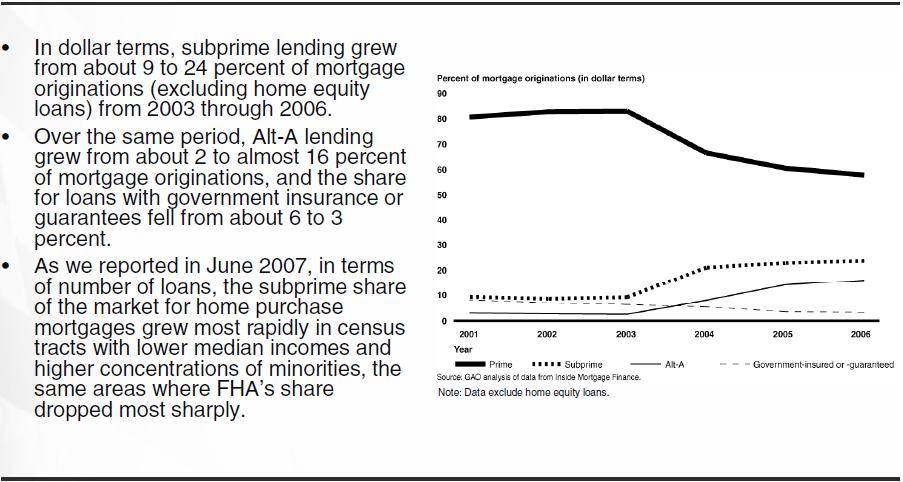
Here are the numbers that show:
1) the percent of subprime lending to total mortgage originations
2) the percent of Alt-A lending to total mortgage originations – An Alt-A mortgage, short for Alternative A-paper, is a type of U.S. mortgage that, for various reasons, is considered riskier than A-paper, or “prime”, and less risky than “subprime,” the riskiest category. Alt-A interest rates, which are determined by credit risk, therefore tend to be between those of prime and subprime home loans. Typically Alt-A mortgages are characterized by borrowers with less than full documentation, lower credit scores, higher loan-to-values, and more investment properties. A-minus is related to Alt-A, with some lenders categorizing them the same, but A-minus is traditionally defined as mortgage borrowers with a FICO score of below 680 while Alt-A is traditionally defined as loans lacking full documentation. Alt-A mortgages may have excellent credit but may not meet underwriting criteria for other reasons – http://en.wikipedia.org/wiki/Alt-A
3) GSE backed loans

http://www.mortgagebankers.org/files/News/InternalResource/57640_GAOReportInformationonRecentDefaultandForeclosureTrends.pdf

the percent of the total market of GSE and FHA, sub-prime loans (Col 1)
the default percentage of the total market (Col 2)
the amount in billions of the total market defaults (Col 3 )
Note: All currency amounts in billions
Year Col 1 Col 2 Col 3
1997 10% 0.9% $8
1999 13% 0.9% $12
2001 12% 0.7% $17
2003 11% 0.6% $21
2005 11% 1.5% $9
2007 13% 0.5% $28
Detail for Subprime Loans – see endnotes for sources (page 10 pdf)
http://www.aei.org/docLib/Pinto-High-LTV-Subprime-Alt-A.pdf
GSE Investment Portfolio and MBS ($ Billions, Left Axis)
GSE % of Total Outstanding Single Family Mortgages (Right Axis)
http://www.fcic.gov/hearings/pdfs/2010-0227-Jaffee.pdf
GAO report (page 18 for sub-prime data and page 21 for default rates data in pdf):
http://www.mortgagebankers.org/files/News/InternalResource/57640_GAOReportInformationonRecentDefaultandForeclosureTrends.pdf
http://www.aei.org/docLib/Pinto-High-LTV-Subprime-Alt-A.pdf (page 12 pdf)

This data clearly shows that:

The increase of low income, sub-prime loans and the low overall default rate of all loan originations (1.5% in 2005 was the highest tracked in this data, through 2007). This dispels that myth that the crisis was caused by loan defaults of low-income folks.

For more informations see – https://www.mixermuse.com/blog/2010/10/14/how-george-bush-and-the-private-mortgage-market-created-the-perfect-storm/

Something I blogged on the Huffington Post…

“Class warfare has been going on for decades. Republicans are really good at propaganda. However, they have finally deconstructed themselves. They could only talk generally for so long about cutting the size of the Federal government before their rhetoric caught up to them. Now that their own people are demanding that they walk the talk, the folks that are in the “What’s the Matter with Kansas?” syndrome will find that their leaders have been picking their pocket to sell them their own watch. The Republicans must put up or shut up and this will be their demise. Yes, they would love the Democrats to do the fate fatale for them so they could sophistically blame that on the Democrats as well (as they try to blame their failed economics on the Democrats) but Obama has caught the fox in his own trap – His populism actually works and helps the middle class (Proof: https://www.mixermuse.com/blog/2012/01/06/all-you-need-to-know-about-politics-1-6-12-2/) while their populism, as is typical, does exactly what they condemn the Democrats for – split the American public (religious, crush the middle class, attack immigrants, destroy the government they say the love, change the constitution they say they want to uphold the ‘original’ intent of, etc.) . The ‘populism’ of Obama as understood by the right is finally the courage that brings into the daylight the right’s own secret class warfare against the non-elite. As is typical, the right does the damage and blames it on the Democrats (i.e., lose of AAA rating). As a an ardent socialist in the industrial revolution (corporatism on steroids), Orwell is falsely revered by the right for “Animal Farm” but Orwell would have been much more sympathetic to this, https://www.mixermuse.com/blog/2012/01/06/the-fox-and-the-hen-house/, than the unmitigated proponents of capitalism.”

After a little more thought…

There has been a ‘secret war’ going on for decades on the middle class that every economic study has shown for many years. The latest census data tells us 1 out of every 2 Americans is in poverty. Yet, we get the right’s self-righteous shrill proclamations about the newly formed class warfare project from President Obama. Republicans really merit study for the copulas conjunction of the subject, President Obama and the predicate, class warfare. Republicans have well understood “The Little Prince” and the war of all against all. The best war is the invisible war; the war that takes the moral high ground while simultaneously erasing the enemy all the while producing its dominance. In this case, policies that prefer the rich and impoverish everyone else, are ‘capitalism’, the aspiration that any old fool could be rich too and corporatism would be their self-crafted philosophy, the philosophy that reifies the exception and punishes the accidental. If the old fool was rich he would be a king and the bourgeois jester of the noble would speak with Republican lips. The drama of the fool is more powerful than his poverty. Now, these new leftists come along and tell the fool that he is dreaming; that the jester lies as sirens sing. How dare the leftist disturb the fools slumber, let him dream. The leftist is the true enemy. These nag flies get in the way of baseless dreams, the opium of truth. I must say that it is ingenious along the lines of Nietzsche’s idea of Christianity. The truly powerful is never seen. It never becomes obvious. It hides in un-thought hermeneutics. It is the only proper language. It is the language that establishes and maintains truth and excludes madness (“Madness and Civilization”). Without the proper, the fool will fail but the fool fails anyway. Here resides the aporia, the riddle. When the riddle, the conundrum, the paradox is solved it loses its passion. In this therefore, existence loses. The end of the proper announces the beginning of anarchy, the victory of chaos – but how could anarchy have a beginning – can a circle be a square? When riddles multiply, mystification abounds and canon subverts its undoing. The past is lifted into the future as revised, continually re-established in service to unseen manipulation. The horror is the actual life I live and the sacred is the one I aspire to. The taboo is my inability to buy bread and the totem is the feasts I will have when I am rich. To understand what it means to be human must think the desire for fantasy. The elite Republicans know this well and count their riches on it. Truth in a void that can only endlessly turn on itself, eat itself, to obtain its ends must hide the producer at all costs. Obama is the evil Marxist spokesman of class warfare not because he did it (class warfare) but because he said it. He spoke the profane, the improper and therefore must die in his sin…and we wonder why there was a need for postmodernism?

What is a “Postmodern Conservative”?

There used to be a conservative website, some of its content is still around, called “The Postmodern Conservative”. I read a little content from this site as I am a little intrigued how one could maintain the conjecture of a ‘postmodern conservative’. On the surface, this is an oxymoron. Perhaps it is intended ironically. It is tantamount to thinking of Nietzsche’s nihilism and Christianity together in positive terms. Postmodern thinking seeks to overturn constructionism and its resulting epistemological result, structuralism. Postmoderism cannot be thought as a coherent, autonomous and positive philosophy. It is a symbiotic philosophy. It preys on structure and narrative. It is a methodology that deconstructs structure based on the specific structure’s own content, its counter narratives that contradict and undermine its canonical determinations. No philosophical system of thought is immune from the oxidizing effect of its most ardent iron. Deconstruction is the tool of the nihilist. In light of this, how would a ‘conservative’ postmodernists be thought except as ironically?

Their claim is further confused in their assertion that a ‘conservative’ postmodernist is more coherent that a ‘liberal’ postmodernist. This is like thinking that a Lucifer is more Christ-like than an Antichrist. What would one ‘conserve’ as a postmodernist? Why would the content of their conservation be immune from their own devices? How could a postmodern recommend ‘conservative’ content over ‘liberal’ content? Haven’t we established a canon, a ‘logocentrism’, by maintaining conservatism? If the thought is one of a sort of Darwinian mind-beating as opposed to the more conventional chest-beating in the belief that survival of the fittest is established, these folks should re-read Derrida’s essay on “Force and Signification” in “Writing and Difference”. Derrida writes, “To comprehend the structure of a becoming, the form of a force, is to lose meaning by gaining it.” 1) If the structure of ‘conservatism’ is meaningful and is to be recommended over ‘liberalism’ then, for deconstruction, its meaning is lost at the same time that it is achieved.

If, on the other hand, ‘conservatism’ here is meant to designate brute force, mystification of raw power, then power becomes that text that Derrida writes of when he states, “To say that force is the origin of the phenomenon is to say nothing” 2) He goes on to state that Hegel clearly demonstrates that force is a tautology. Force can only assert itself. Force and language amount to the same thing, the same identity. Nothing new or different is added in thinking either word. To rejoin this notion to conservatism is reminiscent of Ayn Rand and her elitist dogma; a tautology of power makes right, history IS the narrative of the conqueror. Without regard to any moral or ethical disjoins, this assertion merely redundantly marks itself. Its only claim is to force or the structuralism that it establishes. To deconstruct its specific narrative is the task of postmodernism. To deconstruct deconstructionism is to revert to constructionism and thus re-establish (or never have de-established) its myopic insistence, its force. In other words, it is to say nothing using a lot of words. While this trend has certainly not been alien to philosophy it seems to rise to the level of infinite nonsense in the thought of a “Postmodern Conservative”.


1) Writing and Difference, Force and Signification, page 26 (paperback)
2) Ibid, page 26 (bottom)

The Obvious: Why have Republicans suddenly found religion on the national debt?

First, let’s start with the obvious:

From January 20, 2001 to January 20, 2009 the national debt increased from $5,727,776,738,304.64 to $10,626,877,048,913.08.  For those that still believe in arithmetic this is an 85% increase in the debt over the Bush administration’s term ((10,626,877,048,913.08 / 5,727,776,738,304.64) * 100) = 185% or an 85% increase).

From January 20, 2009 to today July 12, 2011 the national debt increased from $10,626,877,048,913.08 to $14,343,010,710,537.58.  This is a 35% increase in debt over President Obama’s term ((14,343,010,710,537.58 / 10,626,877,048,913.08) * 100) = 135% or a 35% increase).

Don’t take my word for it, check it out on the US Treasury Department site at: http://www.treasurydirect.gov/NP/BPDLogin?application=np

So, in light of the simple math, why would anyone suggest that President Obama is big government and the Republicans are not?  This is patently absurd.  President Bush and the 6 year majority of Republicans  in the House of Representatives and the Senate went from the 4 year surplus that President Clinton left to record deficits and an 85% increase in the national debt.

No amount of groveling can erase this FACT so “man up” Repubs.

Myth 1: Republicans do not favor BIG Government.

Myth 2: Republicans favor tax cuts to create jobs.

Myth 3: Deregulation increases jobs

The first part of Myth 2 is true.  Bush cut the marginal tax rates across the income spectrum.  For those making over 1 million dollars a year the income taxed over $373,650 went from a marginal tax rate of 39.6% to 35%.  The lowest income bracket marginal tax rate went from 15% to 10%.  What is not true in Myth 2 is that the Bush tax cuts increased jobs.  It increased unemployment dramatically 98% as this post documents:

http://mixermuse.com/blog/2011/07/08/the-obama-administration-raises-unemployment-25-really/

The national debt went up 85%.  We lost the four years of budget surplus that the Clinton administration gave us AND gained the stock market and mortgage market crashed as this post documents:

http://mixermuse.com/blog/2010/10/14/how-george-bush-and-the-private-mortgage-market-created-the-perfect-storm/

The deregulation of the financial industry, oil and gas and product safety (and almost every other government regulatory function) was a disaster.  The private sector, unregulated market for credit default swaps went from 900 billion to 30 trillion dollars under President Bush.  The financial collapse under President Bush was the result of a 30 trillion dollar unregulated market based on junk mortgages.

Now, after the first African-American president the Republicans deem as “socialist” has actually turned the Republican nightmare of the Bush years around, Republicans are popping out of the the wood work with newly found religion on the national debt.  Where were these disciples during the Bush years?  Could it be that spending was ok when a Republican was doing it, at least judging from the rhetorical decibel level of their party, and now that Democrats “have the checkbook” they are fuming with moral debt rage?  This is two-faced and hypocritical.  It is a laughable elitism that was deferred in part by Dick Armey’s creation of the TEA party.  It was smart to off-load the most intense Republican anger with the Bush administration with a thinly veiled, far right wing group that will still vastly vote Republican.  They can in effect be Republican in their voting habits but fantasize that they are neither Republican nor Democrat.

In any case, I am encouraged by the rising sentiment in the Republican ranks against absurd wars and wish they had joined us during the most costly wars started in the Bush administration.

Across the board, Republican ideology has failed to live up to its essential claims AND historically proven themselves to have opposite consequences.  Their counter claims about what Democrats do to the economy have also proven themselves to be fabrications and historically unfound…oh for the days of the budget surplus and the 4.7% unemployment rate of the Clinton administration. ..I would also take the 2% decrease of unemployment under President Obama to the 98% increase under President Bush.

The only way to understand how the Republicans have succeeded in their claims is to understand how “marketing” or better yet “propaganda” can be used effectively to control voters.  They are the masters of propaganda, revisionist history and sophistry.  Their ideology of “free market based” survival of the fittest gives them the latitude to employ these techniques freely.  Democrats are much less adept at these practices.  They have more resistance to lying and manipulation built into their ideology and are generally awful at it when they try.  If the Republicans succeed, the crony capitalism that results will be disastrous for the masses that gave them the votes to do it and the “middle class” will continue to disappear.

As for me, I still maintain that there are facts that are not private and some statements can be deemed more historically accurate than others.  I hope I am not in the minority.