Category Archives: Politics

The Question of Conservatism

Conservatives want to conserve. Certainly this is ostensively true. The question of conservatism comes when the object of conservatism is explicitly posed. For example, conservatives are fond of talking about the past. They believe that their notion of the past is ‘real’. However, an objection could be made that their interpretation is ideal and therefore, as an example, a return to the conservative past is not only impossible as it never really existed but could be used for voter manipulation (please see the addendum below to illustrate this point).

In philosophy we would say that history is hermeneutical; that is, it lends itself to interpretation. Are there historical facts that are more certain than others? –Absolutely. Hitler existed. However, there are mainstream Republicans that believe Hitler was a liberal, socialist since Jonah Goldberg (see https://www.mixermuse.com/blog/2010/01/03/fascism-is-liberal-and-squares-are-circles/). While the vast majority of historical scholars disagree with Goldberg’s conclusions, it does demonstrate the susceptibility of history to interpretation. The Bible is another clear example of how history can interpreted differently viz. all the different Christian denominations. Of course, there are multiple attempts to define the ‘true’ history but that is beyond the scope of this discussion. The point is that history has empirically demonstrated a propensity for radically different interpretations.

Since there is an interpretive variability to history, it makes conservatism more problematic. The argument gets turned into a struggle for defining or perpetually having to redefine what we need to conserve. A more skeptical view of conservatism is that it lends itself to propaganda – in this case, a re-creation of the past that is repeated enough times to manipulate public opinion into believing it is true – marketing is proof that propaganda works. Nietzsche would be in perfect agreement with the notion that the past is a story told by the victors. I would in no way imply that liberals are immune from the criticism of propaganda. However, the criticism of liberals and propaganda is not from ‘conserving’ the past but generally from different directions.

The obsession with the past that needs conserving is what many philosophers call reactionary. That is, it sustains itself by trying to establish a ‘true’ understanding of the past. It must therefore react to every challenge to the ‘true’ understanding. If conservatism could establish a ‘true’ history, it would justify its existence, its essence or in philosophy, its origin (arche in Greek). This task is a bit like the myth of Sisyphus who had to eternally roll a stone up a hill only to have it roll down again. Conservatism, not unlike Christianity, depends in part on the monumental task of preserving or trying to establish an interpretation of the past. The struggle then in conservatism is a struggle for the ‘true’ and the proper.

In current philosophy there is much discussion about the ‘proper’ and its essential reciprocity to the ‘improper’. The proper is indentified with essence, origin, history, sacred, eternal and true. The improper is identified with accidental, contingent, insignificant, profane, finite and false. The truth claim as what is proper is not so much in question as how the dynamics of proper and improper depend on each other to be, to exist as what they are. Many philosophers, Hegel not the least, have exhaustively shown that the true could not even be thought without the errant, the not-true. In philosophy there is something called a tautology; something that is absolutely, necessarily true. For example, A = A is an identity and therefore a tautology. A proper identity in philosophy is always true and a tautology. However, the set of all not-As has just as much to do with A being A as the positive statement. Without the not-A, the A not only would not ‘exist’ but it could not even be thought. Likewise, in any hermeneutic of history a canon, a dominant narrative that gets established as ‘true’, must perpetually topple any counter narratives, any themes that oppose or contradict the dominant narrative. The very fact the task is continual shows that the counter themes are never extinguished completely. A symbiotic relationship exists in which both canon and not-canon must preserve each other in order to ‘be’, to even ‘be able’ for thought. So, the proper cannot do without the improper. The proper must, of necessity, sow the seeds of the improper. It must provide the themes for its destruction as it insists on its proper-ness. In the context of this essay, conservatism owes its existence to what it cannot and does not want to maintain – the nemesis of historical truth – hermeneutics (historical interpretation). Regular folks call this relativity or relativism.

Relativism as commonly thought means that tautology is impossible. However, to suggest that true is not true is utter nonsense. What gets conflated in the common notion of relativism is historical and moral uncertainty, viz. the play of hermeneutics, is tantamount to no absolute, no tautology, no truth. This is an unfortunate equivocation of the legitimate direction of ‘relativism’. Even Einstein, the father of modern relativity, was harshly criticized for overturning the absolute time and space of Newton. However, Einstein did not mean that all is falsity, or ambiguous mush. For Einstein there are ‘truths’ but they are relative to each other not to some absolute, metaphysical construct of time and space or ether. The tension here is one of habit. Up until Einstein, we had a historical tradition of understanding time and space as absolute. Our ‘common sense’ was a habitual and linguistically enforced ‘filter’ for making sense of ‘reality’. Anytime a habit is uprooted, whether it is personal or sociological, there is tension, the compulsion to adapt, the loss of a ‘past’ and the ‘thrown-ness’ toward an uncertain future. The future is shown in the need to reinterpret the past according to some new paradigm and therefore, the past itself shows an almost ‘movie-like’ projection screen whose projector has the lens of the future – the uncertainty of what will be taken into the showing of the past.

For Martin Heidegger, a contemporary philosopher, the uprooting of our previous historical constructs (historicity) was the very possibility for authenticity. In other words, the need for fundamental change, adaptation, reflection was anxiety. He called this being-toward-death. He wanted to identify my death, my end, and the anxiety it induces with the absolute requirement for the possibility of ‘truth’. He interpreted ‘truth’ as aletheia – unconcealedness or what shows itself as itself as distinguished from concealment. So, for Heidegger, the ‘truth’ of human being is in our capacity for being-towards-an-end.

Our truth is not gained from some apriori, metaphysical understanding of the ‘truth’ but from our ability to stand in the face of our end. In the context of this essay, this would mean not having to ‘conserve’ the past but living in the uncertainty of the past and our dogmatic notions of what its ‘truth’ really was. This is not to suggest that there was no truth as Einstein was not suggesting there wasn’t truth but to try to get us to think differently about what a ‘truth’ could be; not absolute time and space but space-time continuum.

In conclusion (please don’t applaud), I believe that the dilemma of conservatism does not necessarily have to be viewed as some kind of relative gaping void from the absence of truth. The alternative to conservatism is not relativistic mush and nihilism. Fundamental change is not necessarily bad and improper. It certainly creates anxiety in the openness of the question but the openness itself is what makes one young, engenders the notion of freedom, the possibility of change to something more authentic. What is more, it resists the heaviness of banality and empty repetition, the slow decay of the novel and passion. The transform that I alluded to with Heidegger is not to another movie for the projector but taking the step back to see the wonder of truth and its showing – and the ways that it continually thwarts our insistence on the ‘final’ showing. In my opinion, conservatism is an illusion that we sincerely feel like we need but carries an essential downside that must of necessity reappear – why not give up that Herculean struggle and just take a look around?

Addendum:

Let’s take a recent example:

Mitt recently stated, “The president says he wants to transform America, I don’t want to transform America into something else. I want to restore it.”

Let’s see, restore it to…

…the Bush administration
During the Bush administration two wars were started and the economy was bankrupted. The national debt increased twice as much as the current administration. During the Bush administration unemployment went up 77% more than during the Obama administration.

Bush administration increase in debt: 85%
Obama administration increase in debt: 43%
Bush administration increase in unemployment: 86%
Obama administration increase in unemployment: 9%
Transition Date: January 20, 2009

Note: The latest unemplyment rate is 8.5%.

http://www.bls.gov/news.release/empsit.nr0.htm

For more details see this:

https://www.mixermuse.com/blog/2012/01/06/all-you-need-to-know-about-politics-1-6-12-2/

Note: The debt numbers are a bit of a broad brush as it does not break down discretionary and non-discretionary parts of the budget and the contribution of each administration to both of these types of spending.

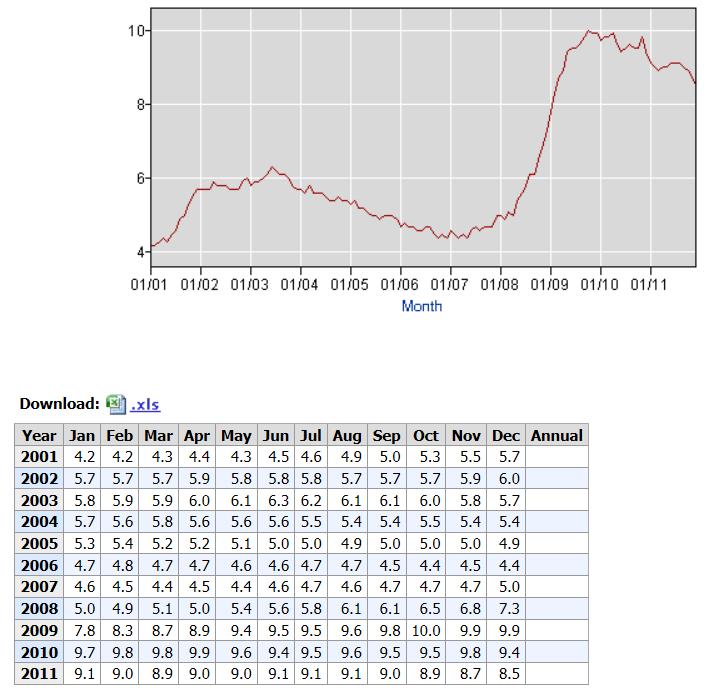
From the graph below you can see that the unemployment rate exploded just as President Obama got into office. I think this explosion arguably was not due to anything President Obama did in his first few months (just 4 months later the rate was 9.4%) as the national unemployment rate does not turn on the dime. Given this, the difference would be a 134% increase in unemployment during the Bush administration over the Obama administration.

Bush administration increase in unemployment: 124%
Obama administration decrease in unemployment: 10%
Transition Date: End of May, 2009
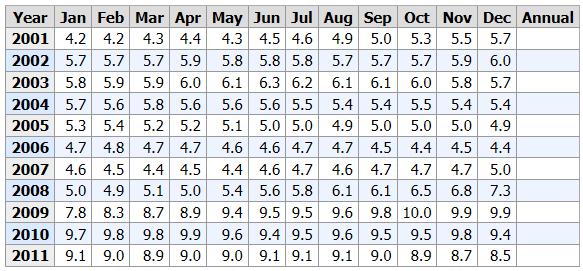
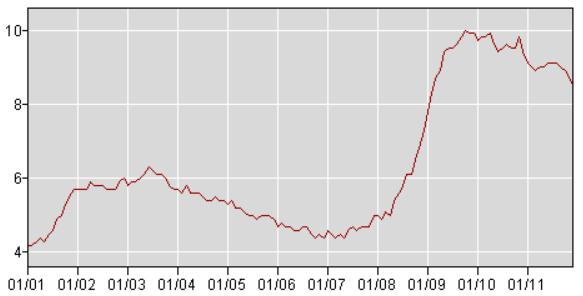
http://data.bls.gov/timeseries/lns14000000
Note: For some reason, you may have to do a couple refreshes on this link to show the graph.

Also, see:
https://www.mixermuse.com/blog/2012/01/11/the-great-recession-how-the-free-market-got-rigged/

…prior to Medicare and Medicaid?
“Before Medicare, only 51% of people aged 65 and older had health care coverage, and nearly 30% lived below the federal poverty level.”
http://www.usgovernmentbenefits.org/hd/index.php?t=define+medicare

…before women had the right to vote and blacks and gays were hung for entertainment?
http://en.wikipedia.org/wiki/Lynching_in_the_United_States

…before Social Security?
“the best estimates show that the elderly poverty rate in 1935 was probably somewhere in the range of 70 to 90 percent.”
http://www.politifact.com/truth-o-meter/statements/2010/aug/17/eddie-bernice-johnson/texas-congresswoman-eddie-bernice-johnson-says-soc/

…before the civil war
Slavery

…from the beginning
In 1800, the mean life span in the United States was about a quarter century
In 1900 the mean was about 50 years
http://www.longevity.ca/info_life_expectancy.htm

Do you REALLY want to go there?

The Republicans are painting a fantasy picture for voters that need to believe fantasies of the past – it NEVER happened. The fact is that we have progressed from a dark past albeit in a bumpy and messy way. It is absolute insanity to want to go back to the way it really was. There was no earlier, greater time than now for the United States. Yes, a few things may have been better but don’t let them fool you, things are better now than they have ever been for folks.

So, here is the question, do you want to transform our future or restore our past?
Rich Envy?

In response to this post about the poor’s rich envy…

http://critical-thinker.net/?p=943

I think you may find the Economic Policy Institute has some interesting facts concerning the rich and poor.

http://www.epi.org/publication/11-telling-charts-about-2011-economy/

For example:

“In other words, the richest 5 percent of households obtained roughly 82 percent of all the nation’s gains in wealth between 1983 and 2009. The bottom 60 percent of households actually had less wealth in 2009 than in 1983, meaning they did not participate at all in the growth of wealth over this period.”
http://www.epi.org/publication/large-disparity-share-total-wealth-gain/

“In 1978, compensation of CEOs was 35 times greater than compensation of average workers. Since then, this ratio has skyrocketed, peaking at 299-to-1 in 2000. During the Great Recession, CEO pay fell relative to pay of typical workers because much of CEO compensation is directly linked to the stock market, which fell sharply in 2008 and 2009. However, the ratio bounced back during the recovery and stood at 243-to-1 in 2010. At this rate, it likely will not take long for the gap to reach its prior peak.”
http://www.epi.org/publication/ceo-ratio-average-worker/

However, the unemployment situation has improved since President Obama took office – checkout the graph.
http://www.epi.org/publication/job-seekers-ratio-remains-4-1-34th-straight/

I have also tracked this data at…
https://www.mixermuse.com/blog/2012/01/06/all-you-need-to-know-about-politics-1-6-12-2/

I think what is at issue here is not the ‘envy’ factor but the relative growing disparity between the rich and the poor and the erosion of the middle class. Put another way, how far would you let it go before you thought there may be an issue – 5% very wealthy and 95% very poor as many small countries have been historically and continue to be? Would you employ the same logic of envy and wealth creation if this were the case? In other words, have you set up an absolute ideology of your stated terms or are your concerns relative to the ‘current’ situation? If the current situations in these graphs is true or were true, is this acceptable to your current ideology? If not, what would be the trigger point where you might concede a break down in your ideology? Also, do you believe that the facts cited are wrong?

Is the relative growing disparity between the rich and the poor because the rich deserve it more or the poor deserve it less (let’s not get into blame about what party is responsible yet – just want to get an idea of your belief system)?

Interesting Note:
Here are America’s Highest Paid Chief Executives…
http://www.forbes.com/lists/2011/12/ceo-compensation-11_rank.html

My Presidential Election Prediction

Mitt will win the nomination.

There will be more alternatives to the Democrats and Republicans in this election than ever before.

Republican libertarians will go independent.

However, the far right, conservative, evangelicals will run on a different ticket. Santorum will get the ride on this ticket. Santorum’s ticket will deal, relatively speaking, more damage to Mitt than other tickets will deal to the Obama ticket.

President Obama will win.

The Mitt group will blame the far right group and visa versa. Republicans will not be able to heal the divide and a new ‘conservative’ party will take the evangelicals and working class out of the Republican Party.

The Republican Party will disappear as a major political party. For many years the Democrats will dominate the political scene (as they did for decades).

I think there will always be far right groups, evangelicals, libertarians and conservatives. However, eventually the conservatives will unite with a more socially moderate, fiscally conservative agenda much like the conservative groups in Europe.

The US is young and assuming we do not throw a teenage temper tantrum and blow up the world with nukes we will mature just as Europe has done over hundreds more years than we have been around. One day we will learn that Europe was much more mature culturally than we have been and are much further down the road trying to figure out how to address basic human needs and responsibilities.

Our biggest problem is the perfectly normal problem that every teenager has – narcissism and arrogance. As long as we out grow it, it will not become pathological.

Behold, the Great Beast has Fallen…

It appears that the Republican Party is close to collapse. I have seen this coming on for years and am happy that it is finally getting its inevitable justice. There are four factions in the Republican Party:

1) The establishment: financiers, wealthy, intelligentsia
2) Fundamentalist Christians
3) Libertarians
4) Working class

The establishment faction combined with the fundamentalist Christians several decades ago. Many of the fundamentalists are working class. The libertarians have, from the start, been loosely aligned with the establishment and are chiefly made up of working class as well. The working class makes up the lion’s share of the Republican Party. For many decades the intelligentsia has been able to yank the strings of the working class by making them think that the Republican Party is on the side of Christianity, small government libertarianism and the middle class. All the while the working, middle class has shrunk.

The intelligentsia was successfully able to convince their flock that the Democrats were the reason the middle class was going away. It is analogous to Christians making anything questionable about Christianity as ‘non-Christian’. If Christianity fails it is not ‘true’ Christianity. God can never be guilty so therefore it must always be man. Likewise, the Republican Party can never be guilty of killing the middle class, it must be the Democrats. Republican ideology, as RIGHT, can never be wrong. It would be tantamount to thinking of God as wrong. ‘Conservatism’ always conserves the good and the true. It is unthinkable that the good and the true could be evil. The intelligentsia was amazingly adept at redefining the past as the good and the true (https://www.mixermuse.com/blog/2011/12/30/what-republicans-want%e2%80%a6/).

Even though the good and the true in actuality worked against the working class the well contrived illusory alignment of Republicanism with God, goodness, truth and a made up past went to the emotional kernel of working class devotees. This level of fervent, religious-like zeal has pushed their constitutes to the point where even such things as evolution and climate change is thought of as liberalism, facts and research is a production of liberal universities and big government is the communist goal of the Democrats. In extremism there are no in-betweens. All is black and white. You are either a believer or a scientific atheist, knowers of the good and true or swayed by humanism, a capitalist or a communist. This paradigm that boiled everything down to simples has worked extremely well for the right but alas there was President Bush.

President Bush was president for eight years. The Republicans had the majority of congress for six of those eight years. The economy went down more than any other president in modern history under their watch. Unemployment went up percentage wise more and the national debt increased more than any other time in modern history (https://www.mixermuse.com/blog/2012/01/06/all-you-need-to-know-about-politics-1-6-12-2/). The Republican middle class was the group hit hardest by this. With President Obama we have seen an impressive attempt by the intelligentsia to make him the scape goat for their sins. Dick Armey and company brilliantly master minded the tea party to capture Republican anger towards the Republican Party. They were able to keep these folks in the party by letting them vent and then meekly crawl back into the party of goodness and truth – it was brilliant strategy by the intelligentsia.

However, something is different now for the Republican Party. Through all the consternation a rift was created and is growing in their party. Ever since the fundamentalists were brought into the party there has been tension between the establishment faction and the fundamentalists. The fundamentalists distrust the morality of the establishment and their ambivalence with abortion. They also dislike the libertarians as they are godless and pro-choice. Fundamentalists, as the working class would like less government but they make ever increasing exceptions for religious purposes. The libertarians distrust the fundamentalists for this reason. However, now the fatal blow that is working on all three groups (fundamentalists, libertarians and working class) has been struck against the working class that comprises much of the libertarians and the fundamentalists – the inherent elitism in the establishment of the Republican Party.

The intelligentsia has over played their hand. The flock has been dispersed as the flock is increasingly starting to look at their shepherds as wolves in disguise. The ever increasing disparity of the wealthy and the disappearance of the middle class have left their masses numb from the cold truth of impoverishment. The blame, after Bush, is hard to swallow and to add insult to injury their leading candidate for president is a member of the opulent class that they were supposed to be but are dreadfully not. The Pied Piper has gone out of tune. The emperor has no clothes. The Republican electorate has been dumped into the ditch. There are told it was the Democrats fault but their candidate for president is not one of them. He is what they were supposed to be but are not. When they see Mitt they increasingly see the dream that for them has become a nightmare. They are pressured to believe that only Mitt has the way out for them. However, their pre-existing internal divisions are exasperated by the party’s need for populist appeal.

The working class populist is fundamentally contorted by the need for perceived working class leaders and the reality of entitled elitists. This is the final blow for the party. They have positioned themselves on the side of the working class while the working class has increasingly suffered and the party has spit in their face with trying to make their boss president. You would think the intelligentsia would know that most working class stiffs do not like their boss much less want to vote for him – miscalculation on their part. The fatal blow has been struck – Newt and company have blasphemed the holy rite of capitalism. There is a ‘left’ in their midst where it shouldn’t be. The sacred idol has clay feet and God is not very happy. There is confusion of languages and Babylon has befallen the great Elephant – welcome to the prelude of the Democratic opus.

Money is Free Speech? (update 1/19/12)

The Supreme Court’s decision that makes money speech and therefore protected as free speech under the Constitution is problematic in two areas that I would like to address:

1. How can money be speech?
2. If money is speech how does it differ from speaking?

First, the most obvious observation is that money is not speech. You can place as many dollar bills on the counter that you want and it will never talk to you unless you have a serious mental illness. I assume the Supreme Court members do not have serious mental illnesses so how could they have arrived at this decision? Well, money buys television time and provides a huge megaphone for those that can afford it. However, buying television time is itself not yet speech. Literally, speech occurs in the commercial. Consider this, if a guy talks about robbing a bank he has not broken any law. However, if he actually robs the bank he is guilty of a crime. This is typical of many laws but not all as I will discuss later. Likewise, if Super PACs buy commercial time it is not the same as the speech that occurs in the commercial. It seems that, on the surface, suggesting that money is speech is a huge false equivocation. It would be like saying a tree is a house. Sure, you could cut a lot of trees up into boards and make a house with them but what is meant by ‘tree’ and ‘house’ are two distinct things. If the Supreme Court is using ‘money’ as a metaphor for ‘speech’ they are getting on very slippery legal grounds as metaphors can and do contain similarities between two referents but they also can and do contain dissimilarities between two referents. This tension is actually what makes a metaphor a metaphor otherwise the use of a metaphor would be unwarranted as a tree is a tree. A poet might suggest a tree is like a house providing shelter but a tree is not a house. If legal language opens to door to metaphor it is doomed. So, on the surface, it is very difficult to understand how money could be thought as speech. However, if we can get past that what if money is speech?

If money is free speech as the Supreme Court maintains then what about those without money? Sure, they have free speech – they are free to talk to themselves all they want. However, if speech means communication with others, don’t we have to look at how the speech of money differs from the speech of individuals? Money carries a big stick when it comes to ‘free speech’. It is not the power of dialectic persuasion, the logic of a better argument or the free market of ideas – it is the tried and true manipulative ability of marketing. When speech is rigged for pure manipulation the word we have for that is a ‘con’.

A con man manipulates others for their gain. This type of speech can result in illegal activity but the Supreme Court would support the view that the speech in itself is not illegal but only if the speech results in a crime. In this case, the crime is illegal but not whatever led up to it. While this is perfectly understandable, doesn’t it set up the stage for those with money to get others to do their dirty work while they get off scot free? In law there is a notion of conspiracy. If others conspire to commit a murder they can be held just as responsible as the actual murderer. Yes, the conspirators only committed a speech act but there is precedence for people to be held guilty of criminality for speech acts. However, conspiracy to commit the crime of murder has only relatively recently been deemed a crime. The gangsters of the roaring twenties would not have existed had it been a crime. So, law can and does change over time.

Many people find it ludicrous that the Wall Street investors that broke the country not only were rewarded well for doing it but none broke any laws. Yes, as President Bush admitted, we started the Iraq war by mistake and killed hundreds of thousands of people but no laws were broken. In a democracy laws are suppose to be of the people and for the people. When laws lose touch with their fidelity to this purpose we have the kangaroo court and the banana republic. When laws are circumvented by the state of exception (i.e., laws do not apply to such and such an exceptional condition, laws help this class of people but not this class) there is no systemic way to draw the line at what are the exceptional conditions and what are the applicable conditions. The more this occurs the more people lose faith in the system. Our demise as a country is dependent on the breakdown in faith in law. When law is lawless criminals are kings.

The identity of speech and money is covertly an identity of speech and power. Isn’t this the Orwellian dilemma of 1984? While money may be speech it is certainly power over the individual. This implicitly equates power to speech. Is power a crime? Well, perhaps not in an absolute, abstract sense but what about the propaganda of Hitler? Was his propaganda a crime? Well, according the ideal set by the Supreme Court, no. It was what people did with his rhetoric that was a crime. Doesn’t this notion of speech and money (viz. power) let Hitler of the hook scot free? As far as I know he never personally pulled the trigger himself so given a strict interpretation of power and speech, I guess we could not convict him in the United States. The other side of this question is the slippery slope argument. Where do you draw the line if some speech is not legal? Well, we already have drawn the line in the case of conspirators and murder and Hitler would certainly be guilty in this sense. The difference one might contest is that the speech of Hitler resulted in murder, a crime. The speech of political money does not directly result in a criminal act. Well, this is true. There is no crime in rigging the free market to throw folks out of their house (http://mixermuse.com/blog/2012/01/11/the-great-recession-how-the-free-market-got-rigged/). There is no crime letting people without health insurance die in the over-crowded emergency room. There is no crime letting kids go hungry without school lunches. There was no crime in letting older Americans die on the side of the road at the start of the Great Depression. There is no crime in 1 out of 2 Americans living at or near poverty. There is no crime in the haves and the have nots – it is capitalism – even if it results in misery and death. Well, this is actually correct – there is no crime. Laws are not equipped to handle this kind of disparity. This is the realm of morality in our country.

Morality is a type of law that is neither jurisprudence or optional. While we are certainly not obligated to have any concern for other people’s misery and suffering, no one gets put in jail for not caring. However, don’t we lose something that most people value by disregarding everyone else but ourselves? Don’t we set up a system in so doing that could just as easily target the a-moralist as the moralist? Is Darwinian fight for individual survival at everyone else’s expense the way to sustain a country? Isn’t there a least a need for a pretense to morality to hold the fabric of a community together? When the individual is held up over and against the need of an individual for their community isn’t anarchy the order of the day. Machiavelli called this the war of all against all; it is the world of Mad Max. Have we fundamentally misunderstood law if law is only an excuse for injustice? Has morality become the window dressing for oppression when it no longer motivates our laws? When these questions come to the fore it can truly be said that the fabric of our society is threatened. The system cannot be sustained under this duress. If it tears us apart we will be Afghanistan. We will be factions of tribes that cannot help but kill each other. We will have devolved. The insistence that money is speech opens the door for these thoughtful considerations.

Unfortunately, extremism has been pedaled recently that pits the fight for survival with the insistence of morality. Republicans are fond of telling us the sky is falling and national collapse is imminent unless we vote for a Republican. For the electorate, morality will lose in every case if survival is pitted against morality. Additionally, morality itself is more often than not historically speaking not very ‘moral’. The Germans thought of themselves as morally irreproachable while slaughtering millions in concentration camps. Our country allowed and condoned slavery in some cases based on ‘moral’ arguments. It may be that morality itself is a lie we tell ourselves but in any case it has a certain historical force of conviction. Even if it is denied altogether, the question of morality appears every time we face a person suffering and turn away. The fact is that those that pedal survival against moral responsibility have a self-defeating philosophy. Survival is not possible in the war of all against all. Sooner or later the tides turn on the strongest and their elitist bellowing turns to anguish; what goes around comes around. Morality is not optional even if survival is at stake. Even if morality itself is fraught with contradictions and difficulties we only deny its compulsion at our own expense. We have no choice but to find a way to authentically respond to the suffering of the other without losing our way in our efforts – trash talk about our survival may serve certain political goals but will not address the underlying problems.

Update 1-19-12

The case is actually concerning the restrictions previosuly set on corporations for political involvment. The court ruled that corporations are ‘people too’ and therefore entitled to free speech as individuals are…have to think about this some more…

The God of Convenience

I grew up in Louisiana. I was continually around fundamentalist Christians and Republicans. If anyone tells you that Mitt’s Mormonism is not important to fundamentalists, they are ignorant about fundamentalism. Denominations are famous for slamming other denominations. I can’t tell you how many times I heard sermons at Southern Baptist churches about how the Vatican was the home of the Antichrist Pope. When it comes to Mormonism, fundamentalists are regularly indoctrinated about the evil false prophet, Joseph Smith. Mormonism is considered diabolic heresy. Voting for Mitt Romney would be tantamount to voting for Satan for president.

It is very interesting to hear fundamentalist Christian leaders blasting the Christian, President Obama and supporting the Mormon, Mitt Romney. What this tells me is reminiscent of what Nietzsche thought about Christianity – that it was an ingenious tool religious leaders used to manipulate their followers. When religious arguments work to further the goals of the religious leader they zealously proclaim it. However, they are willing at the drop of a hat to contradict their previous argument and maintain a contrary position when it works for them. Religious fundamentalist leaders are all too willing to take the words of Jesus that were highly concerned with the plight of the poor and the sick and twist them to manipulate their flock into believing in the rigged, free market that favors the rich and impoverishes the poor (https://www.mixermuse.com/blog/2012/01/11/the-great-recession-how-the-free-market-got-rigged/). Jesus said it was harder for a rich man to enter the Kingdom of Heaven than for a camel to go through the eye of a needle. They also oppose any attempt to help the sick and violently protest any attempt to do so. Jesus said he did not come for the well but for the sick. Do the words of Jesus sound like the fundamentalist Christian?

Contradiction is no problem when explained ‘correctly’ by the fundamentalist, Christian leader. The flock obediently obeys the voice of God. Isn’t this what folks detest in radical, fundamentalist Islam? We do not need to hate fundamentalist Islam, there is much to despise in our own home bred version of fundamentalist Christianity. I am not suggesting this is what Jesus was all about but that Jesus has been shut out from history by purely human, all too human exploitation. It is hard for radical Christians to understand that what many of us see about them is more Hitler-like than Jesus-like. Their testimony smells like the same trash that Jesus opposed. Of course, they dismiss this by telling themselves that they are suffering for Jesus. They are not suffering for Jesus. They are making the rest of us suffer for Jesus sake.

The Great Recession: How the Free Market Got Rigged

What happened after 30 trillion dollars of credit default swap derivatives flooded the worldwide market…

This is my understanding, based on the data cited here:
https://www.mixermuse.com/blog/2012/01/10/the-facts-how-the-republicans-created-our-current-economic-crisis/
http://mixermuse.com/blog/2010/10/14/how-george-bush-and-the-private-mortgage-market-created-the-perfect-storm/

In the latter part of the last decade, real estate pricing had been on the rise for decades and was due for a correction.

Credit default swaps (CDS) are private market derivatives that bundle up packages of mortgages. They were suppose to bundle higher risk mortgages with lower risk mortgages to level off the risk so that they could be sold for higher costs (less overall risk than the higher risk mortgages in the package). These packages are rated by rating agencies. In the Bush administration, regulation and rating agencies were closely aligned with the corporations and Wall Street. This has been thoroughly documented. Rating agencies and their agents were being wined and dined and were rewarding their comrades with lax regulatory enforcement and higher ratings on products like CDS.

CDS have very involved mathematical formulas that attempt to assess the risk of the package being sold. The ratings agencies are suppose to rate or endorse the validity of the risk assessment made by the company producing the derivative. The rating agencies were underfunded and did not really have the expertise to know how to accurately rate the CDS derivatives. Therefore, they were receiving ratings that were much higher than they should have been.

With the rapid increase of CDS, 900 billion to 30 trillion during the Bush years, more mortgages were needed to build the CDS packages. If you remember the last decade you will remember continual commercials on TV for ‘liar loans’. Private mortgages went up dramatically and were leaving the GSEs (Fannie and Freddie) in the dust. Everyone and their brother were jumping into the mortgage provider business. Housing pricing was going off the chart in an already inflated real estate market and house flipping was a favorite past time for many people. All this expansion was being funded by the need for CDS packages that were being sold like wildfire on the private market.

In the ‘free market’ the notion of value is really all about trust. When securities and derivatives are sold the buyer has to believe that the asking price is fair and worth doing the transaction. Even gold does not have an intrinsic value. It is also subject to trust as the recent rapid rise of asking price demonstrates. Capitalism which depends on the ‘free market’ depends on trust. Capitalism periodically has bubbles, runaway market segments where pricing goes up rapidly beyond any justifiable intrinsic value of the commodity being sold. When investors see other investors making money on inflated products they are inclined to jump in and trust that their investment will be rewarded with ever increasing pricing.

In a normal bubble cycle the market corrects itself, the latest investors to the ‘pyramid’ scheme lose and pricing goes down dramatically when the bubble bursts. This does not always happen. Occasionally the market develops ‘super bubbles’. This happened in the Great Depression. This also occurred in the CDS fiasco. In both cases lack of regulation and ratings agencies were key factors. For the CDS super bubble, instead of a ‘run on the banks’ there was a ‘run on the CDS’. The highly overinflated valuations of a super bubble carry with it the seeds of its own destruction. Trust gets strained and investors get more and more nervous as pricing goes up. This engenders more scrupulous requirements for risk assessment on the part of the investor. All the while, the requirement for more and more new mortgages to feed the beast is exasperating the oncoming doom. This is why the private mortgage market was leaving the GSEs in the dust.

Once the trust starts to break down, the market goes into panic sell mode. No investor wants to be left holding the bag. Housing valuations plummet. The housing market is left with very high inventories while pricing is out of whack for new home buyers. Mortgage holders are left holding all the risk consequences of highly inflated housing valuations and variable rate loans that make over-leveraged home owners absolutely incapable of making their payments or selling their house. So how is it that the homeowner takes the blame, all the risk and the consequences?

Anyone that blames the CDS super bubble of the last decade on the government has not understood the facts of what really happened. Wealthy Republicans control the purse strings of the Republican Party. They are the natural ones to benefit from the bubbles and super bubbles in the market. It is in their interest to find a straw man to blame when the bubble bursts and the individual mortgage holders are the last investors on the pyramid scheme. Housing valuations plummeted when the super bubble burst and the mortgage holders were left with the consequences. If Republicans allowed the idea that the ‘free market’ sometimes is rigged, people would demand oversight (regulation and independent ratings agencies) to level off the inequality of the market. Who do you think this would hurt? –wealthy Republicans of course. If the Republican electorate would maintain the same skepticism for the ‘free market’ they have for the government, market inequalities would be tilted more in their favor by electing politicians that exercise regulatory restraint on market excesses. Instead, the Republican electorate is made to believe that regulation kills the market and puts them out of jobs. Sure, a market can be regulated to death but that has never been the issue in this country. Our country has been highly tilted to the other side – no regulation and crony capitalism. How this problem has been made to be the Democrat’s fault is nuts. It is flagrant manipulation of the electorate by the Republican Party that creates this impression. If the electorate buys the Republican agenda and elects more Republican candidates, they will be throwing gasoline on the fire that will burn them alive. The next super bubble will make the Great Depression look like a time of affluence.

The Facts: Deregulation=Republicans=Economic Crisis

Myths about the Mortgage Meltdown

Myth 1: Clinton caused the mortgage meltdown
Myth 2: Low income lending caused the mortgage meltdown
Myth 3: Bush did not contribute to the mortgage melt down
Myth 4: The private (free market) was not the cause of the mortgage meltdown

The increase of MBS (mortgage backed securities) purchased by the GSEs (Fannie and Freddie) from 2003 through 2006 under pressure from the Bush administration to meet their 56% affordable housing requirement started PRIVATE, market speculation – a 30 trillion dollar bubble worldwide on the PRIVATE, credit default swap derivatives markets – this was the cause of the housing bubble that burst into the subsequent economic crisis. Deregulation of the financial market allowed this bubble to occur. The private (free market) speculative derivative bubble caused the meltdown not the low income housing increase and subsequent loses. The low income housing loses in the Bush years resulted in tens of billions of dollars. The private market speculation for derivatives, 30 trillion dollars, is orders of magnitudes larger than the low income housing loses during the Bush years and is the only amount large enough to bring down the markets worldwide.

To understand how all this created the perfect storm see:
https://www.mixermuse.com/blog/2012/01/11/the-great-recession-how-the-free-market-got-rigged/

Even Alan Greenspan, a Republican, admitted in his interview with Brian Naylor:

BRIAN NAYLOR: The man once known as the maestro for his direction of the nation’s economy as Fed chairman sat for four long hours yesterday, watching lawmakers who once cheered his performances turn into harsh critics. Testifying before the House Oversight Committee, Greenspan didn’t down play the severity of the crisis in the nation’s markets.
Mr. ALAN GREENSPAN (Former Chairman, Federal Reserve): We are in the midst of a once-in-a-century credit tsunami. Central banks and governments are being required to take unprecedented measures.
NAYLOR: Under questioning from Democrats on the panel, Greenspan conceded he might have been, as he put it, partially wrong in not moving to regulate trading of some derivatives that are among the root causes of the credit crisis. He also admitted his free market ideology may be flawed. This exchange with committee chairman, Democrat Henry Waxman of California, verged on the metaphysical.
Representative HENRY WAXMAN (Committee Chairman, Democrat, 30th District of California): You found a flaw in the reality…
Mr. GREENSPAN: Flaw in the model that I perceived is a critical functioning structure that defines how the world works, so to speak.
Rep. WAXMAN: In other words, you found that your view of the world, your ideology was not right. It was not working.
Mr. GREENSPAN: How it – precisely. That’s precisely the reason I was shocked, because I’ve been going for 40 years or more with very considerable evidence that it was working exceptionally well.
http://www.npr.org/templates/story/story.php?storyId=96070766

In September 2002, Greenspan, Treasury Secretary Paul O’Neill, Securities and Exchange Commission chairman Harvey Pitt, and Commodity Futures Trading Commission chairman James Newsome wrote a letter to members of Congress to note their opposition to legislation that would regulate derivatives.

They wrote:

“We believe that the [over-the-counter] derivatives markets in question have been a major contributor to our economy’s ability to respond to the stresses and challenges of the last two years. This proposal would limit this contribution, thereby increasing the vulnerability of our economy to potential future stresses….
We do not believe a public policy case exists to justify this governmental intervention. The OTC (over the counter) markets trade a wide variety of instruments. Many of these are idiosyncratic in nature….
While the derivatives markets may seem far removed from the interests and concerns of consumers, the efficiency gains that these markets have fostered are enormously important to consumers and to our economy.
Greenspan and the others urged Congress “to be aware of the potential unintended consequences” of legislation to regulate derivatives.
They got it exactly wrong. Swaps and derivatives ended up undermining, not bolstering, the economy.
http://www.motherjones.com/politics/2008/10/alan-shrugged

Proof:

Certainly, a significant event that started the collapse happened during the last few years of the Clinton administration. The Gramm–Leach–Bliley Act of 1999, known as financial services deregulation,

“It repealed part of the Glass-Steagall Act of 1933, opening up the market among banking companies, securities companies and insurance companies. The Glass-Steagall Act prohibited any one institution from acting as any combination of an investment bank, a commercial bank, and an insurance company.”

http://en.wikipedia.org/wiki/Gramm-Leach-Bliley_Act

The bill was a compromise between the Clinton Administration and the House Republicans:

“The bill then moved to a joint conference committee to work out the differences between the Senate and House versions. Democrats agreed to support the bill after Republicans agreed to strengthen provisions of the anti-redlining Community Reinvestment Act and address certain privacy concerns; the conference committee then finished its work by the beginning of November. On November 4, the final bill resolving the differences was passed by the Senate 90-8, and by the House 362-57. This legislation was signed into law by Democratic President William Jefferson “Bill” Clinton on November 12, 1999.”
http://en.wikipedia.org/wiki/Gramm-Leach-Bliley_Act

“In 2003, the two [GSEs, Fannie and Freddie] bought $81 billion in subprime securities. In 2004, they purchased $175 billion — 44 percent of the market. In 2005, they bought $169 billion, or 33 percent. In 2006, they cut back to $90 billion, or 20 percent. Generally, Freddie purchased more than Fannie and relied more heavily on the securities to meet goals.
In 1997 the GSEs owned about 12% of the total market share of these securities. In 2001 the GSEs owned about 15% of the total market share of these securities. In 2008 this percentage had grown dramatically to 40%.
In intervening years it was much more. President Bush directed his HUD director to pressure the GSEs into buying massive amounts these MBS [Mortgage Backed Securities] on the open market. This created huge market for these securities and encouraged more and more risky private sector mortgages so they could be bought, bundled and sold on the open market largely to Fannie and Freddie.
But by 2004, when HUD next revised the goals, Freddie and Fannie’s purchases of subprime-backed securities had risen tenfold. Foreclosure rates also were rising.
That year, President Bush’s HUD ratcheted up the main affordable-housing goal over the next four years, from 50 percent to 56 percent. John C. Weicher, then an assistant HUD secretary, said the institutions lagged behind even the private market and “must do more.”
For Wall Street, high profits could be made from securities backed by subprime loans. Fannie and Freddie targeted the least-risky loans. Still, their purchases provided more cash for a larger subprime market.
“That was a huge, huge mistake,” said Patricia McCoy, who teaches securities law at the University of Connecticut. “That just pumped more capital into a very unregulated market that has turned out to be a disaster.””
“In 2003, the two bought $81 billion in subprime securities. In 2004, they purchased $175 billion — 44 percent of the market. In 2005, they bought $169 billion, or 33 percent. In 2006, they cut back to $90 billion, or 20 percent. Generally, Freddie purchased more than Fannie and relied more heavily on the securities to meet goals.
“The market knew we needed those loans,” said Sharon McHale, a spokeswoman for Freddie Mac. The higher goals “forced us to go into that market to serve the targeted populations that HUD wanted us to serve,” she said.”
But because Fannie and Freddie were buying mortgage-backed securities rather than the actual subprime loans, their involvement came too late to require stiffer standards from lenders.
Fannie and Freddie “made no progress in civilizing the market,” said Sandra Fostek, a senior regulator at HUD.
William C. Apgar Jr., who was an assistant HUD secretary under Clinton, said he regrets allowing the companies to count subprime securities as affordable.
“It was a mistake,” he said. “In hindsight, I would have done it differently.””
http://www.washingtonpost.com/wp-dyn/content/article/2008/06/09/AR2008060902626.html

Conclusion: Even though Fannie, Freddie and FHA had much less to do with new loans in the Bush administration they bought huge amounts of MBS in those years to meet President Bush’s 56% housing requirement.

Additionally, the President encouraged the GSEs to “focus” their “core housing mission” “with respect to low-income Americans and first-time homebuyers” in the following statement from the White House,

“The Administration strongly believes that the housing GSEs should be focused on their core housing mission, particularly with respect to low-income Americans and first-time homebuyers. Instead, provisions of H.R. 1461 that expand mortgage purchasing authority would lessen the housing GSEs’ commitment to low-income homebuyers.”
http://georgewbush-whitehouse.archives.gov/omb/legislative/sap/109-1/hr1461sap-h.pdf

Conclusion: President Bush had directed HUD to require the GSEs to meet the 56% low income housing requirement. This pressured the GSEs to buy massive MBS. This created a massive market for junk mortgages.

Credit Default Swaps are insurance policies on mortgages, sort of like the futures market for commodities for MBS. Credit Default Swaps are not regulated. The government did not own credit default swaps. This was purely a private market commodity.

Between 2000 and 2008, the market for such swaps ballooned from $900 billion to more than $30 trillion.
http://topics.nytimes.com/top/reference/timestopics/subjects/c/credit_default_swaps/index.html?inline=nyt-classifier

This is what brought AIG down.

Goldman Sachs played both sides MBS and Credit Default Swaps.

When the Fannie and Freddie bought huge amounts of MBS, pressured by the Bush administration, the market for credit default swaps went astronomical. This is ultimately what broke them and resulted in tax payers having to bail them out.
http://money.cnn.com/magazines/fortune/fortune_archive/2005/01/24/8234040/index.htm

If you do not believe me what about Greenspan, Treasury Secretary Paul O’Neill, Securities and Exchange Commission chairman Harvey Pitt, and Commodity Futures Trading Commission chairman James Newsome (quoted above)?

Here are the numbers that show:
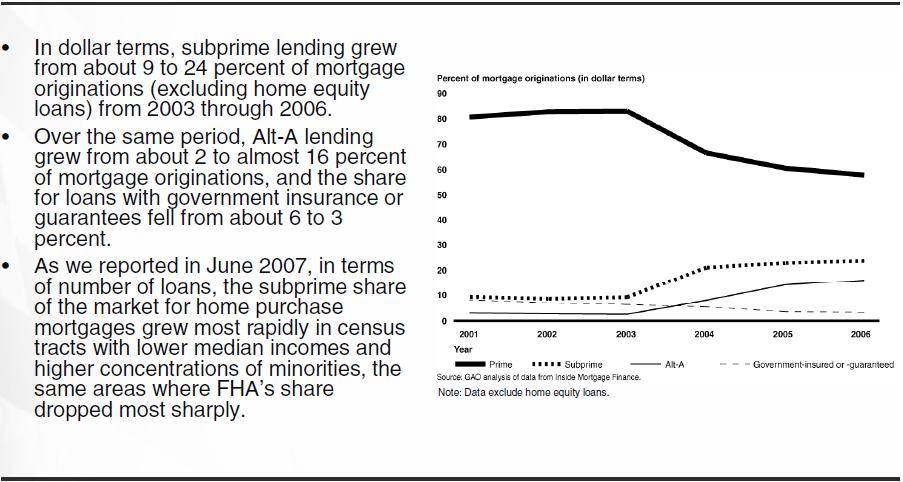
1) the percent of subprime lending to total mortgage originations
2) the percent of Alt-A lending to total mortgage originations – An Alt-A mortgage, short for Alternative A-paper, is a type of U.S. mortgage that, for various reasons, is considered riskier than A-paper, or “prime”, and less risky than “subprime,” the riskiest category. Alt-A interest rates, which are determined by credit risk, therefore tend to be between those of prime and subprime home loans. Typically Alt-A mortgages are characterized by borrowers with less than full documentation, lower credit scores, higher loan-to-values, and more investment properties. A-minus is related to Alt-A, with some lenders categorizing them the same, but A-minus is traditionally defined as mortgage borrowers with a FICO score of below 680 while Alt-A is traditionally defined as loans lacking full documentation. Alt-A mortgages may have excellent credit but may not meet underwriting criteria for other reasons – http://en.wikipedia.org/wiki/Alt-A
3) GSE backed loans

http://www.mortgagebankers.org/files/News/InternalResource/57640_GAOReportInformationonRecentDefaultandForeclosureTrends.pdf

the percent of the total market of GSE and FHA, sub-prime loans (Col 1)
the default percentage of the total market (Col 2)
the amount in billions of the total market defaults (Col 3 )
Note: All currency amounts in billions
Year Col 1 Col 2 Col 3
1997 10% 0.9% $8
1999 13% 0.9% $12
2001 12% 0.7% $17
2003 11% 0.6% $21
2005 11% 1.5% $9
2007 13% 0.5% $28
Detail for Subprime Loans – see endnotes for sources (page 10 pdf)
http://www.aei.org/docLib/Pinto-High-LTV-Subprime-Alt-A.pdf
GSE Investment Portfolio and MBS ($ Billions, Left Axis)
GSE % of Total Outstanding Single Family Mortgages (Right Axis)
http://www.fcic.gov/hearings/pdfs/2010-0227-Jaffee.pdf
GAO report (page 18 for sub-prime data and page 21 for default rates data in pdf):
http://www.mortgagebankers.org/files/News/InternalResource/57640_GAOReportInformationonRecentDefaultandForeclosureTrends.pdf
http://www.aei.org/docLib/Pinto-High-LTV-Subprime-Alt-A.pdf (page 12 pdf)

This data clearly shows that:

The increase of low income, sub-prime loans and the low overall default rate of all loan originations (1.5% in 2005 was the highest tracked in this data, through 2007). This dispels that myth that the crisis was caused by loan defaults of low-income folks.

For more informations see – https://www.mixermuse.com/blog/2010/10/14/how-george-bush-and-the-private-mortgage-market-created-the-perfect-storm/

All You Need to Know About Politics 1-6-12

Here are the latest numbers:
Bush debt increase: 85%
Obama debt increase: 43%
Bush increase in unemployment: 86%
Obama increase in unemployment: 9%

Bottom Line: Anyone that tells you President Obama ran up the debt percentage wise more the President Bush OR that President Obama ran up unemployment percentage wise more than Bush IS A LIAR and here are the numbers and references to absolutely unquestionable sources (Treasury Department and The Bureau of Labor Statistics).*

Please note the the seasonably abjusted unemployment numbers for December was revised downward to 8.5% so don’t let them tell you it was Christmas help.

http://www.bls.gov/news.release/empsit.a.htm

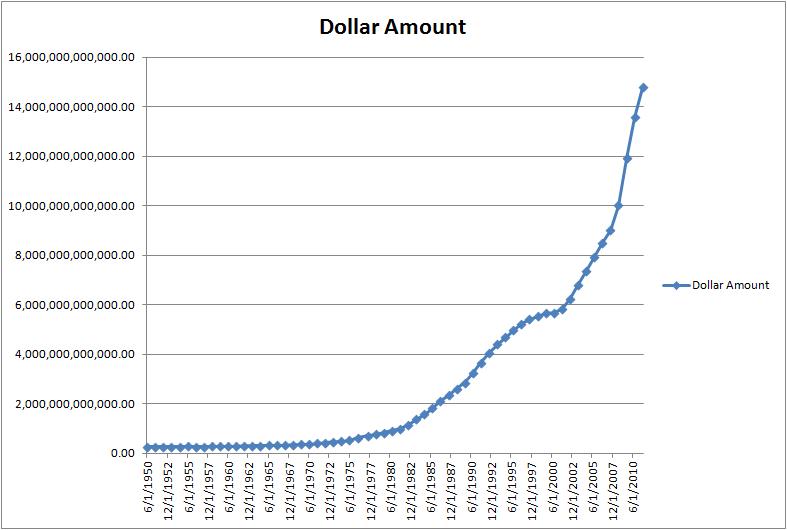
This is a graph of the debt since 1950 (click on the graphs to make them larger)…

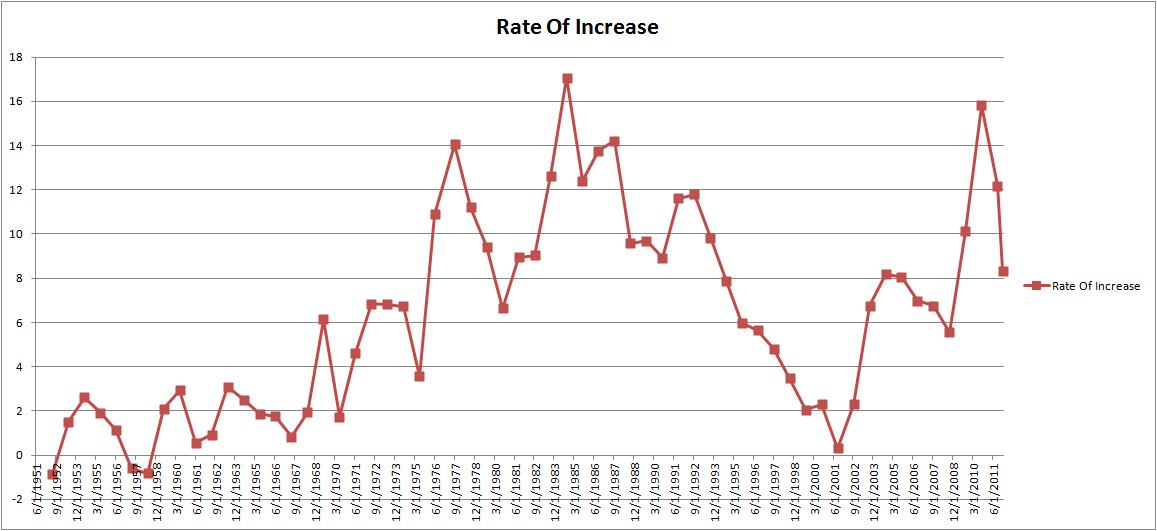
This is the rate of increase of the debt since 1950…

Please note the difference from 2001 to 2009 and 2009 to 2011. This is Bush vs Obama

Note: The graph only uses full fiscal year data. The last fiscal year ended was September 30, 2011

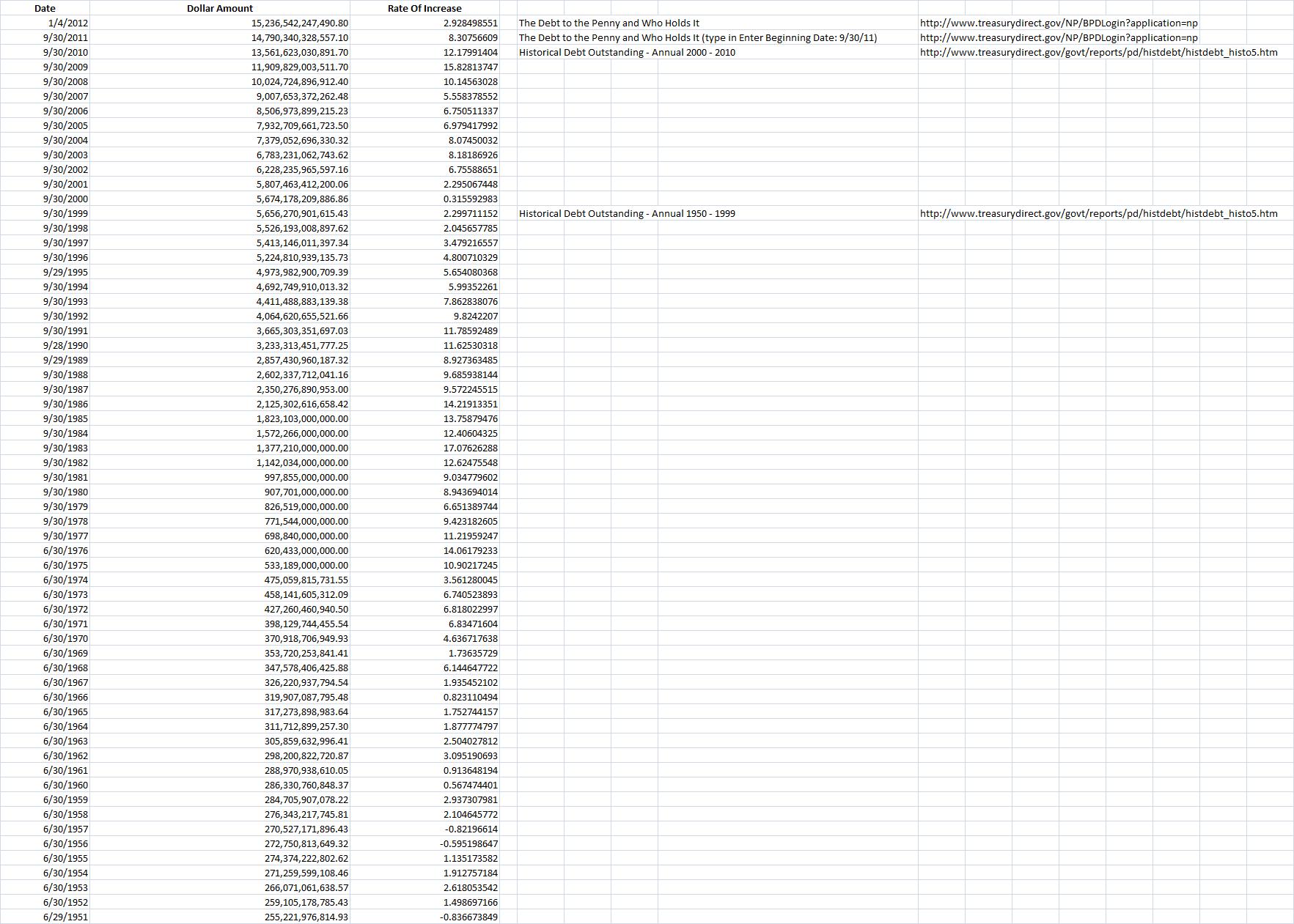
Here is the data and links to the Treasury Department to verify the numbers…

The links shown above are:
Historical Debt Outstanding – Annual 2000 – 2010
Historical Debt Outstanding – Annual 1950 – 1999
The Debt to the Penny and Who Holds It
Debt Position and Activity Report
The Debt to the Penny and Who Holds It (type in Enter Beginning Date: 9/30/11)

Check for yourself…
From January 20, 2001 to January 20, 2009 the national debt increased from $5,727,776,738,304.64 to $10,626,877,048,913.08. For those that still believe in arithmetic this is an 85% increase in the debt over the Bush administration’s term ((10,626,877,048,913.08 / 5,727,776,738,304.64) * 100) = 185% or an 85% increase).

From January 20, 2009 to January 5, 2012 the national debt increased from $10,626,877,048,913.08 to $15,236,541,899,973.10. This is a 43% increase in debt over President Obama’s term ((15,236,541,899,973.10 / 10,626,877,048,913.08) * 100) = 143% or a 43% increase).

Don’t take my word for it, check it out on the US Treasury Department site at:
http://www.treasurydirect.gov/NP/BPDLogin?application=np

When Bush took office on January 20, 2001, the national unemployment rate was 4.2%. When he left office on January 20, 2009 and President Obama took office the national unemployment rate was 7.8%
http://www.bls.gov/cps/prev_yrs.htm

The current unemployment rate as of January 6, 2012 is 8.5%
http://www.bls.gov/news.release/empsit.nr0.htm

Doing the math, the increase during the Bush administration was (7.8 / 4.2) * 100 = 186% or a 86% increase in unemployment. For the Obama administration the math is (8.5 / 7.8) * 100 = 109% or a 9% increase in unemployment.

* Note: I have revised this based the January, 2009 unemployment number of 7.8%. Preseident Obama took office January, 20, 2009. From the graph below you can see that the unemployment rate exploded just as he got into office. I think this explosion arguably was not due to anything President Obama did in his first few months (just 4 months later the rate was 9.4%) as the national unemployment rate does not turn on the dime but I will give the detractors the benefit of the doubt. There is still a huge difference in 86% (Bush) and 9% (Obama). If the numbers from 4 months after President Obama took office are used they work out to:

Bush administration increase in unemployment: 124%

Obama administration decrease in unemployment: 10%

Transition Date: End of May, 2009

Given this, the difference would be a 134% increase in unemployment during the Bush administration over the Obama administration. I would love it of someone could explain to me how this is an indictment of the Democrats? Doesn’t this clearly show that the Democrats are doing something right and the Bush administration did something wrong? Why are we suppose to believe that this is something peculiar to the Bush Presidency and not endemic to the ideology of Republicanism that ALREADY is back to the rhetoric of deregulation?

http://data.bls.gov/timeseries/lns14000000