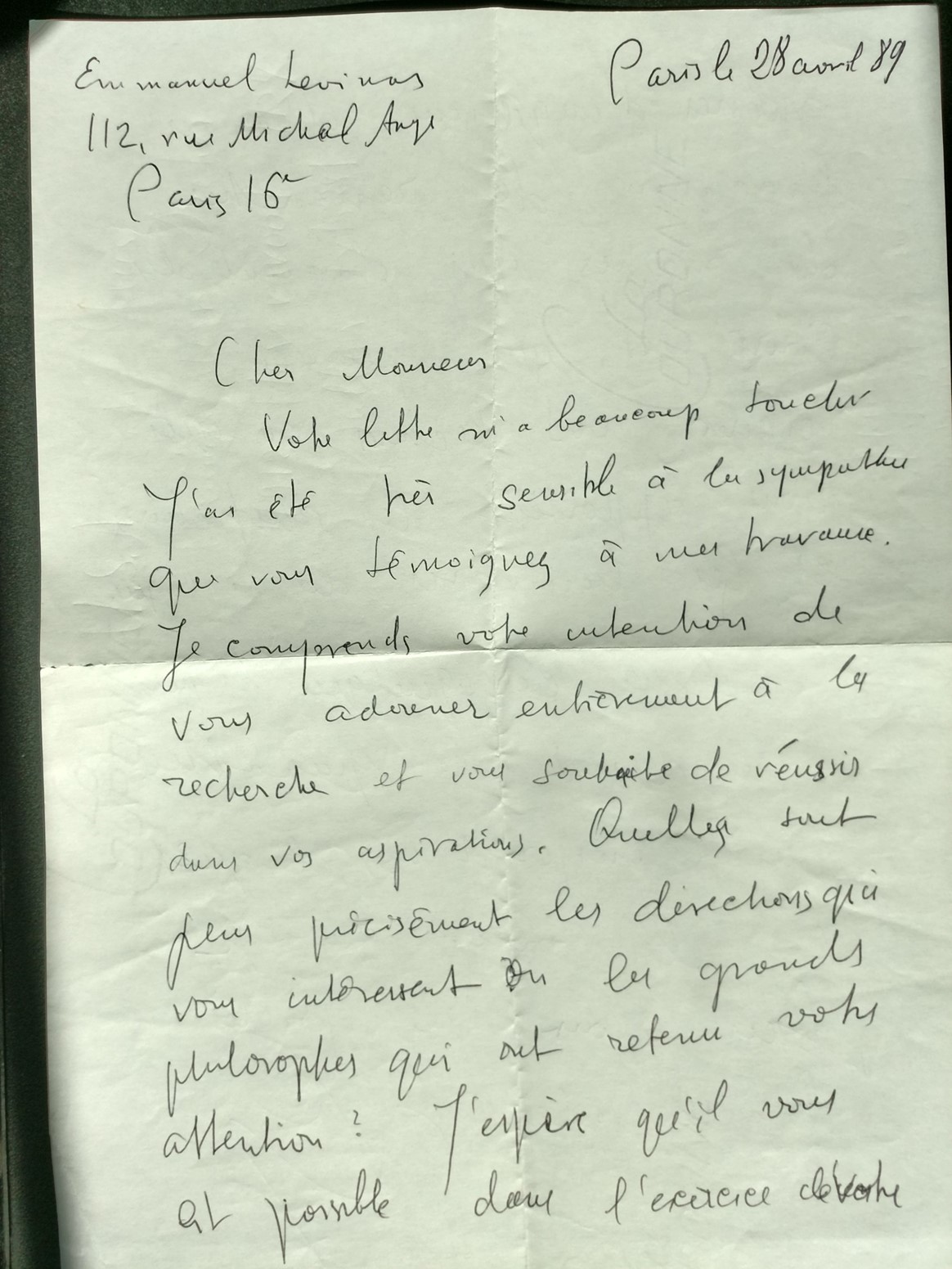
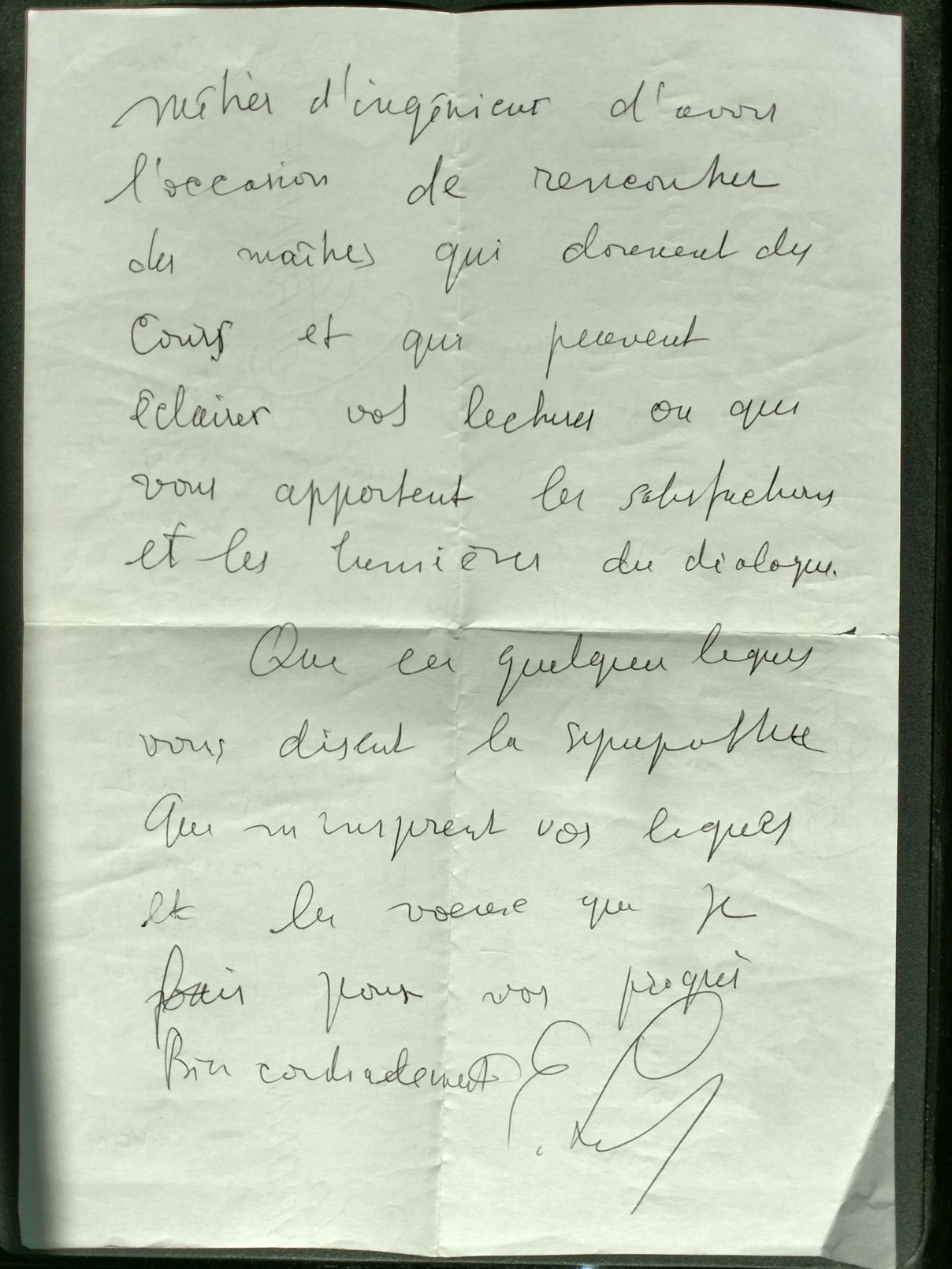
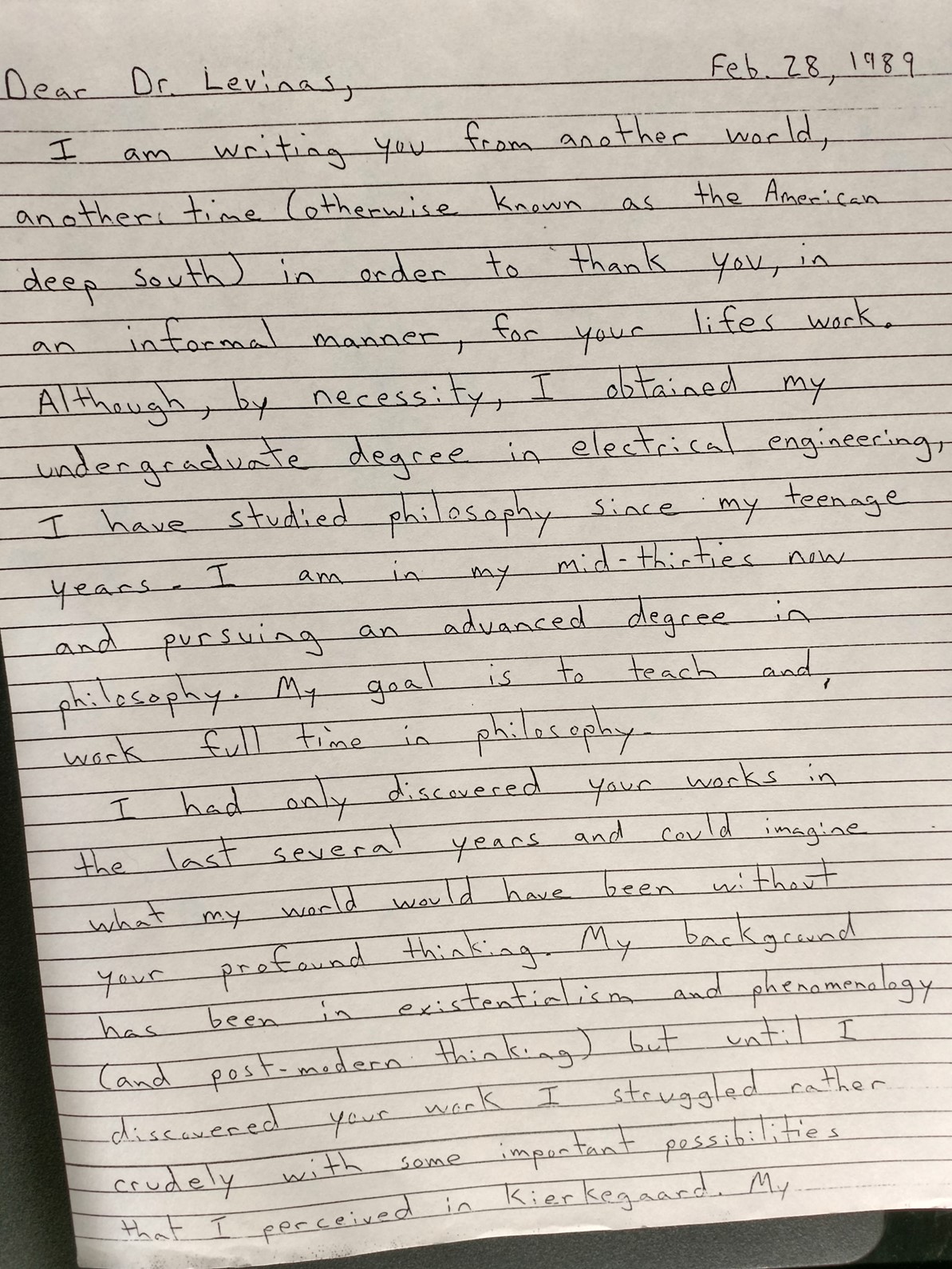
Category Archives: Philosophy

Postscript from “A thought experiment…”

While I am not a Christian, I find ages of accumulated wisdom in many religious traditions which must be wrested out from the noise which history has encased within these traditions. While I certainly do not ascribe to the effectively cliche metaphysical positions which have dominated these traditions, I do find the historic play of metaphysics can embody allegorical dramas which has the possibility to bring a kind of clarity from the dust bins of dystopic ages past.

One of the more interesting and intentionally playful metaphysical musing was given to us by Friedrich Nietzsche most notably in his work, “Thus Spoke Zarathustra”. Within the backdrop of classic, Newtonian physics, Nietzsche reasons that since space and mater is limited and time is eternal all combinations of matter will eventually be repeated exactly as it was before. Effectively, this means every human life will always come again only to repeat itself in the exact same way for an infinite amount of time. Zarathustra called this the ‘Great Nausea”. By this he meant that it sickened human spirit to think such a metaphysical thought. However, Zarathustra’s insight was that this nausea held the possibility for affirming life as the ‘eternal recurrence of the same’. He thought this was the sign of an ascendant life as opposed to the decadent, sickened life of despair and the utter pitifulness of those who are forever condemned to take their extreme vengeance on life. In the case of Zarathustra, we can clearly see a kind of allegorical play with Metaphysics which can illustrate the philosophical underpinnings of Nietzsche’s thought. In this way, I would propose another metaphysics in a contrary direction as Nietzsche’s concern which has a more updated take on physics.

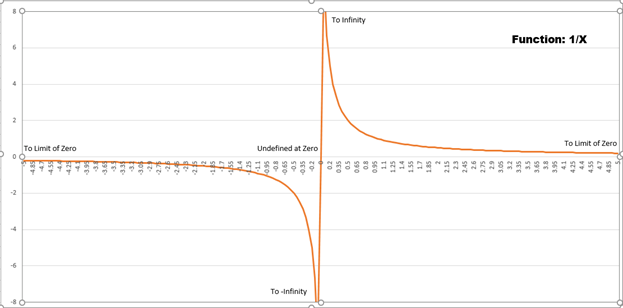
With the advent of relativity and quantum mechanics absolute time and space are no more. While physicists hate singularities and infinities, they are compelled at the current time to labor under these mathematical obscurities. Certainly, calculus is the mathematics of infinities and the peculiar formalities in which physics currently shows its dilemma (e.g., as converging and diverging infinite series, peculiarities of zero, etc.). What is more, physics has discovered that most of the universe is pervaded by an absolute mystery called dark matter and dark energy. We find that the fundamental building blocks of all mater is held together by quarks which pop in and out of existence, more like flavors of reality than reality itself. We are told that nothing can be smaller than a Planck size or the distance light travels in a perfect vacuum. A Planck is the absolute smallest possible unit of measurement which can have meaning (approximately 1.6 X 10 -35 m). And yet we are told that black holes can reduce the mass of a sun, billions of times larger than our sun, down to a singularity. What is more, we also have the peculiar dilemma which has yet to be disproven that intrigues many physicists that black holes may really be the other side of a ‘big bang’. So, even though we know meaning can only be thought in terms of Planck size we effectively are saying that universes can be created from what we think is a finite amount of matter in a huge sun. Universes have much more matter than one huge black hole. Our universe has many supermassive and known ultra-massive black holes in addition to all the other mass in our universe. So, if a black hole can create a universe with extreme orders of magnitudes more mass than the mass of its collapsed star – even more so, according to Einstein’s physics, the infinite mass of a singularity, we have a huge amount of mass in the new universe which can have no meaning according to the notion of a Planck size. What shows itself here is that our idea of meaning is more convention than ‘meaning’. Furthermore, to suggest as some physicists do that there may be infinite universes, makes Nietzsche’s metaphysics outdated and a bit moldy. That is why I would like to propose a counter metaphysics which has more affinity with the present.

Instead of a finite amount of matter given over to the infinite amount of time producing eternal recurrence of the same. Perhaps the singularity of Heraclitus’ river which can never be stepped in twice is more apropos. Nothing is ever repeated in exactly the same way. There can by rhymes but not repetitions. If the metaphysical notion of the soul has a rhyme, may it be in the notion of a one without another which nevertheless cannot remain in absolute obscurity but must affirm an Other, the other. A singularity cannot remain shrouded in absolute meaninglessness but must rise again to affirm the other, not the same which is fundamentally meaningless. Instead of the assertion of power and might, of absolute Spirit, perhaps the weakest confounds the strongest. The weakest not condemned to utter despair and vengeance but opened upon the possibility of others. The decision that spirit cannot remain in absolute certitude of itself but must Decide that others, that other, is built into the cry of despair and emptiness. Instead of perpetual and eternal vengeance we have the ‘meek inheriting the earth’. Why? Because they cannot stand in the allusion of grandeur, of mastery and self-subsistence, ‘self-substance’ which makes no sense. The other is not the multiplication of the same, it is the opening onto the ‘tree of life’, that which makes possible any such erroneous notion as the same. Meaning as convention fails to be what it aspires to, what it asserts itself as. Only in the Decision of choice, Ethics, can obscurity rouse itself from its eternal slumbers in welcoming the Other, the stranger, the he and the she.

Whimsically, can I also suggest that in order to rise from the dead as the God, mythically spoken of in the last post (“A thought experiment…”), could it be that every obscure singularity must through many universes and worlds ultimately become a ‘Jesus’ and die for the world, the Other, eternal Agape?

All life and death and elsewise must forever be in its singularity, its moment which can never be altered. Even more I, as a rhyme of singularity, must ultimately take upon myself the sins of the world, missing the mark, such that I become sin meaning that I am Responsible and held to account for the suffering of the Other…just saying…

A thought experiment…

God is dead.

In orthodoxy, God is omnipotent and omniscient – all powerful and all knowing.

This would mean God “is all and in all”

Here there is not Greek and Jew, circumcised and uncircumcised, barbarian, Scythian, slave, free; but Christ is all, and in all. Colossians 3:11 (Paul, AD 90)

…one God and Father of all, who is over all and through all and in all. (Paul, AD 62)

But if God is all there is, was and ever will be and knows everything how awfully boring and lonely would that be?

What is more, it is a living, eternal Hell.

So, what did God do…

God made a Decision – thou shalt be Other.

This was creation from nothingness.

And so, we were born.

In so doing, God deemed that absolute is Other not self.

Not logical other as opposed to same but he, she and other that is not he or she…

one who has face and faces.

Face is appearance, the presentation of the other.

You get to decide if the other is Other or only your own reflection, opinions, and attitudes.

In denial, you lose face as all faces die with you.

And so, God died…on a cross they say.

Moreover, God descended into Hell.

Therefore it says, “When he ascended on high he led a host of captives, and he gave gifts to men.” (In saying, “He ascended,” what does it mean but that he had also descended into the lower regions, the earth? He who descended is the one who also ascended far above all the heavens, that he might fill all things.) Ephesians 4:9″ (Paul, AD 90)

Hell is absolute absence of the Other until perhaps…

one becomes as God, dead to self-absolutism and faced with the Other by virtue of Decision.

By this then, God deemed the lowly, weak, poor, sick, homeless, hopeless, suffering of the Other to be more paramount than the powerful, high, and mighty.

Absolute is no longer omnipotent and omniscient.

Absolute is the lowly, the stranger, the sojourner, the other.

Absolute essence is the other.

Those who fuel their vanities, elevate their conceptions of themselves; feign the omnipotent and omniscient condemn themselves to Hell.

They gorge themselves on their own illusions of grandeur.

They deny the plight of the other, the lowly, the suffering in their indolence.

Ultimately, they become omnipotent and omniscient in a living Hell of nothing other…

but only themselves.

Maybe in eternal Hell they find themselves, a god, who has only themselves with none other.

In that place who is to say they cannot make a Decision – that there is an Other, others.

God died to self for Other.

If God rises from the dead, it is only when we all rise together…

If you would know God, do what God does: die to yourself, live for others.

You Decide.

References

Paul. AD 90.
Bible. AD 90. Vol. Colossians 3:11, English Standard Version.

—. AD 62.
Bible. AD 62. Vol. Ephesians 4:6, English Standard Version.

—. AD 90.
Bible. AD 90. Vol. Epeshians 4:9, English Standard Version.

Philosophy Series 14 – George Orwell and Emmanuel Levinas Introspective: Socialism and the Other

Philosophy Series 2 – Introduction

Philosophy Series 3 – Appendix A, Part 1

Philosophy Series 4 – The Pre-Socratics – Hesiod

Philosophy Series 5 – A Detour of Time

Philosophy Series 6 – The Origin

Philosophy Series 7 – Eros

Philosophy Series 8 – Thales

Philosophy Series 9 – An Interlude to Anaximander

Philosophy Series 10 – On the Way to Anaximander: Language and Proximity

Philosophy Series 11 – Aristotle and Modernity: The Eternal and Science

Philosophy Series 12 – Levinas and the Problem of Metaphysics

Philosophy Series 13 – On Origin

Philosophy Series 14 – George Orwell and Emmanuel Levinas Introspective: Socialism and the Other

————————————————
Philosophy Series 14

George Orwell and Emmanuel Levinas Introspective: Socialism and the Other

Introduction

George Orwell (1903 to 1950) and Emmanuel Levinas (1905 to 1995) were both engaged in the fight against fascism during the 20th century. Orwell, born in India but educated and resided in England, fought with the Popular Front, leftist government in Spain against the right-wing, military coup of Nationalists lead by General Francisco Franco. Orwell was shot in the neck and barely escaped with his life (Colls, 2014). Levinas, a Lithuanian, became a naturalized French citizen in 1931. He fought with the French and was captured by the Nazis where he remained a prisoner of war until the end of the war in 1945. His father and brothers died at the hands of the Nazi SS in Lithuania. Maurice Blanchot helped Levinas’ wife and daughter spend the war in a monastery (Emm). Both men understood the horror of war and made brilliant strides to wrestle with the absolute need for meaning in what appeared to be a meaningless world. They both described in very different ways the pitfalls of humanity and articulated with painful integrity and brilliance an avenue of hope in a hopeless world. For Orwell, with astute recognition of the weaknesses of socialism, nevertheless thought of socialism as the only possible hope for the disenfranchised and horrors of impoverishment in industrialized England. Levinas is not so easy to pin down with a political philosophy. Levinas warns us of the insidious nature of totalitarianism. In this way, his forebodings about the state have a kinship to Orwell’s critique of nationalism. While Levinas’ philosophy is deeply informed by the history of philosophy, his purpose is quite simple.

Sometimes, I think academic philosophy is its own worst enemy. Philosophy started out and literally means ‘love of wisdom’. Wisdom is not limited to the Aristotelian academy and its occidental linage. To the contrary, wisdom is widely available to every tradition, every culture, every human being. Personally, I also find wisdom in other animals besides humans. It seems the repetition which comes with age invites a certain sort of memory which allows the possibility for accommodation of difference and a sense of the profundity of love amid inevitable tragedies. This is not a given but a potential as Aristotle would suggest.

Perhaps, one way to think of the failure to make wisdom actual could be as a decline of our species, an evolutionary failure. However, even in this paradigm, individual evolutionary adaptation is always given as a possibility endemic to life. The downside of reducing wisdom to an evolutionary paradigm is to once again fall into the mode of totalizing objectivity which transforms the other to an ‘it’ of objectivity in the form of evolutionary taxonomy. In any case, the paradigm of evolution is not adequate in thinking about and desiring wisdom.

Levinas opens an alternative route to wisdom by putting a face on the other. He exposes convention which itself totalizes the other in the form of self-interest. In my estimation, anyone who follows the actual teachings of compassion and responsibility for the other, the stranger, the oppressed, the impoverished has achieved the goal, the telos (culmination, end) of Levinas’ monumental challenge – to help us see the face of the other for the very first time not obscured by the pitfalls of an already-assumed, historic situatedness cooked into language and tradition.

However, as each one of us carries our histories with us, we will eventually have to write a new history if the state is to be viable. This is the direction I am pointing towards in this post. Certainly, the kinds of historic changes I am thinking of takes hundreds of years. To the extent that academics bring the notions of Levinas and similar others to a wider audience is how they live the responsibility Levinas’ places on each of us. To the extent that academics puts up barriers of access to the wisdom of our responsibility to the other is once again reinforcing the barriers of totalitarianism. My goal is, to the best of my ability, to continue to open with others which proceeded me the historic way we came into totalitarianism and highlight the way out of the prison of self-interest to the he or she who faces us. In any case, let us remember the following which I will come back to later:

Language is the historic, cultural map that defines reality for us.

First, I would like to look at Orwell’s eyewitness chronicling of Europe’s devolution leading up to World War II with a view to his political solutions for the state. Today, we once again hear the rhyme of Orwell’s history. It seems we are always only condemned to repeat the past no matter what the state looks like although certainly some states seem better than others for delaying the inevitable. Levinas provides us with an especially needful alternative to the inability of the state to survive inevitable catastrophic failure and to deal effectively with planet wide threats from climate change and nuclear weapons. However, Levinas’ alternative requires a monumental change which probably represents more like a species type adaptation. It resides in the potential of wisdom if humans are to survive on this planet. To arrive at Levinas’ solution, we will need to look at how we arrived philosophically from ancient Greeks to modernity and what perpetually sabotages the state, any state.

Democratic democracies, communism, and science all arrived in the modern, occidental age from enlightened liberalism. Enlightenment also brings in the rise of capitalism and socialism. For once and for all lets please put this oxymoron to rest, there has never been a pure democracy or a pure socialism. Every democratic country, including the U.S., is a combination of both. Democracy is the will of the people. If the people vote for government run social programs like welfare and food stamps or government funded research and development, health care, retirement, industry regulation, and so forth, it is because private enterprise is unable or unwilling to address the human condition and suffering of its citizens. When people in a democracy vote for government owned and operated services, the people want the text-book definition of socialism. The U.S. is a democratic, capitalistic, socialist country like it or not. If democracy denies the vote of the people, democracy is plain and simple totalitarianism. If the state totally controls and owns every resource, that is not socialism it is communism. Communism clearly is nothing other than totalitarianism as history has shown.

In this post we will take a brief look at the beginning of modernity and British Enlightenment to orient us to the path we are traversing. This will also require a look at the ancient Greeks to situate how Enlightenment came about in the first place. After that, I will take the political, and necessarily philosophical, challenge Levinas presents us to prevent the fate of the totalitarian state. Levinas understood the necessity of the state and the conditions for which it could escape its failed history. For Orwell, socialism was the hope for resolving an inevitable fascist nationalism resulting in the bourgeoisie and the proletariat. Orwell faced the impossibility of democratic change in 20th century England with the intractability of aristocracy and its self-interest in the face of Hitler’s fascism. He saw no other solution for England except revolution. For Levinas, the inevitability of state totalitarianism was due to how each person in the state was locked in a philosophical and historic leveling off, or totalizing, of the other to the same. For now, the ‘same’ here is meant as how we find ourselves always already caught up in a history, a language, a culture which levels off radical alterity (otherness, difference) and holds the state hostage to preconceptions doomed to violence.

Orwell Chronicles the Impossibility of Totalitarianism in the Histories of 20th Century States

One of the most alarming struggles of reality over illusion is chronicled in the Spanish Civil War from 1936 to 1939 by an early thirty-year-old Eric Blair whose pen name was George Orwell. Orwell fought in the war with the Popular Front government Republicans against the Spanish revolutionary Nationalists. For Orwell nationalism was synonymous with fascism. Contrary to the propagandized illusions of Jonah Goldberg in his book “Liberal Fascism”, the history of fascism is the history of conservatism, aristocracy, and wealth. The Spanish Civil War is yet one more example of how corrosive nationalism will always pit the haves against the have nots. Orwell faced the autocracies of nationalism and extreme poverty in England. He traveled to Spain to fight for the Spanish Republicans, a left-leaning group, against the Nationalist fascists. As a life-long devoted socialist, Orwell’s greatest virtue was his devotion to the plight of impoverished and oppressed others and his undying willingness to critically question any ideology which undermined that quest, including the horrors of communism. He would even make fun of his own socialists in “Can Socialists Be Happy” (Freeman, 1943) written under the pseudonym John Freeman where he writes,

Nearly all creators of Utopia have resembled the man who has toothache, and therefore thinks happiness consists in not having toothache. They wanted to produce a perfect society by an endless continuation of something that had only been valuable because it was temporary. The wider course would be to say that there are certain lines along which humanity must move, the grand strategy is mapped out, but detailed prophecy is not our business. Whoever tries to imagine perfection simply reveals his own emptiness. This is the case even with a great writer like Swift, who can flay a bishop or a politician so neatly, but who, when he tries to create a superman, merely leaves one with the impression the very last he can have intended that the stinking Yahoos had in them more possibility of development than the enlightened Houyhnhnms.

The debate between those that believe Orwell was ‘conservative’ or ‘liberal’ in contemporary, U.S. politics is superficial. Most appropriately, Orwell was a painfully honest socialist. When the Franco fascists won the Spanish Civil War, Stalin and the Bolshevik communists who fought on the side of the socialists against fascism exterminated the socialists. Thus, we have Orwell’s hatred of communism illustrated in “Animal Farm” and “Nineteen Eighty-Four”. However, the essential link between fascism and communism for Orwell was nationalism. In Orwell’s essay, Notes on Nationalism (Orwell, 1945), he lays this out very clearly. Nationalism is the eternal struggle between rotting protectionism, spoiled mana, violent conservation of wealth, consolidation of power and the resulting facts of human suffering. He writes,

It is also worth emphasizing once again that nationalist feeling can be purely negative. There are, for example, Trotskyists who have become simply enemies of the U.S.S.R. without developing a corresponding loyalty to any other unit. When one grasps the implications of this, the nature of what I mean by nationalism becomes a good deal clearer. A nationalist is one who thinks solely, or mainly, in terms of competitive prestige. He may be a positive or a negative nationalist – that is, he may use his mental energy either in boosting or in denigrating – but at any rate his thoughts always turn on victories, defeats, triumphs and humiliations. He sees history, especially contemporary history, as the endless rise and decline of great power units, and every event that happens seems to him a demonstration that his own side is on the up-grade and some hated rival is on the down-grade. But finally, it is important not to confuse nationalism with mere worship of success. The nationalist does not go on the principle of simply ganging up with the strongest side. On the contrary, having picked his side, he persuades himself that it is the strongest, and is able to stick to his belief even when the facts are overwhelmingly against him. Nationalism is power hunger tempered by self-deception. Every nationalist is capable of the most flagrant dishonesty, but he is also – since he is conscious of serving something bigger than himself – unshakeably certain of being in the right.

Indifference to Reality. All nationalists have the power of not seeing resemblances between similar sets of facts.

The nationalist not only does not disapprove of atrocities committed by his own side, but he has a remarkable capacity for not even hearing about them.

Every nationalist is haunted by the belief that the past can be altered. He spends part of his time in a fantasy world in which things happen as they should – in which, for example, the Spanish Armada was a success or the Russian Revolution was crushed in 1918 – and he will transfer fragments of this world to the history books whenever possible. Much of the propagandist writing of our time amounts to plain forgery. Material facts are suppressed, dates altered, quotations removed from their context and doctored so as to change their meaning. Events which, it is felt, ought not to have happened are left unmentioned and ultimately denied.

Indifference to objective truth is encouraged by the sealing-off of one part of the world from another, which makes it harder and harder to discover what is actually happening. There can often be a genuine doubt about the most enormous events.

Eerily, this reminds us of events in the U.S. today. In the buildup between the Spanish Civil War and the rise of fascism in Nazi Germany, the aristocracy and conservatism of Prime Minister Neville Chamberlain in England from 1937 to 1940 was sympathetic to the other axis powers, Germany, Italy, and Japan of World War II. Orwell writes,

The British ruling class were not altogether wrong in thinking that Fascism was on their side. It is a fact that any rich man, unless he is a Jew, has less to fear from Fascism than from either Communism or democratic Socialism. One ought never to forget this, for nearly the whole of German and Italian propaganda is designed to cover it up. The natural instinct of men like Simon, Hoare, Chamberlain, etc. was to come to an agreement with Hitler. But – and here the peculiar feature of English life that I have spoken of, the deep sense of national solidarity, comes in – they could only do so by breaking up the Empire and selling their own people into semi-slavery. A truly corrupt class would have done this without hesitation, as in France. But things had not gone that distance in England. Politicians who would make cringing speeches about “the duty of loyalty to our conquerors” are hardly to be found in English public life. Tossed to and fro between their incomes and their principles, it was impossible that men like Chamberlain should do anything but make the worst of both worlds (Orwell, The Lion And The Unicorn: Socialism And The English Genius, 1941).

While Orwell detested war with Germany he believed that war was a necessity despite the conservative leanings of Chamberlain to make peace with Hitler and avoid war,

If I had to defend my reasons for supporting the war, I believe I could do so. There is no real alternative between resisting Hitler and surrendering to him, and from a Socialist point of view I should say that it is better to resist; in any case I can see no argument for surrender that does not make nonsense of the Republican resistance in Spain, the Chinese resistance to Japan, etc. etc. But I don’t pretend that that is the emotional basis of my actions. What I knew in my dream that night was that the long drilling in patriotism which the middle classes go through had done its work, and that once England was in a serious jam it would be impossible for me to sabotage. But let no one mistake the meaning of this. Patriotism has nothing to do with conservatism. It is devotion to something that is changing but is felt to be mystically the same, like the devotion of the ex-White Bolshevik to Russia. To be loyal both to Chamberlain’s England and to the England of tomorrow might seem an impossibility, if one did not know it to be an everyday phenomenon. Only revolution can save England, that has been obvious for years, but now the revolution has started, and it may proceed quite quickly if only we can keep Hitler out. Within two years, maybe a year, if only we can hang on, we shall see changes that will surprise the idiots who have no foresight. I dare say the London gutters will have to run with blood. All right, let them, if it is necessary. But when the red militias are billeted in the Ritz I shall still feel that the England I was taught to love so long ago for such different reasons is somehow persisting. (Orwell, My Country Right or Left, 1940)

Orwell determined that inaction was the action of fascism and could not be tolerated. He also saw that the indifference of ‘democracies’ prior to Franklin Delano Roosevelt and Winston Churchill, some anarchists, pacifists, and those that did not have the will to actively oppose bourgeois fascism, were themselves an instrument of nationalism and thus, fascism.

‘It is nonsense to talk of opposing Fascism by bourgeois “democracy”. Bourgeois “democracy” is only another name for capitalism, and so is Fascism; to fight against Fascism on behalf of “democracy” is to fight against one form of capitalism on behalf of a second which is liable to turn into the first at any moment. The only real alternative to Fascism is workers’ control. If you set up any less goal than this, you will either hand the victory to Franco, or, at best, let in Fascism by the back door. Meanwhile the workers must cling to every scrap of what they have won; if they yield anything to the semi-bourgeois Government they can depend upon being cheated. The workers’ militias and police-forces must be preserved in their present form and every effort to “bourgeoisify” them must be resisted. If the workers do not control the armed forces, the armed forces will control the workers. The war and the revolution are inseparable.’ (Orwell, ‘Three Parties that Mattered’: Extract from Homage to Catalonia, 1938)

In any serious emergency the contradiction implied in the Popular Front is bound to make itself felt. For even when the worker and the bourgeois are both fighting against Fascism, they are not fighting for the same things; the bourgeois is fighting for bourgeois democracy, i.e., capitalism, the worker, in so far as he understands the issue, for Socialism. And in the early days of the revolution the Spanish workers understood the issue very well. In the areas where Fascism was defeated they did not content themselves with driving the rebellious troops out of the towns; they also took the opportunity of seizing land and factories and setting up the rough beginnings of a workers’ government by means of local committees, workers’ militias, police forces, and so forth. They made the mistake, however (possibly because most of the active revolutionaries were Anarchists with a mistrust of all parliaments), of leaving the Republican Government in nominal control. And, in spite of various changes in personnel, every subsequent Government had been of approximately the same bourgeois-reformist character. At the beginning this seemed not to matter, because the Government, especially in Cataloñia, was almost powerless and the bourgeoisie had to lie low or even (this was still happening when I reached Spain in December) to disguise themselves as workers. Later, as power slipped from the hands of the Anarchists into the hands of the Communists and right-wing Socialists, the Government was able to reassert itself, the bourgeoisie came out of hiding and the old division of society into rich and poor reappeared, not much modified. Henceforward every move, except a few dictated by military emergency, was directed towards undoing the work of the first few months of revolution. Out of the many illustrations I could choose, I will cite only one, the breaking-up of the old workers’ militias, which were organized on a genuinely democratic system, with officers and men receiving the same pay and mingling on terms of complete equality, and the substitution of the Popular Army (once again, in Communist jargon, “People’s Army”), modelled as far as possible on an ordinary bourgeois army, with a privileged officer-caste, immense differences of pay, etc., etc. Needless to say, this is given out as a military necessity, and almost certainly it does make for military efficiency, at least for a short period. But the undoubted purpose of the change was to strike a blow at equalitarianism. In every department the same policy has been followed, with the result that only a year after the outbreak of war and revolution you get what is in effect an ordinary bourgeois State, with, in addition, a reign of terror to preserve the status quo. (Orwell, ‘Spilling the Spanish Beans’: Extract from Homage to Catalonia, 1937)

But who are the pro-Fascists? The idea of a Hitler victory appeals to the very rich, to the Communists, to Mosley’s followers, to the pacifists, and to certain sections among the Catholics. (Orwell, The Lion And The Unicorn: Socialism And The English Genius, 1941)

Orwell would not tolerate apathy with the oncoming tidal waves of fascist autocracy in World War II. He believed that while socialism was flawed, it was the better than all the other alternatives, so much so that here was his plan to save England,

I suggest that the following six-point programme is the kind of thing we need. The first three points deal with England’s internal policy, the other three with the Empire and the world:–

I. Nationalization of land, mines, railways, banks and major industries.

II. Limitation of incomes, on such a scale that the highest tax-free income in Britain does not exceed the lowest by more than ten to one.

III. Reform of the educational system along democratic lines.

IV. Immediate Dominion status for India, with power to secede when the war is over.

V. Formation of an Imperial General Council, in which the coloured peoples are to be represented.

VI. Declaration of formal alliance with China, Abyssinia and all other victims of the Fascist powers.

The general tendency of this programme is unmistakable. It aims quite frankly at turning this war into a revolutionary war and England into a Socialist democracy. I have deliberately included in it nothing that the simplest person could not understand and see the reason for. In the form in which I have put it, it could be printed on the front page of the Daily Mirror. But for the purposes of this book a certain amount of amplification is needed. (Orwell, The Lion And The Unicorn: Socialism And The English Genius, 1941)

Immediately following this plan, he elaborates in detail on each point. I will only state the first one in the main text of this paper but will include the rest in the notes below. [1]  On the first point he writes,

I. Nationalization. One can “nationalize” industry by the stroke of a pen, but the actual process is slow and complicated. What is needed is that the ownership of all major industry shall be formally vested in the State, representing the common people. Once that is done it becomes possible to eliminate the class of mere owners who live not by virtue of anything they produce but by the possession of title-deeds and share certificates. State-ownership implies, therefore, that nobody shall live without working. How sudden a change in the conduct of industry it implies is less certain. In a country like England we cannot rip down the whole structure and build again from the bottom, least of all in time of war. Inevitably the majority of industrial concerns will continue with much the same personnel as before, the one-time owners or managing directors carrying on with their jobs as State-employees. There is reason to think that many of the smaller capitalists would actually welcome some such arrangement. The resistance will come from the big capitalists, the bankers, the landlords and the idle rich, roughly speaking the class with over £2,000 a year – and even if one counts in all their dependants there are not more than half a million of these people in England. Nationalization of agricultural land implies cutting out the landlord and the tithe-drawer, but not necessarily interfering with the farmer. It is difficult to imagine any reorganization of English agriculture that would not retain most of the existing farms as units, at any rate at the beginning. The farmer, when he is competent, will continue as a salaried manager. He is virtually that already, with the added disadvantage of having to make a profit and being permanently in debt to the bank. With certain kinds of petty trading, and even the small-scale ownership of land, the State will probably not interfere at all. It would be a great mistake to start by victimizing the smallholder class, for instance. These people are necessary, on the whole they are competent, and the amount of work they do depends on the feeling that they are “their own masters”. But the State will certainly impose an upward limit to the ownership of land (probably fifteen acres at the very most), and will never permit any ownership of land in town areas.

From the moment that all productive goods have been declared the property of the State, the common people will feel, as they cannot feel now, that the State is themselves. They will be ready then to endure the sacrifices that are ahead of us, war or no war. And even if the face of England hardly seems to change, on the day that our main industries are formally nationalized the dominance of a single class will have been broken. From then onwards the emphasis will be shifted from ownership to management, from privilege to competence. It is quite possible that State-ownership will in itself bring about less social change than will be forced upon us by the common hardships of war. But it is the necessary first step without any real reconstruction is impossible. (Orwell, The Lion And The Unicorn: Socialism And The English Genius, 1941)

From our current vantage in the history in the United States, “bourgeois fascism” seems to many on the political right to be an impossibility. However, our state as a constitutionally based democracy is in tatters on the Republican right who are increasingly in favor of authoritarianism – the necessary step to fascism. Many conservative libertarians have also jettisoned the state as, at best, an example of anti-capitalism due to market regulation and at worse to make it so small we can drown it in the bathtub. While many of these folks have not acknowledged it, this really ranges from anarchism to pure market Darwinism. Certainly, all this would only play into the hands of those who would seek to protect their wealth and power not some anti-government ideology. In Orwell’s time the ‘state’ was not optional even with 20th century fascism and communism breathing down his throat. For Orwell, the state as “the common people” in socialism would make them “feel, as they cannot feel now, that the State is themselves”. The proletariat would be promoted to co-owners of the state. Orwell did not see the oblivion of the state as a viable alternative. Certainly, the abolition of the state is not ‘viable’ in any sense of the word. However, for Orwell, the fatal flaw of any state was nationalism. He cited the rich English class as shining examples of decadent nationalism,

England is a family with the wrong members in control. Almost entirely we are governed by the rich, and by people who step into positions of command by right of birth. Few if any of these people are consciously treacherous, some of them are not even fools, but as a class they are quite incapable of leading us to victory. They could not do it, even if their material interests did not constantly trip them up. As I pointed out earlier, they have been artificially stupefied. Quite apart from anything else, the rule of money sees to it that we shall be governed largely by the old – that is, by people utterly unable to grasp what age they are living in or what enemy they are fighting. Nothing was more desolating at the beginning of this war than the way in which the whole of the older generation conspired to pretend that it was the war of 1914-18 over again. All the old duds were back on the job, twenty years older, with the skull plainer in their faces. Ian Hay was cheering up the troops, Belloc was writing articles on strategy, Maurois doing broadcasts, Bairnsfather drawing cartoons. It was like a tea-party of ghosts. And that state of affairs has barely altered. The shock of disaster brought a few able men like Bevin to the front, but in general we are still commanded by people who managed to live through the years 1931-9 without even discovering that Hitler was dangerous. A generation of the unteachable is hanging upon us like a necklace of corpses. (Orwell, The Lion And The Unicorn: Socialism And The English Genius, 1941)

Orwell was a Democratic Socialist which is still the most prolific party in Europe today. There is no doubt that Jonah Goldberg was merely smoking the pot of bourgeois fascism when he fantasized the link between liberalism and fascism. Even now, in U.S. politics, the warnings and admonitions of Orwell ring true as QAnon regurgitates its radical conservative fantasies in praise of bourgeois fascism. Ironically, it is those that have the least to gain from bourgeois fascism that are its most ardent supporters. This exemplifies the extent to which history, language, culture, and marketing have eroded the hard-earned lessons from the past. It appears that the demons of Orwell’s era once again rise from the depths of Hades to conserve its dark domain in the twilight of mere mortals.

So, history certainly has a rhyme which beckons to us today. The reality of living in illusion in the U.S. is that the cat we see jumping on our lap to purr is really a very hungry old lion akin to the one in Nazi Germany. When the ancient notion of democracy is wholly abandoned by the ruling elites (e.g., white bred, wealthy capitalists) we find ourselves in Orwell’s chaotic world of ‘damned if we do’ and ‘damned if we don’t’, the hellacious necessity of impossible decision. For Orwell, the choice of every individual living in an illusory, anti-government, ‘free market’ with little or no state, was a ‘wish-fulfillment’ conservatism that must result in a dystopian nightmare. He was right. Let’s not forget that even Germany was required after World War I to be a republic, the Weimar Republic. These republics eventually erupted in the horrors of World War II. Orwell’s fight on the side of the proletariat, artists, and socialists in the Spanish Civil War against fascism failed and, to add insult to injury, the Stalinists communists took over much of what was left of the Republican resistance in Spain slaughtering the remaining socialists.

Orwell was a man who felt the pain of injustice in a time of mind-boggling, body-numbing dizziness requiring action but thriving on the meaninglessness of any action. When all ideals fail or fall into delusion, one must still find a way to live with meaning even if it has little hope of succeeding. However, unlike the delusions of the bourgeoisie, Orwell hung on to a version of the state that would be ‘owned’ by the people. Orwell was fully aware that that the communists were an abject failure just as the bourgeois capitalists were. However, his compass was to move towards egalitarianism, fairness, dignity, and income equality for the common folk. Even if this is yet another delusion, at least, it is based on a concern for the other which cannot dismiss the other or belittle the other in its delusional obsession with itself. If it is a delusion, it is a delusion which is centered on the same ideals the ancient Greeks envisioned in democracy as flawed as it was. So how did democracies and communism evolve from modernity? Through what lens does Levinas view the violence of 20th century states?

The Rise of the State in Modernity

For Levinas, traditional, enlightened liberalism is contaminated by a kind of obscurantism resulting in a more sedated but deadly predecessor to the endlessly repeated horrors of National Socialism or Nazi fascism. By ‘liberalism’ I do not mean the trite understanding in today’s U.S. politics. Hitherto, liberalism is meant as the enduring history from Kant to Hegel to British empiricism and enlightenment embodying all forms of democracy, capitalism, communism, and socialism. Enlightened liberalism is found upon the individual and its function as a collectivity. Both modern democracies and communism were offshoots of this tradition.

For 17th century English, Enlightenment thinkers Adam Smith, Thomas Hobbes, and John Locke, the greater good was promoted by self-interest. Self-interest was necessarily tied to the ‘state of nature’ for these thinkers. In modern terms Hobbes is what we might call a pure materialist. Hobbes saw reasoning as merely a causal reaction to sensation. The world was full of objects which we bump into with our senses. We form images of them in our mind which remain there when we close our eyes. From this, similarities are recognized between things which give rise to signifiers. An example of a signifier could be a mark made on a stone which stands for some animal. The mark is a signifier. Signifiers can be abstracted in the mind and used in various applications. Signifiers give rise to ideas and knowledge is acquired from them. Ultimately, everything is material substance. Hobbes had a public disagreement with a contemporary of his time named Rene Descartes who believed that mind and body were two distinct substances so there could be a thinking thing which had no body. This was absurd for Hobbes who thought the only substance was in nature as a material body.

For Hobbes, it seems a certain insidious idea of ‘nature’ has been assigned to phenomenon as already known – as matter, as stuff, as thing called ‘substance’ which was self-evident. By ‘self-evident’ he did not mean ‘innate’. He meant how phenomena show itself to our sense. ‘Substance’ is a shorthand for showing of phenomena as material object, whether human, animals, or inanimate and nothing more. With this pre-understanding of phenomenon, relations are simply transactions. Generic signifiers such as matter, stuff, things can then be pragmatically taken as a common, radically reduced (regressus) assumption of all phenomena, as what really ‘is’ and nothing more. For example, a rock is an object. In turn, the assumed essence of a rock is simply its ‘thingness’, ‘object-ness’, its ‘stuff-ness’ or what in Latin we could call substance (substantia meaning ‘stand under’). By the way, in using the word ‘reduction’ I am not intending to evoke a true or false judgement. What I am referring to is a way of seeing, understanding, orienting oneself to our environing in the world. In a Kantian sense this kind of understanding would be stated as temporally a priori or a prior conditioning which makes a certain kind of sense possible. This is what I mean by ‘understanding’ as what rests under and guides our footing, our orientation, our standing. What stands under all phenomenon from Enlightenment is already understood from the ancient notion of substance.

Substantia is a controversial translation of the ancient Greek work ousia. A well-known 20th century phenomenologist philosopher Martin Heidegger takes issue with translating ousia as substance. Rather, Heidegger thinks the word should be translated as ‘being”. So, already in the translation from ancient Greece to Latin Christendom we have a change from being to what Heidegger tells us is present-at-hand. By present-at-hand he means a certain modality of being which privileges presence, a stark appearance of phenomena, over other ways or modalities of human beings in the world. For example, another way of human being in the world is when we are working with tools. When we are working with tools, we are not looking at the tool as an object present before us. The modality of “ready-to-hand” is how we work with tools because the tool disappears in use so we can focus on the work we are trying to accomplish with the tool. This modality can change if the tool breaks. In that case, the tool immediately becomes present-at-hand while we curse it out. I will come back to this a little further down. What I want to draw our attention back to is the modality of present-at-hand where substantia accurately describes a particular modality of human being in the world. In the case of present-at-hand, substantia is a particular appearing of how we are situated in phenomenon. When the Latin translation converts this modality of our being in the world into ‘essence’ we privilege a modality of human being in the world over other ways we are in the world. In this case, substantia refers to the verb ‘to be’. ‘Being’ here is thought as stark existence, as the privileged and myopic way in which we are situated in the modality of present-at-hand.

Once this historic reduction is made, all is reduced to mere materiality and control, ownership, and self-interest become front and center. The ancient Latin idea of res publica (republic) became a loose translation as the term ‘commonwealth’. Hobbes had a notion of the commonwealth that was based on rational self-interest which motivated each person’s compulsory entry into an implicit ‘social contract’ with a ‘sovereign authority’ to preserve his or her life. Certainly, this contract could be broken by the sovereign at any time, but the social contract was based on the devil you thought you knew. Let’s take a deeper dive into this and the idea of commonwealth with its ancient underpinnings.

The Cato Institute, a very conservative, libertarian think tank is sympathetic to the idea that the commonwealth was invented to protect private property. The idea of a commonwealth as self-interest rests on ancient metaphysics which can be traced back certainly to a Roman statesman named Cicero. Cicero was a major influencer of the founding fathers most notable, Thomas Jefferson. In an article on the Cato Institute’s web site Paul Meany tells us,

Cicero believed “political communities and commonwealths were established particularly so that people could hold on to their property.” He advised that the first and foremost duty of those who administer public affairs is to “see that everyone holds on to what is his, and that private men are never deprived of their goods by public acts.” Cicero accepts that no property is private by nature; however, “everything produced on the earth is created for the use of mankind.” Despite explaining the importance of the state’s protection of private property at great length, a glaring fault in Cicero’s writings is that he did not adequately explain how one can initially appropriate property justly. At best, he reasoned that convention, tradition, and harmony are adequate reasons for us to respect private property. (Paul Meany, 2021)

The notion of commonwealth was really a religious idea that Latin Christianity took from the ancient Hebrew account of Genesis where God says,

So God created humankind in his image, in the image of God he created them; male and female he created them. God blessed them, and God said to them, “Be fruitful and multiply, and fill the earth and subdue it; and have dominion over the fish of the sea and over the birds of the air and over every living thing that moves upon the earth.” God said, “See, I have given you every plant yielding seed that is upon the face of all the earth, and every tree with seed in its fruit; you shall have them for food. And to every beast of the earth, and to every bird of the air, and to everything that creeps on the earth, everything that has the breath of life, I have given every green plant for food.” And it was so. God saw everything that he had made, and indeed, it was very good. And there was evening and there was morning, the sixth day. (Genesis 1:27 to 1:31)

So, the earth belongs to all humankind, but practicality requires private property. While Meany acknowledges commonwealth means literally what it says, he goes further to state Rome meant it to protect private property. Meany goes on to discuss how John Locke arrived at this conclusion as well. However, his reasoning does not follow the path of Locke’s reasoning as I will show a little later. For now, I want to dig deeper into what made such notions as private property and commonwealth even possible in the way they get articulated in the Enlightenment tradition especially. So, how does the idea of commonwealth play into the previous mentioned idea of substance?

In a review of Michael Krom’s book “The Limits of Reason in Hobbes’s Commonwealth”, the reviewer tells us,

In chapter 6, Krom moves to the role of philosophy in maintaining political stability. He distinguishes vain from true philosophy, and summarises Hobbes’s explanation of the origin of vain philosophy and how it leads to sedition through the pride of philosophers in thinking that they know better than the sovereign. In explaining the origin of vain philosophy, Krom focuses on the failure of philosophers to define their terms (Leviathan 8), and omits to mention the passage in Leviathan 46 (especially the Latin version), where Hobbes ingeniously diagnoses the ultimate source of vain philosophy as being the verb ‘to be’ when used as the copula and Greek and Latin. Aristotle assumed that there must be something in reality corresponding to every component of a true proposition. Since there is no material substance or quality corresponding to ‘is’, he invented the immaterial entity ‘being’, and hence the whole range of fictitious metaphysical entities integral to vain philosophy. Since it lacks the copula, the Hebrew language is not infected by meaningless abstractions or immaterialism, and the Old Testament contains a purer theology than that of Greek and Latin writers influenced by Aristotle. (Reviewed by George MacDonald Ross, 2011)

The notion of being in Aristotle as existence is disputed by a very renown Greek scholar named Charles Kahn is his work “The Greek Verb ‘To Be’ and the Problem of Being” (Kahn, 1965). He claims that the notion of existence or ‘is-ness’ is not in the ancient Greek language as a much later 19th century philosopher John Stuart Mill claims. Mill was highly influenced by the Enlightenment philosophers we are discussing. Mill furthers Enlightenment in suggesting what matters is what is and leads him to utilitarianism which has been taken up by the analytic school of philosophy in the United States and some psychological branches of behaviorism. Kahn does believe that the Greeks used the verb einai translated as to-be more as a grammatical connector for a noun and a predicate or premise and conclusion of logic. Furthermore, Kahn tells us for the ancient Greeks, einai did not have anything to do with being or existence and later Latin notions of substance. Without even thinking about it, we use the term existence as a word which privileges the ‘real’ over illusion.

We think the practical world as ‘real’. Utility is more important because of what it does in ‘reality’. So, at a certain point in history we take what every child thinks when they ask us, “Why do we have money and why isn’t everything free?” We explain to them the notion of private property upon which they look at us puzzled and respond, “Oh, ok” as if it should be in a Monty Python skit. Could it be that the child, as many philosophers of the past, had not yet comprehended the history of ‘what is’ and ‘what is real’ and why it is exclusive? I am trying to elucidate here a valid question in language and history and how our answer came to color, before we even are aware of it, how we understand the nature of ‘reality’. Also, to avoid any confusion, I do not deny the need for money and private property. Certainly, it is a necessity from a practical point of view. I am simply trying to bring out how the notions of utility and practicality have been truncated from their origins. In so doing, the consequences of this negatively affects how we understand the world, other people, and our notions of state.

These distinctions are important because the phenomenologist philosopher, Martin Heidegger, claims to think that what comes to presence in the mode of present-at-hand does not, for example, account for how humans are spread across time from the past through the present to the future. We are not merely temporally located in a ‘now’ moment as a stone would be for instance. We are not locked in a present, ‘now’ moment where our senses are only perceiving matter as stark presence-at-hand. Our lived experience of time has a stretch. One example is how we experience time when we are depressed as slow or when we are on a roller coast and time flies by. Neither do we experience space as linear distance. We experience distance as what Heidegger thinks as the human capacity to dissever, bring closer and nearer, ‘regions’. For example, when we are looking at a glass of water through a pair of glasses the glasses may be closer to us in terms of linear distance, but our lived reality is that we inhabit the ‘space’ of the glass of water, the region of the glass of water that our attention is directed to, not the abstract, linear distance of the glasses on our face. This is how we experience time and space which comes ‘naturally’ with children as well. To think that clock time and linear space is the ‘practical reality’ we live is an abstraction based on a history of language and thought, not what actually ‘is’ as it shows itself. Additionally, science has well shown us that clock time and linear spatiality are highly relative – there is no absolute. Heidegger thought this reduction privileges the present due to an abstraction of history and grievously reduces the reality of how we experience and think about ‘what is’.

We do not process language in terms of a serial succession of words. It would be like walking down a hallway and calculating the spatial distance between each wall, floor, and ceiling before we take another step. We orient ourselves in a totally different way when it comes to space and time. Space and time are not a serial successions of linear spatial calculations or a consciousness of one ‘now’ moment after another. If that were so, we would be running into walls and moving very slowly in a way which would not make the survival of Homo sapiens possible. Similarly, ideas do not come to us as present-at-hand where each word comes to our consciousness before we process the next word. Our current digital computers process information in a serial fashion like this and only seem to ‘think’ in certain ways in which we think because they process data much faster. In my opinion, with very recent breakthroughs in the last few days, quantum computing we will be able to have androids which think like we do. Apparently, IBM already has a 127-qubit machine. [2]

Human consciousness or ideas as present-at-hand take around 150 to 300 milliseconds to come into a conscious idea. Athletes are able to process their movements much faster because they trained their motion to be reflexive after years of habitual training. When we are thinking an idea, we dissever the idea from the whole of language so that it becomes present-at-hand or visible as a particular conscious thought. Behavioral psychology is effective because it deals with our associative behavior without reference to language and ideas. Behaviorists work at the level of habituation and retrain associations more as reflexive embodiment. The ability we have to experience language as a whole rather than as pieces is what Kant, Heidegger, Chomsky, Jung, and many others have referred to as a priori. A priori means prior to our conscious, intentional ideas. Freuds notion of the unconscious is based on a priori. Now we can rewrite the sentence we used earlier in the introduction as this:

Language is the a priori historic, cultural map that defines reality for us.

The ancient Greeks did not have these historic shorthand ways to perceive the world that we take for granted. They had a much older and richer history and language which took account of a much fuller range of what we now think as ‘reality’ or existence.

Ancient Greeks and the Time Before Being

From my reading of the ancient Greeks, I find their notion of privation (steresis) and apeiron (infinite, unlimited, indefinite) might illustrate an unaccounted-for excess which has been lost through time. Steresis for the latter ancient Greek Aristotle (c. 384-c.322 BC) is opposition defined in terms of the absence to presence, negation to affirmation. Eidos (idea in Plato) is used by Plato (c. 428-c.348 BC) as his notion of the forms.

In much earlier Greek history, Eidos meant look or shape. Heraclitus (c. 535-c.475 BC) used the logos (word) to suggest order and speech. Here are some translations of some of the fragments from various sources that we have,

Though this Word [logos] is true evermore, yet men are as unable to understand it when they hear it for the first time as before they have heard it at all. For, though all things come to pass in accordance with this Word, men seem as if they had no experience of them, when they make trial of words and deeds such as I set forth, dividing each thing according to its kind and showing how it is what it is. But other men know not what they are doing when awake, even as they forget what they do in sleep.

Though the logos is common, the many live as if they had a wisdom of their own.

things whole and not whole, what is drawn together and what is drawn asunder, the harmonious and the discordant. The one is made up of all things, and all things issue from the one.

On those who enter the same rivers, ever different waters flow.

Also, another source is translated as,

We step and do not step in to the same rivers; we are and are not. (DKBht)

Apeiron (without limit, peras) was a very ancient term associated with Hesiod’s idea of chaos as prior to the gods. I prefer to think about it as the fertile void from which form (peras) emerges. This is common to many cosmological myths including the Hebrew account in Genesis. Peras (end, limit, boundary) brings order and harmony as logos.

However, in earlier Greek thinking privation is thought as what cannot come to presence. It seems to me that, in varying degrees, not all could be brought into what is seen as a reduction to a negative idea (eidos). Other ancient Greek, pre-Socratic philosophers seem to go against privation as negative idea with various admonitions of Heraclitus, Anaximander, Anaximenes, Xenophanes, Pythagoreans, Eleatics by Melissus, the atomists, and Zeno. They do not write exclusively in such explicit bipolar, reductional oppositions.

Anaximander by Diogenes Laertius tells us this about apeiron,

Anaximander son of Praxiades, of Miletus: he said that the principle and element is the Indefinite, not distinguishing air or water or anything else… [Diogenes Laertius n, 1-2 (DKi2Ai])

We also have this account from Aristotle of the earlier Greek philosophers,

We cannot say that the apeiron has no effect, and the only effectiveness which we can ascribe to it is that of a principle. Everything is either a source or derived from a source. But there cannot be a source of the apeiron, for that would be a limit of it. Further, as it is a beginning, it is both uncreatable and indestructible. For there must be a point at which what has come to be reaches completion, and also a termination of all passing away. That is why, as we say, there is no principle of this, but it is this which is held to be the principle of other things, and to encompass all and to steer all, as those assert who do not recognize, alongside the infinite, other causes, such as Mind or Friendship. Further they identify it with the Divine, for it is ‘deathless and imperishable’ as Anaximander says, with the majority of the physicists. (Physics 3.4; 203b)

These accounts tend to disqualify apeiron as having an origin (archê) much less even an opposite as in propositional negation. It seems that for Anaximander chaos (χάος, yawning gap) and apeiron may have had some early similarity in the sense of indeterminate. This notion of apeiron would appear to add another hint of anarchy, no origin, and bring it closer to Hesiod’s notion of chaos. It could well be that Hesiod and perhaps Anaximander are telling us of a radical disjunction, a gap other than distinctions of whole/not whole, together/asunder, harmony/disharmony, and all things/one. (Dreher)

In this way of thinking, privation in early Greek thinking does not necessarily have elements as what comes to presence as mere negation, as the idea (eidos) of what is not. In the case of idea as negation, privation must always come to presence under the auspices of the showing of absence. Perhaps one might think the earlier ‘primitive’ Greek notions were inferior or under-developed with a view to latter developments. However, I understand this as, the early Greeks did not yet have, much less accept, such a reduction as a positive indication of the scope of their inquiries. As I previously discussed, Kahn makes the case that einai has nothing to do with being and existence. This would indicate that a reduction to being was not a given for Aristotle as Heidegger and Latin Christianity thought. I think the earlier notion of privation as an unaccounted-for excess, a radical rupture of what we think as ‘being’, was what Levinas would latter put a face on, the face of the other. In this case, Hesiod’s chaos has become a face.

From the latter Greek philosophers, logos seems to have been associated with speaking/words and strife as oppositions of whole/not whole, together/asunder, harmony/disharmony, and ‘all things’/one. I find this to have elements of the seen/unseen in Aristotle’s notion of privation. Aristotle thinks of logos as persuasive dialectics. When privation or steresis “becomes a kind of eidos“, it becomes a “thinking about being”. Eidos is in Heideggerian terminology is ‘what shows itself’ or what becomes present as coming to presence before us. Ontology is the study of being (Greek: ὄν, on; GEN. ὄντος, ontos, ‘being’ or ‘that which is’ and -logia (from logos, -λογία, ‘logical discourse).

“Heidegger says that the basic category of steresis dominates Aristotle’s ontology. Steresis means lack, privation. It can also mean loss or deprivation of something, as in the example of blindness, which is a loss of sight in one who by nature sees. Steresis can also mean confiscation, the violent appropriation of something for oneself that belongs to another (Met. 1022 b33). Finally, Aristotle often calls that which is held as other in an opposition of contraries a privation. Heidegger will point out in his later essay on Physics B1 that Aristotle understands this deprivation as itself a kind of eidos. Thus, steresis is the lack that belongs intrinsically to being. According to Heidegger, with the notion of steresis Aristotle reaches the pinnacle of his thinking about being. Heidegger even remarks that Hegel’s notion of negation needs to be returned to its dependency on Aristotle’s more primordial conception of the not.” (Brogan)

To suggest that – privation may be an excess to Heidegger’s notion of Being would be absurd to Heidegger. Heretofore, in keeping Macquarrie and Robinson translation of “Being and Time” I will capitalize ‘Sein’ to mean Being as the universal, ontological sense of all of Being and lower case ‘sein’ to mean ontic or individual beings. Heidegger discusses certain phenomenal ways of being as in anxiety when “all beings retreat” meaning there is no object, reason, cause as in the case of fear. He further states, “in anxiety, Dasein gets brought before itself through its own Being” (Being and Time, 184). In anxiety there is sheer and empty Being or Being as such. However, anxiety as an existentiell or situational way of being in the world casts privation more as a lack not as an exteriority to Being for Heidegger. Heidegger imputes on Aristotle an assumption that einai meant to-be. Kahn disputes this as a certain later development in which the notion of Being cannot, in Heidegger’s definition, exclude anything. If this definition is accepted, then of course any excess would be ‘thought’ as nonsense since the definition of Being cannot be limited for Heidegger. Heidegger thought human beings can have an inauthentic relation to Being. This is more like the negative of authenticity. Being cannot have an unaccounted excess as in the earlier Greek notion of privation. Or, as we shall see for Levinas, the other is exteriority, an excess to Being. For Levinas, ‘Being’ is a totalitarian retreat from radical alterity.

Let’s look at a notion of privation from G.W. Hegel (1770-1831). In Hegelian dialectical terms what is ‘seen’ of the idea of privation is its ‘not’ or negation. Hegel was highly influenced by Aristotle. Hegel is thought of as a German Idealist. Hegel earlier in his dialectic had derived the intuitive, abstract, universal, ideal concept of self from the plurality of individual selves. He then goes on to write that the self wants an external to itself. He calls this self-externalization. Since it is impossible, as no externality exists outside the self, self-externality negates itself and in so doing transforms (lifts up, sublates, German: aufheben) itself to a point. Self-externality wants to externalize itself as a point but again finds that impossible. So, self-externality negates itself to make another point. In so doing, self-externality wants to externalize itself again but since that is impossible, self-externalization negates multiple points and transforms itself to a line. As you might guess, self-externality as a line wants to externalize itself again. However, since that is impossible, self-externalizing transforms itself to a plane. When self-externalization wants to externalize itself as a plane, it also finds that impossible. Again, self-externalization negates itself as space and becomes time. Hegel thinks space and time are natural occurrences and intuitive phenomena. I think Antonio Wolf has a better explanation of how space and time come about in Hegel,

Space, Hegel tells us, is self-externality as such. To be external to itself is the concept of space. Immediate absolute space runs away infinitely from itself and never contains itself as it is always outside itself. Without determinacy, without distinctions of spatial or any other character, this self-externality fails to be self-external. It does not succeed in going outside itself and is immediately inside itself, and so space is itself revealed as non-spatial to itself, it is the zero-dimensional point. The point, however, is also the beginning of the success of space to be spatial, for a point is how space as outside itself appears as and relates to itself. From the standpoint of the absolute runaway expanse of immediate space, its encounter with another space which is outside it is the presence of that space as a point in relation to it. Mutually these two spaces are points to each other, but how can this be? In order to appear as points they must themselves be separated, they must be divided from each other by a third self-externality which enables them. One-dimensionality, or the line, is the self-externality of points. Two-dimensionality, or the plane, is the self-externality of lines. Three-dimensionality, or volume, is the self-externality of planes. (Wolf)

The reason I bring this up is to show how entrenched the notion of self was from an earlier period of Enlightenment. Hegel takes this notion to an absolute ideal as Concept. Hegel is still very popular in many kinds of philosophical circles. We can also see from Hegel how externality is thought vis-à-vis the self’s impossibility. Here privation is literally the concept of negation. As I previously wrote the notion of privation as the ‘idea’ of dialectical negation is found in the latter ancient Greek thinker, Aristotle. In this case, what is seen as privation is the negative of a positive premise of logic. Privation finds its utter dependence on the light or showing of what is seen as idea. Privation at this point in Greek thought has become a premise of logic. Nietzsche in his dissertation work that became the book “The Birth of Tragedy” sees this period in ancient Greece as the end of the greatness of the ancient Greeks which became ‘frozen’ as logic.

It seems to me the Greeks understood the notion of privation as a kind of excess which hid from experience but nevertheless was not nothing or emptiness. It was more like Heraclitus’ notion of a river which cannot be stepped into twice. The reduction we find beginning in Christian Rome and traversing through Descartes as ‘everything which could be doubted’ to his notion of perfection and infinity as overflowing itself to be proof of the existence of God, rests in the earliest beginnings of modernity with its prejudice for short-hand reductions to the purely negative. These reductions inevitably lead to private property, self-interest, ‘practicality’, ‘utility’ as found in Enlightenment. They get simply accepted as what is real, as what is true, and cannot be separated from the idea of the state. The negative makes the universal possible as it appears to polarize the opposition or contrary of a premise making any excess or difference to it reduced to its domain. The elimination of an excess or middle term gives it the appearance of a universal account. Could it be that the state, as long as it must live under the absolute terms of ‘Being’ or ‘Idea’ from the tradition of self-interested substantia is always doomed to fail? Isn’t there a kind of anesthetic circularity in these a priori, historic and linguistic assumptions?

Back to the Age of Enlightenment

In the reduction of all to ‘Being’ or the substantia of Enlightenment that philosophers call ontology we have a kind of circularity that always already sums up all possibilities of human experience. Even what ‘Being’ isn’t finds its negative idea and thus logical (logos) totality. This useless circularity elicits a certain orientation to everything we encounter as mere objects to which we now simply think or associate as pure practicality. Being and existence itself is more generically given as what stands under all; the rubric of ‘stuff’. This then is what Hobbes referred to as the state of “mere nature” which differed from John Locke in some ways we will explore further below.

As a side note, science has, in its own way, gone well beyond the Hobbesian reduction by looking much more closely at what makes up ‘stuff’, a planet, a universe, an atom, a sub-atomic ‘particle’. For science, the word ‘particle’ is a useful abstraction.

With any other object, the object’s properties depend on its physical makeup — ultimately, its constituent particles. But those particles’ properties derive not from constituents of their own but from mathematical patterns. As points of contact between mathematics and reality, particles straddle both worlds with an uncertain footing. (Editor) [3]

A ‘particle’ is a virtual ‘wave function’. It only becomes a ‘particle’ when the wave function collapses. Even then, the ‘particle’ is more like an ocean with wave-like currents. Particles are better thought as energy fields with wave crests and troughs. The crests and troughs have higher and lower concentrations of quantum energies. Quantum waves are thought to ‘pop in and out of existence’ according to Heisenberg’s uncertainty principle. What do they mean by ‘popping in and out of existence’? Quantum physicists tell us ‘out of existence’ means ‘virtual particles’ which do not ‘exist’ except as a highly abstract mathematical function which includes all possibilities of matter. Virtual particles are an essential part of what we think as ‘existence’. Under certain circumstances these virtual particles are elicited to make such things as electrons, protons, etc. – matter. Virtual particles may also explain entangled particles and how they can react instantly over vast distances with no respect to time and the speed of light. What we think as ‘real’, as materiality, as what shows itself to the senses can never become merely an object to the senses. It can only exist as a yet unfinished mathematics. There is no absolute ‘is’ as an object present to the senses, no substance, to reality in the way Hobbes and Enlightenment perceived it. Similarly, philosophy from the ancient Greeks to modern science and, perhaps intuitively religion, perceives that our ‘understanding’ is what is lacking. I think our history is also what makes our notions of state condemned to perpetually push Sisyphus’ stone up the hill which must always roll down from the fascist state.

To review, Hobbes viewed absolute sovereignty as a collective decision where the ruled entered unwillingly into a social contract with the sovereign. The only alternative would be the chaotic ‘state of nature’ somehow ruled under the pure signification of random materiality. Hobbes viewed this state of nature as the war of all against all. In his book, Leviathan published in 1651, he writes on social contract theory. For Hobbes, “the strong do what they can, and the weak suffer what they must.” Here, self-interest meant people willingly give up some things in the hope that the sovereign authority would let them live. The social contract theory gave them a sense of order, commerce, God – meaning for their “solitary, poor, nasty, brutish, and short lives”. (Hobbes, Leviathan XIII.9)

Ironically, Hobbes did believe in God and gave a cosmological argument for the existence of God saying the only thing we can know about God is that he is the “first cause of all causes”, and therefore, exits. (Thomas Hobbes) Here we have God as a substance which is the first cause of ‘stuff’ and the rest must be left to agnosticism. He made no attempt to explain how the ‘first cause’ could be material without a prior cause.

So, what of the state and the mere ‘state of nature’ as our model?

Hobbes’s near descendant, John Locke, insisted in his Second Treatise of Government that the state of nature was indeed to be preferred to subjection to the arbitrary power of an absolute sovereign. But Hobbes famously argued that such a “dissolute condition of masterlesse men, without subjection to Lawes, and a coercive Power to tye their hands from rapine, and revenge” would make impossible all of the basic security upon which comfortable, sociable, civilized life depends. There would be “no place for industry, because the fruit thereof is uncertain; and consequently no culture of the earth; no navigation, nor use of the commodities that may be imported by Sea; no commodious Building; no Instruments of moving and removing such things as require much force; no Knowledge of the face of the Earth; no account of Time; no Arts; no Letters; and which is worst of all, continuall feare, and danger of violent death; And the life of man, solitary, poore, nasty, brutish, and short.” If this is the state of nature, people have strong reasons to avoid it, which can be done only by submitting to some mutually recognized public authority, for “so long a man is in the condition of mere nature, (which is a condition of war,) as private appetite is the measure of good and evill.” (Hobbes’s Moral and Political Philosophy)

As Orwell, John Locke was highly critical of authoritarianism both on an individual and institutional level. Individuals must use critical reason to make decisions for themselves based on facts not opinions or superstitions. On the institutional level there are legitimate and illegitimate functions. Reason should be used to maximize human flourishing “for the individual and society both in respect to its material and spiritual welfare”,

It shall suffice to my present Purpose, to consider the discerning Faculties of a Man, as they are employ’d about the Objects, which they have to do with: and I shall imagine that I have not wholly misimploy’d my self in the Thoughts I shall have on this Occasion, if in this Historical, Plain Method, I can give any Account of the Ways, whereby our Understanding comes to attain those Notions of Things, and can set down any Measure of the Certainty of our Knowledge…. (I.1.2, N: 43–4—the three numbers, are book, chapter and section numbers respectively, followed by the page number in the Nidditch edition)

The term ‘idea’, Locke tells us “…stands for whatsoever is the Object of the Understanding, when a man thinks” (I.1.8, N: 47). Experience is of two kinds, sensation and reflection. One of these—sensation—tells us about things and processes in the external world. The other—reflection—tells us about the operations of our own minds. Reflection is a sort of internal sense that makes us conscious of the mental processes we are engaged in. Some ideas we get only from sensation, some only from reflection and some from both. (John Locke)

Locke tells us that sovereignty lies in the people not an aristocrat. Neither Hobbes nor Locke believed in innate ideas as Plato did with his notion of memory. Descartes thought an innate idea was infinity which was placed in our mind by God and from which we get the idea of God. Locke believed we all start as blank tablets (tabula rasa) and, as Hobbes, believed all ideas comes from the senses but Locke broadens the senses from Hobbes to include reflection. Locke, as Hobbes, also believes in social contract theory. However, his conception of the state of nature necessarily includes “natural rights”. Like Hobbes, Locke tells us an idea signifies an “Object of Understanding” which must arise from the sensation of objects in the “external world”. However, unlike Hobbes, Locke tells us ideas arise from reflection. Reflection is not merely a signifier for an object which can be abstracted from material substance but another kind or type of idea which arises from the senses. While reflection arises from senses of the external world, Locke thinks of reflection as internal. In reflection, rationality is internally based not based on external objects. Rationality in reflection gives us access to another kind of ‘state of nature’ he calls “natural rights”.

For Locke ideas could start as simple ideas but the mind could put simple ideas together to make complex ideas. There were three kinds of actions the mind could perform:

1. Complex ideas were made up of two kinds he called ideas of substance and ideas of modes. Substances are independent existents like God, angels, humans, animals, plants, etc. Modes are dependent existents.

2. Complex ideas of relation where separate ideas could be thought in relation to each other.

3. Complex ideas could be made abstract so they could leave behind particularities from which they were derived. We might call these transformations today.

He also speculated that God could add ideas to matter with a kind of internal organization which mimicked the mind. This could lead Locke to think that the soul could trans-mutate from one body to another and there could even be bodies with multiple souls. From this, it could be that the soul was immortal.

In any case, the reflective mind could ascertain a law of nature he called natural rights and which the brute beast of Hobbes would not include. Locke tells us,

The state of nature has a law of nature to govern it, which obliges everyone: and reason which is that law, teaches all mankind who will but consult it, that being all equal and independent, no one ought to harm another in his life, health, liberty or possessions…. (Treatises II.2.6)

Since, natural law dictated the equivalent of the Golden Rule, social contract theory was called for so that mutual respect would guarantee these rights. According to Locke, this natural right entitled everyone to life, liberty, health, and property. The U.S. Declaration of Independence contains the phrase “life, liberty and the pursuit of happiness” which is an indication of the sway Locke had on our Founding Fathers. Also, this natural right forbid war and slavery. However, if one side started a war unjustly then Locke would allow the offenders to be taken as slaves. This consideration seemed to conveniently be left out of the original U.S. Constitution which simply stated nothing about the injustice of slavery. Additionally, Locke believed,

God, who hath given the World to Men in common, hath also given them reason to make use of it to the best advantage of Life, and convenience. The Earth, and all that is therein, is given to Men for the Support and Comfort of their being. (Locke, 1689)

In the first U.S. Constitution written by John Adams entitled “Constitution of Massachusetts”, Adams starts with (Adams, 1780),

A Declaration of the Rights of the Inhabitants of the Commonwealth of Massachusetts.

Article I. All men are born free and equal, and have certain natural, essential, and unalienable rights; among which may be reckoned the right of enjoying and defending their lives and liberties; that of acquiring, possessing, and protecting property; in fine, that of seeking and obtaining their safety and happiness.

In the U.S. ‘commonwealth’ is still the official description of Kentucky, Massachusetts, Pennsylvania, and Virginia. The immediate influence for John Adams in thinking of a new government came from England which was a ‘British Commonwealth’. The idea of a commonwealth was not just an idea of Locke but went all the way back to the Romans and Cicero as was previously mentioned. Locke had to jump through lots of hoops to justify private property. He thought of private property as a more of a practical necessity.

As much as anyone can make use of to any advantage of life before it spoils, so much by his labor he may fix a property in; whatever is beyond this, is more than his share, and belongs to others. (Locke, 1689) (Treatises II.5.31)

and furthermore,

Nor was this appropriation of any parcel of land, by improving it, any prejudice to any other man, since there was still enough, and as good left; and more than the as yet unprovided could use. So that, in effect, there was never the less for others because of his inclosure for himself: for he that leaves as much as another can make use of, does as good as take nothing at all. No body could consider himself injured by the drinking of another man, though he took a good draught, who had a whole river of the same water left to quench his thirst: and the case of land and water, where there is enough, is perfectly the same. (Locke, 1689) (Treatises II.5.33)

which lead to the need for money,

… before the desire of having more than one needed had altered the intrinsic value of things, which depends only on their usefulness to the life of man; or had agreed, that a little piece of yellow metal, which would keep without wasting or decay, should be worth a great piece of flesh, or a whole heap of corn; though men had a right to appropriate by their labor, each one of himself, as much of the things of nature, as he could use; yet this could not be much, nor to the prejudice of others, where the same plenty was left to those who would use the same industry. (Locke, 1689) (Treatises II.5.37)

This partage of things in an inequality of private possessions, men have made practicable out of the bounds of society, and without compact, only by putting a value on gold and silver, and tacitly agreeing to the use of money: for in governments, the laws regulate the rights of property, and the possession of land is determined by positive constitutions. (Locke, 1689) (Treatises II.5.50)

From the commonwealth that God gave to all men, Locke’s reflection based on internal ideas lead to the notion of private property and the legitimacy of money. The importance of this discussion is that Locke recognized a higher level of ideas which synthesized simple ideas into complex ideas which did not rest simply on pure substance, the ‘stuff’ of Hobbes universe. Reflection could take on a level of complexity, transformations, relations, and dependence which was not merely external but internal. In this, Locke imperfectly conceived how a world could be internally mirrored in each person. However, it also introduced major problems like, how is it every person does not have to learn language from brute repetition and individual synthesis after we are born? Perhaps for Locke, it was the trans-mutation of the soul but that is more an idea of dogma than reflection. Also, how is it that ideas came already categorized such as quantity (unity, plurality, totality), quality (reality, negation, limitation), relation (inherence and subsistence (substance and accident), causality and dependence (cause and effect), community (reciprocity)), and modality (possibility, existence, necessity)? These are the categories of understanding which Kant tells us are a priori.

Kant’s monumental breakthrough in philosophy, the transcendental method, allowed him to fuse the salient objectives of rationalism and empiricism, the two integral yet distinct views of philosophy. Rationalism attributed intellectual intuition (i.e., innate ideas) to humans dispensing the notions of universality and necessary factual knowledge whereas empiricism accorded the sensible intuition, hindering the rationalist approach. Kant helped bridge this gap by agreeing with empiricists that all human factual knowledge begins with sensible intuition (the only kind we have), and by agreeing with rationalists that we bring something a priori to the knowing process. Factual knowledge, according to Kant, involves both sensory experiences, which provide its content, and a priori mental structures, which provide its form. It is insufficient to have one without the other. He famously writes, “Thoughts without content are empty, intuitions without concepts are blind”. There is nothing for us to know without empirical, sense content; nevertheless, without such a priori frameworks, we have no method of giving intelligible form to whatever content we may have. (Gupta)

In the Stanford Encyclopedia of Philosophy in the article entitled “Kant and Hume on Morality”, Kant tells us the individual is autonomous, from Greek meaning ‘self-rule’. By ‘autonomy’ Kant means,

the property of the will by which it is a law to itself (independently of any property of the objects of volition)” (G 4:440). According to Kant, the will of a moral agent is autonomous in that it both gives itself the moral law (is self-legislating) and can constrain or motivate itself to follow the law (is self-constraining or self-motivating). The source of the moral law is not in the agent’s feelings or inclinations, but in her “pure” rational will, which Kant identifies as the “proper self” (G 4:461). A heteronomous will, on the other hand, is governed by something other than itself, such as an external force or authority. (Wilson, 2022)

Enlightenment is built on the notion that the proper meaning of individual will is that it is a law unto itself. Enlightenment defines the ‘law unto itself’ as self-interest. Additionally, the improper will is heterogenous as it is governed by something other than itself. If individual will is interrupted by the radical alterity of the other or by an ethics not based on the social contract of self-interest the will is condemned to inauthenticity. Therefore, autonomy is based on rationality. Kant intended that ‘proper’ self-interest would give way to a universal law. The proper meaning is satisfied by Kant’s categorical imperative which states, “Act only according to that maxim by which you can at the same time will that it should become a universal [moral] law”. While he may have envisioned a link of altruistic ethics based on the universal, the basis is derived from me, the individual. Many powerful people have reasoned that they are the ‘final solution’ to the ignorant masses of “solitary, poor, nasty, brutish, and short lives”. However, Kant also tells us not to treat people as a means but as an end. The ‘end’ for Kant is not just any end but an end which arrives at ethics. However, when ethics is based on rationality determined by self-interest, the history of the state has repeatedly shown that it can only rise to the façade of ethics. Only an end not based on me or ‘not me’ or its endless simulacrum but on the radical infinity of the face of the other can ‘end’ find ethics.

Capitalism as formulated by Adam Smith appears to satisfy the categorical imperative in that if all people act on self-interest, then the greatest satisfaction will be generated for the greatest amount of people meaning competition produces the greatest quality product for the cheapest price. However, self-interest promotes treating people as a means and not an end. The result of this is that Kant’s notion of the proper, autonomous individual was later overtaken by capitalistic democracies to be the Enlightenment notion of self-interested individual. The greater good had become subject to and defined by the greater self-interest. Capitalism encourages and rewards self-interest. In this way it can work to amalgamate self-interests into the hands of a few. Contrarily, the Founding Fathers believed the separation of powers in the structure of our government would prevent this kind of amalgamation.

Locke’s “state of nature has a law of nature to govern it” which “obliges everyone” that “reason which is that law, teaches all mankind who will but consult it, that being all equal and independent, no one ought to harm another in his life, health, liberty or possessions”. However, when ‘equal’ right to vote is taken as ‘the election was rigged’ or ‘life’ means a woman’s individual autonomy is subject to the state so she cannot decide under any circumstances to abort a fetus or ‘possessions’ means the one with the most toys wins while the masses of the world are impoverished, then – ‘ethics’ becomes the sole domain of the bourgeoisie and once again plants the seeds of fascism. For Kant, we have a state of nature whose self-interest leads by rationality and founds a state in which somehow self-interest and the other live in harmony. Kant’s ‘proper self’ is motivated by pure rational will, people are treated as an end in themselves and not as a means to the self-interest of others. Our Founding Fathers were fully aware of the dangerous results of self-interest which were not guided by Locke and Kant’s rationality. They believed that the checks and balances of our Constitution was built to resist such attacks. When others are treated like a means to an end, transactionally, James Madison wrote in the Federalist Papers how the balance of his government structure would prevent the consolidation of power into a few,

Having reviewed the general form of the proposed government, and the general mass of power allotted to it; I proceed to examine the particular structure of this government, and the distribution of this mass of power among its constituent parts.

One of the principal objections inculcated by the more respectable adversaries to the constitution, is its supposed violation of the political maxim, that the legislative, executive and judiciary departments ought to be separate and distinct. In the structure of the federal government, no regard, it is said, seems to have been paid to this essential precaution in favor of liberty. The several departments of power are distributed and blended in such a manner, as at once to destroy all symmetry and beauty of form; and to expose some of the essential parts of the edifice to the danger of being crushed by the disproportionate weight of other parts.

No political truth is certainly of greater intrinsic value or is stamped with the authority of more enlightened patrons of liberty, than that on which the objection is founded. The accumulation of all powers legislative, executive and judiciary in the same hands, whether of one, a few or many, and whether hereditary, self appointed, or elective, may justly be pronounced the very definition of tyranny. Were the federal constitution therefore, really chargeable with this accumulation of power or with a mixture of powers, having a dangerous tendency to such an accumulation, no further arguments would be necessary to inspire a universal reprobation of the system. I persuade myself however, that it will be made apparent to every one, that the charge cannot be supported, and that the maxim on which it relies, has been totally misconceived and misapplied. In order to form correct ideas on this important subject, it will be proper to investigate the sense, in which the preservation of liberty requires, that the three great departments of power should be separate and distinct. (Madison, 1788)

In this structural balance of government powers, Madison thought the basic conflict which occurs from the pure self-interest of capitalism and the enlightened rational imperative to treat others as an end in themselves would be solved for the state. However, as we have seen, the Enlightenment path of rationalism was itself built partially on the self-evidence of the objectivity of the senses which adhered to social contract. For Enlightenment, this meant that the checks and balances of self-interest would prevent, for Locke, or at least resist, for Hobbes, tyranny. It turns out after Enlightenment the trial of history demonstrated by the Trump administration pointedly tells us that self-interest does not necessarily spawn social contracts that are guided by treating others equally. Furthermore, there are no governmental checks and balances which can perpetually forestall the consolidation of various branches of government like the Executive, Legislative, and Judicial branches of government. Under the insane and dangerous lies of Trump, the corruption of the Justice Department, decades of Congressional gerrymandering, and shameful radical right-wing loading of the Supreme Court clearly demonstrate to those paying attention that the practical reality of self-interest mitigated by social contract results in one more example of the failed history of state from liberal Enlightenment. Under Trump we could have very easily lost our democracy and the next time, there will be a next time, we may not be so fortunate.

We are all baptized in the tragic consequences of being “all too human” as Nietzsche reminds us. However, the daemon of wisdom and justice requires action even when action seems impossible. It is not possible to be true to oneself without being true to the other. The state is a collection of people who are bound together for better or worse. We are not nomadic. We only find an empty shell of existence if we live in narcissistic delusions that the state is optional or able to survive by mere self-interest of a few. For Orwell, the only way the state could be viable was for the ‘state to be themselves’. However, when ‘themselves’ is conditioned by unmitigated self-interest in the socialist state, it is also doomed to failure. Eventually, the history of Enlightenment must be replaced by a new history which points us in the direction of Levinas. The only way to be ‘ourselves’ is for us to be towards the other; to face the other with integrity and conscience. The poor, the disenfranchised the oppressed must have a stake in the state for the state to thrive. Self-interest does not and cannot provide a path forward and is only forever condemned to repeat the past. The history of self-interest continually shows the battle lines of protectionism are draw by the few to prohibit entry and conserve power at the expense of the many.

Foucault’s symbiotic necessity and fog of sanity and insanity in “Madness and Civilization” is the inevitable result of creating the world, the state, in our own image. The gaze of Medusa is the narcissism of state nationalism when protected by the few. The ‘one’ as state is made up of many ‘ones’. When ‘me’ is pronounced, the invocation of the state is already assured. The existential decision which reckons with the other to which I am essentially indebted, must by decision decry the illusory fictions of self-satisfaction at the expense of the other. To paraphrase a wise man, to lose one’s life for the sake of the other is to find life. The essence of life is the other, which cannot be the propositional negation of ‘not-me’. To abandon oneself to the nationalism of self-interest is to lose oneself in auto-fascination of a supplemented and marketed recreation of reality in certain one’s own image. When all one sees is pre-manufactured history of ‘oneself’, we call this dreaming while one is awake. When those among us mock the “Woke”, they put to death exteriority. The externality of the other recognizes indebtedness to the destitution and plight of the other. The prescription to be warm and filled by the bourgeoisie is like giving vinegar to a thirsty man dying on a Roman cross. Orwell recognized the monstrosity of the elite and the impending doom of the holocaust. He recognized the source as the unmitigated, protectionist strategies of the wealthy which pitted the other into a war of all against all, a Hobbesian Leviathan, a Machiavellian prince, a Donald Trump. Orwell also wrote about how even Catholicism, or I would add Christianity in general, has been sublimated in service to the nationalism of self-interest. Currently, in the U.S we are seeing the rise of Christian Nationalism. How will this be any different from what the Maga people call Sharia law?

Totalization of the Other Culminates in Nationalism of the State

From the perspective of the dominate occidental, philosophical history of ‘Being’ called ontology, the other is an idea, an eidos. This is fundamental to liberal Enlightenment as we have seen. The idea of the individual is universalized in the collectivity of self-interest under social contract theory. This is utilitarian transactionalism as the essence of the other. Transactionalism is only possible when the modality of the other is already, a priori, understood as eidos. The other becomes ‘presence’ as idea. This seems to me to take on the same reduction as substance which I discussed earlier. The other is substance as idea. Self-interest requires us to make use of the substance of the other who has become idea so we can acquire capital. To harken back to Heidegger and the idea of environment as standing reserve, we can also use the environment in the self-interest of capital acquisition. But what is the break between Heidegger and his ex-student Levinas?

Here is where the massive split between Levinas and Heidegger begins. For Heidegger, ‘Being’ (German: Sein) is a totality without excess. For Levinas, Heidegger’s ‘Being’ is a ‘nationalism’ of the highest order. Reinforcing Levinas’ claim is the fact that Heidegger committed himself to Nazism when he became the Rector of Freiberg University in 1933. While Levinas certainly understood Heidegger’s tact on the concrete facticity of lived human being in such acts as lived space and time, standing reserve of technology and the environment, the experience of art, etc., Levinas had a fundamental difference with the consignment of the other to Being. Additionally, Heidegger also discussed the everydayness of the ‘they-self’ (das man) as an inauthentic modality of being-in-the world. Wrathall writes this in his “Being-with (mitsein)” summary,

BEING-WITH is the character of DASEIN whereby it is always already structurally related to other Daseins (even when one is alone and others are actually absent). Mitsein (literally “being-with”) in everyday German simply means “togetherness” or “companionship,” but in Being and Time Heidegger gives the term a particular philosophical inflection. The everyday, public, cultural world of oneself among others is a “primary phenomenon” for Heidegger. Each one exists in a world saturated with others linked through shared social practices. (24. – Being-with (Mitsein), 2021)

For Heidegger, ‘being-with’ can fall into the inauthenticity of ‘everydayness’ he calls the ‘they-self’ (das man). Levinas found that such renditions of others reenforced a kind of totalism, or I would say a nationalism of Spirit, in the form of Being. Levinas asks us, are all experiences consumed by the totality of Being or are there concrete experiences which point towards an exteriority to Being? Certainly, as we have seen, concrete relations to others can take on transactional qualities but does that sum up our experiences of the other? The occidental history of metaphysics evolved from Aristotle’s inquiry into the physics of ‘first philosophy’, the study of being as being, to other ancient wisdom traditions to the advent of Christian metaphysics in Rome, and perhaps even from questions that loom in modern physics on the big bang (or big bounces) beg the question of first causes.

For Heidegger, metaphysics is ‘Being’ suspended over nothingness. He claims metaphysics asks the question, why are there beings at all, and why not rather nothing? Jose Conrado A. Estafia tells us,

Science, with all its vastness, only deals with something. It accepts nothing of the nothing. For how can the nothing be tested or verified? We need not trouble about the nothing. “Science,” observes Heidegger, “wishes to know nothing of the nothing.” Science, in expressing its own proper essence, never calls upon the nothing for help. In the midst of this “controversy” the question begins to unfold and must be formulated explicitly: “How is it with nothing?” Such kind of inquiry may presuppose something. Thus we “posit the nothing in advance as something that ‘is’ such and such; we posit it as a being.” Our assumption is that nothing is something this or that. Hence Heidegger proceeds by saying that, with regard to the nothing, “question and answer alike are inherently absurd.” (Estafia, 2019)

However, for Heidegger, the metaphysical question brings us “for the first time before beings as such”. Estafia writes,

This is the reason why logic can never be of help in the original revelation of the truth of our existence. Heidegger’s declaration that logic is not primarily important for philosophy means that logic merely deals with the “surface phenomena of meaning – theoretical propositions.” The nothing is no object or any being at all. With nothing the manifestation of beings as such is possible. Heidegger believes that “in the being of beings the nihilation of the nothing occurs.” With this original nihilation of the nothing, Dasein is brought “for the first time before beings as such.” (Estafia, 2019)

For Levinas, metaphysics is the failed history of the radical alterity of the other. This can be demonstrated by many violent histories of theism. Additionally, instead of a face as Levinas would tell us, Heidegger finds the nothingness of metaphysics brings us before the question of Being as a whole. Heidegger writes,

Our inquiry concerning the nothing is to bring us face to face with metaphysics itself

….

Metaphysics is inquiry beyond or over beings that aims to recover them as such and as a whole for our grasp. In the question concerning the nothing such an inquiry beyond or over beings, beings as a whole, takes place. It proves thereby to be a “metaphysical” question. (Heidegger)

Levinas believes metaphysics historically lost its way from the root of metaphysics, which was always anchored in phenomenal, concrete experiences of radical alterity, the other. It is the question of exteriority with a face, a face of the he or she that we concretely experience. His inquiry asks, what was the metaphysical experience really always about? Do we get the notion of metaphysics from the question of nothingness which brings us before “beings as such” or does nothingness have a face? Is it possible that infinity is not just mathematical, not just a supposition of a mathematical singularity, or a Cartesian idea? Is it possible that the retreat from infinity which we face every day gets effaced by Being, by history and language as idea? If so, doesn’t this fundamentally change our orientation to ethics? Instead of ethics as social contract in the service of self-interest or some optional consideration of altruism, could it be that ethics points to a radical exteriority to all our lived experiences as mine (Heidegger, jemeinigkeit, “mineness”) or mitsein (literally “being-with”)? As we have seen, does the history of liberal Enlightenment level over the meta in our experience of the other? My question in this post is, if so, can we write an other history. Can we start a history more habitable for the planet and for each other?

If beings can only be understood in the framework of Being, the presentation of the other is already mediated into an authentic or inauthentic conception or experience of Being. However, the other which stands before me in his or her presentation is not always, already understood as a universal. The mode in which I actually encounter the other is not an assimilation or covering over of Being. Nor is it merely a repetitive simulacrum of some prefabricated mirage or phantasma of a face. Levinas goes even further to suggest that using the other as a means to an end has also become an end in itself – but not of the other, of the end as totalization. Totalization of the other is violent in its reduction. It is domination and slavery in the service of use-value to borrow a term of Karl Marx. Here, the exchange is human capital captivated by marketing in the useful object’s unknowing enslavement to artificial needs. The other has become a cog in a machine and as such is an end in itself – Levinas calls this murder.

The popular criticism of the ‘bad faith’ other (“othering me”) as the way others get objectified as an insufficient, evil, ignorant, weaker, inferior other is not the other at all. It is the idea of an other projected onto the other. It is the by-product of self-interest which totalizes the other, retreats from the face of the other as Levinas would tell us. It is the a priori historic, cultural map which defines reality and, in so doing, imprisons us in an internality without any reference to externality, the alterity of the other. The other in this sense is not the other at all but my own narcissistic face which gets taken as the other. If there is a hell, it is the one without another, my self-interest as ‘all there is’. In my estimation of Levinas, ontology is the totality of me without an other, without radical externality. Externality is not of the idea of God but externality has a face. The other does not inhabit my time, my space my universe as the totality of me. In Christian metaphysics, isn’t this the sin of vanity that cast the arch-angel Lucifer out of heaven into external hell – the sin of absolute narcissism? When a collectivity of self-interested ‘me-s’ create a state, it is inevitable that nationalism will doom the state to authoritarianism and fascism. Eventually, those who consolidate their self-interested power over others will create the Hobbesian state of Leviathan, the war of all against all. The war of all against all is fundamentally the absolute incongruity of one without the other.

Our history and language are not inconsequential as Enlightenment’s raw sense data would have us believe. Some might think it was fashioned for a reason, for survival. However, at the present time this tool which we employ has become a detriment to our planet and our survival. We need only look at the tragic failures of modernity to the present to understand that our time for adaptation to an essentially other history is now. Climate change informs us it can no longer be postponed. Ethics, altruism, self-interest, our major religions have all left us helpless to have a state which is survivable for us and the planet. The voice of Levinas offers a radical solution to start a history which does not retreat, deface, and totalize the other. What is needed is a recognition that the insufficiency of history itself gives no avenue for the other to be radically external other from the ‘me’ of history. This new history would be the call of responsibility to me to put away the historic narcissism of self-interested me-ism and recognize our limitations by allowing a radical alterity in the face of she or he. A history which allows exteriority is a history which fully realizes that we are not creators of reality. We have gifts freely given to us from the unknowing of birth which now must lead us to the recognition of externality – not just neutral, homogenized externality but externality which brings ‘me’ into fundamental question. For the first time the responsible choice to recognize radical externality of a he or she that is not a “not -me”, a negation of me, but a he or she, or they of the “third other” (mentioned below from Levinas’ latter work “Otherwise Than Being or Beyond Essence”). The externality of the other is not in my power, my history, or my freedom to comprehend. I think even the current state of modern physics should at least hint of the gravity of what we do not know.

The other that we stand before interrupts my deliberation of who she is. She is not called forth from my comprehension. She interrupts my monologue of her essence. Not only is she not contingent on me but she always breaks through the plastic caste I make of her face. She is not a derivative of my lived temporality or my lived space. She is a radical exteriority, a time not my time, a space not my space. I will never know her essence. Her ‘being’ is my radical reduction of her not who she is. My history, the history of Enlightenment has led me towards a totalization of her and not-her. She is not a moment of my freedom. I have no power over her. Therefore, I must recognize my powerlessness and my debt to her before my will and my power can define her. The only way to recognize her radical alterity which cannot be a not-me is in the responsibility of ethics. Ethics is the recognition of my inability before the infinitude of her or him. My politics required by this ethics is not based in some altruistic or benevolent concern. It is based on my debt to the stranger, the sojourner, the indigent, the oppressed that faces me.

In relation to beings in the opening of being, comprehension finds a signification for them on the basis of being. In this sense, it does not invoke these beings but only names them, thus accomplishing a violence and a negation. A partial negation which is violence. This partiality is indicated by the fact that, without disappearing, those beings are in my power. Partial negation, which is violence, denies the independence of being: it belongs to me. Possession is the mode whereby a being, while existing, is partially denied. It. is not only a question of the fact that the being is an instrument, a tool, that is to say, a means. It is an end also. As consumable, it is nourishment and in enjoyment, it offers itself, gives itself, belongs to me. To be sure vision measures my power over the object, but it is already enjoyment. The encounter with the other (autrui) consists in the fact that despite the extent of my domination and his slavery, I do not possess him. He does not enter entirely into the opening of being where I already stand, as in the field of my freedom. It is not starting from being in general that he comes to meet me. Everything which comes to me from the other (autrui) starting from being in general certainly offers itself to my comprehension and possession. I understand him in the framework of his history, his surroundings and habits. That which escapes comprehension in the other (autrui) is him, a being. I cannot negate him partially, in violence, in grasping him within the horizon of being in general and possessing him. The Other (Autrui) is the sole being whose negation can only announce itself as total: as murder. The Other (Autrui) is the sole being I can wish to kill. (Levinas)

I find Levinas’ remarks here to be almost eerily reminiscent of what Jesus said in the sermon on the mount.

You’re familiar with the command to the ancients, ‘Do not murder.’ I’m telling you that anyone who is so much as angry with a brother or sister is guilty of murder. Mathew 5:21 (MBT)

This is also repeated in 1 John.

If you hate each other, you are murderers, and we know murderers do not have eternal life. 1 John 3:15 (CEV)

The retreat from the other which stands before us into the totalitarianism of history, of Being, is the inevitable leveling off the same as reduction to idea, to substance, to mere presence before the self-interested ‘me’. The other is simply the understood ‘not-me’. When the collection of ‘not-me-s’ become a state, this is the definition of nationalism and its certain demise into fascism. In view of this, how could the state work in a way which is habitable for the planet and us?

What would Levinas’ State Look Like?

Levinas has been thought from one political theorist as a kind of “inverted liberalism”. In Fred Alford’s words,

“Three propositions about the state define Levinas’ project: peace is impossible within the state; peace is possible only beyond the state; going beyond the state to find peace cannot mean leaving the state behind. All three propositions are reflected in the title of article published shortly after his death, “Beyond the State in the State.” (Alford, 2004)

This presents a very difficult challenge in trying to find a political strategy in Levinas. Alford tells us,

One way to take his challenge seriously is to demonstrate that Levinas’ thinking does not fit into any of the categories by which we ordinarily approach political theory. If one were forced to categorize Levinas’ political theory, the term inverted liberalism would come closest to the mark. As long, that is, as one emphasizes the term “inverted” over “liberalism.” Levinas’ defense of liberalism is likely the strangest defense the reader has encountered. We should, argues Levinas, foster and protect the individual because only the individual can see the tears of the other, the tears that even the just regime cannot see. The individual is to be fostered and protected for the sake of the other individual. (Alford, 2004)

From my understanding of Levinas, we encounter the other in an anarchical (without origin) infinity which cannot be temporally consumed. I think of it as a kind of awkward nakedness in which we are left bare until we can immediately cover ourselves with temporality, with history, with Being. Levinas refers us to radical alterity, an interruption of the face of the other. Being is the garb from which we hide from the other. We temporalize the other in existence as an ‘existent’, a being among other beings, a thing among other things. In other words, we retreat from the infinite face of the other into history as if from chaos. Even ‘chaos’ is already thought as origin in Hesiod. From chaos and dystopia, we already are determining and determined as universal, as retreat from the temporal determination of horror. The ‘fear of death’ becomes ground for retreat. In chapter 17 of Huxley’s “Brave New World”, Mustapha is extolling the virtues of the drug soma to John telling him,

And if ever, by some unlucky chance, anything unpleasant should somehow happen, why, there’s always soma to give you a holiday from the facts. And there’s always soma to calm your anger, to reconcile you to your enemies, to make you patient and long-suffering. In the past you could only accomplish these things by making a great effort and after years of hard moral training. Now, you swallow two or three half-gramme tablets, and there you are. Anybody can be virtuous now. You can carry at least half your morality about in a bottle. Christianity without tears—that’s what soma is. (Huxley, 1932)

In Huxley’s book soma is a drug which makes Huxley’s futuristic, dystopia possible. The future is here for MAGA Republicans. We have finally seen a Christianity without tears. They envision a state where the traditional, ‘tried and true’ comes back in the form of Christian Nationalism’s ‘democratic autocracy’ and they blink. Autocracy here is guaranteed by the ‘true’ majority in which voting can only reflect their ‘trueness’.

For the first time social problems and the struggles between humans do not reveal the ultimate meaning of the real. This end of the world will lack the last judgement. The elements exceed the states that until now contained them. Reason no longer appears in political wisdom, but in the historically unconditioned truths announcing cosmic dangers. For politics is substituted a cosmo-politics that is a physics. (Caygill, 2000)

Reminiscent of Huxley’s ‘somatic’ futuristic virtues, Caygill points to a Baudrillardian nether world in which simulacra begets simulacra ad infinitum. Judgement has been replaced by titillation and ‘somatic’ delight. Marketing is the futuristic oracle of Apollo at Delphi where instead of the declaration that Socrates was “the most free, upright, and prudent of all people” we have the state is “the most free, upright, and prudent of all” states or Trump is “the most free, upright, and prudent of all people”. Truth is what Trump says. Contradiction itself has become the truth of non-sensical. In nationalism’s extreme, the Enlightenment tradition based on sense data gets given over to a ‘sense’ without externality. In all this we hear the echo of Nietzsche’s last man where absolute mediocrity wins the day. The state as totality levels off. Nationalism determines and is determined by the place of custom, tradition, manufactured reality. Marketing becomes the ‘physics’ of what is.

For Levinas, the totalitarian state is a vehicle that must always flee from my responsibility to the other. In the radical asymmetry and timelessness of the exteriority of the other we are held hostage, powerless to utilize the state, our state, in pure self-interest. We must retreat from an anarchical past which we never knew. We must temporalize the other to retreat from primal fear which has already brought the other into a symmetry, a relation, which mediates our fundamental angst. In our moment of horrific retreat, we envision Mary Shelly’s Frankenstein. However, the other we shrink from is not the infinity of the other but the finitude of our phantom-sized proximity to the other. Proximity to the other which has lost the distance of infinity is our account, logos, of the other. On this account, proximity is the physics of space and time where people ‘things’ mingle. I am related to another in pre-determined ‘physics’ of the state unknowingly derived from the history of Being.

But unless there is an ‘I’ how can there even be an other? The ego must be, exist, to retreat from the face of the other. We must be temporally embodied as a condition for the encounter of the radical alterity of other. The ‘I’ is not extinguished by the other. Only in embodiment can the other face us. Fleeing from the face of the other is not an active choice. It is raw impulse inextricably wedded to the ‘there of being’ as Heidegger situates ‘mineness’ (jemeinigkeit). Furthermore, we are not alone. We encounter many others. The encounter of many others is what Levinas refers to as the “third other”.

When we retreat from the other, we retreat from many others. Here Frankenstein is no longer a monster but many monsters. This is the encounter of the evil others where violence to the other is taken up into justice. In the determinations of good and evil we efface all the others. Here we have the state. The state as composed of many others is the historic, cultural ground from which justice is required and to which it is invented without reference to the radical alterity of the other which faces ‘me’ with tears. To the degree that justice is ‘soma’, we level off the encounter with others as appeasement, as transactional. Justice becomes self-justification. Justice is ‘the election was rigged’. It is the mechanism which vindicates, sanctifies, and translates us into Lewis Carrol’s up is down and down is up. However, justice need not cover over shame. Shame is the essence of retreat from others. We hide ourselves from the nakedness of the face of others.

This is how we arrive at Alford’s notion of “inverted liberalism”. From the Enlightenment era of Hobbes and Locke, practicality as my embodiment is taken up as the liberal tradition of individuality. We are all individuals, single monads in a collectivity, in which we live and move and have our being in the day to day so how can there be a beyond the state? How can Alford tell us,

“Three propositions about the state define Levinas’ project: peace is impossible within the state; peace is possible only beyond the state; going beyond the state to find peace cannot mean leaving the state behind.” (Alford, 2004)

Apart from the seeming senseless riddle of this statement, how can the practical embodiment for individuals in the state be anything other than what it presents to us in the day to day? In view of my recent discussion, I would rather put Alford’s statement like this:

“peace is impossible within the state”

The face-to-face encounter with the other is impossible in ontology, totality, nationalism also known as the history of Being. The other must always be leveled off, comprehended, and totalized as a practical this or that which becomes the foundation of the state. Peace as decision to not level off the other cannot be achieved in the practicality of the enlightened state or any nationalism.

“peace is possible only beyond the state”

The determination that the stranger, the indigent, the disenfranchised are not simply refuse of the state cannot be achieved by a collectivity of enlightened individuals in the self-interested, totalitarian state. Only by a ‘beyond’ the state to a face-to-face encounter with alterity of the other can the state be viable. The viability of the state is only possible when the other is not reduced to mere existents, objects, cogs in a ‘being machine’ waiting for the lightning strike of animation. It turns out the day-to-day practicality of the state cannot produce a living human being but a disembodied human being which impossibly can never come to life except in the fictions of groupthink. Here groupthink goes well beyond Orwell’s critique of Stalin and penetrates the very fabric of occidental, democratic liberalism. Groupthink must inevitably produce monsters not others. To go beyond the state is to decide on a day-today basis to let groupthink go and let the other be other. The other is not simply a ‘not-me’, not simply substance, a thing, animated by the metaphysical lightning strike which magically makes life. There is no infinite regression into a ‘Huxleyian’ utopia which always mediates, codetermines, and thus, universalizes. Beyond the state is not deep philosophy but simple decision which in the day-to-day restrains itself from mediation in deference to the immediacy of radical alterity, of the he or she which faces me.

“going beyond the state to find peace cannot mean leaving the state behind”

In this then we come back to the state but ‘inverted’. I am no longer determined by the state but determine by decision my responsibility to the other which exceeds the state. I think Alford is correct in suggesting that Levinas comes back to liberal democracy but ‘inverted’ or as I would suggest, radical rupture which invigorates us by decision to help the poor, the stranger and the disenfranchised. Externally, we still look like a liberal democracy, but not by ‘self-interested enlightenment of the other’ – by my decision based on the radical, anarchic encounter with the face of the other which resists place and situatedness in my determinations. A state cannot see tears. Only I can see tears. Only I can decide I am responsible.

Conclusion

The impossibility Orwell faced in a meaningless world was not vanquished but simply receded into the simmering politics of post-World War II states. The liberal democracy in which Orwell envisioned in socialism was not utopian but the best form of dystopia. It can only find its dark promise in Huxley’s future. It can only repeat an Orwellian past in ebbs and flows from marketed, utilitarian determinations of the nationalistic state to apocalyptic nightmare. Here ‘meaning’ is subsumed by a Derridean ‘differance’ where endless deferment results in the trace which is,

not a presence but is rather the simulacrum of a presence that dislocates, displaces, and refers beyond itself. The trace has, properly speaking, no place, for effacement belongs to the very structure of the trace. (Derrida, 1973)

The trace never ends in my freedom. The trace is my infinite regression of one without the other. However, the trace is not an infinite regression as Baudrillard thought. Levinas tells us the choice which ends the infinite regression of trace is not the never-ending mediation of the face but the ethics of responsibility which interrupts history with the radical rupture of infinity; an infinity which was never mine but him or her.

The state cannot be a mediated field of ghastly dreams in which the passivity of nebulous nationalism is homogenized by mass marketing dressed up as truth values – an endless procession of a presence which never gets revealed. Passivity is death. Virtual reality is an oxymoron imbued as true. The simple face of she or he is not immediacy which begins or continues mediation as Hegel would have it. Its immediacy is anarchic, without origin, as Moses’ inability to look at the face of God without hiding in the cleft of the rock. Such analogies are meant to ask us, do we really know what we think we know. Are we really so sure that a face is merely a mediated idea of a face not dissimilar from a rock – a mere body of Concept or physics? Can we perhaps sense an encounter where ‘sense’ did not immediately cover over something raw, radically unknown, which felt infinite only to reflexively draw away back into something that felt more like home? Did you ever feel a glimpse of another as radical rupture which threw you back on yourself? And yet, you were stone cold sober. Isn’t love really the shadow of the otherness of the other where idea arrives too late? Levinas invites us to simply encounter the other as if we were the stranger to the one who cannot ‘know’, the eyes of whom we look. Perhaps, we are not alone in an assumed cosmic machine but have retreated away from the other which cannot ‘be’, cannot have origin, cannot be synchronously invested in me. Only when the political can be beyond ontology for ‘me’ can I find a state, can we find a state, which is found upon a history not yet written of state that brings forth the ethics of responsibility for the other and for environing which preserves and sustains environment as the cradle of incomprehensible others. While this seems like high-brow philosophy it is embodied in the simple face to face encounter with the other. It is not restricted to the domain of academic philosophy. It need only meet with humility as choice taken into responsibility to the other whom we do not know, who cries before us as if he or she was not in my thought, nor the wind, nor the earthquake, nor the fire, but the “the still, small voice” saying but not ever captured in the said.

“My effort consists in showing that knowledge is in reality an immanence, and that there is no rupture of the isolation of being in knowledge; and on the other hand, that in communication of knowledge one is found beside the Other, not confronted with him, not in the rectitude of the in-front-of-him. But being in direct relation with the Other is not to thematize the Other and consider him in the same manner as one considers a known object, nor to communicate a knowledge to him. In reality, the fact of being is what is most private; existence is the sole thing I cannot communicate; I can tell about it, but I cannot share my existence. Solitude thus appears as the isolation which marks the very event of being. The social is beyond ontology.” (Levinas, Ethics and Infinity: Conversations with Philippe Nemo, 1985)

————————————————————————————————————————

Further Reading Links:

https://press-pubs.uchicago.edu/founders/documents/v1ch16s3.html
https://ndpr.nd.edu/reviews/the-limits-of-reason-in-hobbes-s-commonwealth/
https://plato.stanford.edu/entries/heidegger/
https://orb.binghamton.edu/cgi/viewcontent.cgi?article=1094&context=sagp
https://plato.stanford.edu/entries/mill/
https://ndpr.nd.edu/reviews/complicated-presence-heidegger-and-the-postmetaphysical-unity-of-being/

End Notes:

[1] More from Orwell, The Lion And The Unicorn: Socialism And The English Genius:

  1. Incomes. Limitation of incomes implies the fixing of a minimum wage, which implies a managed internal currency based simply on the amount of consumption-goods available. And this again implies a stricter rationing-scheme than is now in operation. It is no use at this stage of the world’s history to suggest that all human beings should have exactly equal incomes. It has been shown over and over again that without some kind of money reward there is no incentive to undertake certain jobs. On the other hand the money reward need not be very large. In practice it is impossible that earnings should be limited quite as rigidly as I have suggested. There will always be anomalies and evasions. But there is no reason why ten to one should not be the maximum normal variation. And within those limits some sense of equality is possible. A man with £3 a week and a man with £1,500 a year can feel themselves fellow-creatures, which the Duke of Westminster and the sleepers on the Embankment benches cannot.

III. Education. In wartime, educational reform must necessarily be promise rather than performance. At the moment we are not in a position to raise the school-leaving age or increase the teaching staffs of the Elementary Schools. But there are certain immediate steps that we could take towards a democratic educational system. We could start by abolishing the autonomy of the public schools and the older universities and flooding them with State-aided pupils chosen simply on grounds of ability. At present, public-school education is partly a training in class prejudice and partly a sort of tax that the middle classes pay to the upper class in return for the right to enter certain professions. It is true that that state of affairs is altering. The middle classes have begun to rebel against the expensiveness of education, and the war will bankrupt the majority of the public schools if it continues for another year or two. The evacuation is also producing certain minor changes. But there is a danger that some of the older schools, which will be able to weather the financial storm longest, will survive in some form or another as festering centres of snobbery. As for the 10,000 “private” schools that England possesses, the vast majority of them deserve nothing except suppression. They are simply commercial undertakings, and in many cases their educational level is actually lower than that of the Elementary Schools. They merely exist because of a widespread idea that there is something disgraceful in being educated by the public authorities. The State could quell this idea by declaring itself responsible for all education, even if at the start this were no more than a gesture. We need gestures, as well as actions. It is all too obvious that our talk of “defending democracy” is nonsense while it is a mere accident of birth that decides whether a gifted child shall or shall not get the education it deserves.

  1. India. What we must offer India is not “freedom”, which, I have said earlier, is impossible, but alliance, partnership – in a word, equality. But we must also tell the Indians that they are free to secede, if they want to. Without that there can be no equality of partnership, and our claim to be defending the coloured peoples against Fascism will never be believed. But it is a mistake to imagine that if the Indians were free to cut themselves adrift they would immediately do so. When a British government offers them unconditional independence, they will refuse it. For as soon as they have the power to secede the chief reasons for doing so will have disappeared.

A complete severance of the two countries would be a disaster for India no less than for England. Intelligent Indians know this. As things are at present, India not only cannot defend itself, it is hardly even capable of feeding itself. The whole administration of the country depends on a framework of experts (engineers, forest officers, railwaymen, soldiers, doctors) who are predominantly English and could not be replaced within five or ten years. Moreover, English is the chief lingua franca and nearly the whole of the Indian intelligentsia is deeply anglicised. Any transference to foreign rule – for if the British marched out of India the Japanese and other powers would immediately march in – would mean an immense dislocation. Neither the Japanese, the Russians, the Germans nor the Italians would be capable of administering India even at the low level of efficiency that is attained by the British. They do not possess the necessary supplies of technical experts or the knowledge of languages and local conditions, and they probably could not win the confidence of indispensable go-betweens such as the Eurasians. If India were simply “liberated”, i.e. deprived of British military protection, the first result would be a fresh foreign conquest, and the second a series of enormous famines which would kill millions of people within a few years.

What India needs is the power to work out its own constitution without British interference, but in some kind of partnership that ensures its military protection and technical advice. This is unthinkable until there is a Socialist government in England. For at least eighty years England has artificially prevented the development of India, partly from fear of trade competition if Indian industries were too highly developed, partly because backward peoples are more easily governed than civilized ones. It is a commonplace that the average Indian suffers far more from his own countrymen than from the British. The petty Indian capitalist exploits the town worker with the utmost ruthlessness, the peasant lives from birth to death in the grip of the moneylender. But all this is an indirect result of the British rule, which aims half-consciously at keeping India as backward as possible. The classes most loyal to Britain are the princes, the landowners and the business community – in general, the reactionary classes who are doing fairly well out of the status quo. The moment that England ceased to stand towards India in the relation of an exploiter, the balance of forces would be altered. No need then for the British to flatter the ridiculous Indian princes, with their gilded elephants and cardboard armies, to prevent the growth of the Indian Trade Unions, to play off Moslem against Hindu, to protect the worthless life of the moneylender, to receive the salaams of toadying minor officials, to prefer the half-barbarous Gurkha to the educated Bengali. Once check that stream of dividends that flows from the bodies of Indian coolies to the banking accounts of old ladies in Cheltenham, and the whole sahib-native nexus, with its haughty ignorance on one side and envy and servility on the other, can come to an end. Englishmen and Indians can work side by side for the development of India, and for the training of Indians in all the arts which, so far, they have been systematically prevented from learning. How many of the existing British personnel in India, commercial or official, would fall in with such an arrangement – which would mean ceasing once and for all to be “sahibs” – is a different question. But, broadly speaking, more is to be hoped from the younger men and from those officials (civil engineers, forestry and agriculture experts, doctors, educationists) who have been scientifically educated. The higher officials, the provincial governors, commissioners, judges, etc., are hopeless; but they are also the most easily replaceable.

That, roughly, is what would be meant by Dominion status if it were offered to India by a Socialist government. It is an offer of partnership on equal terms until such time as the world has ceased to be ruled by bombing planes. But we must add to it the unconditional right to secede. It is the only way of proving that we mean what we say. And what applies to India applies, mutatis mutandis, to Burma, Malaya and most of our African possessions.

V and VI explain themselves. They are the necessary preliminary to any claim that we are fighting this war for the protection of peaceful peoples against Fascist aggression.

Is it impossibly hopeful to think that such a policy as this could get a following in England? A year ago, even six months ago, it would have been, but not now. Moreover – and this is the peculiar opportunity of this moment – it could be given the necessary publicity. There is now a considerable weekly press, with a circulation of millions, which would be ready to popularize – if not exactly the programme I have sketched above, at any rate some policy along those lines. There are even three or four daily papers which would be prepared to give it a sympathetic hearing. That is the distance we have travelled in the last six months.

But is such a policy realizable? That depends entirely on ourselves.

Some of the points I have suggested are of the kind that could be carried out immediately, others would take years or decades and even then would not be perfectly achieved. No political programme is ever carried out in its entirety. But what matters is that that or something like it should be our declared policy. It is always the direction that counts. It is of course quite hopeless to expect the present government to pledge itself to any policy that implies turning this war into a revolutionary war. It is at best a government of compromise, with Churchill riding two horses like a circus acrobat. Before such measures as limitation of incomes become even thinkable, there will have to be complete shift of power away from the old ruling class. If during this winter the war settles into another stagnant period, we ought in my opinion to agitate for a General Election, a thing which the Tory Party machine will make frantic efforts to prevent. But even without an election we can get the government we want, provided that we want it urgently enough. A real shove from below will accomplish it. As to who will be in that government when it comes, I make no guess. I only know that the right men will be there when the people really want them, for it is movements that make leaders and not leaders movements.

Within a year, perhaps even within six months, if we are still unconquered, we shall see the rise of something that has never existed before, a specifically English Socialist movement. Hitherto there has been only the Labour Party, which was the creation of the working class but did not aim at any fundamental change, and Marxism, which was a German theory interpreted by Russians and unsuccessfully transplanted to England. There was nothing that really touched the heart of the English people. Throughout its entire history the English Socialist movement has never produced a song with a catchy tune – nothing like La Marseillaise or La Cucaracha, for instance. When a Socialist movement native to England appears, the Marxists, like all others with a vested interest in the past, will be its bitter enemies. Inevitably they will denounce it as ‘Fascism’. Already it is customary among the more soft-boiled intellectuals of the Left to declare that if we fight against Nazis we shall “go Nazi” ourselves. They might almost equally well say that if we fight Negroes we shall turn black. To “go Nazi” we should have to have the history of Germany behind us. Nations do not escape from their past merely by making a revolution. An English Socialist government will transform the nation from top to bottom, but it will still bear all over it the unmistakable marks of our own civilization, the peculiar civilization which I discussed earlier in this book.

It will not be doctrinaire, nor even logical. It will abolish the House of Lords, but quite probably will not abolish the Monarchy. It will leave anachronisms and loose ends everywhere, the judge in his ridiculous horsehair wig and the lion and the unicorn on the soldier’s cap-buttons. It will not set up any explicit class dictatorship. It will group itself round the old Labour Party and its mass following will be in the Trade Unions, but it will draw into it most of the middle class and many of the younger sons of the bourgeoisie. Most of its directing brains will come from the new indeterminate class of skilled workers, technical experts, airmen, scientists, architects and journalists, the people who feel at home in the radio and ferro-concrete age. But it will never lose touch with the tradition of compromise and the belief in a law that is above the State. It will shoot traitors, but it will give them a solemn trial beforehand, and occasionally it will acquit them. It will crush any open revolt promptly and cruelly, but it will interfere very little with the spoken and written word. Political parties with different names will still exist, revolutionary sects will still be publishing their newspapers and making as little impression as ever. It will disestablish the Church, but will not persecute religion. It will retain a vague reverence for the Christian moral code, and from time to time will refer to England as “a Christian country”. The Catholic Church will war against it, but the Nonconformist sects and the bulk of the Anglican Church will be able to come to terms with it. It will show a power of assimilating the past which will shock foreign observers and sometimes make them doubt whether any revolution has happened.

But all the same it will have done the essential thing. It will have nationalized industry, scaled down incomes, set up a classless educational system. Its real nature will be apparent from the hatred which the surviving rich men of the world will feel for it. It will aim not at disintegrating the Empire but at turning it into a federation of Socialist states, freed not so much from the British flag as from the moneylender, the dividend-drawer and the wooden-headed British official. Its war-strategy will be totally different from that of any property-ruled state, because it will not be afraid of the revolutionary after-effects when any existing régime is brought down. It will not have the smallest scruple about attacking hostile neutrals or stirring up native rebellion in enemy colonies. It will fight in such a way that even if it is beaten its memory will be dangerous to the victor, as the memory of the French Revolution was dangerous to Metternich’s Europe. The dictators will fear it as they could not fear the existing British régime, even if its military strength were ten times what it is.

But at this moment, when the drowsy life of England has barely altered, and the offensive contrast of wealth and poverty still exists everywhere, even amid the bombs, why do I dare to say that all these things “will” happen?

Because the time has come when one can predict the future in terms of an “either – or”. Either we turn this war into a revolutionary war (I do not say that our policy will be exactly what I have indicated above – merely that it will be along those general lines) or we lose it, and much more besides. Quite soon it will be possible to say definitely that our feet are set upon one path or the other. But at any rate it is certain that with our present social structure we cannot win. Our real forces, physical, moral or intellectual, cannot be mobilized.

[2] Additional Information:

https://www.digitaltrends.com/computing/scientists-just-achieved-a-breakthrough-in-quantum-computing/, https://scitechdaily.com/quantum-breakthrough-researchers-demonstrate-full-control-of-a-three-qubit-system/, https://newsroom.ibm.com/2021-11-16-IBM-Unveils-Breakthrough-127-Qubit-Quantum-Processor

[3] Additional Information:

https://sites.pitt.edu/~jdnorton/teaching/HPS_0410/chapters/quantum_theory_waves/index.html
https://www.scientificamerican.com/article/are-virtual-particles-rea/
https://www.symmetrymagazine.org/article/july-2009/60-seconds-virtual-particles

References:

(n.d.). Retrieved from Emmanuel Levinas – War Experiences (liquisearch.com)

(n.d.). Retrieved from http://heraclitusfragments.com/Fragments.html

(2021). 24. – Being-with (Mitsein). Cambridge Univerity Press. Retrieved from https://www.cambridge.org/core/books/abs/cambridge-heidegger-lexicon/beingwith-mitsein/973FBDDF2038B08AF56CEB8053C449E3

Adams, J. (1780). Constitution of Massachusetts. National Humanities Institute. Retrieved from http://www.nhinet.org/ccs/docs/ma-1780.htm

Alford, C. F. (2004). Levinas and Political Theory. SAGE journals. Retrieved from https://www.academia.edu/19947425/Levinas_and_Political_Theory

Brogan, W. A. (n.d.). Heidegger and Aristotle The Twofoldness of Being. State University of New York Press.

Caygill, H. (2000). Levinas’s political judgement, The Esprit articles 1934–1983. Radical Philosophy. Retrieved from https://www.radicalphilosophy.com/article/levinass-political-judgement

Colls, R. (2014, January 11). The war that made Orwell. salon. Retrieved from https://www.salon.com/2014/01/11/the_war_that_made_orwell/

Critchley, S. (n.d.). Cambridge Companion Online @ Cambridge University Press. Retrieved from https://partiallyexaminedlife.com/?get_group_doc=43/1367205278-CambridgeCompaniontoLevinas.pdf

Derrida, J. (1973). Speech and Phenomena: and other Essays on Husserl′s Theory of Signs. Evanston: Northwestern University Press. Retrieved from https://books.google.com/books/about/Speech_and_Phenomena.html?id=N4v2AkGMnqcC

Dreher, M. (n.d.). Philosophical Series 6, The Origin. Retrieved from https://www.mixermuse.com/blog/western-philosophy/philosophy-series-6-2/

Editor, N. W.-S. (n.d.). What is a Particle? Quanta magazine. Retrieved from https://www.quantamagazine.org/what-is-a-particle-20201112/#:~:text=A%20Particle%20Is%20a%20’Quantum%20Excitation%20of%20a%20Field’&text=In%20addition%20to%20photons%20%E2%80%94%20the,that%20fill%20all%20of%20space

Estafia, J. C. (2019). Martin Heidegger’s Metaphysical Question of the Nothing (das Nichts) and Edith Stein’s Commentary. PHAVISMINDA Journal. Retrieved from https://img1.wsimg.com/blobby/go/028b0f1b-224c-45f2-944a-0a4e4bbf7b2b/downloads/02-Estafia-JC-Fin.pdf?ver=1613304679143

Freeman, G. O. (1943). CAN SOCIALISTS BE HAPPY? The Orwell Foundation , originally published by Tribune. Retrieved from https://www.orwellfoundation.com/the-orwell-foundation/orwell/essays-and-other-works/can-socialists-be-happy/

Gupta, V. (n.d.). Immanuel Kant’s Categories of Understanding. The Philosophy Project. Retrieved from https://www.thephilosophyproject.in/post/immanuel-kant-s-categories-of-understanding

Heidegger, M. (n.d.). What is Metaphysics?

(n.d.). Hobbes’s Moral and Political Philosophy. Stanford Encyclopedia of Philosophy. Retrieved from https://plato.stanford.edu/entries/hobbes-moral/

Huxley, A. (1932). Brave New World.

(n.d.). John Locke. Stanford Encyclopedia of Philosophy. Retrieved from https://plato.stanford.edu/entries/locke/

Kahn, C. H. (1965). The Greek Verb ‘To Be’ and the Pr ‘ and the Problem of Being. Binghamton University, The Open Repository @ Binghamton (The ORB), The Society for Ancient Greek Philosophy Newsletter. Retrieved from https://orb.binghamton.edu/cgi/viewcontent.cgi?article=1094&context=sagp

Levinas, E. (1985). Ethics and Infinity: Conversations with Philippe Nemo. Pittsberg, PA, USA: Duquesne University Press. Retrieved from https://www.amazon.com/Ethics-Infinity-Conversations-Philippe-Nemo/dp/0820701785?asin=0820701785&revisionId=&format=4&depth=1

Levinas, E. (n.d.). Basic Philosophical Writings.

Locke, J. (1689). The Founders’ Constitution – Second Treatise. The University of Chicago Press. Retrieved from https://press-pubs.uchicago.edu/founders/documents/v1ch16s3.html#:~:text=God%2C%20who%20hath%20given%20the,and%20Comfort%20of%20their%20being.

Madison, J. (1788). The Federalist, Number 47, [30 January], 1788. National Archives, Founders Online. Retrieved from https://founders.archives.gov/documents/Madison/01-10-02-0266

Orwell, G. (1937). ‘Spilling the Spanish Beans’: Extract from Homage to Catalonia. The Orwell Foundation, originally published by New English Weekly, 29 July and 2 September 1937. Retrieved from https://www.orwellfoundation.com/the-orwell-foundation/orwell/essays-and-other-works/spilling-the-spanish-beans-2/

Orwell, G. (1938). ‘Three Parties that Mattered’: Extract from Homage to Catalonia. The Orwell Foundation. Retrieved from https://www.orwellfoundation.com/the-orwell-foundation/orwell/essays-and-other-works/three-parties-that-mattered-extract-from-homage-to-catalonia/

Orwell, G. (1940). My Country Right or Left. The Orwell Foundation, originally published by Folios of New Writing. Retrieved from https://www.orwellfoundation.com/the-orwell-foundation/orwell/essays-and-other-works/my-country-right-or-left/

Orwell, G. (1941). The Lion And The Unicorn: Socialism And The English Genius. The Orwell Foundation. Retrieved from https://www.orwellfoundation.com/the-orwell-foundation/orwell/essays-and-other-works/the-lion-and-the-unicorn-socialism-and-the-english-genius/

Orwell, G. (1945). Notes on Nationalism. The Orwell Foundation, originally published by Polemic. Retrieved from https://www.orwellfoundation.com/the-orwell-foundation/orwell/essays-and-other-works/notes-on-nationalism/

Paul Meany, C. B. (2021, January 15). The Founders, The Classics, and the Origins of Classical Liberalism. Retrieved from https://www.cato-unbound.org/2021/01/15/paul-meany/cicero-locke-american-founding/

Reviewed by George MacDonald Ross, U. o. (2011). The Limits of Reason in Hobbes’s Commonwealth. Notre Dame Philosphical Reviews. Retrieved from https://ndpr.nd.edu/reviews/the-limits-of-reason-in-hobbes-s-commonwealth/

(n.d.). Thomas Hobbes. Stanford Encyclopedia of Philosophy. Retrieved from https://plato.stanford.edu/entries/hobbes/

Wilson, E. E. (2022). Kant and Hume on Morality. Stanford Encyclopedia of Philosophy Archive. Retrieved from https://plato.stanford.edu/archives/fall2022/entries/kant-hume-morality/

Wolf, A. (n.d.). Fichte and Hegel On The Definition of Concepts. Epoche Philosophy Monthly. Retrieved from https://epochemagazine.org/40/fichte-and-hegel-on-the-definition-of-concepts/

On Agápe

These are some excerpts from my ongoing discussion with Antonio on Hegel which I wanted to highlight as they reflect on agápe – unconditional love…

My Comment to Antonio,

I wanted to respond to the post on love which you published here – https://epochemagazine.org/better-to-have-loved-lost-recognition-love-and-self-211a3948f281.  I find the observations you make about love the result of practical wisdom.  Personally, I would not lay the Hegelian grid over the very important and mature lessons one needs to learn to have a successful older age and, in my opinion, a successful life.  Many never learn these lessons: recognition, desire, abstract and concrete love, self-love (and self-esteem), love for the other (I would also include Other – more on that later) and the ‘better to have loved than never to have loved at all’ which to me translates to ‘to be or not to be– that is not the question – the question is what shall we make of the Other’.  I understand perfectly how negation can apply in all the cases you cited.  ‘Negation’ in these cases meaning notions similar to what I might think as projection, need, sensual pleasure, recognition by the other which always fails, etc.. 

However, where I think these dialectics fail is a case you did not mention – what the ancient Greeks had the unique word for – agápe.  Agápe is unconditional love like the love a parent has for a child.  All the ‘negations’ or pitfalls along the way that you mention can derail a person such that are incapable of agápe when they have children.  In turn, this dysfunctionality can result in children that have barriers set up to their mature and full development in the ways of love.  Of course, Freud and Lacan both deal with these psychological pitfalls but I prefer Lacan to Freud.

For a child to develop in infancy it needs mirroring, first by the mother according to Lacan (although I am not convinced others cannot fill this role in infancy).  First, a few things about Lacan.  For Lacan, the unconscious is language.  Language is not private or personal but collective, cultural, social, historical, etc..  For Lacan there is a tripartite: Imaginary, Symbolic and Real.  The imaginary is the root of meaning, semantic or what we might generally think of as consciousness.  The symbolic is not conscious, it is the linguistic writing of the unconscious, the syntax, constituted by mutual differences.  For Lacan the symbolic is the radical alterity of the Other – for me the he or the she.  For Lacan the real is an ontological absolute or what Hegel would call the being-for-itself.  All the parallelisms you name, Being and Nothing, form and content, appearance and essence, thought and thinking, etc. are regions of the symbolic not the real.  The real is undifferentiated.  It is outside language and absolutely resists symbolization.  It is impossible to imagine and impossible to attain.  It cannot be mediated and therefore is the locus of absolute anxiety. 

With regard to Desire, Lacan distinguishes need from demand.  Need is the desire for recognition from the other.  Demand both articulates need and the demand for love.  For Lacan, the demand for love is the need to receive agápe – unconditional love.  For me, all of the dynamics you refer to in your post fall under the rubric of Lacan’s notion of Desire. 

If a child fails to get mirroring in infancy and fails to integrate transitional objects into its reality, the child will likely have a lifelong problem connecting words and thoughts to meaning.  If the child cannot name objects in the world and have them correspond to meaning, intense anxiety is the result.  Remember the real is undifferentiated and coupled with the child’s inability to differentiate, to connect, to verbalize, to relate the imaginary to the non-present-able symbolic results in the basis of anxiety.  When semantic cannot find syntax it flounders in the horrific real which can never come to conscious or unconscious. 

For me, as I understand Levinas, the symbolic is the retreat from the face of the Other, the he or the she.  The he or the she is the real.  However, by real I mean the radical alterity of their infinity which faces us.  Their otherness is taken as horror, as alien, by ontology.  The retreat from the he or the she as transcendent to me, to my past, my temporality, my imagination, forms the basis of what Levinas calls the ‘said’.  The ‘said’ is the locus of language and history.  It is the dread of the scene of writing in Blanchot, the il y a. The said is the mechanical and monstrous repetition of what Hegel referred to as the negation of the idea to the thing – the thing can never appear in itself as alienated and also ontologically ‘present’ (e.g., as if in some metaphysical sense).  So the idea is a phantasm of the thing.  The idea supplants the thing in a ghostly form just as imagination for Lacan holds the place of the symbolic, the conscious supplants the unconsciousness.  Juxtaposed to the said is the saying, the other that faces us and speaks to us.  Just as with the thing – we must supplicate, supplant, the he or she with the idea, with language, with phantasma.  In so doing, we replicate the violence of murder for Levinas.  We violate the commandment against murder, vis a vis our passivity beyond all passivity to the infinity of the Other.  This why I think of the Concept, the Idea, the Notion in Hegel as a reification of the absoluteness of the said.  This is why Hegelian idea-ology has been utilized by both fascist and communists.  The said is replication.  Replication can be manipulated and thus, the imaginary, the semantic, can be determinate as violence, ambition, power. 

Let me back up at this point and give you my personal idea concerning agápe – giving unconditional love for a child.   If a person can make it through all the pitfalls of love that you explicated, they may be lucky enough to encounter a Desire which is not based on need and the demand for love as reception in the Lacanian sense.  It is still a Desire but it is an absolute Desire for the good of the Other – even against my need or my demand – even if it destroys me to benefit the Other, the child.  Unconditional love is Desire which we  consciously know with absolute certainty that it will never be fulfilled but counts that as nothing in regard to the Other, the he or the she, the child.  Unconditional love lays down its life for the Other, turns the check, accepts abuse without recourse to anger and retribution – to murder.  This, I and Levinas, call Ethics.  It cannot be supplanted by violence as violence goes against its absolute constitution.  It is always for the Other over against my fears, my imaginations, even my ontological concerns for Being, for my being, my temporality, my past. 

One practical example of how this plays out is my experience when I occasionally would lose patience with my child.  I could never be simply angry with my child even if I was the object of abuse.  Any feeling of anger was always and immediately mediated by pain for my child.  Even after the horrific and tragic suicide of my son I have felt anger as to how could he do this to me, how could he rob me of my pride and joy for his future – for our future – even with that anger it always comes with mediation, with pain, with essential concern for him.  I cannot languish in anger only in pain, a ‘full’ pain for him, for what he must have feared that drove him to such an extreme act.  Now, what I have left with regard to the presence of my son is his absence and the presence of pain, deep – beyond my ability – beyond my able to be able – to be ultimately vulnerable to Chris…but honestly, if that is all I have left, as far as presence, with Chris – I will take that with the fullness of his once upon my time with his diachronous time.  My eternal hurt and my pain pale to the radical infinity, the alterity, that was/is my son, my Chris.  I will take the debt I owe him for his Otherness to my grave and count it as the basis of the highest, the best, the most beautiful which imagination could and never can, by essence, discover.  Because of unconditional love for the Other, my son, I have found contentment even in the most painful loss anyone could ever imagination.  I think this is the essence of what Levinas calls Ethics.

Antonio’s Response…

No worries about the delayed response, I was actually expecting it to be much more delayed by what you had said prior. Now it’s me with the delayed response. Apologies, my mind has been wandering lately and I haven’t felt the inspiration to properly reply.

First, I must say (and you will see this repeated often enough the longer the conversation goes) that we agree more than is at first apparent. This isn’t just true for this, but I’ve noticed with anyone it ends up being about everything. It’s not a something uniquely Hegelian, often one finds it in eclecticism as well, but it seems immanent to the Hegelian standpoint as such. For many this strikes as initially confusing, but it also ends up striking them as sophistry which moves back and forth, and for the extremes it ends up making me the enemy of both while being found nowhere between them on their flat plane. For me, however, it is no surprise to find agreement beyond myself in just about anybody who has anything to say that is true. The great barrier is, of course, our own background and terminology and what these really mean as opposed to what we think the other means in equivocating our terms which may only share the term name but not form/content.

Regarding this…

“Personally, I would not lay the Hegelian grid over the very important and mature lessons one needs to learn to have a successful older age, an in my opinion a successful life.  Many never learn these lessons: recognition, desire, abstract and concrete love, self-love (and self-esteem), love for the other (I would also include Other – more on that later) and the ‘better to have loved than never to have loved at all’ which to me translates to ‘to be or not to be– that is not the question – the question is what shall we make of the Other’.  I understand perfectly how negation can apply in all the cases you cited.  ‘Negation’ in these cases meaning notions similar to I might think as projection, need, sensual pleasure, recognition by the other which always fails, etc..”

I agree that we should not lay such a grid over reality. In an existential comprehension, Hegelian structures and dynamics aren’t conducive to much of anything, but I would also say what I tend to say to people regarding Hegelian analysis and speculation: if you ever did it well nobody at all would notice that you were doing it. A good Hegelian never appears as “Hegelian,” and the recollection of experience is only possible after the fact, but it is also the case that we do not experientially learn in the same manner that we conceptually learn in abstraction.—That aside, your shift from “to love or not to love” to “to be or not to be, that is not the question” is interesting. I had not considered that shift.

Correct my interpretation if I err, but what I comprehend here is this: these are inevitabilities of the very fact of life, that they occur or not is not ours to choose, rather we can only choose how we shall relate and what we shall make of the Other once we are in this moment (and it must also be implied that this concerns ourselves).

Concerning negation, it literally applies to everything. Hegel begins with the being of nothing, the substantiality of activity, determinate indeterminacy. Any moment of positivity is but the turn of attention towards one moment of the dialectic.

You’re right to have noticed the deep flaw that is the lack of agape in my article—I intentionally left it out. Originally the piece was more than double the length and expanded far more on issues that for need of conciseness and clarity I decided I should just leave out with but a passing mention without relying on the usual philosophical terminology and Jargon.

Now, you say dialectics *fail* with agape. This is a misunderstanding, for dialectical movement is not exactly what you might think, although seeing your blog and your knowledge of Zizek/Lacan I think you are aware of what I shall say next. The dialectic returns at full force with agape in its full reflexive inversion when it fully plays itself out on an absolute standpoint. It is not only about what we experience for ourselves, but what we end up doing to ourselves in our own faithfulness to our intent. This does not imply a failure of our intent, we may succeed in everything we desire all the while having failed to embody in ourselves an absolute condition. If agape is love without condition and by implication self-regard in its sacrifice, then this only makes intelligible sense as meaningful in its ultimate opposition to its absolute other, the self-regarding. To love those who love us and do not harm us is easy, to forgive mistakes is simple. The difficulty always lies when the other truly meant to hurt us, was indifferent to us, and shows no sign of caring. You and I know that it takes a very special kind of insight and emotional development and detachment from immediate emotions to not just utter, but really experience, the forgiving of such acts and persons.

You and I know full well the reality of a situation in which this unconditional love returns as self-harm, complete disregard for ourselves, becoming not our self-constitution but dissolution. No general reality can be maintained with an agape with no self-regard, for when faced with a force that is self-regarding it will only succumb to its violence. The beauty of letting the other be and merely reveal itself to us is, I think, a reality for few and not a general reality for most. The language of ‘revelation’ in letting the other be was exactly what I used to describe my relation to my mother and to my sister, as well as theirs to me. This revelation, ideally, should only be that: revelation. It is, however, a lie we tell ourselves in believing no judgment should come of this as if such revelation is indifferent to us or to them. No one who loves us, and nobody we love, can make revelations that do not at once force us to make judgments, and judgments at once separate while uniting. Here Hegel’s concept of infinity is the model of an unconditionality which is in fact conditioned by its own necessary reality. In judging others we also judge ourselves, in their revelation to us we are immediately forced to reveal ourselves as well. While this is less common now, thankfully, we both can remember the absolute fear the LGBT community lived and continues to sadly live in many place concerning their revelation not just to society but to family itself.  There are plenty of stories where many parents were put between the contradiction of love for god or love for child, and to this day among the Hispanic community there is still a hesitance of this contradiction even though it more than less is beginning to shift towards accepting the child “while not accepting the sin.” People jump through hoops to delude themselves that there can be a difference between loving their child and hating something that they simply are. This is a willing split between form and content. With a child, and even with a lover and friend this is possible, but it’s not exactly ideal.

I think you will disagree, but my view of unconditional love is *not* self-sacrifice. My view of unconditional love is ideally the relation of two free individuals which operate as one, fully dependent in their independency, no externality imposes the relation and neither is it imposed by an internality of emotions that may drive us to self-destruction. This is love which is at once self-love, full revelation and opening of the self to an other which accepts it, self-constituting and creative—to me it is truly friendship as Aristotle conceived it.  In the reality of failure, unconditionality of love hinges on the power of forgiving, not in simply being a passive stepping stone for the other to continually relate to in any way. The other may harm me, it may be too much for me at one moment, but that does not rescind love though it may rescind our contact for a moment. To give my example: the pain inflicted on me by my sister and my mother was great, and in my sister’s case one could even add evil intent, nonetheless I never rescind love to them. I shall not be present for their abuses as a constancy, but I am open to contact regardless of the past. Not only am I open, but I attempt to seek that contact as the reality of that openness. I remember my sister with a deeply sad fondness and longing, but not anger or blame.

With my mother this has worked out and we are much closer than ever, though reservations of revelation persist. With my sister, however, I send a message once a year every year wishing her the best and reminding her that if she ever needs help I will help, and if she ever wishes t talk, I am open even though I am terrified of such contact. I maintain a distance not only because she seems to not want any relation, but also because I am aware of the harm it can cause me. I think you would understand what my relation is like if you consider that at the point when I met my sister I was internally not well-constituted and lacked a solid sense of self and self-worth. What she did to me then was in large part internalized both positively and negatively, and while I am infinitely better for it, I am also still carrying the scars of negativity which remained as well as were added then. Imagine if your son before dying had blamed you for everything, called you a failure as a father, and you had taken it *seriously* if only for a moment, and let that enter you and become part of you. Radical openness to the other, as I conceive it, is this self which only drinks in the other for its own content. Hegel conceives the other first as this radical falling into otherness. The one that does not do this is in fact not existentially open to the other *as merely other*, for its has its own inner otherness to that otherness (the other of the other is the other within), it has a standpoint to keep it at bay and remain disinterested observant to its revelation. You say you feel no guilt for your son,and you shouldn’t, but you are someone who clearly achieved a significant self-concretization. As Hegel determines it, you are the other which has its own otherness in opposition to the other. Most people do not have this, this is why they cannot stand and bear the other to be. Every little thing the other does, even just intellectually or sensuously grasped, enters into their own emptiness. For you, however, there is no fear, for you are. You have ways to comprehend the other that do not imply their necessary internalization to you, all the while you need not do anything to or for them in recognizing their otherness. You unlike most can let this difference stand because you have determination which they do not.

Agape, is, of course, not necessarily manifest as some pure passivity, it has momentary limits which it may set, but these are not ultimate limits. As you note, no parent that loves their child can truly set that final limit where love, care, desire for well-being of the Other is cut off. The reality, is, however, that this relation can almost never be real. It can never be real not only because the other may come to harm us by our own allowance to a degree that can kill us, but because this unconditionality itself can sometimes breed the very soul which destroys us when it itself has never experienced the limit of the Other.——(This leads to other issues too long to go on here, but I think part of our capacity to have such an active experience as love at all has to do precisely with that the Other is in fact perceived not in its otherness. I mentioned the truly alien in a prior email, to me that is the real Other, not any human being. Even to a psychopath we can find a way to relate, but of another being which has different capacities and a different order of reason which is indifferent if not different to ours, that is something that really puts us off. Artificial intelligence is also a real candidate of the Other, many are just terrified of what an intellect that lacks emotion and our embodied limits would think and therefore do in relation to us. They point precisely to this fundamental inconceivability of what the other is within as the eeriness.)

Agape, while beautiful in one moment, is a terror in another. The assumption behind its beauty is not agape as such in some absolute abstraction, but the wise who can bear it—people like you who have the self that stand for itself and can bear this weight without self-destruction. I know too many people who have unfortunately given themselves for their children without any restraint, and in doing so they produced monsters who leech their life and bring them to ruin for not having the capacity to set a limit. No society can actually be based on this bare selfless regard, it destroys itself even in its purity.

This is, to finish this part of my response anyway, a second part of the reality of dialectic. Not only is it there in the existential and the logical reflexion, but it is ultimately an abstraction of this as an absolute principle in the intent to show that this in fact is not the basis of world that can function. Here you and I are speaking not just from different philosophical traditions, but of different aims of discourse. You stand within the phenomenal and existential relative, however, I stand within the intelligible and universal absolute. My discussion of love concerns its capacity for completeness regarding the standpoint of freedom, which it simply cannot achieve even in its most perfect existence. However, this does not negate your standpoint at all, for insofar as we are to be speaking of the same moment of our lives and its experiences, I think we shall find an overwhelming similarity not just in our stories but our conceptual and experiential observations if we bracket ourselves to this domain and an aim of discussion. I’ve noticed this in the general literature of this concept as well, where I find differences of conception, but an immense overlap in those very differences.

——————————-

By the way, I read your blog post on mathematics and paradox, where you mention Hegel. I’ll leave it for another time, but I think your discussion of Hegel there fails by no fault of your own, but rather of your secondary sources on the account of what dialectical contradiction is. It’s something I consider so mundane and baseline that I’m amazed scholars have failed so badly to state it clearly.

My Comment to Antonio,

I should also apologize to you for a delayed response.  I have been more busy now with regular work – software, guitar playing, recording, wife, daughter and working out every day…uggg…anyway, I have also been working on a rather lengthy response to your previous email – the one where you cite your belief in aether – I found this email intriguing all the way through but I am currently working on the first part with regard to the aether.  I have been brushing up on my knowledge of historic and current schools of thought in relativity and quantum mechanics – which is time consuming in its own right.  I want to understand among the different schools of physics where anything such as ‘aether’ finds its current roots.  I have already found much to write in this regard but I would like to work through the rest of the email first.  I appreciate this new email you just sent and will add that to my future response as well but I did want to make a few brief remarks about your thoughts of unconditional love.  Unconditional love, even as a pure concept, loses its meaning if it becomes obsession or extinction of the self for various reasons of self-loathing, projecting on the other ones own failures and losses to move towards maturity, using the other as a tool of one’s own existential angst, etc..  Let me point out a few cases in your email that exhibit what I think is a loss of the definition of unconditional love…

Regarding this…

 “by implication self-regard in its sacrifice, then this only makes intelligible sense as meaningful in its ultimate opposition to its absolute other, the self-regarding. To love those who love us and do not harm us is easy, to forgive mistakes is simple. The difficulty always lies when the other truly meant to hurt us, was indifferent to us, and shows no sign of caring. You and I know that it takes a very special kind of insight and emotional development and detachment from immediate emotions to not just utter, but really experience, the forgiving of such acts and persons.”

Let me say, I have told others that my son, in killing himself, did something to me that my worst enemy could have never done.  However, it would never occur to me to consider forgiveness as an object of importance or even relevance in this matter.  I do not feel the need to forgive him as if that would clear the way for love again or something of the sort.  Perhaps, this is something that would be a concern for a person who felt jilted or hurt by someone they cared about, possibly like your sister, but for me, for my beautiful son, my unconditional love for him goes beyond the grave, beyond the immense pain inflicted on me.  The question of forgiveness does not even come close to me questioning my love for him or his love for me – the love I have for him cannot find a negation or a failure, remorse, self-loathing projection from some psychological perceived or real existential self-doubt, etc. – it is not any need on my part to torment or negate my sense of self.  ‘Sacrifice’ is also irrelevant.  Unconditional love does not love a child to satisfy some sense of ‘sacrifice’.  Sure, sacrifice is a practical result of this type of love as one’s work and effort is performed for an other to myself but what might look like sacrifice from the outside is from the inside joy, fulfillment and solid satisfaction which is lasting. The types of self related and absorbed notions you cite totally miss what I think is meant by unconditional love.  In your notions of forgiveness and sacrifice, there is a neutrality and irrelevance with regard to unconditional love which I will mention more later.

Regarding this…

 “the reality of a situation in which this unconditional love returns as self-harm, complete disregard for ourselves, becoming not our self-constitution but dissolution. No general reality can be maintained with an agape with no self-regard, for when faced with a force that is self-regarding it will only succumb to its violence”

By definition and existential reality, unconditional love is NOT self-harm, NOT dissolution of self, NOT passive in regard to some masochistic need to torment oneself.  All these suggestions escape the orbit of unconditional love altogether.  Again, there is a neutrality and irrelevance to these concepts which are artificially imported perhaps from other dysfunctional types of love but can in no way be called or thought as unconditional love.

Regarding this…

 “There are plenty of stories where many parents were put between the contradiction of love for god or love for child, and to this day among the Hispanic community there is still a hesitance of this contradiction even though it more than less is beginning to shift towards accepting the child “while not accepting the sin.” People jump through hoops to delude themselves that there can be a difference between loving their child and hating something that they simply are. This is a willing split between form and content. With a child, and even with a lover and friend this is possible, but it’s not exactly ideal.

I think you will disagree, but my view of unconditional love is *not* self-sacrifice. My view of unconditional love is ideally the relation of two free individuals which operate as one, fully dependent in their independency, no externality imposes the relation and neither is it imposed by an internality of emotions that may drive us to self-destruction. This is love which is at once self-love, full revelation and opening of the self to an other which accepts it, self-constituting and creative—to me it is truly friendship as Aristotle conceived it.  In the reality of failure, unconditionality of love hinges on the power of forgiving, not in simply being a passive stepping stone for the other to continually relate to in any way.”

Again, no resemblance to unconditional love at all in my opinion.  Of course, it is not self-sacrifice, hating what one simply is or some sort of helpless passivity in the face of the other.   All of these criticisms (negations) you cite STILL belong to self- obsession and inability to rise above self, me, mine, etc..  This is not unconditional love – this is narcissism whether conscious of itself or not.  Also, an infant-child cannot, by definition, be fully independent (i.e., like a fully mature adult).  I agree that a healthy love relationship (i.e., like the love my wife and I have for each other) can only happen when each person is independent and self-fulfilled.  Honestly, I think unconditional love may be essentially based on a parent-child relationship not any other type of love relationship.  An infant is absolutely dependent.  A child and an adolescent are on the beginning of a long journey.  They have yet to learn the lessons you cited in your essay on love.  Certainly, a parent that has unconditional love for their child wants them to acquire the basics they need to have a chance of learning more mature lessons of love which you have cited and learned.  But wisdom dictates that my child has **their** sacred journey and a wise parent does not want to infringe, control or project on their sacred obligation to allow their child to find their own path, their own self –  a wise parent wants to enhance a child’s unique right to be but not control their right to be in any way.

Regarding this…

“Imagine if your son before dying had blamed you for everything, called you a failure as a father, and you had taken it *seriously* if only for a moment, and let that enter you and become part of you.”

True, that never happened between Chris and I.  He always loved and respected me and I cannot even imagine him ever saying or even thinking such things.  Chris was a beautiful and very sweet kid – his elementary school teachers called him ‘the lover’ because he always stood up for other kids that were not popular or ridiculed by other kids.  However, even if that had happened as you describe it, it would not become a ‘part of me’.  Sure, it would be hurtful but since I know the extent which I, in practice, loved and cared for Chris day to day and year to year – I could never doubt that real and practical commitment towards his good.  As far as mortally possible I loved him unconditionally –  I know the extent of that love and I can see no shadow of doubt about it.  I also know that I was the adult in that relationship and my role was not to control Chris or win some kind of recognition but to be steadfast and sincere in **his** regard – not mine – a mature adult has boundaries not walls.  By the way, since I was able to retire when my kids were very young I was able to be full time Mr. Mom to them when I think it was a very critical time for them – I was really lucky to be able to do that.

I feel no guilt or remorse about how I loved my son because, as far as mortally possible, I loved him wholly and fully through many years of tenderness, respect, obligation with wisdom about my boundaries and his.  I can say humbly and without any negative connotations for those that believe differently that, for me, unconditional love is the absolute that love for the other can attain.  Unconditional love cannot even be possible without learning all the lessons you alluded to in your post on love.  Also, as I mentioned earlier I am not sure unconditional love is possible for any other type of love than a parent-child.  I am not aware of any ancient Greek notion of agape that would vary with that notion.  In any case, I think unconditional love as the pinnacle of what love can be sets the height, beauty and wonder for the ideal of love.

As a corollary, I think the absolute that healthy, self-love can attain to is ethics.  For me, honesty, compassion, active concern for the other, etc. is only possible for those that have attained integrity.  By the way, integrity is also a duty to oneself to take care of one’s own health so that one can be able to be able for the other.  The self is most its own when it holds itself open and fully in an ethical relation to the other.  Hatred, envy, arrogance, violence, etc. is a pathology of selfhood.  Holding oneself genuinely and ethically open to the other is the highest and most difficult the self can attain.  This is why I would think of it as absolute – perhaps not an absolute from the perspective of Hegelian Idea but functionally and existentially the state of self-hood which is most itself – healthy, at peace, without regret or self- doubt.  To the degree that one violates selfhood as ethical obligation to the other (what I think as integrity), is to the degree that one fails to be most their self.  I have seen, as I am sure you have, what happens when people lose their way in anger, regret, addiction, desire which simply uses the other, etc..

I have no need to make the notions of unconditional love larger than me as towards some absolute constitution of Concept – it may be that the notions do have such portions but, for me, Concept adds nothing to or takes anything away from these notions.  I think there have been several instances in my discussion where, from the way I perceive it, there is a neutrality in some of your imported objections/negations/dialections (I know this is not a word) to unconditional love.  I suppose you can make unconditional love into a ‘good and bad side’ (light/darkness, positive assertion/contradiction, thesis/antithesis, etc.) which culminates in a union of opposites  to the ‘higher Concept’.  But from my perspective, I am not sure the ‘higher Concept’ has room, is capable of, encoding neutralities ((alien, nonrelational, without regard to, irrelevant to, unaccountable to the absolute as Concept, simply what ‘is’ without having the **potentially capacity** for essential negation without losing the notion altogether – making the neutrality into dogma, other to System and thus irrelevant, etc.)) into its vocabulary.  As an example and question, do we still have unconditional love when we insist on applying all the adjectives of negation you cited and I have pointed out in this discussion or do we just have a convenient way to lose the idea which has a definite and distinct existential content?  Does the idea lose something in translation from the particular to the universal?  Why must we insist that neutrality, irrelevance, to Concept is yet **still** Concept – is this knowledge or obsession?  Oh well, in any case, for me, unconditional love is heterogeneous and diachronous – incapable of finding a universal foothold in Concept – works just fine for me. l

An Interesting Dialog: A Hegelian and Myself (as of 6/1/19)

This is an ongoing conversation I have been having with a Hegelian.  I think it is interesting and informative.  Antonio seems like a really sharp young person.  He has taught a old dog like me a few things about Hegel so who says and old dog can’t learn new tricks.  …still have major misgivings with Hegel…

His blog is here: The Empyrean Trail

He has also published on some other sites.

To skip ahead to the latest comments look for “***New Comments***” towards the bottom of this post.

***Previous Comments***

Me…

Hello. I am also an amateur student of philosophy. I did three graduate programs officially in philosophy and audited other programs while working professionally as an engineer. My background is ancient Greek philosophy and contemporary continental philosophy (Heidegger, Derrida, Levinas, Husserl, Hegel, …). Here are some of my questions concerning this article:In general, it seems like a pattern that Hegel’s dialectic starts with pure indeterminateness and emptiness, abstraction, pure knowing, – then, negates such to give way a more positive, determinate which then, gives way to aufhebung which holds both together in their mutual self-negation as lifted up and transformed into a more concrete Idea. I am thinking of:

Being->Non Being->Becoming, the One->the Many->Repulsion->Attraction->Quantity

Being-in-itself->Being-for-other->Limit->Finite->Infinite

Essential->Unessential->pure mediation-Being’s pure immediacy->Reflection->External

Reflection->Determining Reflection->Identity->Difference->Contradiction->Ground

All have these dynamics play with terms such as abstraction, emptiness, negation otherness -> to/from -> opposition, positive otherness -> aufhebung

Hegel seems to think these dynamics prevent his Idea from being susceptible to the tautologies or ordinary science. Tautologies in this sense seems to simply be naming something then repeating the definition in the ‘findings’ of science. This seems to be a naïve view of science (especially for the “Encyclopedia of Science”) in that science is pervaded with supposition->empiricism->contradiction-> paradigm transformation. Certainly, ‘empiricism’ can be deemed a metaphysic, an abstraction, a tautology, etc. but it could also simply be a pragmatic assumption which allows further inquiry. Any Concept or Idea has, at least, this pragmatic, functional capacity including Hegel’s terms like Being, Otherness, Negation, Contradiction, etc. In a minimal sense what I have referred to as the dynamic, pragmatic terms, for Hegel indeterminate, abstraction, emptiness, negation, otherness, aufhebung, etc., are not unlike mathematical operators such as addition, division, square root, etc. in that they reflect relationships. Hegel seems to think he ends up in absolute Concept, Idea and completes philosophy as the System. It seems to me his Ideas are more reflective of a Newtonian styled absoluteness (i.e., time and space) than the newer sciences of relativity, quantum uncertainty, observer effect, dark matter and energy, etc.. – Indeterminacy in the newer sciences is not swallowed up as an artifact of dialectic but would remain in the same apotheosis as absolute Idea or Concept for Hegel.

The other or otherness is always peppered in as idea. To ‘think’ of the other as a he or a she would be what for Hegel? A he or she is yet another concept or idea that faces us? Would a ‘real’ he or she be a metaphysic? Would it simply be yet another form of the depraved naturalism of science? A he or she ‘in time’ even as the idea of a he or she assumes time and the ‘thought’ of a he or she.

What is to ‘think’? Doesn’t it assume time (e.g., a specific thought or thought process). Let’s look at Hegel’s notion of time:

Shall we say the ‘In the beginning was the Concept’, could we say time-space-less-ness? Concept is NOT the thought yet or the word (logos) – assumes time.

The absolute other of time is pure, empty, indeterminate space without dimensions of course.

The absolute other of space is a point.

The absolute other of the abstract point turns out to be time…which turns out to be yet another empty abstraction moving towards past, present, future, etc..

Ok, let’s ‘think’ about this…The Concept is concrete self-determinateness as Idea. We have not asserted any ‘thing’ yet (perhaps literally). Anyway, Concept must have an absolute other which is space. But space is also an idea – not empirical or any such metaphysic, so how can ‘space’ be an absolute other in the ‘absolute’ sense. Sure, it can be a contradictory idea or shall we say the ‘anti’ of tautology, tautology being Concept as Idea. Why do I write ‘tautology?

The jump from Idea to space (which turns out to be yet another idea) is not so complete as Hegel would have us believe. Anyway, from there we go to the point and then temporality. So thinking happens in time but Idea has not yet developed the notion of time so thinking (e.g. about Concept) cannot happen in time since Concept is time-space-less-ness. Yet, do we assume concept is something absolutely other from thinking? How can we think that without ‘thinking that’? Are we now postulating some kind of transcendent other (i.e., the Idea without thinking) – have we not lapsed into metaphysics but deny ourselves the possibility of thinking Idea as such? Wouldn’t this metaphysical leap be the hobgoblin of all self-respecting post-post-post (ad infinitum)-modernists. Hegelians tell us they are not metaphysicians – yet if Idea talks like a duck, quacks like a duck, waddles like a duck…isn’t it a duck? If Concept can be thought without thinking it haven’t we simply asserted yet another tautology?…otherwise called a metaphysic. Could it be in the highly circuitous route we have taken to Concept we have conveniently lost the notion of ‘metaphysic’ even though the dynamic Idea without a thought harkens back to God without Being and convinced ourselves that it is surely and essentially different?

———————————————————————————
Antonio…

Concerning Hegel’s critique of empirical science I can see why you would think this, but Hegel’s critique of science is actually simpler and rather a critique of what goes on in the Phenomenology in a pointed sense. The main argument is about his concept of theory and practice, and he does have a rather short version of it in the Introduction to the Phil of Nat. The critique of theory attacks both rationalist and empiricist doctrines of science, and something like pragmatism is for Hegel just not worthy of attack since it has given up the attempt of science as absolute knowledge.

Concerning empiricism as a metaphysical doctrine, well, in Hegel’s concept of metaphysics it is. All concepts of ontological nature are at once both about what is and how to know it. The way we think of the world is a metaphysics. I agree, and Hegel would too, that his concepts are indeed exactly what you describe as mathematical functions, which is why concepts are logics. I would say, however, that it is a mistake to term Hegel’s views as grounded on a Newtonian view of absolutes (Hegel despises Newton, just as an aside) since how Hegel conceives things is not what anyone even today conceives as an absolute *even* at the radical process fringes of QM and related theories. As someone most simpathetic to the critics of modern science, *especially physics*, I would say that one must be careful with the dogmatic adoption of these new terms about reality, particularly due to their nebulous indeterminacy and a historical lineage of conception by contingent caprice and erroneous hand-waving of things ‘out of fashion’ such as a demand for coherency and intelligibility. History tells us much of the origin of these terms, and they are indeed not entirely pragmatic but rather a necessity of axiomatic dogmatism taken for fact.

Concerning otherness and the “he/she” and what concerns the thinking of such. At an ontological level, this ‘thinking’ manifests as the action of a ‘he/she’ and their relating to us. In this it is what they are and thus, yes, a metaphysic.

Concerning the he/she in time, it seems you really wanted to get at the existential presupposition of time in regarding the pure logic of self-thinking thought. Concerning beginnings, well, Hegel denies there ever was a beginning since everything in the finite sphere has a prior and posterior without end. Concerning the relation of time and space: you must keep in mind that Hegel’s foundational structure and dynamic of all Nature is self-externality. Depending on how we will look at this externality, either as substance or subject, being or activity, we shall determine this self-externality as space or time. The otherness of time and space is based on the unifying role of this self-externality such that space qua space finds itself existent through the diremption that is time, and time qua time finds itself existent through the diremption that is space.

Expanding on how “space” can be the absolute other of the Concept, I’m not going to pretend I fully know Hegel’s explanation for this, however, there are a few simple structural reasons that can be given. For one, the determination of the Logic in its closure of the Absolute Idea is the determination of logic as a domain of self-thinking thought. Experience, however, tells us there is more than pure thought, there is a realm of out-there-ness we call Nature. If logic qua logic is determinate, it exists, therefore it is determinately negated, therefore it has an other, this other is the Idea opposing itself, hence outside itself, and this relation is its fundamental concept: self-externality. There is the simpler and more straight forward logical explanation, which is that logic being determinate and existent now moves towards an opposite domain which is by negation determinate as not-logic, not self-immanent thought, but the inverse, and this is fittingly called Nature.

As for Hegel being a metaphysician: He does not deny it, I don’t deny it, but by his conception of metaphysician literally everyone who has a thought about any fundamental aspect of reality, cognitive or substantive, is engaging in the act of metaphysical determination of their world by positing some view as the true absolute (even relativism cannot escape this).

Returning to the problem of existential presupposition of the Concept: yes, *we* must and do think temporally in a natural sense. The conception of pure logic, however, is not about a temporal thinking, but just the process of the self-determination of thought, a determination that has always already been complete with all its defined parts. An atom’s self-determination certainly does not await time for its complete determination, even in frozen space it is logically articulated in many ways in one single moment. The determination of time is irrelevant for logic as such, and if you are pragmatic, you know this is the case for the world itself. Removing time cannot and does not remove at least half of the determinations of things, mostly the substance portion of logic, but plenty of dynamic logic still remains even without time (conditionality, relations, etc).

This blog is unfortunately in need of a deep revising which I have worked on over time. Currently the draft stands at double the length and certain sections like the one on time have been significantly changed in an attempt to clarify, as well as my comments on science in general have expanded to try to show the concreteness and relevance to issues today. I don’t find much to disagree with Hegel here in this first chapter, but trust me, I know I have differences with him which are indeed to do with the advances in knowledge we have had.

Thank you for your comment, I appreciate that others read these monstrosities I write haha.

———————————————————————————

Me…

Antonio, I find your posts to be quite clear.  In fact, more so in some cases than actually reading Hegel which can get quite convoluted and obfuscated in my opinion.  I think perhaps a definition of terms might be good here as the word ‘metaphysical’ can have a wide variety of meanings…

Metaphysics was a term applied to a collection of Aristotle’s works in the first century AD.  It has been entangled in Latin and Catholic interpretations which as Heidegger thought obscured more than clarified Aristotle’s works.  Aristotle described his subject matter as ‘first philosophy’ or the study of being as being.  I have written on my blog rather extensively about the earliest form, phusis (φῠ́ω thought to be from proto-indo-european (phúō, “grow”) +‎ -σῐς (-sis)), which pervaded ancient Greek thought from Heraclitus and Parmenides.  From the earliest, phusis is a kind vitalism which increasingly through ancient Greek thought takes on the budding rationalism of logos.  For Aristotle, Metaphysics was a survey concerned with ‘first cause’ and the origin of things.  It was the highest level of generalization.  However, Metaphysics from Latin Neoplatonism and Christian thought transformed and lost some of the earliest origins of phusis.  Metaphysics became a leap, a dogmatism, which equated being with God, God beyond being, and eventually base metal with gold vis-à-vis the philosopher’s stone, etc..  My impression is that for Hegel after Kant the metaphysical would always be fashioned in purely negative terms since it is impossible to determine if synthetic, a priori claims are ‘absolutely’ true.  Metaphysical dogmatism was discredited by Kant in his Critique of Pure Reason.  However, the ‘thing-in-itself’ was precisely what Hegel wanted clear up and do away with from Kant.  Beiser thinks Hegel resists using the term Metaphysics except in a negative sense of the pre-Kantian, rationalist tradition.  In any case, Beiser certainly argued that Hegel retained a pre-Kantian foundationalist approach that the absolute could be obtained through reason – “What is rational is real; And what is real is rational.”.  In this way, Hegel seems to retain an influence form Spinoza albeit in the idealistic tradition. It seems that many contemporary philosophers do not find a transcendental leap of faith in Hegel but a highly rational and analytic approach to the absolute which was not typical of many of the traditional domains of metaphysicians. 

The dogmatism you referred to in your reply and the ‘not’ of Hegel’s ‘metaphysics’, in your opinion, was certainly something Hegel thought he overcame.  Certainly, indeterminacy and uncertainty are not hallmarks of traditional dogmatism which insists on the opposite, determinacy and certainty.  I am not a pragmatist but I do take pragmatism as a starting point at times for the least possible and most commonly accessible starting place for agreement on terms.  If indeterminacy and uncertainty have become a modern form of ‘scientific’ dogmatism that is news to me.  My engineering background and further education in relativity and quantum mechanics do not play loosely with those terms.  However, when I look in my own philosophical background for scientific equivalents I am not faced with Hegelian certainties and rationalism.  Certainly, we know that Hegel’s earlier attempts with the ether did not end so well.  I would also argue that his totalitarian and authoritarian views on how more enlightened cultures were allowed, entitled by right, to handle the more primitive cultures strikes a negative and violent tone to his absolute certainties (which I consider dogmas i.e., not ‘proven’ by his dialectics as he thinks).  Because the state is divine freedom is defined as right, violence is given necessary and free reign as “Machiavellian genius” (Hegel’s opinion of Machiavellian – “the great and true conception of a real political genius with the highest and noblest purpose”).  Violence can only come to its end after it has had its ‘last word’ and the last word has been accepted as divine.  As Nietzsche tells us, history is the story told by the victors.  Hegel certainly used the Christian motif in his terminology and the kenosis of Jesus.  For Hegel, God may be the whole or Spirit and certainly has a historical relationship to Christianity.  In any case, it has a double play which intentionally plays on historical Christianity and rationalism.  In this double play I see a intentional indeterminacy which can also lead to “a necessity of axiomatic dogmatism taken for fact”.  Uncertainty and indeterminism always plays an inferior role in Hegel’s dialectics.  That is, they are certainly never in themselves.  They are always an avenue, a vehicle, which never ‘stand-in-themselves’.  They always ‘stand-for-another’.   Indeterminacy and uncertainty lead us to determinacy and certainty – to the rational, the logos.  I do think in spite of Hegel’s dislike for Newton he did favor a “Newtonian styled” orientation at the very least, in a reductionary pragmatic sense, in the fact that both of them highly favored the ‘absolute’.  Also, both of them favored notions of Christianity and God although I will give you for very different rationales. 

Let’s take a specific case in the start of Hegel’s Logic – of Being he tells us:

“Being, pure being, without any further determination. In its indeterminate immediacy it is equal only to itself. It is also not unequal relatively to an other; it has no diversity within itself nor any with a reference outwards. It would not be held fast in its purity if it contained any determination or content which could be distinguished in it or by which it could be distinguished from an other. It is pure indeterminateness and emptiness. There is nothing to be intuited in it, if one can speak here of intuiting; or, it is only this pure intuiting itself. Just as little is anything to be thought in it, or it is equally only this empty thinking. Being, the indeterminate immediate, is in fact nothing, and neither more nor less than nothing.”

of nothing he tells us:

“Nothing, pure nothing: it is simply equality with itself, complete emptiness, absence of all determination and content — undifferentiatedness in itself. In so far as intuiting or thinking can be mentioned here, it counts as a distinction whether something or nothing is intuited or thought. To intuit or think nothing has, therefore, a meaning; both are distinguished and thus nothing is (exists) in our intuiting or thinking; or rather it is empty intuition and thought itself, and the same empty intuition or thought as pure being. Nothing is, therefore, the same determination, or rather absence of determination, and thus altogether the same as, pure being.”

Let’s symbolize this as Being = A, Nothing = B, indeterminate, immediacy = C

A = C

B = C

Therefore: A = B or Being is Nothing

Then we have Becoming…

“Pure Being and pure nothing are, therefore, the same. What is the truth is neither being nor nothing, but that being — does not pass over but has passed over — into nothing, and nothing into being. But it is equally true that they are not undistinguished from each other, that, on the contrary, they are not the same, that they are absolutely distinct, and yet that they are unseparated and inseparable and that each immediately vanishes in its opposite. Their truth is therefore, this movement of the immediate vanishing of the one into the other: becoming, a movement in which both are distinguished, but by a difference which has equally immediately resolved itself.”

Here Hegel tells us that actually Being and nothing does have a determination in spite of the fact the he just told us both are absolutely and immediately indeterminate (and therefore the same).  He told us that Being and nothing are the same and now he tells that they are not the same.  Now we find out that they have a distinction – a determinacy.  In either case, Being or Nothing, they are still that same as immediacy.  So while they do and do not have determinacy (i.e., they are absolutely distinct), they both have immediacy.  Each one immediately vanishes into the other.  So now we have a difference even though they are the same.  The difference and their immediate nullity is becoming.  Moreover, becoming is mediation.

So now we have determinacy (i.e., they are absolutely distinct) and mediation = D

Certainly, we can say that C != D (where != is not equal).  They are actually syllogistically, diametrical opposites.

Now Hegel wants to say A = C = D and B = C = D

Therefore: A = B or Being is Nothing but here we have absolutely contradicted ourselves because C != D

So, we have contradicted ourselves.  Is Hegel telling us that the contradiction is becoming and therefore we now have:

Being = Nothing = absolute indetermination and absolute immediacy = determination (absolutely distinct) and mediation (since they are both held in their absolute contradiction (both the same and different)

As far as I can see the only way to maintain this as TRUE is not based on logical deduction from a necessarily TRUE categorical syllogism but to maintain it dogmatically (and falsely) as a tautology.  It is not really a tautology but it is assumed by Hegel to be necessarily and absolutely TRUE and as a categorical syllogism BUT it cannot be proven true with a common medium term only a common medium contradiction (which must be ‘intuited’ and lifted up).  Additionally, in Kant’s term the beginning of “The Logic” cannot be analytic, a priori and thus necessarily true but can only be a synthetic judgement in that terms are applied to the subjects (Being and nothing) which are not contained in the mutual and contradictory predicates (indeterminate, immediacy, determinate, mediate).  Synthetic judgements are always contingent on perception.  Contingency does not belong to the absolute in Hegel.  Are we to arrive at the absolute when we start with the contingent?  Certainly this is a question of are synthetic a priori judgements possible?  I think they are.  The may or may not be true but there can never be an ‘absolute’ truth as analytic, a priori judgements.  They can never obtain that level of absolute if you will.  If you add in intuition, conditioned by categories of sensibility by Kant, you can arrive at a contingent certainty (such as cause and effect appears in empirical observation) but those judgements are ALWAYS conditioned by a degree of indeterminacy and uncertainty.

If we are now to apply intuition to Hegel’s Logic (i.e., we intuitively know that Being is distinct from nothing) we have introduced another medium term from ‘Being = indeterminate, immediacy = nothing’ to ‘Being = indeterminate, immediacy = determinate, mediate = nothing’.  The start in Hegel’s logic begins in intuition and therefore contingency and ends in Concept – the ‘absolute’ (not contingent).  Haven’t we made base metal into gold?  Are we to assume that the philosopher’s stone will resolve our dilemma?


———————————————————————————

Antonio…

Regarding the definition of metaphysics, well, I place no value on it whatsoever. Frankly, I don’t care if someone is or is not metaphysical according to anyone. Hegel talks about metaphysics both as that generality of Being and Essence, but also as ontology in general which ends up making all philosophy nothing but a metaphysical exercise in asserting anything fundamental in any categorial sense. Whether you, Heidegger, or anyone else agrees I see as having no concern *within* Hegelianism. The issue with using someone else, even Kant, to define Hegel and point out strange contradictions is precisely that Hegel himself doesn’t *take* definitions from anyone, and his concepts are themselves not definitions in a common sense either. While one may talk about the relation, as Hegel himself does, one has to keep in mind Hegel conceives the relation not of himself to them, but them to him once he has his systematic groundwork in place. In this same way, although here I admit total immanent ignorance, charges of ‘onto-theology’ against Hegel strike me as, well, rather inane from a Hegelian standpoint itself. I’ve seen descriptions of this concept and have been given some by some self-professed Heideggerians and I always found it a strange charge (there have been times when a couple Hegelians reverse the charge against Heidegger lol on related matters such as the ontic difference).

Being, thought, and God aren’t exactly the same thing for Hegel except for the implicated dynamic that binds everything as the Absolute. The unity of Being and thought is, I think, a rather clever conception made by Hegel on analogical ground (Phenomenology of Spirit Preface) of existence=abstraction=thought, as well as the simple conceptual ground (Logic): With the concept of Being the only existential possibility is nothing due precisely to its immediacy.

Concerning the Absolute, while Newton was an absolutist, I think it mistaken if not disingenuous to equate what these two refer to by the same term name. Hegel’s absolute is not something else different and independent of the relative like Newton’s absolute space and aether were in regard to motion. The relative is not relative as something else, but as a moment which depends yet also is depended on for the realization of the Absolute.

Concerning Hegel’s politics, I certainly won’t defend his outlooks. First, because I’m not yet familiar with the works in their proper logic, and second because even if I was I am not someone who will defend Hegel for being Hegel, he does indeed have failures in lapses of his own methodology. However, as someone with some eye towards history, may I say that a Machiavellian prince is certainly something that for all realities of our nice natures does seem to be a great necessity in maintaining a shift from one social world to another. To my mind comes Simon Bolivar, whose liberal kindness and resolute moral idealism unfortunately ended up betraying his own dream and that of the continent he helped liberate… all because he refused to be a dictator in a historical moment where such concentration of power and vision was required to see the project of a new Latin America through. Poor fool. As for Hegel’s totalitarian tendency, well, I think that’s overstating things considering the whole of the project is to see the freedom of individuality flourish, which of course requires the stability of its social totality. Take my point with a grain of salt, however, I don’t speak for Hegel or Hegelians here, it’s so far an opinion based on a singular view of history.

Regarding the Being, Nothing, Becoming issue. You’re right to note that there is something glaring in the claims and methodology, but Hegel himself tells us so right from the first pages of that chapter. The beginning, as he presents it, is a ruse. He begins legitimately, but explains the movement in illegitimate form in taking on our own assumptions of the nature of these distinctions (hence the identity through indeterminacy/indifference and difference through intent). First is the intent, second is of course the appeal in Nothing to *existence* in order to make the return to Being. A lot of this issue sort of arises not just because these term names have some implication of some pretended meaning that seems unutterable, but that immediacy itself really is weird to us who are so determinate and used to given determinateness.

The issue of this beginning is that it is so abstract that linguistically there is simply going to be an inescapable failure to describe the immanent move without relying on external categories. Discounting the intention of meaning, we can make the difference of Being and Nothing in many ways: form and content, appearance and essence, thought and thinking. The beginning is presuppositionless and indeterminate in its *immanent intelligibility*. Indeed, these concepts don’t presuppose other concepts, they are what we conceive normally as closest to pure immediacies. In being truly immediate, they cannot be relative in the sense of Being vs Nothing, because that would presuppose the relation. Though thought content in conceptual form is indeterminate, we cannot escape that thinking is inescapably determining in action and determinate as existent. Regardless of how we try to explicate these categories, however, their indeterminacy only transfers to everything else if we try to be immanent, and though we may do things determinately we are left incapable of saying anything immanently as to why these are determinate.

The truth of the distinction, as I see it, is simply that we *can* make the distinction in act despite not having any conceptual cognizance of how we can conceive that we did it. This is because thinking is a capacity/power capable of self-abstraction without any seeming limit (its reflexivity). Thinking can think of thinking, and the fundamental split at the beginning is simply two faces of the thought process itself: thought and thinking. We are either immersed in penetrating thought already, or we are standing back from thought prior to this immersion. Being is thought, Nothing is thinking. We either notice the immediacy in its form/thought and simply determine that it is present indeterminately, or we notice the immediacy in its content/thinking which re-emerges into thought as the recollection of this activity and the observation that presence was absent in the engagement. With this there is no appeal to some intent to Being or Nothing, nor is their identity through a third, but rather through their inverting reflexion: Being is Nothing because that is what its thinking reveals itself to be. Nothing is Being because that is what its thought reveals it to be. Here, of course, you may charge that intention has only shifted to the subjectivity of attention—we want to attend to something different about each—and thinking of it right now, you may be right, but I have quite a bit of thinking I’ve been doing on this particular formulation of it and it still needs development. Part of me hopes that maybe this formulation has something more objective due to its tie to the nature of thought itself, of course, a nature which is not internally conceivable at the beginning.

Here, of course, you may level against Hegel the charge that indeed he is wrong or lying about his supposedly logical methodology because he *indeed has relied on an intuition*. This charge, I think, Hegel would simply wipe off like a chip on his shoulder. The intuition here is not at all a sensuous intuition. It is from the beginning an intellectual intuition about what thinking experiences of itself in pure thought terms, for it is indeed as I call it a phenomeno-logic that Hegel uses the entire way across all works from the beginning. Thinking itself has a phenomenal being, and why shouldn’t it? The appeal to the empty intuition of Nothing can indeed be taken in sensuous form, that of the suspension of thinking simply temporally idling with no possible engagement. We can, however, just as well recognize this as something we may want to call intellectual intuition of this suspension of thinking itself: immediate thinking is immediately negated, halted—absent. To call this an intuition in any Kantian sense is of course erroneous, and Hegel himself doesn’t use such language, but if we may speak of experience as learning, and if thought is an object of thinking, thinking intuits thought in a loose sense. If you find this unappealing, it can just as well be cast off as a rather sloppy description in terms, but what Hegel does remains working just as well.

I don’t in any way expect this satisfies your  curiosity and answers its problematic, but rest assured I too am (when I get into the issue) puzzled by the enigmatic beginning of the Logic as well.

Finally, to return to something earlier, on your mention of empirical science, pragmatism, and its concepts (such as indeterminacy), I’m not quite sure what you mean without any determinate (ha) case for you to give. I don’t think it would at all be fair to say that, say, the concept of indeterminacy in QM is what Hegel would be referring to by his concept of indeterminacy.

All in all, thanks a lot for the email. I would offer some books to read… but I don’t actually read many about Hegelianism so I can’t. I certainly enjoy a challenge, and if I seem stubbornly Hegelian it is perhaps because I am. My mind is thoroughly determined in the Hegelian conceptual fashion which is certainly quite different to what you’re used to, and I can say the same to the Heideggerian logic which is unusual to me. I’m only familiar with small bits of Heidegger, but those small bits are actually ones I like quite a lot due to how well thought they are, and how they meld well with Hegelian thinking. I’m afraid I ramble now.


———————————————————————————

Me…

First, I am flattered a Hegelian would even take the time to talk to me.  The academics I have known including my best friend for decades will not engage in this kind of conversation at all.  To be fair, they spend all their time ‘publishing or perishing’.  I can tell you have not had a wide variety of exposure to philosophical thinkers but that is ok – I think philosophy should be fair game for all no matter what their background.  I can also tell you are a very bright young (I think) person and quite impressive for your Herculean efforts in what is probably the most difficult philosopher to understand.  I also like you honesty in dealing with the material.  From a very young age to the age of 62 (and having retired at the age of 43) I have had a lot of time for academic and my own studies in philosophy.  I have a broad background in the history of continental philosophy (not so much analytic tradition) with an emphasis in the ancient Greeks and contemporary philosophy (starting at the beginning of the 20th century).    I have had a number of decades in philosophy but still a content beginner IMO.

You are right in detecting that much of my academic background was in Heidegger.  However, for a number of years now I have not considered myself to be a Heideggerian.  I understand Heidegger now as having more to do with German Idealism than I previously thought.  More generally, my background in contemporary philosophy has been in phenomenology which is not the ‘phenomenology’ of Hegel but starting with Husserl.  This phenomenology was about not abstracting away from phenomena but observing it as it shows itself in such phenomena as lived time – the stretch of subjective time, epochs for Heidegger et al, etc. (not abstract linear ‘now’ moment time – oh, lived time fits well with relativity – came about around the same time) or lived space – as regions of deseverance for a subject, horizons for history and language, etc.  (not abstract geometrical three dimensional space – fits well with QM).

Perhaps my critical concern of ‘metaphysics’ comes from my reading of post-modernists, Derrida in particular.  His critique of ‘logocentrism’ certainly plays into the history of violence (capitalism, Stalinism, etc.).  He brings out the dogmatism in metaphysics not with another dogma but with a deconstruction of the text…using the margins of the text…the text’s own implicit determinations to undermine its ‘canon’.  I have read and talked to Hegelians which I think come from contemporary Hegelianism that believe Hegel is NOT metaphysical in essence.  They think that his logic follows rationally, immanently, without any transcendental leaps into metaphysics.  I know there have been many schools of Hegel which differ from that orientation and are more sympathetic to your irrelevance of the term.

In any case, I would currently think of myself as a Levinasian (he has been called an anarchist communist).  He was a student of Heidegger and Husserl but went in very different, and I would say very conflictive, directions from Heidegger.  For Levinas, simply put, the history of violence which he also finds in German Idealism is a history of retreat from the face of the other.  The face of the other is an infinity, a radical alterity which ontology retreats from.  Levinas’ major later work is entitled “Otherwise than Being or Beyond Essence”.  Levinas reserves the absolute as the he or the she which faces me and breaks through the ‘plastic cast’ I form of them given by the history of totality.  The other is not Concept or Idea but face that confounds me.  History which is the effacement of the other is ontology.  From this relation you can see how Levinas derives an ‘Ethics’ not as an altruism, a derived duty or idea, but a primacy from the ‘anarchic’ start with the encounter of the other.   The other has a ‘time not my time’ a ‘past not my past’ which cannot be coincident with my phenomenal temporality.  He calls this a ‘diachrony’.  All of our historic, linguistic categories which synchronizes time/space, universalizes idea, gives us certainty and determinacy (i.e., ‘reality’, being, Concept, even historic metaphysics, etc.) have been derived from an absolute inability to face the infinity of the other – a ‘passivity beyond all passivity’.  Before we think we are held captive by a substitution – I for the other.

In any case, I like the openness towards the other I find in Levinas.  I see a violence and reductive immanence in universalizing idea, naturalism (materialism, positivism, pragmatism, etc.)…a totality which truncates and essentially alienates.  Levinas as many of the other contemporary phenomenologists starts in embodiment, lived sensibility, etc. and even his Ethics is from the ‘touch’ not the Idea of the encounter with the other.

I know this is off the topic but I did want to give you a little background on where I am coming from so you do not have to guess.  I, as I think for yourself, am left of liberal and an activist for many years.  I also like Marx – his critiques of capitalism in particular).  I guess I would be more of the Trotsky type in that I take Marx to be speaking of a natural ‘evolution’ towards socialism and, for him ultimately, communism.  If nothing else, with the advent of technology and manufacturing automation, the future cannot be pure capitalism unless we are willing to exterminate the masses so only the elite can thrive.  We will have to think productivity and value in very different terms in the future than pure, Austrian capitalism can conceive.

I still love philosophy as Levinas did – incredible scholar.  I am intrigued by Hegel and the absolute ‘idea’-lism which for me, personally would be an absolute horror and false security that would reduce all to the one, the Idea, and forgo any excess – to the point of annihilating something phenomenally essential to ‘otherness’.  If ‘otherness’ is the occasion for dialectic culminating in self-determining Concept, certainly the protests of existentialism (Kierkegaard, Nietzsche, etc.) go unheeded but beyond that any ‘other’ has already been determined in advance as Idea (for Hegel).  I also have seen in Hegel and his students an indifference (perhaps smugness) and arrogance about his ‘presumption-less’ philosophy.  I and many others do not accept that on face value.  I think it is an exaggeration and apothotheois which cannot stand up to critical examination.

Notwithstanding my critical concerns of Hegel, I will say that I do have admiration for him.  He obviously had an incredible mind – even the very fact that he is sooo hard to criticize says something about his genius that few philosophers have ever attained.  I can see his philosophy as more of a work of art than the way he and his students seem to want to take him.  The ‘circularity’ of his philosophy and the apparent wholeness, completeness, of his System are apparent to me.  It almost seems ‘fractal’ like to me and so, embodies a kind of organic naturalism to it.  So, just because I have problems taking him in the way I think he wants us to take him, I can still appreciate his work and the challenge it presents.

The reason I brought up Kant is because Hegel himself brings up Kant as important to his philosophy and therefore, find it relevant to the discussion.  It is not based on what I think or others but what Hegel thinks relative to Kant.

With regard to onto-theology I also share a bit of a reservation with the free use of that critique.  Neither Hegel or Heidegger ‘should’ be simply reduced to onto-theology…almost as if it were some kind of psychologism of the thinkers.  Both thinkers borrow terms from the history of Christian theology but generally have very different reasons for doing so.  I have never ever read a word that Heidegger was Christian (hard to see) but Hegel certainly was – does not necessarily mean too much.  That being said, there certainly is a theological school of Hegel (mainly Catholic I think) and his fascination with the kenosis and Jesus as, how shall I say, presently the most complete manifestation of Geist does bring him in proximity to a reification of Christianity.  Sure, it can have a very different foundational reason but it is curious shall we say.  I understand the God/Man dialectic and the introspective subjectivity/individuality he thinks this brings to Geist and history.

Hegel himself in his early writing did employ the aether (Jena I, II, III – unpublished see http://www.cosmosandhistory.org/index.php/journal/article/viewFile/393/781) so it was not just Newton (and others including Einstein) although he seems to have recanted that in his later writings.  With regard to the ‘absolute’ in both, I agree that it means very different things but it is not simply ingenious that we observe they both employ the terms.  Both were highly concerned with the ‘absolute’.  I have read your own comments, something to the effect that modernity has disregarded and lost the concern for the absolute.  Both Newton and Hegel were immediately and evidently active about the business of thinking what the absolute could be.  An obsession with the absolute has dominate strains in history and while the particulars are different, the direction of the inquiry is motivated by what simply and at least pragmatically is given by the word ‘absolute’.  Certainly, what we currently understand by relativity (in physics at least) has deflated that concern and spilled over into contemporary philosophy as you seem to have observed.  Additionally, there was crossover from Newton to philosophy and Hegel to physics as temporal/spatial (certainly from the ancient Greek meaning of phusis to physis to Latin nature, etc.).  Certainly, there is a passion an intense concern culminating in a lifetime of substantial work after the absolute.  From an existentialism and 20th century phenomenological perspective (existing subject, egoistic) they share that desire.  It is certainly possible to say they share the same passion without implying that their field of work was the same.

With regard to Being and nothing as immediacy (“pure immediacy”), ‘immediacy’ for Hegel seems to me to be an artificially asserted state (or experience) which, in lived experience, never happens.  By the very presumption of ‘immediacy’ as some kind of vegetative human state of consciousness where there is no determinacy (except when it becomes) may be some kind of extremified state of Buddhist consciousness but it can only really be extrapolated as ‘real’ in some sense since, to have it as an experience, would be to lose it in any definitive modality.  When we correlate Being immediacy to the nothing immediacy, it seems to me that we have tread into deep waters which has lost the light of day.  Sure, we can imagine that state but to think of it as phenomenological, as a lived experience, seems to me to be self-contradictory.  It seems to me that immediacy in Being and nothing at the start of the Logic is as Epicurus wrote: “So death, the most terrifying of ills, is nothing to us, since so long as we exist, death is not with us; but when death comes, then we do not exist. It does not then concern either the living or the dead, since for the former it is not, and the latter are no more.”   I guess it could be ‘analogical’ for something or another.

With regard to this,

“However, as someone with some eye towards history, may I say that a Machiavellian prince is certainly something that for all realities of our nice natures does seem to be a great necessity in maintaining a shift from one social world to another. To my mind comes Simon Bolivar, whose liberal kindness and resolute moral idealism unfortunately ended up betraying his own dream and that of the continent he helped liberate… all because he refused to be a dictator in a historical moment where such concentration of power and vision was required to see the project of a new Latin America through. Poor fool. As for Hegel’s totalitarian tendency, well, I think that’s overstating things considering the whole of the project is to see the freedom of individuality flourish, which of course requires the stability of its social totality. Take my point with a grain of salt, however, I don’t speak for Hegel or Hegelians here, it’s so far an opinion based on a singular view of history.”

From the ‘world historical perspective’  Bolivar can be thought as a “Poor fool” but I am not sure that exhausts the subject of validity.  I suppose we could say that of Gandhi, Siddhartha Gautama, Jesus, Martin Luther King Jr., etc. but the measurement of the success of failure is not necessarily and exclusively taken in some socio-politico aftermath which may or may not have occurred.  It seems to me that all of these folks taken in a purely human way had no idea that, at the time, they were going to have a ‘world historical’ socio-politico-consciousness effect.  All, at the time, lived their life as if it were simply ‘a life’.  Apart from the mythical connotations they picked up in later history, they themselves were not motivated by delusions of (historical) grandeur.    It does bring up the question in view of the diversity of possible lived lives, “How shall we live our life?  What choices based on what concerns?  …an ethical question based on what? …world historical, illusions of grandeur, humble, empathetic, ethical, narcissistic (like our infamous president), etc.?

Also, individuality certainly is one level of Hegel but not necessarily a privileged level.  We know the ‘state” is “sacred” for Hegel.  Also, Spirit (or Geist) is epochal and collective  -even to the point where the individual seems almost slave-like with regard to the state and the Spirit.  Individualism seems more like a stop at the beginning of the way where not all individuals are given some endowment of freedom but hold the possibility for freedom as given by their epoch and their ability to perceive it.  For the more primitive they must be ‘mastered’ due to their enslavement and further, the end result of violence seems to be a ‘right’ of the…master race shall we say obliquely at the least (ok, too much but can we say that freedom is taken hold of, created by, the enlightened, the Spirit of the age, the victors?).

From this comment “Indeed, these concepts don’t presuppose other concepts, they are what we conceive normally as closest to pure immediacies” I would remark…

I find these parallelisms you name, Being and Nothing, form and content, appearance and essence, thought and thinking, etc. are interesting, especially thought and thinking.  Are these suppose to be analogous in some sense?  Perhaps as they share Hegel’s predicates of indeterminate/determinate, mediate/immediate, assertion/negation, diremption “of itself into itself as subjective individuality and itself as indifferent universality”.  I assume these hinge on existential-particular/universal?  Sure, these words can have meanings which, when pushed, can take on these connotations but there is nothing necessary in that ‘push’.  I have already talked about the ‘immediacy’ notion but when these other notions are set up as exclusive oppositions, dialectically opposites and negating each other, they seem to artificially and conveniently lose some of their included middles.  For example, form and content – form could be a perception of content and thus existential (as what one sees) but perception as seeing does not have to be an externality, a face, of content… an appearance.  From a minimal sense there are many ‘ways’ to see the same ‘content’ depending on how – the mechanism, by which you look.  In a banal sense we can look at the content of space as visible light, infrared light, electromagnetic, radio frequency, QM, etc.  Is the form accidental to content or essential?  This is a philosophical question.  The fact is that form is never, phenomenally at least, absolutely separable from content.  They could be ‘thought’ as antithetical I suppose, as negating each other, but not necessarily.  As a side, Nietzsche said ‘my body does my mind’ as a way to turn conventional thought on its ‘head’ so to speak.  It seems an abstraction to me to think these predicates as oppositional and exclusively.  Sure they can be thought that way but there are other ways such as the same phenomenon, mutually exclusive and inclusive members, purely formal, phenomenal, noumenal, etc. but to lose all these other denotations in a reductionary pool of oppositions is not somehow self-evident.   These terms are never “pure immediacies” that can somehow be stripped of their presumptions except in a purely abstract and oracular fashion.  We never experience them as somehow separate and purified of their fields of connotations as some kind of sterilized experience of ‘immediacy’.  To insist on this ‘immediacy’ is to presume on our lived experience which grasp heterogenous multiplicities of meanings and inflections in everyday, a priori (in Kant’s terms), understanding of the terms.  Contemporary phenomenology does not want to abstract and infer/imply abstractions to the way we encounter language but examine how we live them on horizons/wholes of meaning.  I know we can think as Hegel would have us think and assume a pure immediacy that is indeterminate but I think there is nothing necessary about that abstraction and, in that only a human vegetable could experience them as such, it would be impossible to isolate those predications as ‘indeterminate’ and still have any such thing as language.

“Finally, to return to something earlier, on your mention of empirical science, pragmatism, and its concepts (such as indeterminacy), I’m not quite sure what you mean without any determinate (ha) case for you to give. I don’t think it would at all be fair to say that, say, the concept of indeterminacy in QM is what Hegel would be referring to by his concept of indeterminacy.”

This is fair enough.  I only find indeterminacy in philosophy as an excess to, what I think, is an assumed absolute determinacy based on ‘logical’ abstractions.  I think your reasoning is very clear and honest.  I appreciate that.  In Hegel’s ‘logic’ it all fits together very well, artistically I would say.  I think perhaps it really comes down to a choice.  Do we want to think that Hegel and his Logic exhaust, sum up, complete the absolute, the all, without excess or even the possibility of being wrong?  If we make that choice then I suppose there is a kind of psychological security for some in that determinacy and certainty (as a pragmatic least anyway).  For me, indeterminacy leaves open possibility for the novel, for awe and wonder, for an other which has not entered my determinacies and certainties and that also has some psychological component to my choice as well. 

Just to let you know, I had full knee replacement September 10th on one knee and the other replaced December 3rd.  This has given me more time to read, think and converse than I would normally have.  Generally, my days are filled with working out every day, playing/composing/recording music in my studio, writing software for musicians which I really love, reading/thinking/writing philosophy and family.  I have really enjoyed this conversations and look forward to future discussions – I just may be a little longer to respond in the future as I get better.  I am sure you also have many engagements as well.


———————————————————————————

Antonio…

Unfortunately I find myself by necessity of external factors, but also by choice, outside the road to the ivory tower. Indeed, I haven’t actually read widely in philosophy, but because I know my bit of Hegel so well people assume quite often that I do. It is not due to lack of interest at all, even the philosophers I am antagonistic towards (Deleuze and Schelling for example) deeply fascinate me, but alas I am a inspirational reader and thinker who finds the spark of thought in a community of those who share in the effort and discuss, and outside of academic life this is almost an impossibility. That I have managed so much with Hegel in so short a time and with relatively so little read is almost entirely due to the luck of having met fellow enthusiasts open to the challenge. Most of what you find on my blog is actually written within time frames when I read with these groups and was caught up in the exercise, most of it really was conceived in the total of one year not of heavy reading, but of simply consciously and (mostly) unconsciously meditating on the short parts I’ve read.

Unfortunately I have been and currently am of ‘modest’ means, that is, scraping by. Often people sigh disappointedly at my financial state because they are impressed with my intellect, but think I use it for the wrong things (that which makes no money). Indeed, I may be more busy in the coming weeks which is often not the case, which is why I so readily answer emails. I’m going to be an entrepreneur (financial services), and while I despise the idea, the potential of it and the need of the money requires that I give up my discomfort and shame for a moment in order to achieve anything of this sort. I intend to succeed despite my usual misgivings about bothering people, I must succeed.

Indeed, Hegel places himself in stronger connection to Kant than to his immediate priors, but as I’ve noticed we must not mistake the nature of the relation to flow from Kant to Hegel, such that Kant will somehow elucidate Hegel from outside because Hegel simply elucidates himself and compares/contrasts himself to others.

On the aether, it seems I overlooked mentioning in the last response that I myself stand by a concept of aether. The concept of aether as such need not be absolute qua reference frame, and the implications of physics itself require it for other reasons of brutely paradoxical and conceptual nature. The nature of inertia, radiation, gravity, light, electromagnetism (fields in general) from within themselves call out to our reason to investigate the medium of their reality. Light, for all that we practically do with it, is in itself unintelligible to us, so is electromagnetism, gravity, and simple things like inertia and relativistic mass, particle/wave duality, etc. A relativistic infinitesimal aether not as a type of matter but as a general concept of what is for us indeterminately determinate matter would, given the material reality of Nature, answer and serve the mediating purpose to make intelligible a lot of these strange relations. Not fully, of course, I’m aware that certain issues are present concerning empirical attempts motivated to answer the issue one way or another, and while some of these experiments are supremely well designed, they rest on assumptions on what this aether would be and the nature of what relations may appear as. Multiple individuals far more capable than ourselves in these matters seem to think the conceptual issue is otherwise and far from unsettled, and it is from my experience these individuals who show the greatest grasp of the conceptual issues compared to the standard theorists.

About the parallels, I call them analogies in the Kantian sense of structural equivalences, i.e. we can talk *about* the dynamic of Being/Nothing with any of those and the exact issues will actually present themselves only with a different veneer. It does have to do with the movement of the Concept, but I don’t talk of it in those terms (mainly because they’re so advanced and I’m not so comfortable with it on that level of concretion). You note that there seems something forced in the abstractions of Being/Nothing, that we don’t necessarily have to think this way or think these thoughts, but I shall put that aside for now and simply say that *existentially* you’re right (Fichte has some beautiful words on the choice of philosophy and the individual, but like him I think that though this choice is telling of the individual it is also telling of what this individual is really committed to, and that there are higher and lower philosophies). I’ve been thinking a lot about this in the last couple of days because of you and someone else (the professor I was responding to in a prior email).

======On The Problem of Immediacy=====

Perhaps some elucidation on immediacy is required to make sense of this issue. Being and Nothing are immediate in that they do not presuppose any relation internal or external to them. Hegel says they are ‘equal only to themselves and not unequal to another,’ that they are indifferent within and without. In a way, this is a ruse, and Hegel knows it. We appeal to equality without difference, to innerness without exteriority, to indeterminacy without determinateness, to form without content, to immediacy without mediation as if such even makes sense.

This is the problem of immediacy as immediate: it can never be what it pretends, it itself never has or will be immediate alone. In common talk we speak of the immediate only as it is in mediation: the immediate is precisely something split and differentiated even if the same. Immediacy is always immediacy in mediation, immediate in relation to. We see an apple immediately, the apple is immediately to the right, it is immediately one, it is immediately in contact, it is immediately itself—here A=A, as Fichte shows in his opening to the Science of Knowledge, is itself hopelessly mediated in this posited identity which splits a thing from itself and rejoins it.

Being is absolutely immediate thought. There is not only no thought before or behind it, there is none within it. It’s not a thought at all, it is the absence of it. How did we ever manage to conceive indeterminacy at all? Because we implicitly operated with its opposite, determinacy, in order to determine it so. It is against determinacy’s absence that Nothing is determined. It is by the presence of the very determination of indeterminacy that Nothing is. The implicitness of this, and this is crucial and a very important difference, is in action and not in conceptual explicitness. I’ll explain this further below with thought/thinking.

The dialectic of Being and Nothing entails all dialectics of the Logic. Nothing is. Indeterminacy is a determinateness. Absence is present. Difference is identity. Content is form. Appearance is Essence. Thinking is thought. Subject is substance. Change is permanent. This occurs endlessly because thought and thinking are two sides of one coin which when we attempt to explicitly split will either end in Nothing or it will end in its immanent opposite side of the coin if we simply follow it through for itself.

What is Being? Nothing. It could not be otherwise. What is Nothing? It is indeterminate Being. This is where the action is implicitly happening. Nothing is determinacy (existent thought) falling into indeterminatess because of its drive to absolutize a determinacy we call immediacy, to achieve abstract absolute negation, to remove from content its form, to remove substance from subjectivity — in short, to rip thought from thinking and posit them as utterly distinct. Are we, then, wrong about Being? Is it not the most general, the most universal, the most immediate? Hegel seems to say quite early that, yes, we are indeed wrong about Being. If, indeed, all is, then Being entails far more than itself, but Being as a term has connotations that are more fit for the beginning of this impossible absolute one-sided abstraction.

The Identity

Being and Nothing are one and the same, not by a comparison of their immediacy and indeterminacy, but by the intellectual experience of their reflexive engagement in which one thought supplants the other. Being and Nothing are indistinguishable, they are one and the same concept in this indifference, nonetheless, they are different. They are indeed two different moments of thought, two indeterminacies which have yet to be determinate as thoughts, but we cannot yet immanently specify what this difference is from within the content of these thoughts themselves. We can, however, give an external account for the sake of methodological guidance and explanation. The usual manner of explaining this difference is in the shift of attention between form and content, but I shall opt for a more intuitive (in the experiential sense) distinction.

Thought and Thinking

We must come to awareness and keep in mind the peculiarity of our situation in the Logic: We are existentially beginning at a point far beyond where the Logic begins. We are by the fact of what we are, self-conscious thinkers, capable in ways these lower elements of the investigation themselves explicitly are not. This is also a truth we find in the Phenomenology of Spirit, where likewise we operate with capacities which lower forms of consciousness are simply not equipped to ever conceive or perhaps even come to awareness. Therefore, a key question implicit in this beginning, how we go from indeterminacy to determinacy, will be answered by an existentially determinate capacity — we are not limited to indeterminacy in action even if explicitly we do not call upon it. The capacity of thought is already a determinate capacity, and its power to conceive will be necessarily in use. This power at its most basic can be termed absolute negativity, the capacity to abstract without limit which by implication of its absoluteness determines it as self-operating in that thinking can think of itself.

We can perfectly explain how we arrive at Being is Nothing without making any unwarranted explicit leaps in the thought process by simply using the full capacities of thinking as such in its implicit functions. We must remember: at the outset we do not even know what thought or thinking as such are, let alone how they should function. The only way to find out is to carry out the task of thinking in its purity, and being that we presuppose nothing the only thing to do is to let thought think with the stricture of its self-abstraction. Thinking, being determinate, will operate determinately and determiningly without need of our awareness or comprehension of it.

We can discard with Being and Nothing and just as well speak of Thought and Thinking and still retain the problem at hand: there is a difference that immanently is no difference between thought and thinking, immediately they are recollected in immediacy, but we know that both are true because we know one is the immediacy of observation and the other of action. The indifference lies in that each concept simply falls into the other immediately, and this we find fully intelligible in that we do it in simply thinking these thoughts. However, we are struck by not knowing the intelligibility of the immediate difference within or between each despite the fact that we do make a difference. The difference is an inescapable practical reversal in the movement of absolute cognition exhausting all of its practical capacities: it can engage and it can stand back. Being appears to that which stands back (thought), Nothing to that which steps in (thinking). As noted, thinking already works determinately, so despite the intent of absolute immediacy it is already mediated, and despite the intent of indeterminacy, it is already determinate as indeterminate. The issue, to repeat, about the confusion of the beginning is precisely that the whole operation of thought works implicitly in determinate distinction such that Being is treated as existence (determinacy), Nothing as its absence (indeterminacy), but we cannot explicitly recognize this at the beginning.

This is the ruse, a ruse which after thinking through (never did I think it so much) now appears as not a ruse on us by Hegel, but by ourselves. The beginning works as the indeterminate coming to be determinate only explicitly, determinateness was always already there implicitly, and as Hegel repeats endlessly, we can only bring to explicit light that which is already there implicitly in action. Therefore, you are right of being a skeptic of the indeterminate and immediate beginning, the presuppositionless beginning. I return to my original point: Hegel is indeed presuppositionless explicitly, but the absolute has always aready been there in the process and it is we who are the fools to think we can get rid of its action even if we blind ourselves to preconception. Indeed, the think the indeterminate is not possible for the indeterminate as such, just as in the Phenomenology no form of consciousness can transcend itself if it does not already posses in its power absolute knowing.

==========Individual vs State=========

I feel that I understand your worries of totality and the importance of the Other. Unfortunately, I think it’s a bit of a romanticizing which given your political leaning is not unexpected to find in your theory.

On the individual vs totality, I think the fear here comes from two spooky considerations: the state and the Universal. The state is sacred to Hegel just as Spirit is sacred, and the Universal is sacred—sacred because they are quite literally holy as whole. The state is, for Hegel, the reality of an explicit community open before itself in its own universality. Prior to the life of a state there is a community, there is a Spirit, and the state is there implicitly already. All communities have norms, have rules, have an ethical life which, even if not codified in explicit statements open to the view of all, is nonetheless most definitely there in the very actions of that community’s members toward each other. Since the state is this unity of an entire way of life, the state as community is the basis which generates individuals and is regenerated by them, were we to negate the state and literally dissolve society, the obvious meaning of this is that we will have dissolved our own individuality and destroyed our own Spirit as community. The very ground of the human, its society, is taken from under them and they revert back to a simple animal (e.g. feral children). As a communist you should explicitly value this. Perhaps Hegel may be criticized for speaking of this from the view of some particular state, but according to his own logic the real crime here is for the fall of a type of state in which a higher culture and Spirit will be lost to the seas of history in a dark age, and thus the individual too will regress in that lower society to something less than what had been achieved prior. We cheer for the revolution which advances freedom’s reality, not for the one that regresses us to barbaric times and ideas.

=====On Barbarism in History==========

Of course, your mention of imperialism and conquest, genocide even, of other peoples is certainly a concern. It takes a most cold and purposefully disinterested view of history to claim much of what Hegel claims… and yet even when I considered myself mostly a Marxist I think things become apparent about certain realities which do not necessarily justify the horrors of reality in a moral sense, but explain it in an intelligible sense. When Marx says that all that is solid melts into air, and that capitalism’s historical mission was to reshape the entire globe in its image according to its own logic, the logic which ingrains itself to a peculiar culture and to a peculiar individual that enacts its self-expansion, was this not a mere poetic prophecy, but a prosaic statement of the being of this very power above us in history? Is not capital necessary for the material advancement of life? It seems it is, regardless of private or state capital. The enslavement of humanity to this moment of need is unfortunate, the existent horror something most cannot even look at, the unhinged logic of an abstract universality concentrated in deranged individuals serving but this abstract principle, and yet is this not the reality of history on the grand scale regardless of how we look at it? Is conquest not a progress? Certainly not for those individuals afflicted, but what of humanity? I am from Honduras, a state in ruins. First it was the natives conquering each other, then it was the Spaniards, then it was the US, now it is in addition a war of state vs gangs, etc. Should I grieve for a past people I feel and know no connection to, whose culture even if preserved is not really a culture that lives now? Should I reject the Americans, the Germans, the West in general, for having brought to being some of the greatest luminaries of humanity in the midst of a rape of the world and my people? I can certainly hate them for my life predicament in many ways, but that the West has a way of life and ideals which I would die for is unquestionable. Freedom is not something I will give up, those cultures be damned. Now, I think that if we were fully recognitive in explicitude we couldn’t do what we do to others regardless of their backwardness, but Hegel’s points about not grieving the disappearance of backwards people is simply a logical truth. Nobody rational grieves for the reality of the old ethical life prior to modernity, only for moments of it which we wish we had.

As for the bloody march of history, isn’t it an expected logical conclusion that when this material power is mixed with grandiose or base ambition that all society shakes and trembles under such a boot? And is not such a base ambition born not just of character but of ideal? Does it not, then, come to pass that of historical necessity this is the exact reality: that conquerors found states and institutions, that states unify and homogenize their people, that in the Spirit of the founding is the Spirit of the people, and that these states immanently live and die in the logic of their own contradiction? Should it then surprise us that this mix is not just possible, but actual? That individuals concretize an entire mass of will under their command and as one lead nations to war when interest and ideals collide? Is war not the ultimate sensuous reality of the logic of the other, not as unknown, but as opposed absolutely? To die for an ideal is to die in service of an absolute for us of which no denial or relinquishing is possible. While the boots on the ground may buy a story about an absolute of freedom, the pens in the office tell a story about the absolute of capital. Of course, the winner is not just the one willing to die for ideal, but with the means to kill and survive the opponent.

Ah, but what of those who weren’t founded by conquest? What of those like the Iroquois who seem to finally have recognized each other and come together? They certainly exist, but existence itself is historically of no virtue. The world spirits are those that lead, and we are being led by a train heading towards a cliff—alas, the strong in ethic, will, and charisma are not yet in our camp as champions. —By the way, Simon Bolivar certainly did not see himself as living any common life. He was from nobility and schooled by a radical who veered close to anarchism in many ways. It is this teacher which put him on the path of the vision not just to free Latin America, but with a resolute purpose to found a nation that would rival the United States and not be bullied by external powers. The man had the charisma of Napoleon and the heart of Robespierre, but the aim of a state with the spoken ideals of the US.

As some see it, we humans are adolescents coming to grips with the consequences of mistaking freedom. Who is there, what is there, that could teach us but our own wretched experience? An experience where we have committed and commit collective monstrosities under the guise that something else requires us to do it, under the false pretenses of individuals who care nothing for others and only for themselves. How is this other ever to be recognized without the turn toward ourselves, a turn in which you and I know as individuals partaking in elucidating ideas we have a part, but are hardly the determining part unless we happen to spark an unseen gas. The problems of society aren’t solved with individual reflections, but a whole social movement, and as Hegel and Marx note, history up to now has been a tail that has wagged the dog. The shift to what succeeds capital without stepping back on freedom requires something new and immensely difficult, the self-reflection of a society which understands its position, problem, and determines consciously to meld the solution to the crumbling house in the walls and beams of society itself, in its institutions, in the message of purpose it presents for and to itself.

=====Otherness and recognition=======

There is someone whose works I like despite deep disagreement with their interpretation of Hegel, that is Jay Bernstein. In one of his lectures on recognition he brings up part of this bit about the other. In one it is a point about ‘misrecognition’ which is a popular notion these days, and how American black slaves were and are, according to some, ‘misrecognized’ as an other. Along with Bernstein, I say that’s bullshit. The way we treat these Others is not in fact how one really treats a genuine Other presence. We don’t misrecognize people, it’s not their otherness, it’s the reflection of the negativity we hide in ourselves and which we project onto them. We tell ourselves lies in order that we don’t have to recognize any positivity in them, to hide from ourselves the reality of our own atrocities. Misrecognition on a grand systematic scale is done on purpose, and on the personal case it is done also by purpose hidden in an upbringing which dehumanizes a target.

Were we to meet a genuine Other, and this is just my own musing by the way (conceptually and in example), we’d be talking about meeting a being(s) who exceed our own capacities. A being to whom reason is not limited to our forms, to whom sense is not limited to our forms, and with whom as such we can pretend to have no possible way to truly communicate in a universal discourse of any kind with regard to that which is beyond us and which subsumes us. Of course, to us this being is truly an Other, unthinkable, inconceivable no matter how we play about conceiving it and interacting with it. It would be a being that baffles us in action and in spirit. It would, to use the tantalizing term, really be alien. Certainly the proper life instinct towards the genuine Other is cautious fear precisely in its unknown reality. The other is of course cautious curiosity in attempting to know it.

=========Indeterminacy As Excess========

On indeterminacy as excess against determinacy, the analogy is perfectly right. But now here you fall into a trap: you mistake epistemic indeterminacy for ontological indeterminacy. Phenomenally I’m perfectly comfortable, more than the average person, that reality is more than what appears to us so immediately. But that things do not immediately appear at all is not to say that they are not there, and therefore are already not determinate in their reality. The excess is inconsequential to the Absolute, since it is fundamentally about the total self-determination of thought. On the real philosophy side as opposed to the purely theoretical side of the Logic, Hegel himself is entirely open, especially with the Philosophy of Nature, that the relations and orders of Nature can and will be revealed as not being what we think on the theoretical side. This is why his use of just about everything is in fact provisional. As he cheekily notes, to paraphrase: Even if we were wrong about the empirical determinations that correlate with the concepts we generate, the concepts themselves are true. Perhaps he is wrong that the concept of time corresponds to the empirical reality we call time, but the movement of thought which occurs as the concept of time is for itself true and we should call it something else if need be. So, we can be wrong. We can be wrong about the empirical relation, we can be wrong about how many mediating steps there are in what we wish to talk about, we can be wrong about a lot of things. What we can’t be wrong about is how these thoughts immanently relate to each other.

So, could there be other modes of as of yet unknown sensibility? Absolutely. Do we have any reason to posit such and could we know what they are without any experience of it from ourselves or someone else who can communicate something about it? No. This indeterminate excess, this genuine other, is for us only a nothing, an indeterminacy brought to attention. And note that excess is in relation to us, the mere possibility which can only intelligibly be grounded on our actuality. It is entirely a subjective fancy to dream up that there is the undreamable, just as Lovecraft crafted his horrors in negations and the fear of the inscrutable unknown which is utterly indifferent to us as dirt is to our shoes.

me…

I wanted to respond to the post on love which you published here – https://epochemagazine.org/better-to-have-loved-lost-recognition-love-and-self-211a3948f281.  I find the observations you make about love as the result of practical wisdom.  Personally, I would not lay the Hegelian grid over the very important and mature lessons one needs to learn to have a successful older age, an in my opinion a successful life.  Many never learn these lessons: recognition, desire, abstract and concrete love, self-love (and self-esteem), love for the other (I would also include Other – more on that later) and the ‘better to have loved than never to have loved at all’ which to me translates to ‘to be or not to be– that is not the question – the question is what shall we make of the Other’.  I understand perfectly how negation can apply in all the cases you cited.  ‘Negation’ in these cases meaning notions similar to what I might think as projection, need, sensual pleasure, recognition by the other which always fails, etc.. 

However, where I think these dialectics fail is a case you did not mention – what the ancient Greeks had the unique word for – agápe.  Agápe is unconditional love like the love a parent has for a child.  All the ‘negations’ or pitfalls along the way that you mention can derail a person such that are incapable of agápe when they have children.  In turn, this dysfunctionality can result in children that have barriers set up to their mature and full development in the ways of love.  Of course, Freud and Lacan both deal with these psychological pitfalls but I prefer Lacan to Freud.

For a child to develop in infancy it needs mirroring, first by the mother according to Lacan (although I am not convinced others cannot fill this role in infancy).  First, a few things about Lacan.  For Lacan, the unconscious is language.  Language is not private or personal but collective, cultural, social, historical, etc..  For Lacan there is a tripartite: Imaginary, Symbolic and Real.  The imaginary is the root of meaning, semantic or what we might generally think of as consciousness.  The symbolic is not conscious, it is the linguistic writing of the unconscious, the syntax, constituted by mutual differences.  For Lacan the symbolic is the radical alterity of the Other – for me the he or the she.  For Lacan the real is an ontological absolute or what Hegel would call the being-for-itself.  All the parallelisms you name, Being and Nothing, form and content, appearance and essence, thought and thinking, etc. are regions of the symbolic not the real.  The real is undifferentiated.  It is outside language and absolutely resists symbolization.  It is impossible to imagine and impossible to attain.  It cannot be mediated and therefore is the locus of absolute anxiety. 

With regard to Desire, Lacan distinguishes need from demand.  Need is the desire for recognition from the other.  Demand both articulates need and the demand for love.  For Lacan, the demand for love is the need to receive agápe – unconditional love.  For me, all of the dynamics you refer to in your post fall under the rubric of Lacan’s notion of Desire. 

If a child fails to get mirroring in infancy and fails to integrate transitional objects into its reality, the child will likely have a lifelong problem connecting words and thoughts to meaning.  If the child cannot name objects in the world and have them correspond to meaning, intense anxiety is the result.  Remember the real is undifferentiated and coupled with the child’s inability to differentiate, to connect, to verbalize, to relate the imaginary to the non-present-able symbolic results in the basis of anxiety.  When semantic cannot find syntax it flounders in the horrific real which can never come to conscious or unconscious. 

For me, as I understand Levinas, the symbolic is the retreat from the face of the Other, the he or the she.  The he or the she is the real.  However, by real I mean the radical alterity of their infinity which faces us.  Their otherness is taken as horror, as alien, by ontology.  The retreat from the he or the she as transcendent to me, to my past, my temporality, my imagination, forms the basis of what Levinas calls the ‘said’.  The ‘said’ is the locus of language and history.  It is the dread of the scene of writing in Blanchot, the il y a. The said is the mechanical and monstrous repetition of what Hegel referred to as the negation of the idea to the thing – the thing can never appear in itself as alienated and also ontologically ‘present’ (e.g., as if in some metaphysical sense).  So the idea is a phantasm of the thing.  The idea supplants the thing in a ghostly form just as imagination for Lacan holds the place of the symbolic, the conscious supplants the unconsciousness.  Juxtaposed to the said is the saying, the other that faces us and speaks to us.  Just as with the thing – we must supplicate, supplant, the he or she with the idea, with language, with phantasma.  In so doing, we replicate the violence of murder for Levinas.  We violate the commandment against murder, vis a vis our passivity beyond all passivity to the infinity of the Other.  This why I think of the Concept, the Idea, the Notion in Hegel as a reification of the absoluteness of the said.  This is why Hegelian idea-ology has been utilized by both fascist and communists.  The said is replication.  Replication can be manipulated and thus, the imaginary, the semantic, can be determinate as violence, ambition, power. 

Let me back up at this point and give you my personal idea concerning agápe – giving unconditional love for a child.   If a person can make it through all the pitfalls of love that you explicated, they may be lucky enough to encounter a Desire which is not based on need and the demand for love as reception in the Lacanian sense.  It is still a Desire but it is an absolute Desire for the good of the Other – even against my need or my demand – even if it destroys me to benefit the Other, the child.  Unconditional love is Desire which we  consciously know with absolute certainty that it will never be fulfilled but counts that as nothing in regard to the Other, the he or the she, the child.  Unconditional love lays down its life for the Other, turns the check, accepts abuse without recourse to anger and retribution – to murder.  This, I and Levinas, call Ethics.  It cannot be supplanted by violence as violence goes against its absolute constitution.  It is always for the Other over against my fears, my imaginations, even my ontological concerns for Being, for my being, my temporality, my past. 

One practical example of how this plays out is my experience when I occasionally would lose patience with my child.  I could never be simply angry with my child even if I was the object of abuse.  Any feeling of anger was always and immediately mediated by pain for my child.  Even after the horrific and tragic suicide of my son I have felt anger as to how could he do this to me, how could he rob me of my pride and joy for his future – for our future – even with that anger it always comes with mediation, with pain, with essential concern for him.  I cannot languish in anger only in pain, a ‘full’ pain for him, for what he must have feared that drove him to such an extreme act.  Now, what I have left with regard to the presence of my son is his absence and the presence of pain, deep – beyond my ability – beyond my able to be able – to be ultimately vulnerable to Chris…but honestly, if that is all I have left, as far as presence, with Chris – I will take that with the fullness of his once upon my time with his diachronous time.  My eternal hurt and my pain pale to the radical infinity, the alterity, that was/is my son, my Chris.  I will take the debt I owe him for his Otherness to my grave and count it as the basis of the highest, the best, the most beautiful which imagination could and never can, by essence, discover.  Because of unconditional love for the Other, my son, I have found contentment even in the most painful loss anyone could ever imagination.  I think this is the essence of what Levinas calls Ethics.


————————————————————————————————–

Antonio…

Good to see a response even if it is a return to the earlier problems.

Concering the aether, if one does not question the onto-logical presuppositions of the orthodoxy I don’t see how you would become open to aether. For my part, it was really the conceptual issues that turned me, for that is what opens up the field of interpretations to become a valid standpoint. Whether one accepts it or not, however, the point of my bringing it up is for critical reflection and I’m glad you’re looking into it at all.

As for the issue of presuppositionlessness, unfortunately you give Hegel too much credit. He himself admits the beginning is not something you will ever be rationally convinced of at the beginning. It is, and after dealing with a couple others who asked me the same issue at the same time, clear to me now that it is a hopeless endeavor to attempt any explanation prior to the immanent practice which will explain it. One either goes with it and enters, or one does not and the whole thing will never make sense. Hegel, for his part, seems to have accepted this and so gives little argument for most of his beginnings other than pointing out the failures of others and offering his own systematic movements.

You mention that Hegel seems to take an either/or standpoint, I assume this is with Being/Nothing. I don’t see what that connects to Kant with, the whole issue about that indifferent difference is entirely to do with the operative cognition of immediacy as such. If one simple does this, it’s clear what it is. Recently I have been tutoring someone on the Logic, and once I managed to get them to stop fighting it by trying to think about it and instead to think it it quickly dawned on them what was going on even if they too became baffled about how it is that we operate that difference despite not knowing what it is. Once one builds up at least to Existence the description becomes increasingly easier concerning the beginning. I cannot argue it further, I’m afraid this is the limit of the discussion if you cannot step into the open mystery haha.

To go onto the other critiques, I must say I’m rather confused as to your confusion. Not only is Hegel not engaging either/or thinking as absolute, only as a real part of the determination process of concepts (and cognition if you like), but he is also not splitting ontology, logic, and epistemology. The Logic is actually all three. For some reason people are baffled by this, but the Phenomenology already proves from the very beginning that what we call epistemology and ontology is actually the phenomenon of logic: how we know things is necessarily what we think they are.

Next, it seems that you are misunderstanding determinacy for Hegel. It is not exclusive, nor is it imposed. The determinate is being with non-being, the category of their simultaneous immediate operation. This ends up requiring a doubling at every turn in that every being is immediately linked to its non-being and only repeats the unity of determinacy. The ‘ruse’ I mention is simply that with the beginning we take an indeterminate standpoint on an already existent determinacy, we should know this because we are dealing with thought and indeterminacy, the issue is simply that if we can’t latch onto a presupposed structural dynamic to these concepts we’re going to have to see for ourselves how an indeterminate conception becomes determinate when the difference asserts its reality and we cannot simply bring those higher categories into play. Andy Blunden has some papers that talk about this as a cognitive thing, e.g. how you and I can face something completely new which we cannot determine with given categories. How do we go about determining what we have no concepts to determine? By taking their immediacy and just seeing what they end up doing. I don’t know what A is other than that it is immediately. I observe it and look into it and notice B which is just what A already was. I stand back and see A again and notice B already was A. I look at the totality and A-B really are a whole that is C. The indeterminacy is only there when I am focused only on A or only on B, but if they do relate well are’t we intelligent and notice C? Basically, things we do not individually know as determinate, hence indeterminate, can and do relate as indeterminate and thus are just determinate. The determinate relation has no privilege of anything, all things that are are just as much nothing at all points, so they are both. The claim that there is some logical jump just doesn’t hold up. If you work through the first to second chapter you can see why and how it works.

The stuff about the other and the in-itself is just an external reflection on the categories. To defend Hegel from that I can only reiterate the entire movement of the Logic to show you that you are misunderstanding the categories as what they are, what they do, and how that relates to the more familiar realm of our actual existence. Regardless of what Levinas thinks of the other this is irrelevant for what Hegel means because for him the other is just a poor category very early in the system. Next, for Hegel the categories do not translate, they are the intelligibility of what is, i.e. Hegel is not a representationalist or philosopher of presence as some accuse. As to Hegel’s thing-in-itself being Idea, it’s an astute recognition though your following comments make me think it is a correct one for the wrong reasons. I haven’t read Kant directly, mostly secondary literature. According to Winfield, Kant does actually on rare occasions identity the thing-in-itself as the Idea of Plato, since it is the objective truth, but because of their transcendental nature and the limits of human reason we are never able to grasp them and they only serve as regulatory ideals of reason. What Hegel means by Idea is much the same, but since epistemology is ontology is logic, the question of stripping the Idea of ontological status is rather nonsensical.

The neo-Kantian reading of Hegel as merely a philosopher of cognition is just blatantly ignorant that Hegel already has thrown such ideas into the trashbin for being utterly useless and empty presuppositions, for what we think the world is is how we think it is. To put it concretely with our other issue, aether: what you already think the world is has a priori rendered you either capable or incapable of seeing such a thing is. We cannot pretend the world just is and that our cognition here is waiting, it isn’t. The world is as much as we strive to reveal it is, and we strive to reveal it is insofar as we think there is more to it in the presuppositions of what we believe it ultimately is. Shocks happen, but no shock itself has ever revealed that it can topple what we think the world is until the shock breaks the wall of dogma. Beyond that we just ignore these shocks and reinterpret them according to our standing beliefs. The ‘evidence’ for much is there, to whom and for what it is evidence of and why we even conceive the what is the question. There is no thing-in-itself except for the epistemologist who refuses to see that the thing-in-itself is only a product of their presupposition of a world already split from reason.

The rest of your comments on the Idea and nature I’m afraid are just too confused. The Idea is just the truth, that which is in and for itself. Insofar as anything has any independent being, it is Idea. Anything which forms a system of self-development and subsistence is Idea to the extent that it does so, with life and mind doing so to the highest degrees. Any other consideration of Idea is presupposing too much. Idea has nothing to do with finite minds, it is simply the Idea of Plato in Hegel’s sense: that which grounds the intelligible and objectively existential as one in accord with itself.

To aid matters of communication along, may I suggest you look into either Winfield’s “Hegel and the future of systematic philosophy” or if you prefer something a bit more involved with Kant, James Kreines’ “Reason in the World.” Kreines deals more heavily with the Idea and the problems it deals with. I don’t think Kreines is wrong, he has a fascinating reading, but he does go towards topics I have little interest in. Good book nonetheless. Winfield is more dense but also in my opinion initially a lot clearer on the issues though he spends less time with them in that book. A lot of misattribution and miscommunication can be saved with the clarification that these two provide to these very important but also very difficult categories.

Me…

Antonio,

Sorry for the delay but my music recording has been taking up large portions of my time.

With regard to this,

“As for the issue of presuppositionlessness, unfortunately you give Hegel too much credit. He himself admits the beginning is not something you will ever be rationally convinced of at the beginning. It is, and after dealing with a couple others who asked me the same issue at the same time, clear to me now that it is a hopeless endeavor to attempt any explanation prior to the immanent practice which will explain it. One either goes with it and enters, or one does not and the whole thing will never make sense. Hegel, for his part, seems to have accepted this and so gives little argument for most of his beginnings other than pointing out the failures of others and offering his own systematic movements.”

I do not give Hegel too much credit but I do give deductively logic more credit than Hegel apparently does.  All the issues I have with Hegel’s beginning can be simply reduced by giving the definition of deductive logic…

“If all premises are true, the terms are clear, and the rules of deductive logic are followed, then the conclusion reached is necessarily true.”

If Hegel would have prefaced his entire “Logic” as inductive I would have no problems with it.  For a quick and famous review of deductive logic…

All men are mortal. (First premise)

Socrates is a man. (Second premise)

Therefore, Socrates is mortal. (Conclusion)

The first premise states that all objects classified as “men” have the attribute “mortal.” The second premise states that “Socrates” is classified as a “man” – a member of the set “men.” The conclusion then states that “Socrates” must be “mortal” because he inherits this attribute from his classification as a “man.”

I am sorry Antonio but a ‘ruse’ is not a good start for deductive logic.  Further, to go on with this ‘ruse’ with that boastful and unabashed claim that Hegel and his devotees have bellowed as “presuppositionlessness” could certainly be justified if in fact it were deductive logic but not if it is in fact inductive logic.  Hegel’s “Logic” is no doubt ‘inductive’ but he treats it as deductive.  Further, it is doubtful that the universal claims he wants to make could ever be made with deductive logic.  What makes deductive logic work is the included middle in the premises.  The included middle really amounts, in my estimation, to no more than a tautology.  Unfortunately, tautologies do not really give us new information but tend to simply repeat the premises in the conclusion in a different form.  So, Hegel could never start his work, much less complete it, as a deductive argument.  This comment you made seems to me to be the definition of inductive logic…

“Next, it seems that you are misunderstanding determinacy for Hegel. It is not exclusive, nor is it imposed. The determinate is being with non-being, the category of their simultaneous immediate operation. This ends up requiring a doubling at every turn in that every being is immediately linked to its non-being and only repeats the unity of determinacy. The ‘ruse’ I mention is simply that with the beginning we take an indeterminate standpoint on an already existent determinacy, we should know this because we are dealing with thought and indeterminacy, the issue is simply that if we can’t latch onto a presupposed structural dynamic to these concepts we’re going to have to see for ourselves how an indeterminate conception becomes determinate when the difference asserts its reality and we cannot simply bring those higher categories into play. Andy Blunden has some papers that talk about this as a cognitive thing, e.g. how you and I can face something completely new which we cannot determine with given categories. How do we go about determining what we have no concepts to determine? By taking their immediacy and just seeing what they end up doing. I don’t know what A is other than that it is immediately. I observe it and look into it and notice B which is just what A already was. I stand back and see A again and notice B already was A. I look at the totality and A-B really are a whole that is C. The indeterminacy is only there when I am focused only on A or only on B, but if they do relate well are’t we intelligent and notice C? Basically, things we do not individually know as determinate, hence indeterminate, can and do relate as indeterminate and thus are just determinate. The determinate relation has no privilege of anything, all things that are are just as much nothing at all points, so they are both. The claim that there is some logical jump just doesn’t hold up. If you work through the first to second chapter you can see why and how it works.”

If “we can’t latch onto a presupposed structural dynamic to these concepts we’re going to have to see for ourselves how an indeterminate conception becomes determinate when the difference asserts its reality and we cannot simply bring those higher categories into play” then we have not restricted the field of play by essentially tying two premises (i.e, Being and nothing) through a included middle to reach a conclusion as you have just suggested.  So, let’s not call what we are doing deductive logic or immanent logic as other Hegelians have called it.  The problem I see is that Hegelians seem to think that if Hegel employs inductive logic they cannot make the absolute claims in the way they want to make them as apodictic truth.  I find this arrogance untenable and simply wrong.  Can we say that Hegel was wrong in thinking his logic as “deductive” and proceed with it as inductive logic?

Here is another issue we are running into which I think has been my fault to some extent.  I have been responding to you from my background in what other Hegelian schools are writing about Hegel and not precisely about your conclusions on Hegel.  You seemed to have reached your conclusions in variance to other scholars I have read.  I think you have a much more tame and understandable take on Hegel which I find refreshing and more palatable. Here is one example, 

The either/or comment does not come from me and my interpretation of Hegel but from a scholar who wants to force us to that direction.  Remember this comment I made,

“It is a logical jump to make this into an either/or dilemma – e.g. merely epistemological or systemically deriving every determinacy without presupposing any underived determinacy.  If we say that Hegel’s project “to systematically derive every determinacy without presupposing any underived determinacy” MUST be assumed in advance because the only other alternative to an “immanent method of derivation” of logical deduction IS purely (and merely) epistemological, we have assumed an absolute bifurcation of logic and epistemology which has not been purely and immanently derived but conveniently assumed.  Why can’t there be a confluence between logic and epistemology?”

This is not my take on Hegel but Dr. Kisner’s argument.  Remember, I ask, “Can it be that logical determination and knowledge is both/and?”  We do not have to accept Hegel based on a reaction to a perceived and probably justified  history of  philosophy.  We can simply call Hegel’s logic inductive and be done with it. 

Another tendency of contemporary thinking on Hegel is to, in true post-post-modern thinking, react to transcendental steps in logic which, for them, amounts to slipping in gaps in logic based on dogmatic claims not on the “immanence” of the text.  You seem to have no problem with transcendence or metaphysics with regard to Hegel’s “Logic” – this is a taboo in many Hegelians I have read unless it is somehow swallowed up along the way in some historical dialectic.

So, another problem in our communications is that I react to other Hegelian schools and not more directly to your views.  I know you do not care about other philosopher’s take on Hegel when they diverge from your opinions but my understanding thus far on Hegel is not simply based on your views but my previous readings and understandings of Hegel.

Oh, certainly there is a philosophical, historical notion that identifies the thing-in-itself with Plato’s forms but Kant means something much more specific than Plato.  His argument is that because ESSENTIALLY understanding can only come from a priori categories of knowledge and thus if you will, our existence/ontology/subjectivity etc., we can never know any ‘thing’ as it is apart from our understanding of the ‘thing’.  You may object but I would suggest that for Hegel – there is no ‘thing’ other than Idea (which is not really a ‘thing’.   However, Hegel’s mission, it seems to me and other Hegelians I have read, is to actually think the ‘thing-in-itself’ so we can be rid of metaphysics once and for all.

You stated, “There is no thing-in-itself except for the epistemologist who refuses to see that the thing-in-itself is only a product of their presupposition of a world already split from reason.”  – this is the either/or I referred to which I was not assigning to Hegel but to why Hegelians think we need Hegel to overcome it.  Certainly, Hegel himself pushes this line but only in so far as it opens up the space for him to make another more important claim – the claim you also want to make – that the only alternative to Hegel’s Idea (Begriff) and epistemology’s Cartesian (mechanistic) split is his “Logic”.  Sorry, I do not buy it – it is an alternative but not THE alternative.  I find the force of violence (in thought, i.e., presuppostionless) is the only emotional reaction Hegelians have to the both/and approach.  Certainly, Hegel is one possibility.  I think we could go on to demonstrate Hegelian weaknesses if nothing else – his violent historic interpretations which lead to human atrocities.  Is it unlawful to ask the question, ‘How did this come about?”  Was it mere misinterpretation as we see for example in the reasoning of Christian apologetics or is there something in Hegel’s philosophy itself which can give rise to such unabashed indignance and totalitarian power?  I do not see how this question should strike fear in the heart of Hegelians or indignant affronts.  If Hegel and Hegelian’s are correct and we have obtained objective certainty in the “Logic” what does it matter if one questions it – why react at all?  As Kierkegaard tells us what does it matter that Galileo denied his finding that the earth revolved around the sun when his life was stake by the church?  If 1 + 1 = 2 and Hegel has obtained deductive logic in all its immanence – what does it matter if we entertain the question of its sort comings?  Why react indignantly?  What really is at stake here in such a reaction? 

One more thing, “Idea has nothing to do with finite minds, it is simply the Idea of Plato in Hegel’s sense: that which grounds the intelligible and objectively existential as one in accord with itself.”  We see in Christianity that Plato’s forms took on the face of the Christian God and later the face of Descartes mind/body split which led to mechanistic philosophy – I prefer to simply give the ‘face’ to the other – the he or the she – as it is rightly theirs.

As I have mentioned I much more to write and have written about the aether you and others (apparently) ascribe to but I will save that for a later post.

Best Regards,

Mark


————————————————————————————————
Antonio…

Not surprised about the confusion, it is endemic to Hegelianism itself as I told you.

On your first comments on the beginning of the Logic, it is deductive and not inductive. Being is Nothing, and cannot be otherwise no matter where, when, who, or what name it is called by. If one thinks immediately, one does not think at all and that is necessarily that these mean. If something were immediate, it would not be anything at all. If Being immediately is Nothing and Nothing immediately is Being, then they are the movement called Becoming, etc. There is no induction here, there is no way to think this differently if this movement is what we are thinking. Not even an alien from the mystical plains of the 12th dimension with intellectual intuition who does not speak by only uses intuitive telepathy could controvert this. To think otherwise is simply to assert something else. This proof only requires that one think these in their purity away from external contingent elements.

Now, Hegel, and I by extension of that project, can do nothing to ease your doubts about why the beginning is fine. I would say that your doubts are ultimately unfounded, for at the beginning of the Logic all knowledge of what logic is are out the window. That’s why no argument can be given to you, there isn’t even the shadow of any argumentative structure to be given at the outset. It is not asking you to take it on faith, for if you really have such concerns the answer lies in the immanence of the Phenomenology of Spirit—that is if your question concerns these issues of onto-epistemic relations or whether this or that conception of the Absolute really can be absolute. Your focus on the ethical, the Other, too are dealt with in the Phenomenology as it is one of the ways that we may conceive of ourselves and the world and its ultimate purpose and meaning. Certainly you will not find your position as you hold it spelled there, but considerations of why ethics cannot be the stopping point of philosophy is certainly there.

Concerning the ruse of Being/Nothing, it seems I was not clear enough: the ruse is not what the Logic does, the ruse is what we do to ourselves. The confusion we experience in the beginning with being surprised that Being is Nothing, mainly about why, arises not from Hegel having hid anything, but because it seems almost without fail we lose ourselves to this movement and strangely (but conveniently for the exercise to prove its point)  forget how we got to the starting position in the first place. If we keep that in mind we get a perfectly reasonable external explanation for why we can do the movement of Being-Nothing-Becoming. There is no mystery at the end of the day about why it’s experientially possible, and further there is no mystery about why this is logical since we engage a pure thinking of thinking. Concepts are logics, etc.

Regarding the Idea, well yes, I agree. There is nothing other than the Idea. This, however, is nothing spooky, rather it’s a banal point if one grasps the simple meaning: the Idea is the unity of concept and object, i.e. it is simply the self-articulated thing itself. A atom is an Idea, an apple tree, a dog, a worm, the solar sun, the ecosystem. Any thing which achieves self-differentiated articulation in being is the Idea. The concept is pure articulation, the object is the body of this articulation, the Idea is the recognition that these are the same thing just as form and content are the exact same thing. It’s Platonic only in intelligible purpose (and Kantian to this end as well insofar as the Ideas are the ideal of reason’s consummation of knowing the thing itself), otherwise it is closer to Aristotelian form. To know the in-itself is simply to know this articulation of being from within, as a self-articulation in the same manner that we know that a species of animal is what it is according to the specification of its genetic plan of articulation. To me, it is a rather mundane yet fitting concept. To know this is and is not metaphysical, which is really something quite a few say: Hegel makes the metaphysical mundane even at its most metaphysical (such as Being-Nothing).

As for Hegel’s logic being the alternative to the onto-epistemic split of the absolute: it is and it isn’t. It is if what we are seeking is the self-articulating absolute which is intelligible in and for itself. It isn’t in that, well, obviously Hegel isn’t the first or the only one that just never made the split to begin with. Heidegger also makes no split of this kind, Spinoza, the neo-Platonists, etc. One can find even the truths Hegel puts forth  in his logical derivations all over the place in a rather unsurprising matter since those who thought through these concepts in their intelligibility were by and large thinking the exact same thing.

But, this brings up the question that I think ultimately divides you and I: What are we looking for? What question have we posited that we are seeking an answer to? Because this question radically transforms the ground upon which we judge the offered answers. It’s often not a conscious question, and once we find something satisfying it is not necessarily clear to us what we had bee looking for anyway. Here I am, once a staunch materialist atheist convinced of scientism, and now I’m a staunch Idealist theist who despite his love of empirical science has for the most part almost no respect for it as a the theoretical unity it is. What brought me here? I could give some tale of how I have always valued Truth and that I’ve searched for it all along, but along the way what I thought Truth was changed many times, so was what I searched for in the beginning what I received in the end? I don’t know. At first I believed ethics was obviously the highest philosophy because it was the immediately practical, but then I thought it was ontology that would tell us ethics, and then epistemology and its skeptical issues took over and I thought ultimately everything was relative despite strong intuitions against it, and so on and so on.

Concerning theoretical violence to both and approach, I don’t know what that refers to. Hegelian philosophy is generally hated precisely because it is seen as this, it seems to make no commitments to valuing one side over another. I would like a concrete example. Regarding violence itself, while I once was against it absolutely, I have no qualms with it now. Real violence and theoretical violence are fine by me, it has its use in rational practice. I suppose you take Hegelianism to have some sort of universal violence, but that’s not what I see. Within the field of philosophy the violence is everywhere, and as Jay Bernstein says in his lectures on the Phenom: Why would we think it wouldn’t? If a way of thinking is a form of consciousness, and that is itself a social life world which takes itself as True, why wouldn’t it rise against any opposition to crush it? To question a thought is to question a life. If you question my life, and I believe (perhaps I know) that my life is true against your claims that it isn’t, what person worth calling living would simply lay down and let someone else just end their life? The animal fights against its death, so too does the thought fight against its destruction. We are what we think, and if we have any conviction in our life as our life we must and will retaliate. It is rather interesting, but of course it only appears in one context: the absolute clash. Violence is only apparent when there is no successful interpenetration of the mind, where the Others refuse to open up and remain Other all the while insisting in interaction based on their lifeworld imposed on the other. We’re not talking about people indifferent to each other, we’re talking about people who for whatever reason see a need to interact yet find no basis for interaction, and this leads to violence.

As for why I react, well, we’re having a dialogue of course. Nothing I despise more than misunderstandings, and so I fight your assertions insofar as they are assertions about me, my conceptions. What you believe, how you believe, and what you shall do that does not pertain to me isn’t of interest in the discussion. Were this some kind of meet and greet, a mere sharing of ideas in which i put forth mine, you yours, and we take what we like, then there would be no issue. But you and I are not playing that game. I hope and believe we are not, and that instead we are attempting to pry open that mystery of the Other through this interplay of progressive revelation through argument. As you claim and question, so I answer and attempt to reveal myself as these thoughts to you, and likewise you reveal yourself to me in my assertions and questions. To some extent we think and believe we understand each other, and to another extent each believes the other simply misunderstands and the more we attempt to explain the more we realize there is perhaps a fundamental barrier, the barrier at which the Other is not going to step into our shoes not because they do not will to, but perhaps because they can’t. As Fchte says, each person’s philosophy tells of who they are. If you and I have different paths it is because we are to that extent essentially different people who cannot really conceive the reality of the Other. It does not mean we cannot accept that, I accept far stranger things which I shall never experience or know for myself. But just as you say that I cannot comprehend your notion of love in that I do not know the love of a child, perhaps you cannot comprehend me because you do not know the same deranged passion for universal comprehension which leads one to entertain pure thoughts over any other given. To me the differentiated unity and circularity of thought is just exhilarating, it captures exactly the kind of mystery I want to grasp.

Anyway, sorry for rambling, I do enjoy the exchanges. I’ve been reading on mathematics lately, particularly some basic things on negative numbers in foundational theories. If 2+2=4, well, mathematicians seem to have given up on that being of significant meaning long ago haha.

———————————————————————————————–
Me…

Hey Antonio,

I have been reading some books and essays on Hegel which has kept me busy.  One book I really like is: The Unconscious Abyss: Hegel’s Anticipation of Psychoanalysis by Jon Mills

It takes an in depth look at Hegel’s notion of Schacht and less mentioned abgrund.  He draws out parallels with Freuds notion of the unconscious.  He also spends a lot of time at the beginning on Hegel’s mentors in this regard such as Boehme, neo Platonism and Shelling.  I have written about the notion of Chaos in the Presocratics in my philosophy series especially in Hesiod so the connections are rampant.  The ground which is no ground is where consciousness emerges and the birth place of Spirit.  The Phenomenology starts with the immediacy of consciousness, the pure ‘this’.  Similarly, the Logic starts Idea from Being and nothing as pure indeterminacy.  As such, they seem to echo the abyss at the very start, just as the Phenomenology traced the anthropological start with the immediacy of consciousness.  Hegel refers to the abyss as a “nightlike abyss within which a world of infinitely numerous images and presentations is preserved without being in consciousness” (EG § 453).  Perhaps the nothing is the abyss as the pure not of Idea but there is much more to it than simply nothing. 

I have found that there is much more Hegel would tell us about the nothing than we see in the beginning of the Logic.  Also, the groundless ground never leaves Hegel in the form of desire and drive which is a movement all the way through his analysis.  I have written much about this already elsewhere but for now I will just say that the nothing at the start of the Logic and from which Spirit arises cannot be at rest.  It is genitive replete with “infinitely numerous images and presentations without being in consciousness”.  For me, this marks the erased trace which cannot come into consciousness of the Other.  History is that dead account which must drive Spirit towards self-objectification as what must give account of itself before there is self and consciousness.  The origin, the arche, is abyss for self and fully realized Spirit.  It is merely a footprint that is the unconscious trace, the mystic writing pad of Freud, of what is anarchical…a past not my past.  To encapsulate Spirit as a homogenous whole in self-determined Idea is to remake the Other into the Same, i.e., as soul which has slipped and encapsulated its mortal bounds…Spirit as whole and universal in Idea.  Yet, what remains behind the unity and oneness which culminate from the many is the Other.  The Other is taken up at an earlier stage in the Logic as a necessary objectification of what will otherwise cloth Idea.  In my thinking, this is why Idea can never rest from its work – the absolute dismantling of any such infinity which can be thought as absolute Other.  The abyss and the culmination of Spirit in Idea share one essential predicate – abolition to the point of extinction for any ethic of the Other which is the ‘not’ (the negation of Hegel) dealt with: from the solitary abyss, to the unity of same-other and the self-determining Idea.  What if Idea has an eternal choice – itself or Other…that which is not itself even as the ‘not’ but truly can only remain as a choice, an ethic, a decision to not count equality with God as a thing to be grasped, achieved, completed in-itself but to face us in the simplicity of the he, the she, the it we/history/Spirit could only retain as remnants of presentation, image, even Idea – all mistaken in Hegelian desire as the ‘not’.  Could it be that this Other can never be founded/accounted for in solemnity as Idea but in a once that has no origin, no mediation and can only be retained as disembodied images, as erased traces which cannot come to consciousness but only doomed to the abyss from which Spirit must rise once again until the simple evocation who faces us gives place to found Idea?  I do not think this ethical decision can be arrived at from origin and epistemology only maligned into what will ever be the ‘not’.

I have much more to write about from my studies and your help in understanding and thinking about Hegel.  Even if you contest these points as I am sure you will, surely conceded that merely attempting to grasp, overcome, refute the difficulties of Hegel’s genius must make us better in some yet unqualified sense for having tried.

Much more to write and think through with regard to your previous comments.  However, in short I do not see the included middle of deductive logic in Hegel’s start of the Logic – unless perhaps it is nothing which is inductively, IMO, thought to pass over into becoming – where is the included middle from the premises in the conclusion (becoming)?

Concrete examples of violence taken from Hegel – through Feuerbach into Marx and Engels as dialectical materialism…shall we say Stalin?  I find similar paths which we can speak of later in the road through capitalism to authoritarianism.

I do like the give and take, the challenge towards better thinking and the learning I have in the encounter with you.  I do not take it as any form of violence or attempt at domination.  For me it is fun, not as demeaning to you, but as friends connecting in more significant and satisfying ways than what many folks seem to have no real desire for.  I never want to offend or put you down.  I only ask that we help each other be better, achieve more meaningful goals in our philosophical aspirations.  I know that everything can be reduced to power relations to those who are so inclined to psychologically require such mutilations of meaning but I really believe you and have no need to fall into that abyss 😉 take care…

Mark

——————————————————————————————-
Antonio…

 Hey there Mark,

If the last response seemed to show any hard feelings or annoyance from me it wasn’t intended, I enjoy the discussion.

Regarding there being more to say of Nothing, it is my comprehension that it is true and false. It is true in that the Absolute which Nothing is to explicate is more than a mere abstract Nothing, it is false in that when we speak of Nothing we’re not using it as a higher category of any kind. Each concept has its specific place of poverty or richness in the system and each is used in accord with those levels of relation and cognition. I think a fundamental talking past each other is occurring in that you are attempting to translate your Levinasian terms into Hegelian terms, but while I can point out  partially what is in error, I also cannot pinpoint the error in that I really have no background on Levinas to know what it is that you are trying to get across here. In dealing with the unconscious, or with the ethics of the Other, I do not know what this is really trying to get at. I wrote a lengthy response which was a rant about how I fundamentally cannot agree that otherness among the human in is not possible, and that true others are something truly beyond human cognition and capacities of experience, however, I realized we are talking of the Other in completely different senses.

If you have any book or articles that would give me an overview of Levinas’s philosophy I think it would clarify things between us.

—————————————————————————-
Me…

Antonio,

I have never taken anything you said as offensive – its cool.  I have been busy after my wife’s surgery doing house chores and helping her out.

Actually, in my reading of Hegel lately I am thinking that Hegel may have had it mostly right.  I do think he has charted out the inner/outer workings of the self as it rises through externality to its abgrund which is a transcendent essence.  I just do not think the self ends up in monism – a universal Idea.  OR, if it does end up in a universal, I see it more as a co-existing singularity which can never be done away with by the universal (as it would not be universal then).  Here is a thought for you – suppose you end up at the end of Hegel’s road to the universal Idea.  Is that all that is left to do?  For Aristotle, no.  For Hegel, I think yes.  I do not think singularity can be resolved into the particular.  Suppose the end of this phenomenological life is to rise to the universal Idea which somehow still cannot by essence do away with singularity as I think Hegel and Aristotle had varying notions about – how could it be universal if it does not essentially include singularity?  What if, when we have achieved the Hegelian crown, the next phenomenology which perhaps, we can stand on our tip toes to see from here is to willingly lose it all albeit perhaps in a particular way ;-).  – Just as Hegel thought Spirit had to externalize itself to know itself – after it has achieved this Hegelian knowledge of itself the next thing might be to willingly and consciously without all the trappings of Godhood become or better humbly dwell in its singularity – something like a self-willing mere human (or some equivalent).  Why?  – to welcome the Other – the other singularity which ‘knowing’ as such can never conquer, transcend or integrate into a higher Concept.  What if the co- existing of the absolute singularity has to necessarily recognize the Other – the other absolute singularity that it can never be but only choose to recognize that absolute vis-à-vis Ethics.  The abyss would no longer be relegated to the ‘not’ of drive and desire but the Ethics of an Other which the absolute leaves room for to be an Other absolute which radically exceeds its own Godhood.

Also, I wanted to flesh out deductive logic a little better than I did previously.  In deductive logic the conclusion MUST follow necessarily from the premises.  The way it does this is by establishing a necessary not a sufficient relationship to the premises.  For example,

All men are mortal. (First premise)

Socrates is a man. (Second premise)

Therefore, Socrates is mortal. (Conclusion)

The included middle is men plural and man singular.

The conclusion unites mortal and Socrates vis-à-vis the included middle in a necessary relationship.  If deductive logic does not accomplish this, it cannot be thought as such.  However, this does not make inductive logic false.  Inductive logic gives us greater degrees of certainty as to truth value but can never accomplish necessary certainty as deductive logic can. I would go on to add that the truth claims of deductive logic have a much narrower field of possible claims because deductive logic rest on the apodictic certainty of tautology – the conclusion simply explicitly restates what the premises already said so it is merely the statement A=A.  Science is really almost all inductive logic.  I think Hegel is as well.  See if you can structure a categorical imperative in the example above from the beginning of the Logic.  I do not see how it can be done because becoming is not an included middle or even anywhere in the premises in nothing and Being.  It seems to me the included middle may be undifferentiation.  I might add that Hegel seems to repeatedly ‘define’ undifferentiation as nothing.  Once this is done many predicates can follow such as immediacy.  However, the abyss which is the immediacy of the unconscious or not yet able to rise to consciousness is not really nothing as in some unexplained or at least vague fashion there are images, drives, restlessness, desire, etc. without coherence.  It is not really nothing in a strict sense of no-thing – no thing which can be named or thought.  I think it may be that nothing is an impossibility of thought just as infinity is as well. 

Oh, as far as Levinas, I would recommend “Totality and Infinity” which was Levinas’ most famous early work and “Otherwise than Being or Beyond Essence” as his probably more famous later work.  “Otherwise than Being or Beyond Essence” is more philosophically technical.

Best Regards,

Mark

————————————————————————————————

Antonio…

I am reading this introduction <https://www.goodreads.com/book/show/373332.To_the_Other?ac=1&from_search=true>  overview on Levinas. I read his essay “Ethics As First Philosophy” and while I could follow the first half, the shift to the Other as such was incomprehensible to me. I also listened to this short lecture <https://www.youtube.com/watch?v=RaPNYQ_qdII> , and combined with some other short clips I got the impression that I hardly disagree with the notion of letting the Other be and reveal themselves, etc. My disagreements come more from the ontological claims, but they are not clear to me yet such that I can say I truly disagree.

Anyway, I hope that insofar as I come to learn some of your language I may be able to better clarify our true differences so that our otherness remains not implicit, but is explicit.

————————————————————————————————

Me…

Antonio,

I don’t know about the book but that video was horrendous.  Therefore, I tried to quickly put together something that might address your concerns better with ontology.  It is rather long and I really did not have time to proof it so I apologize in advance for both…

I always like these summaries:

Emmanuel Levinas <https://plato.stanford.edu/entries/levinas/#LogOthThaBei>

On the logic of ontology meant here as the logos of being, the essay states:

“The second chapter [of Otherwise Than Being or Beyond Essence] approaches Heidegger’s theme of language as the way in which Being becomes, the way it temporalizes. Levinas adopts Heidegger’s argument that the logos gathers up Being and makes it accessible to us. But Levinas will argue that the lapse of time between lived immediacy and its representation cannot really be gathered by a logos. Therefore, the lapse poses a challenge to language itself and falls, much the way that transcendence did, outside the realm of Being as process.

I am going to quote some from this dissertation you can get freely on the web here:

Ontology in Levinas’s Philosophy <https://ecommons.luc.edu/cgi/viewcontent.cgi?article=1006&amp=&context=luc_diss_6mos&amp=&sei-redir=1&referer=https%253A%252F%252Fwww.bing.com%252Fsearch%253Fq%253Dlevinas%252Bbeyind%252Bontology%2526form%253DEDGTCT%2526qs%253DPF%2526cvid%253D0fb668f1ef6e4e64a5dc9ba711e59ba7%2526refig%253D12db6765c307453ca1b27047a4b06ed4%2526cc%253DUS%2526setlang%253Den-US%2526elv%253DAXK1c4IvZoNqPoPnS%252521QRLOOyNpVQ2mb6%252521XDswOBZofhN9ZBGKtJjDFQIMoBcnd3IMEUgghearLNUBUOpL2A3Rl6Es52d4K2fOQqvekULsABS%2526plvar%253D0#search=%22levinas%20beyind%20ontology%22>

My comments…

This is mostly in the section: The Dialectic of the Instant: Il y a and the Hypostasis of the Existent

Additionally, with regard to the ‘not’ of Being, Levinas has a somewhat similar notion to Hegel’s abgrund or abyss in the il y a.  In Time and the Other he tells us: “Let us approach this situation [i.e., existence without existents or il y a] from another slant. Let us take insomnia. This time it is not a matter of an imagined experience”

I think you will find Hegel’s notion of abyss as images, presence and the horror as a restlessness – perhaps you could think of not-being or ‘nothing’ in Hegel’s term as insomnia.  In Hegel’s terms the il y a might be thought as the absolute ‘not’ of Being where consciousness has absolutely abandoned Being, ontology has met its other in what we may say has similarities to the beginning of the Logic where Being and nothing are absolutely drowned in indeterminacy, unable to be able

Quotes from the dissertation…

“Insomnia, is constituted by the consciousness that it will never finish—that is, that there is no longer any way of withdrawing from the vigilance to which one is held. Vigilance without end. From the moment one is riveted there, one loses all notion of a starting or finishing point” (TA 27/TO 48).

From existence to the existent: 

The impossibility of tearing the invading, inescapable

[inévitable]

and anonymous rustling [bruissement] of existence is manifested in particular through certain moments where sleep escapes [se déroble] our appeals. One watches when there is no longer anything to watch and despite the absence of every reason to watch. The bare fact of presence oppresses: one is held to being, held to be. One is detached from every object, from every content, but there is presence (DEE 109/EE 61). 

“Insomnia,” Levinas writes, “is constituted by the consciousness that it will never finish—that is, that there is no longer any way of withdrawing from the vigilance to which one is held. Vigilance without end. From the moment one is riveted there, one loses all notion of a starting or finishing point” (TA 27/TO 48). And in From existence to the existent: 

The impossibility of tearing the invading, inescapable

[inévitable]

and anonymous rustling [bruissement] of existence is manifested in particular through certain moments where sleep escapes [se déroble] our appeals. One watches when there is no longer anything to watch and despite the absence of every reason to watch. The bare fact of presence oppresses: one is held to being, held to be. One is detached from every object, from every content, but there is presence (DEE 109/EE 61). 

Levinas expresses this paralytic powerlessness by speaking of our being “riveted” to being (TA 27/TO 48), of being “held to being, held to be” (DEE 109/EE 61)—language that tries to indicate that insomnia is not dependent upon me, but happens to me. I do not seize on il y a, but am seized by a state of sleeplessness, or a feeling of horror. I cannot escape either insomnia or horror, because they come from that which is independent of my will: presence. 

The presence at issue in insomnia and horror is not that of an undesired obstacle, i.e., of a determinate object or complex of objective conditions that I could foresee (and so perhaps avoid or mitigate). The move from “held to being [tenu à l’être]” to “held to be [tenu à être]” serves as a kind of corrective that elucidates the difference between the presence of a being and the presence of existence to which the insomniac is “deliver[ed]” (DEE 96/EE 54) and which horror “executes” upon the horrified one (DEE 102/EE 58): in the first phrase, one might be tempted to say that being or presence is an entity, something outside of me that approaches, that could be an obstacle; in the second phrase, however, it is clear that there is nothing outside of me that approaches.11 I am held to be, made to persist—by what? Nothing determinable, but presence which is not the presence of any thing, nor of a totality of things, but of no thing. Presence is existence in the absence of any and all existents (i.e., individuals)—existing as an unqualified persistence, as failing to lapse, as the presence even of absence (DEE 94, 99/EE 52, 56), which latter then cannot be pure and absolute nothing, even if it also cannot be absence as a possibility of beings in their objective or real being. Presence of absence, global absence sensible12 only as present or presencing and inflicted globally and irremissibly is existence not bound to existents: such presence is an excluded middle that nevertheless happens in the experience of insomnia and horror.

Insomnia, or insomniac subjectivity, to the degree that it is a mode of being structured by existence-as-presence, is not consciousness; at best, it is a deformed consciousness…

Yet what is Levinas’s starting point in both From existence to the existent and Time and the Other? “Let us imagine all beings, things and persons reverting to nothingness” (DEE 93/EE 51). And in Time and the Other, using phrasing that is nearly identical, he likewise invites his audience to imagine that all beings were to “return” to nothingness (TA 25/TO 46).

What is important in insomnia, considered as a relation or a strange and exotic14 form of intentionality, is that its “intentum,” il y a, has a sense that exceeds its intention: it signifies self-less, worldless, objectless presence, presence that is not only distinct from the identity that I am, but which has separated from any particular being, from any totality of beings, from the totality of all beings, and which is not a possibility of my being. This is the crucial inadequation that, when taken together with the withdrawal of being from “exterior things” (DEE 94/EE 52) in toto, warrants the claim that existence as presence is not merely distinct from existents (including me), but separate, though not as a substantive. Absolute absence as positive presence of no individual is not experienceable, yet it is signified in horror and insomnia.

The things of the daytime world do not, then, become in the night the source of the ‘horror of shadows’ because the look would not manage to ambush their “unforeseeable plots”; quite the contrary, they borrow their fantastic character from this horror. Obscurity does not only modify their contours for vision, but brings them back to the anonymous, indeterminate being that they ooze (DEE 9697/EE 54, my emphasis).

Horror as an affect that accedes to the restless verbal reiteration of presence does not modify the daytime world in any derivative fashion; it rather exposes19 “[t]he anonymous current of being” which “invades, submerges every subject, person or thing” (DEE 94/EE 52, my emphasis). This exposure does not take place before consciousness or in consciousness; horror rather “strips consciousness of its very ‘subjectivity’” (DEE 98/EE 55). In later works, Levinas might have reformulated this line to read: subjectivity is stripped of consciousness, but the point is clear: “[t]o be consciousness is to be torn away from il y a, since the existence of a consciousness constitutes a subjectivity, since it is a subject of existence, i.e., in a certain measure, mastery of being [être]

My comments…

Here mastery is exceeded as a kind of anonymous passive beyond all passivities (might we think existence beyond all existents…umm) which cannot even yet be thought as slavery…I suppose the il y a is absolutely antithetical to Being…

At this point we introduce the unfolding of Being, self-consciousness as beginning, as the temporality of the instant or what Hegel might call immediacy as the essential prerequisite for Becoming…

Quotes from the dissertation…

The intrusion and assimilation of my being to the endless presence of il y a is always a threat, but it is difficult to analyze this threat, for it is difficult to discover a way by which to access ontological difference. Existence is ordinarily “contracted” into a relationship with an existent in the instant (DEE 16, 31/EE 1, 12). The instant is the unique event by which there is a beginning within the eternal presence of existence, and is achieved by the appearance of an existent who exists. The existent or subject who exists, takes position “here” in the instant (DEE 118/EE 66). By taking position, existence then “adheres” like an attribute to the existent (DEE 16/EE 1), which dissimulates the difference between existence and an existent, for the participatory relationship between them is suspended. But the existent who masters existence has not managed to break with il y atic being once and for all. The subject who takes position in the instant is the other term of ontological difference, and in relation to insomnia as depersonalized being, it is a kind of sleep (DEE 142/EE 84).

My comments…

“a kind of sleep” as opposed to the insomniac of non-being…here sleep is interiority

Quotes from the dissertation…

An instant is the event by which depersonalized being—il y a—is interrupted by  a subject, who takes position in il y a, thereby polarizing being between existence and existent (DEE 16/EE 2). This polarizing interruption is not something that the subject does, if by this we mean that the subject is already an individual existent who arrives as if from an outside (from some unknown place or world) into anonymous being and effects a polarization, thereby interrupting it, like a stone going through a window interrupts the continuity of the window. The existent who “arises at the bottom of il y a”25 signifies ontologically as effecting the transmutation of existence into an existent: “By the hypostasis anonymous being loses its il y atic character. The being [étant]—that which

is—is a subject of the verb to be and, thereby, it exercises a mastery over the fatality of being become its attribute. Someone exists, who assumes being, immediately his or her being” (DEE 141/EE 83).

The world and knowing [savoir] are not events where the point of existence is dulled in a personality [moi] that would be absolutely master of being, absolutely behind it. The I recoils in relation to its object and in relation to its impersonal self [soi], but this liberation with regard to impersonal self [soi] appears as an infinite task. The I has always already a foothold in its own existence. Outside in relation to everything, it is interior in relation to itself, bound to itself. The existence that it has assumed, it is forever enchained to it. This impossibility for me [moi] not to be a oneself [soi], marks the fundamental tragedy of the I [moi], the fact that it is riveted to its being (DEE 143/EE 84).

My comments…

The instant may be somewhat akin to Hegel’s becoming at the beginning of the Logic.  However, it is different in that, for Hegel, immediacy is still encapsulated by undifferentiation and therefore nothing (although as I pointed out elsewhere nothing is not really nothing…I think better to think the abyss).  From immediacy and the tension, restlessness, drive, desire at the start of the Logic we get becoming.  For Levinas the instant is not undifferentiated.  It is an arising from il ya into self.  However, self here is not meant as an identity – a uniform hypostasis which surmounts the abyss.  For Levinas the tension of il ya and the instant are never resolved and as such remain dynamic.  I am reminded of Freud’s ego which is dynamically suspended between the death wish and libido, id and superego.  Levinas vis-à-vis his mentor Husserl here is departing from Husserl’s notion of what Levinas refers to as the ‘privilege of representation’ in intentional apperception.

Levinas wants to start with sensibility which has not yet privileged episteme and representation.  Kant made a similar move although he took it towards noumena, the thing in itself.  Levinas start is from phenomenology.  This is the concrete self not the self of formal logic.  The concrete self is sensibility as instant, as sleep from the insomnia of il ya.

Quotes from the dissertation…

The identification of the Same in the Me [Moi] does not show up [se produit]19 as a monotone tautology: “I am I” [Moi c’est Moi]. The originality of identification, irreducible to the formalism of A is A, would thus escape attention. It is necessary to fix it not in reflecting on the abstract representation of a self by itself [soi par soi] (TeI 7/TI 37).

Levinas argues that in order properly to conceive the originality of the self’s identification,

[i]t is necessary to start from the concrete relation between a self [moi] and a world. The latter, strange and hostile, should, in all good logic, alter the self [moi]. Now, the true and original relation between them and where the self is revealed precisely as the Same par excellence, occurs as sojourn in the world. The manner of the Self [Moi] against the “other” [<<autre>>] of the world, consists in sojourning, in identifying oneself [s’identifier] by existing [en existant] there at home (TeI 7/TI 37).

My comments…

So the self is never the same as the formal notion of identity.  In Hegel’s discussion of the same and the other we are taken up by a purely formal discussion of the same and the other as a proper function of language; from a purely definitional approach.  Levinas does not see a formal sameness in the self.  Instead he sees an oscillation of the instant as sensibility which he explores in depth and il y a or the abyss.

So, if the self is not the same in a purely formal, privilege of representation but exceeds or precedes such a present which lends itself to the epistemic, how can the other be self-same with itself?

Levinas looks a world and how world relates to the concrete self as non-essentialist, not a “monotone tautology”, as sensibility.

Where do we get the notion of identity and sameness regarding the self?  What is temporality in this context?  How do we get sensibility of time flowing.

Quotes from the dissertation…

It is in relation to the world that the self undergoes changes and identifies itself. And yet, despite its intrinsic reference to the world as its “other,”21 the changes the self undergoes in responding to the world do not undo its identity. The self remains itself and in its concrete relation with the world, its identity cannot be said to be determined or defined by its position within the worldly whole or a system. The self’s sameness is not the result of its delimitation by other beings in the world-system, but somehow comes from itself in its very contact with worldly alterity: the self’s identity is a self-identification in relation to the world. And this self-identification is the very “manner” of the self, its way of being, against the alterity of the world.

What of the alterity of the world, which ought “in all good logic” to alter the self, but fails despite enabling in some fashion the self to change and alter itself? The world as other is a dwelling place: “a place where I can, where, dependent upon another reality, I am, despite this dependence, or thanks to it, free. It suffices to walk, to do in order to seize oneself in every thing […]” (TeI 7/TI 37). The world as other offers the self a place in which the self can find itself in any relationship with a worldly being, and this support that the world-other offers nevertheless—somehow!—does not reduce the self to a moment of its own being or a part of it. Instead, as noted, the world exists in a relationship with the self that is sufficient for the self’s identification, allowing every worldly relationship to function in the self’s self-identification. For no other existent does existing in the world suffice to identify it; only the self enjoys such sufficiency, which is possible only because its existing is—somehow!—self-identification with respect to every other being.

The self as same (the Same as always and only self-same) is, on Levinas’s interpretation, situated as sojourning in the world, which places its identification outside of the bounds of representation. We are rather on the plane of sensibility. Yet where, in the 1950s, sensibility had seemed to be the opening of relations of alterity that did not fall into the immobility of consciousness, it seems here that that claim has been modified, at least as regards its signification: the sensible self constitutes itself as the Same, as an absolute position whence it never can depart. The sojourning self is its self-identifying, for the “alterity of the self and of the inhabited world is only formal,” i.e., delimited by a system I articulate somehow, and which “falls under my powers in a world where I sojourn” (TeI 8-9/TI 38). Conceptual, physical, and emotional force—the panoply of violence, on Levinas’s reading—are encompassed within “my powers” (TeI 14/TI 44). 

My comments…

Our sense of self-sameness.  The relation to the world is where self-identity comes from.  Self-identity comes from a relation with an alterity, the world.  The world is not derived epistemologically from the self and visa versa. There is a sufficient relationship not a necessary relationship of the self to the world.  Here, epistemology does not provide a suitable logic with which we can adequately explain one as a result of the other, as a mathematics of identity.  To think ‘both and’ does not combine, it merely represents one and the other.  To think a sameness with regard to the self and the world is to confuse the distinctness and uniqueness.  The self is the sensible tension between existence and existent as instant.  The world, if you will as essence in Hegel’s thinking, is radically different.  It only ‘shows it essence’ as a relationship not a ‘think of its own…in itself’.

The self sojourns in the world.  It is not a relationship of essentiality.  It is a relation of alterity.  Sure we can make formal relationships but we have to sacrifice sensibility to do so.

What shall we make of alterity?

Quotes from the dissertation…

Three points bear mentioning here: (1) with respect to the fatal ontology, we note immediately that the self’s self-sameness arises in relation to the world, not in direct relationship with pure presence nor in the self’s relationship with itself via a place that accomplishes only the bare or schematic self, so far as this preliminary and rather formal description shows. (2) At the same time, Levinas claims that the self who self-identifies “is not a contingent formation thanks to which the Same and the Other [Autre]—logical determinations of being—can in addition be reflected in a thought. It is in order that alterity show up [se produise] in being that a ‘thought’ is necessary and that a Self [Moi] is necessary” (TeI 9-10/TI 39).22 The self in its self-sameness and identity is, despite its reduction of alterity to identity within the sphere of its own identification, necessary for alterity to show up in being. This is why Levinas first addresses the identity of the self under the heading “The rupture of totality,” where totality is in some fashion aligned with being. By implication, the sameness of the self is not ontological, is not reducible to being or relations with being. At the same time, the self is a manner of existing, a mode of being. What does it mean to hold in addition that sojourning can also accommodate Levinas’s claim that “[t]he Same is essentially identification in the diverse, or history, or system. It is not me who refuses myself to the system, as Kierkegaard thought, it is the Other [Autre]” (TeI 10/TI 40)? This reminds us of the dictum that one cannot leave monadology and expect to escape monism, i.e., one cannot escape the logic of absolute self-sameness and expect to escape an impersonal sameness. The Same is thus an ambiguous formation in terms of its sense. (3) Finally, with respect to the need to substantiate the difference between the identity of the self and the identity of other beings, it remains at this stage unclear what this self-identification is, or how it proceeds. What does it mean to “sojourn” in the world, or to be “at home” there, and so beyond constitution by a totality that is visible to an onlooker?

My comments…

The “fatal ontology” here is one of “pure presence” and only formal.  The same the other as Hegel thinks it is not the self who identifies.  The self that Levinas write of is not a relation to Being as Heidegger thought nor is it a relation to beings as Husserl might have thought in intentionality.  None of this epistemology accounts for the rupture which thinking and identity try to synthesize…bring under the rubric of logic.  The relation is not one of epistemology but one of the failure of epistemology to explain radical rupture.

“one cannot leave monadology and expect to escape monism, i.e., one cannot escape the logic of absolute self-sameness and expect to escape an impersonal sameness.”

So, Hegel’s analysis of the purely formal same and other sucks us down the rabbit hole where self becomes one with the formal Idea..monism.  From Aristotle’s perspective singularity is not subservient universality.  For Aristotle there is at best a co-equal but I think more of an unresolved cataloging which ultimately fails to find a place for logic except in the service of ethics (phronesis… Nicomachean Ethics).  I am reading a really interesting book on this now – The Ethics of Ontology: Rethinking an Aristotelian Legacy <https://www.sunypress.edu/p-3949-the-ethics-of-ontology.aspx>

Quotes from the dissertation…

This link between freedom and identity requires that the other appear only within the system of knowledge visible to the self’s regard, which free subjectivity itself constitutes (TeI 6-8/TI 36-38). This is what it means to receive nothing from an other but what I have already in myself. Within such a visible system, the alterity of the other outside of me is reduced to a set of limits imposed by the other’s position within a greater whole (TeI 8, 9/TI 38, 39): its alterity becomes, in other words, the form of its identity, but this identity derives strictly from the being’s delimitation in relation to other members of the system. The system itself is the manifestation of freedom as the totality of knowledge that makes beings available for me and on my terms.

My comments…

This begins Levinas’ notion of alterity which I will not go further into at this point.

All of this discussion so far has centered on the early works of Levinas before and including Totality and Infinity.  In the mature work of Levinas, Beyond Essence of Otherwise than Being, Levinas will deal with problems of language and temporality.  The last chapter of the dissertation will deal with this work.  For me, that is enough for now.

————————————————————————————————
***New Comments***

————————————————————————————————


Antonio’s comment…

Hey Mark,

Thanks for the expanded stuff. I’m afraid there is little to say other than that there is simply a fundamental talking past one another here. I cannot help but do what Hegel does with others: I agree almost 100% with what you put forth except for the claim that it is the highest Truth. There are issues with your understanding only insofar as I see you projecting onto Hegel what is not there at the standpoint of Nothing.


On the points about the excluded middle in a prior email, there is a misunderstanding on the Being/Nothing issue because Being/Nothing are the middle that is Becoming. Becoming is Being and Nothing, true and false in that they are both its necessary moments. It is also neither Being nor Nothing in that it is not to be reduced to one or the other.


Reading the book on Levinas, I could not help but just agree on most of what I’ve read except for two things: that there is an absolute other. In the phenomenological sense of our individuality of course there are real Others for us. I have made my agreement on this clear. But how is the Other not truly an absolute Other? Because its otherness is its unity as a negative unity. It strikes me that in his view the Other is only considered in its otherness to us, to something. I have been rereading Hegel’s chapter on existence/determinateness, and something interesting comes up which I’m sure you find favorable: the other is not, says Hegel, to be reduced to being only the other of something. The other is independent of us/something, it needs no external other to be other in that it is otherness itself. In that otherness is considered for itself, then it becomes something as the immediate and self-identical in that fact that the other, even if it was other to itself, would in that very fact be something self-related in that otherness which is other to itself is precisely self-identical immediacy. This is not the identity of the other with us, but with itself. Something is only otherness overcoming itself, but it only does so by maintaining the other as alien to it. If something were not the other of the other, if there is no other that truly is alien, then something cannot even be. This entire dynamic really continues onward from here in that otherness is not subordinated to immediate identity. In that existence exists, it only does so in its genuine otherness which cannot be overcome by destroying the other, but in accepting that otherness is itself constitutive of identity itself and that without it we cannot be.


I apologize for not responding to your detailed and expansion and its comments, but I feel I must not for now in that in a way I think we’ll just continue on the roundabout here without going anywhere if I do so because it seems clear to me the issue isn’t just about us miscommunicating, but not being able to come to dialectical agreement on the nature of the communication itself since the projects and perspective of Levinas and other philosophers of difference are so different to Hegel. Hegel’s project concerns the of the Absolute as it is grasped by Reason. Levinas’s project is something quite different, I don’t know that “ethics as first philosophy” can really capture it from what I’ve managed to read. It seems to me that we must find a proper pivot to re-clear the ground of dialogue so that we may proceed fruitfully in the expansion of the concept of the Other and its non-conceptual reality.


The first thing that comes to my mind is that it seems to me that what Levinas means by the Other cannot be equated with what Hegel’s other is. There is the metaphysical/ontological sense in which Levinas is talking about otherness as such, but then there is a phenomenological relative sense of otherness which I see pop up in your use of the term almost entirely, it is the concrete Other as living conscious beings, not just inanimate abstract otherness. Insofar as we are talking of otherness qua Other in the “human” sense I believe Hegel’s other is too poor a category which is not what we must treat as equivalent in depth and and concrete power. The Other as you tend to use it strikes me as something more palpably present in Spirit, whether it be the Phenomenology of Spirit or the Philosophy of Spirit. There the Other appears as an external world and other individuals, and it seems to me that recognition and alienation and its correlate concepts becomes more fitting for our communication.


Another possible avenue of clarification may be in the question of philosophical projects and their aims/beginnings. Insofar as we may clarify Hegel and Levinas in this way, a big task, it would also help to clarify the true ground of disagreement which is not apparent in beginning things in the middle and then bringing up issues that presuppose things which are not valid for either side if only we had the background that showed us our question was not quite well posed. In that Levinas is mainly in conversation with phenomenology as Heidegger posed it, it would be erroneous for me to simply assume that I can talk to you from a standpoint that is assuming that the aim of philosophy is absolute rational articulation, and likewise you fall into error in assuming that we can speak of Hegel theorizing about a given external object of the Real vs his relative Concept of it. As much as you seek such a reading of Hegel, as you find in Zizek and others who still posit the primacy of the ineffable Real underlying or beyond the Concept and the rational, it is in Hegel’s own position not what he holds, and he has plenty of reasons why this cannot be comprehended as the case for his grasp of the issues.

————————————————————————————————

My comments…

Antonio,

Sorry I Am taking a while to respond. I have been reading more on Hegel to try to get a better background. It has been really interesting…

One thing, if I am “projecting onto Hegel what is not there at the standpoint of Nothing” I guess I am not the only one. I am finding many others which are also seeing the ‘logical nothing’ of Hegel as having much more specificity in other works of Hegel which are anthropological (feeling soul), psychological (theoretical Spirit), ontological, etc. and also logical as in the Logic. I think you would really like this book: Mills, Jon. The Unconscious Abyss: Hegel’s Anticipation of Psychoanalysis (SUNY Series in Hegelian Studies) (p. 47). State University of New York Press. Speaking of Žižek, Mills writes:

“Schelling faces, as does Hegel, Žižek notes, is the problem of “phenomenalization.” How does the Ungrund appear to itself and for itself? How does it come to presence, come into being? Unlike Kant, the realm of the noumenal is the self’s starting point, the in-itself is the presupposition of spirit. It becomes a matter of articulating itself, of willing itself to appear. So, the question is not: what is beyond the phenomenal?, it is: what is before? Furthermore, how and why does this primordial (in-itself) undifferentiated being divide and split itself off from itself, thus creating the space to appear (to itself), to produce its own appearance?

“Schelling locates this ultimate foundation, the “origin of all things” in that psychic space that precedes beginning—a nothingness that is. It is this “vortex of drives” where Žižek also places primacy, a “chaotic-psychotic universe” of longing, the real psychical reality. Is, however, the primordial vortex of drives not the ultimate ground that nothing can precede? Schelling would entirely agree with that, adding only that the point in question is precisely the exact status of this “nothing”: prior to Grund, there can only be an abyss (Ungrund); that is, far from being a mere nihil privativum, this “nothing” that precedes Ground stands for the “absolute indifference” qua the abyss of pure Freedom that is not yet the predicate-property of some Subject but rather designates a pure impersonal Willing (Wollen) that wills nothing.”

For Lacan, the Real which corresponds to the abgrund of Hegel (or the logical equivalent – nothing) cannot ever be encountered in any sense, However, as ‘eyes wide shut’ the symbolic and phantasy can only be Hegelian slaves to the master of the Real. Of course, Mills points out the reading of Žižek is not how Hegel or Schelling understands the abgrund. However, this reading of Lacan is not unlike Levinas’ thinking of the Other, at least in radical alterity which for Levinas is the face of the Other. However, for Levinas the Other is not an absolute non-presence in any possible sense of meaning (or nonsense). For Levinas, the infinity which evades ontology and meaning is the face of the other, the he, the she and as I have speculated elsewhere – perhaps the ‘not he or she’ (from early Greek) we now call conveniently and too simply, the it. Mills continues,

“For Schelling and Hegel, the Ungrund is not the gnostic abyss Lacan attributes to desire as the ineffable, where the symbolic cannot breach that which is indescribable, thus remaining unspeakable—to which silence (hush) is our only resort. Nor is the abyss “out there,” disembodied, but rather it is internality itself, pure “inwardness.””

“Perhaps psychic space—this abyss—may be “conceived” by itself, as Schelling suggests; that is, the abyss conceives itself, it generates and produces its space, expands its yawning gulf, to which Hegel would most certainly agree. If the essence of the abyss is to will itself, to affirm (or posit), to produce itself to appear, this would suggest that it also fuels its own lack, an inner chaos, and the gap widens. In this sense we may say that the abyss is not necessarily a lack of being, but rather a relation to lack, a relation it has to itself which it generates from within and seeks to resolve, to fill. The unconscious is not merely a porthole to consciousness, nor is it only a receptacle of consciousness, it is both. Therefore, the abyss is both an agency and a store, the container and the contained, both substance and void, its own cosmos.”

“Throughout our retracing of the Ungrund, we may see a universal philosophical preoccupation with the ultimate explanation of ground. The question of Origin, of Beginning proper—a true Genesis—becomes situated in the realm of the abyss. Hegel’s comprehensive treatment of ground and all its implications are clarified in his Logic where the operations of thought are attributed to conscious spirit. By logical extension, however, we may say that a prereflective unconscious “essence determines itself as ground” (SL, 444). Hegel takes immediate consciousness as his starting point for the analysis of ground, yet by his own epigenetic treatment of spirit, that is, his structural and dynamic elaboration of spirit’s development, consciousness must have certain ontological preconditions that make the appearance of consciousness possible, a necessity claim that Hegel himself would concede. By his own account, spirit first experiences an unconscious intuition of itself as the life of feeling, and in this experience affirms it very being. The free activity of consciousness therefore presupposes the activity of unconscious constitution.”

Here, ”thought first lives underground”. From a logical point of view, as in the Logic of Hegel, all of this, the abyss, IS nothing pure and simple. But it appears that Hegel is not solely interested in logic. The ‘nothing’ of the Logic is not really nothing pure and simple. The nothing in Lacan is the Real and in Žižek and Schelling, the “vortex of drives’. Similarly, it seems that Hegel has much more to tell us about the nothing of the Logic than simply nothing pure and simple in some of his other works taken from different analytic perspectives (anthropological, ontological, psychological, etc.).

One other thing to point out, Hegel does give us an origin, an arche. It is the pre-conscious, the abgrund. Let’s note that what precedes consciousness and feeling soul is not nothing pure and simple but abyss, chaos, Let’s remember that Hegel refers to the abyss as a “nightlike abyss within which a world of infinitely numerous images and presentations is preserved without being in consciousness” (EG § 453). What is the common point of abyss and Spirit? I think it is the monistic self which is the pinnacle of Spirit that has taken hold of self-determination as opposed to the slavery of objectification – Spirit has become free from its bondage to thinking itself as the other, the object, and has taken hold of its own completeness as Idea. While this final, absolute truth (if you will) has left the particular consciousness of feeling soul and objectification of itself and, as such, lays claim to universalization – it still holds the singular in a fashion as it could not be universal without singularity. You wrote previously,

“I have been rereading Hegel’s chapter on existence/determinateness, and something interesting comes up which I’m sure you find favorable: the other is not, says Hegel, to be reduced to being only the other of something. The other is independent of us/something, it needs no external other to be other in that it is otherness itself. In that otherness is considered for itself, then it becomes something as the immediate and self-identical in that fact that the other, even if it was other to itself, would in that very fact be something self-related in that otherness which is other to itself is precisely self-identical immediacy. This is not the identity of the other with us, but with itself. Something is only otherness overcoming itself, but it only does so by maintaining the other as alien to it. If something were not the other of the other, if there is no other that truly is alien, then something cannot even be. This entire dynamic really continues onward from here in that otherness is not subordinated to immediate identity. In that existence exists, it only does so in its genuine otherness which cannot be overcome by destroying the other, but in accepting that otherness is itself constitutive of identity itself and that without it we cannot be.”

You and Hegel are correct is saying that the other cannot be subsumed into sameness and that otherness remains in itself other. However, in suggesting that otherness is constitutive of identity I think Levinas would tell us that the other is beyond essence and otherwise than ontology. Perhaps, an argument could be made by Levinas that identity is formed by the retreat from the face of the Other. It is eerily reminiscent of Lacan’s Real where the Symbolic and Fantasy must flee from the absolute horror of the Real and thus, find their essence which must become necessity as Hegel tells us. However, for Levinas the Other is not horror but encountered as sensibility, the caress, the nakedness of the face, the saying, in hunger and thirst, in suffering and in the brutality of murder. In all this, the Other transcends Isness, ontology – escapes our objectification of the Other. An excess remains to our malformed identity, our Being, our absolute reduction of the other to objectification. This excess cannot be transformed into an identity of self, a moment in dialectic, an object to a subject, an idea of universal totality without losing an excess which escapes essence. Only in violence can the he and the she be brought into ontology and essence.  

While the universal Idea still retains the logical dialectic of otherness and sameness, as ‘universal’ it still remains a monism – a one without an other. I think for Aristotle it may be that when all is said and done, and God has retrieved his/her/its throne, the idea of otherness cannot remain in Idea as concept in an unresolvable fashion but must find an anarchical singularity. This anarchical singularity cannot be logically deduced but ethically chosen. If God as Spirit wanted to simply remain God in the absolute truth of Idea why have ontology, why have abyss and dialectical progression to godhood as Spirit? If Idea escapes the duality of epistemology and essentialist/epiphenomenal dualism of mind-body Cartesian objectification why the need to ‘work it out’ in time-space? Why something rather than nothing? On the other hand, if chaos as thought by the early Greeks becomes the face of the other, the stranger, in Hebraic tradition and, in Levinas, as the incomprehensible but Ethical Other, perhaps there is an excess to the monistic abyss from where Spirit begins in restlessness and ends in universal Idea. However, Idea may have to console itself with an idea that must pass from universal to an otherwise to ontology, an otherwise to itself as Idea and admit an end to its monistic, self-obsession. Perhaps the abyss, the universal Idea, effaces – murders as Levinas calls it, its incomprehensible non-origin that lays waste self-sufficiency to prefer the abyss, the nothing and the start and end of dialecticism. Perhaps Idea has to ultimately face an anarchical singularity which cannot be taken into itself, absorbed in dialectic or captured by Idea. If so, this Other can never be taken hold of by logic and dialecticism – only recognized as Responsibility in Ethics. Any thus, we arrive at Aristotle’s Nicomachean Ethics. Here virtue in the Greek sense can finally take its heralded place as the resolution of form (peras), constancy through change – Hegel’s dialectic, and chaos (apeiron), ceaseless change/void/abyss – Hegel’s negation. However, virtue in this sense is not an accomplishment of Idea, it is a result of choice which can find no trace to Idea. Choice here must take leave of the insularly monism of itself, Idea, and act by choice which has not arrived through absolute Idea but in anarchic renunciation of all its means, abilities, capacities, proficiencies, its dunamis – its ceaseless potency, authenticity and heroic universalism to give way to a passivity beyond all passiveness where the Other is no longer a NOT-ME but an excess. Abyss/self/idea is left with the choice of absolute, solitude in monistic, self-origin and telos OR the foundationless choice of Ethics – the Other which is not even or not yet a NOT-ME and confounds my origin.

I really need to come back to the beginning of the Logic. This is the comment you made regarding the beginning of the Logic:

“On your first comments on the beginning of the Logic, it is deductive and not inductive. Being is Nothing, and cannot be otherwise no matter where, when, who, or what name it is called by. If one thinks immediately, one does not think at all and that is necessarily that these mean. If something were immediate, it would not be anything at all. If Being immediately is Nothing and Nothing immediately is Being, then they are the movement called Becoming, etc. There is no induction here, there is no way to think this differently if this movement is what we are thinking. Not even an alien from the mystical plains of the 12th dimension with intellectual intuition who does not speak by only uses intuitive telepathy could controvert this. To think otherwise is simply to assert something else. This proof only requires that one think these in their purity away from external contingent elements.”

I know you are tired of it. It seems from this statement that you get a kind of apodictic certainty from what you assume to be deductive logic in this one example. Certainly, there is an apodictic certainty in deductive logic as its conclusion merely restates the common grounds of its premises. I am not suggesting the Hegel did not find apodictic certainty in other arguments he made – we would have to look at the individually. However, let’s put your comment in a syllogistic form:

Being is Immediacy

Nothing is immediacy

Therefore, Being and nothing is Becoming

If you said, “Therefore, Being and Nothing is immediacy”, you would have a correctly formed, deductive argument. However, arguments can be correctly formed deduction without being true. Deductive arguments can be false because the premises are false even though the conclusion is correct, as in “Therefore, Being and Nothing is immediacy”. This certainly merely repeats the relationship between the two premises, their asserted commonality (immediacy) and the correct conclusion that “Therefore, Being and Nothing is immediacy”. The veracity of each individual premise is up for grabs which I will discuss in a second. However, we must again state that the interjection of Becoming is not in the premises but a wholly new term that was not any part of the premises. Becoming really comes out of the blue from the literal interpretation of the premises. Now, we can suggest that a common vernacular understanding of the tension between Being and nothing is that they must generate Becoming. Perhaps there is an intuitive resolution to this we could take from the lexicon. However, as words are a lexicon, a commonality and historic usage of the meaning of words we are hard pressed to find a common and historic understanding of Hegel except in a few of us odd balls who read such things. Anyway, this brings me to an inescapable and perhaps unfortunate byway though the miry bog of language. The commonality in language certainly can be minimized with the alteration of a ‘private language’ as Wittgenstein would tell us or specialized languages as we find in philosophy. However, inescapably a private language or specialized language cannot be radically severed from a commonality to language in its implications. A private or specialized language is highly predicated and convoluted from its bare-bones lexicography but cannot exist in some idealized hermetically sealed environment without imputing lexical symbols and semantics. We can construct an argument as the above Hegelian syllogism shows us that brings in certain technical and supplementary additional meanings to the common uses of Being, nothing and Becoming but think about the famous Socratic syllogism:

All men are mortal. (First premise)

Socrates is a man. (Second premise)

Therefore, Socrates is mortal. (Conclusion)

One thing which appears apparent is that the Socratic argument has a kind of ‘ring of truth’ because of the commonality of meaning in the words man, mortal and Socrates. However, we do not see this ‘ring of truth’ in the Hegelian construction. It may be that it is true, but it seems to require supplemental information to begin to think if it as deductively true. Perhaps we could construct it like this:

Being is Immediacy

Nothing is immediacy

Therefore, Being and Nothing is immediacy

Immediacy is Becoming

Therefore, Being and Nothing is Becoming

This seems to follow the rules of deductive logic correctly. But then, we are faced with the truth of the premises. These specialized words in Hegel, Being and Nothing, would then require additional supplementation to show a true relationship in each of the three premises. Then, the two conclusions could be said to be deductive. We can argue that the common meaning of the ideas of Being and nothing make the step to immediacy fanciful. Or, we could just say that the meanings of Being and nothing are, by definition, immediacy. This then becomes a settled matter but in no way proves the premises are true unless you accept the definitive assertion. We could also appeal to some form of intuition to make the association. In any case, the premises are not deductively derived, self-evident of apodictically certain – they require a great deal of supplementation to show their essential relationship. I suppose it is possible a necessary relationship like man/mortal/Socrates could be fashioned to give you the apodictic certainty you desire in this one example at the beginning of the Logic but that would need to be fleshed out. Otherwise, I think the premises rest on an appeal to inductive logic. In conclusion, if your apodictic certainty of Hegel’s truth rested solely on words at the beginning of the Logic, it seems that it would be more a matter of faith than self-evident truth since it seems to need quite a bit of supplementation to give us the same certainty that the Socratic argument gives us. The Socratic argument is based on a common usage of language which needs no additional supplementation…the meaning of these few words at the beginning of the Logic is never the domain of me, alone (or Hegel’s) to re-define arbitrarily without much additional supplementation not given by the bare words themselves. It seems to me that without the supplementation we are merely left with an appeal to the self-evident. I am not saying that your apodictic certainly might not rest on solid grounds elsewhere in Hegel, we would have to look at further cases, but it seems to have a pretty tenuous base in this case unless of course you simply wanted to impute it as an article of Hegelian dogma.

Antonio – I cannot let this pass without commenting on it:

“Concerning theoretical violence to both and approach, I don’t know what that refers to. Hegelian philosophy is generally hated precisely because it is seen as this, it seems to make no commitments to valuing one side over another. I would like a concrete example. Regarding violence itself, while I once was against it absolutely, I have no qualms with it now. Real violence and theoretical violence are fine by me, it has its use in rational practice. I suppose you take Hegelianism to have some sort of universal violence, but that’s not what I see. Within the field of philosophy the violence is everywhere, and as Jay Bernstein says in his lectures on the Phenom: Why would we think it wouldn’t? If a way of thinking is a form of consciousness, and that is itself a social life world which takes itself as True, why wouldn’t it rise against any opposition to crush it? To question a thought is to question a life. If you question my life, and I believe (perhaps I know) that my life is true against your claims that it isn’t, what person worth calling living would simply lay down and let someone else just end their life? The animal fights against its death, so too does the thought fight against its destruction. We are what we think, and if we have any conviction in our life as our life we must and will retaliate. It is rather interesting, but of course it only appears in one context: the absolute clash. Violence is only apparent when there is no successful interpenetration of the mind, where the Others refuse to open up and remain Other all the while insisting in interaction based on their lifeworld imposed on the other. We’re not talking about people indifferent to each other, we’re talking about people who for whatever reason see a need to interact yet find no basis for interaction, and this leads to violence.”

My, my…it seems we have identified ‘me’ as my thoughts alone. Therefore, if someone questions ‘my’ thoughts, they question my right to be in a violent sense. …”To question a thought is to question a life. If you question my life, and I believe (perhaps I know) that my life is true against your claims that it isn’t, what person worth calling living would simply lay down and let someone else just end their life?” Your statement here equates without reserve thought to life. Therefore, to question one’s “claims” requires violence because who would just “simply lay down and let someone else just end their life?” Well, I guess you are correct if you think you are your ideas without excess. Then, to question your ideas would be an act of war. I find this WAY reductionary. The radical reduction is based on the premise that your idea is reality – at least your reality which in Hegel is reality…agreed, But Antonio, this IS the root of violence and a “concrete example” — “Real violence and theoretical violence are fine by me, it has its use in rational practice.” …You, yourself just admitted my point by this statement at least. The “rational practice” of violence has been touted by every totalitarian tyrant since we crawled out of the caves including, I might add the rhetoric of Hitler. I beg to disagree. I am not my words or ideas. I certainly try to find some agreement between the two but honestly, I have been wrong more than I have been right in my life and I would hate to be judged or judge myself by this criterion. As an older guy than you, I think if you want peace in your old age you will have to reconcile yourself to the fact that you were wrong at certain times in your life and made mistakes. It is much better to acknowledge your fallibility than to hold on to a preconception that you are your ideas and anyone who disagrees with you is doing violence to you which justifies your own violence as self-defense. There are many red-necks in Louisiana where I come from who, god bless ‘em, are old curmudgeons who gravitate to conspiracy theories to justify their inability to deal with their own fallibility. I know you are much better than that. I know you recognize your fallibility and shortcomings, if nothing else, based on your maturity and profound discussion on love. So, no – questioning your ideas is not questioning your existence…lighten up. And certainly, violence is not ok. As people we can interact on grounds other than words and ideas. We can make a choice to be ethical even if we disagree…not always easy but not making that ethical decision is tantamount to Machiavelli’s ‘war of all against all’. If Machiavelli is right then we can take it as an individual ‘will to power’ where the world of Mad Max can never explain how we crawled out of the caves OR we could take this explicit case of violence to the more nuanced case where, for example, Hobbes, Locke and Rousseau brought us in the social contract theory. Even Adam Smith in capitalism held to a form of this in the inherit virtue of selfishness (see my discussion, The Free Market: Capitalism and Socialism here https://www.mixermuse.com/blog/capitalism-and-marxism/the-free-market-capitalism-and-socialism-2/). However, when we get to the nuanced level of violence another question emerges: are we pushing the explicit and evident form of violence in a nuanced and reductionary argument in order to attempt to explain difference? Certainly, people can be different without trying to steal, kill, destroy, violently take, con, etc.. The folks which adopted this view that I have debated seem to lack some kind of exteriority to their immediate needs and seem to think everyone is out to get them. That may offer some kind of perverted security they feel a need for but is highly problematic upon philosophical inspection. In any case, this brings up an interesting question, do you think Hegel’s’ notion of the State is based on this kind of nuanced violence? If so, is this what gives you the confidence in saying that you have “no qualms” and are “fine by me” with violence? I am sure that if you were the victim of explicit violence or even murder you might have some qualms with that. Violence works both ways and no one is immune from it. Certainly, this is the basis of social contract theory as an agreement not to do harm to each other so that I may have the hope of living a life of peace. Anyway, from the explicit reciprocity of violence between me and others we can step away from chest-beating, unabashed endorsement of brutal and murderous violence I would think. From there, I really think we need to reflect on our emotional and psychological needs which turn the explicit case into the implicit case for violence. Assuming we have gotten past that as, from your previous statements, I am sure you have, we are free to analyze human interaction in a much less cognitively dissonant fashion as I am sure Hegel did to some extend in his analysis of society, history and the state. I think hacks like Hitler took thinkers like Hegel and Nietzsche in a simpleton and self-justifying way just as Trump is doing now in a much less profound…shall we say stupid fashion (come to think of it). These narcissistic power mongers of history are all too willing to make everything into their own twisted truths of themselves so, I suppose, in a sense you can’t blame the philosophers but certainly some philosophers are more prone to violent adaptations than others. In the case of Hegel, we do have a very long philosophical history that came after him which explicitly retains an intellectual basis from Hegel in the form of dialectical materialism. The violence of the Bolsheviks in communism was built on that intellectual machine which I believe cannot be emphatically proven to be simply a hack job. On the other hand, if Marx’s idea of a gradual revolution in the universal consciousness of Spirit (hint, hint) and the Mensheviks adoption of it in communism would have prevailed, we probably would have had a very different outcome with respect to Hegel’s legacy.

Best Regards,

Mark
 

The Impossible Possibility of Paradox – Part Two

Chaos Theory is:

“When the present determines the future, but the approximate present does not approximately determine the future.”1

In the Part One discussion we discussed the function 1/X. We saw cases in the function of infinity as X goes to plus and minus infinity. We also saw the case where X = 0 and the result is indeterminate. All the points except zero demonstrate a continuous, nonlinear function. That is, all real numbers in the graph is a smooth curve with no breaks or discontinuities except at zero. At X= 0 the function is discontinuous. This function simply demonstrates how we can get a degree of closure even when we entertain the notions of infinity and indeterminacy. Both infinity and indeterminacy tell us that even in the most banal circumstances such as the function 1/X we have a degree of certainty while at the same time entertaining notions where we can’t get absolute closure. Even more, these odd notions tell us that even such banal certainties are ruptured through and through with exteriorities which cannot remain in themselves but indicate an other which mathematics has no answer. In this part of the discussion we will explore further the complications which can only indicate the limits of our logic and the value of the questions these limits pose.2 The last footnote of my recent post On Origin ask this question:

Does chaos theory in contemporary science relate to radical otherness? If so, how? What about the implications of quantum theory and Schrödinger’s cat in the box? Does the uncertainty principle and the apparent malleability of what ‘is’ determined by observation have anything to do with radical alterity and the retreat from the face of the Other? More succinctly, do we face an ‘Other’, a radical alterity, even in the ‘it’ of physics?

This post will try to address this question and contrast its implications with what I consider to be a formidable philosopher whose influence has become a focal point and an anchor, both in its affirmation and negations, for the retreat from the face of the Other – Georg Wilhelm Friedrich Hegel.

For classic physics most notably represented by Newton, absolute time and absolute space is assumed. Underlying much of classic science and philosophy, causality is absolutely assumed. Causality is often associated with the billiard ball metaphor. When the cue ball hits other balls on the table, geometry and force absolutely determine the path of all the other balls. While causality may provide useful information in our everyday world, these notions have been antiquated by a much more precise understanding that spans phenomena from billiards to cosmological physics. Relativity supersedes Newtonian physics. Relativity is orders of magnitude more accurate even in the specific frame of reference which Newtonian physics works including billiard balls. However, relativity has some limitations. Relativity works extremely well on large scales but not on extremely small scales. For extremely small scales quantum mechanics is highly accurate. In special conditions, Einstein’s equations punched holes in the continuity of time-space. In a similar way that our mundane function of 1/X contains examples of infinity and indeterminacy, Einstein’s findings predicted such phenomenon as black holes and wormholes.

Einstein was responsible for pioneering quantum mechanics when he discovered that light had both the characteristics of a particle and a wave. After all he had already demonstrated that energy and matter, like the particle and the wave, were two different states of the same thing – Emc2 (i.e., think of water as liquid or ice where heat, or the lack thereof, determines the state…for matter and energy the speed of light determines the state). However, when quantum mechanics theorized the phenomenon of entanglement, Einstein called it “spooky action at a distance”. Entanglement happens where one particle influences its twin, irrelevant of the distance between them, instantly (i.e., faster than the speed of light). Einstein’s theory of relativity could not allow anything faster than the speed of light. He thought that everything from the very large to the very small must propagate through fields setup by space-time distortions. The physicists of his day also started discussing the ‘uncertainty principle’ and ‘waves of probability’ which he vehemently disagreed. His lifelong search for a ‘unified field theory’ which would unite electromagnetism (and the strong and weak nuclear forces) and gravity suggests that continuity was paramount for him. In addition, he is famously quoted as disparaging the quantum mechanics of his day suggesting the “God does not place dice with the universe”. However, when the universe plays dice with itself, we call that ‘Chaos Theory’. Chaos as discontinuous and probabilistic, just as the budding of quantum mechanics in is day, was a philosophy Einstein might not have held in high regard. Interesting enough it was Albert Einstein that stated, “As far as the laws of mathematics refer to reality, they are not certain, and as far as they are certain, they do not refer to reality.”

Chaotic systems permeate our everyday world. Weather, turbulent water, health sciences, road traffic, sociology, physics, environmental science, computer science, engineering, economics, biology, ecology, the stock market, our brain states, philosophy and temperature are examples of chaotic systems. Almost everything in nature is a chaotic system. Chaos theory is famous for the ‘butterfly effect’ introduced by one of the founders of chaos theory, Edward Lorenz. The butterfly effect informs us that the exact path and time of a tornado may have been started by the flapping of a butterfly’s wings weeks earlier on the other side of the planet. When initial conditions can be specified to a high degree, Newtonian physics works great on a highly restricted system. As initial conditions become more critical, like the real world, chaotic systems become more prominent in relativity and quantum mechanics. Two black holes orbiting each other exhibit a highly chaotic system. There is even a branch of physics called Quantum Chaos3. Mathematically, chaotic systems are always fractals. Fractals occur when real number math (fractions) feedback into the initial conditions of a system. Fractals are the result of simple patterns being repeated infinitely by positive feedback with ever changing initial conditions. Chaotic systems are not random, but they can predict the relative probability of randomness. Chaotic systems are always non-linear and deterministic. Chaos theory is deterministic in that it surmises that if the exact initial conditions of a chaotic system is known, the exact effect of the system could be known. However, chaotic systems also state that the complexity of a chaotic system makes knowing the exact initial conditions a practical impossibility. In effect, determinism is an ideal of a chaotic system which can never be proven only assumed. As the mathematics of chaotic systems, fractals, tell us, the infinite variation of input conditions provided by positive feedback of the system make practical determinism impossible. Additionally, uncertainty increases over time in a chaotic system. In practice, chaos theory always has a degree of indeterminacy. Additionally, the assumption of cause and effect is inherent in determinism but also remains as an ideal of chaos theory not a practical reality of chaos theory. It is highly likely that quantum mechanics influences chaotic systems. Quantum mechanics is proven to be indeterministic. This is due to Heisenberg’s uncertainty principle which shows that fundamental properties of a particle cannot simultaneously be known like the position and momentum of the particle. Since quantum mechanics certainly plays a role in chaotic systems, we can draw the conclusion that chaos theory is indeterminate in practice. Therefore, chaos theory highlights relative degrees of indeterminacy and infinity while producing useful results in the output of chaotic systems.

Chaos theory is a scientific principle describing the unpredictability of systems. Most fully explored and recognized during the mid-to-late 1980s, its premise is that systems sometimes reside in chaos, generating energy but without any predictability or direction. These complex systems may be weather patterns, ecosystems, water flows, anatomical functions, or organizations. While these system’s chaotic behavior may appear random at first, chaotic systems can be defined by a mathematical formula, and they are not without order or finite boundaries. This theory, in relation to organizational behavior, was somewhat discounted during the 1990s, giving way to the very similar complexity theory.4

The reasons chaotic systems can tend towards more chaos over time or fundamental transformation is due to the ‘strange attractor’. Researchers Briggs and Peat tell us:

Evidently familiar order and chaotic order are laminated like bands of intermittency. Wandering into certain bands, a system is extruded and bent back on itself as it iterates, dragged toward disintegration, transformation, and chaos. Inside other bands, systems cycle dynamically, maintaining their shapes for long periods of time. But eventually all orderly systems will feel the wild, seductive pull of the strange chaotic attractor.5

When a strange attractor encounters another chaotic system, it pulls the chaotic system toward a wildly different result. The strange attractor essentially changes a chaotic system. Thus, butterfly wing turbulence can cause a tornado on the other side of the earth weeks later. The strange attractor transforms the chaotic system into something other than what it could be from its own intrinsic properties. The chaotic system’s self-identity is fundamentally altered by the stranger, the Other.

For Newton, time and space were pre-conditioned by Descartes mind-body split. These notions originated in a particular Latin reading of Aristotle. ‘Body’ was substance in this reading. Over time substance took on the characteristic of mechanism. The universe was thought as a machine. Causality was an important underpinning of a lifeless machine. The universe operated obliviously to mind. Just as the ancient Greeks thought the earth was the center of the universe, mechanical causality taught us the we were immersed in a sea of dead ‘things’. The radical other of Newton was alien and followed its own mechanical rules absolutely. In philosophy we would say that a certain, already understood ontology of the universe (a historic-linguistic understanding of the being of the universe), guided even our possibilities for how we could think of everything not us, not mind. This ontological setting guided science and philosophy for centuries. Even the greatest thinker of German Idealism, Hegel (18th-19th century philosopher) was guided by the notion of mind and object where object was simply thought as an idea of mind. From this discussion, what have we seen about the direction of science since Newton?

Einstein has taught us that the universe is not oblivious to body. Time and space are permeable to an incredibly sensitive degree to the mass and speed of everything from galaxies, our bodies and anything with mass. Each one of us is enveloped in our own time and space given by existence [see On Origin]. If our body does our mind as Nietzsche thought, we find that the metaphor of chaos is closer to life than mechanism. We find on the smallest quantum level that indeterminacy, uncertainty and rupture determine ontology not absolutes (such as time and space). We are not immersed in a sea of ‘things’ but participate in intimate cooperation with a ‘what’ we still do not have the language and history to inform our outdated ontologies, our understanding of what we can only name as ‘Being’ harkening back to a once upon a time which no longer exists. We know that infinity was our historic clue that we covered over with certainties and determinacy. Yet, even as Descartes would tell us the thought of infinity overflows itself, it does not remain in itself, it ruptures even the ‘is’. As far back as Hesiod, we have the trace that the force of our misunderstanding had to covered over.

As I have discussed in On Origin, Hesiod’s chaos cannot even yet think itself to be neutrality, the ‘it’. The anonymous was not as easy to come by in Hesiod’s day. Only with the subsequent weight of a history yet to come after Hesiod, can the rupture take on the neutrality of anonymity. The post On Origin attempts to think through some of the ways the ancient Greeks might have tried to cover over Hesiod’s chaos. It also inquisitively tries to find a placeholder in chaos for what Levinas would tell us is the face of the Other. It seems to me a face of a ‘he’, a ‘she’ and even an ‘it’ does not draw on the history and language which misunderstands chaos as night, void, horror, anonymity, Idea…the ‘otherizing’ of the Other, etc. but can only evoke in proximity to the Other, to an infinite transcendence which faces us, the absolute primacy of Ethics. The universe of the ‘same’ as the other is not a flight from fear but a response to awe and wonder. Not until the absolute, un-determinate, chaos has a face can Ethics take the place the ancient Greeks intuited but relegated to the logos and physics (phusis) as neutered. In the radical rupture of the Other we do not ‘see’, we feel a past which we never knew, a time and space which was never ours. We can only wonder if there was an excess which we never accounted for, saw, or understood when she spoke to us, when he faced us – when it was a place or time that lingered long afterwards. And, instead of letting the retreat to the once ‘said’, the memory understood, the place and time resolved by mere extension and ticks we can choose to place Ethics in the fore as the only remnant of the infinity we never knew but glanced in proximity from an Other not us, not me, not mine…a ‘not’ which can remain indeterminate but cannot be ignored.

Addendum:

Here are the question I would pose to Hegelians:

How is it possible that an “Encyclopedia of Philosophical Sciences” would omit the sciences since Newton’s absolute time and space? How can we suggest that science implies absolute time and space, absolute causality and absolute self-determination? If anything, the sciences since Hegel tell us that the universe is permeable on the most intimate and personal scale. Our very existence as bodies with mass and movement shapes and forms a very personal time and space uniquely ours. The universe intimately dances with us to the point of creating own unique ‘time-space bubble’ [see On Origin]. Not only that, but there are others, strange attractors, which interrupt the chaotic systems of body-doing-mind. How is it possible that Hegel’s Logic would not formally account for the essential, un-mediate-able, idea of uncertainty, indeterminacy and essential rupture of self-determinacy by the Other which is not me, whose temporality is not my time, whose spatiality is not my space? Is it with the skepticism of nothingness?6 Is the evocation of the Other “nothingness”? Does the Idea reduce the Other to “nothingness”? Don’t the sciences counter the ‘Absolute skepticism’ and ‘nothingness’ of the infinite Other thought by Hegel’s Idea? Perhaps ‘nothingness’ is the final solution for anything other than Hegelianism. How does infinity and chaos relate to the hierarchy of the ‘higher standpoint’, the self-identity of the object and absolute knowing? For Hegel, isn’t Being thought in the same ontology as that of an object to Idea? For Hegel isn’t Being ‘pure knowing’ which is ‘pure indeterminateness and emptiness’ and merely thought of as the opposite of ‘pure nothing’ which is ‘complete emptiness, the absence of all determination and content’. Hegel tells us that Being and nothing are identical. The mere thought that Being and nothing are opposites gives rise to becoming but how can ‘thinking’ think the thought of opposites in ‘pure indeterminateness and emptiness’ in the absence of content? What is ‘pure knowing’ without content? Might we think that at the very beginning of the “Logic” thinking has the same invisible inflections bending inward as the thought of a ‘thing’. Isn’t the thought without determinations or content an unspecified filler which functions as the thought of a ‘thing’. As such, don’t we recreate the dilemma of Descartes? Ah, but the Hegelians will surely protest that the ‘Logic’ is actually a circle and there is no starting point or end, but rather a totality. If so, is the starting point irrelevant? Why would Hegel disingenuously start the “Logic” with the ‘thought’ of Being and nothing while telling us the first stage has no content and no determinations but, apparently has the thought that Being and nothing are opposites? Are we to overlook this apparent contradiction for what will come later in the “Logic”? Doesn’t Being ultimately answer to the Idea, the Begriff as the ‘object’ of Begriff? For Hegel, certainly we can’t suggest that the idea of chaos participates at the highest level of absolute knowing as the truth of every mode of consciousness? Can the Hegelian Idea un-fixate its Medusa-like gaze to give the proximity of Ethics an Other which is not an object of Being but an infinitely strange attractor which Idea cannot subsume within itself? What relevance shall we give to the idea which holds itself off, which gives itself its own essential limitation on the possibility that it may not be absolute but self-delusion which has an ultimate, world historical reason, for effacing and fleeing from what it can never ‘know’ but only encounter in the ‘he’, the ‘she’…and the ‘it’ which science informs us is not the ‘it’ we thought as ‘was’. The question is not ‘to be or not to be’ or even ‘why is there something rather than nothing’ but why is there ‘Other rather than nothing’?

Here are my unedited answers:

Thinking for Hegel is existential.7 Thinking is only allowed to think from the structure of his dialectic. Hegelianism is the autopsy of Idea in the region of the absolute. Hegelians seem to have almost have a gym-rat type vibrato about thinking the Thought. What are the building blocks of Hegelianism in the Thought of the Absolute? First, Hegel takes on the mantle of Totality driven by the Absolute – the science of his day. Certainly, the dialectic of Hegel assumes structure – hierarchical structure. Hegel’s claim to the circularity of his hierarchy does not undo the hierarchy but indemnifies it from temporality. In this way, he positions his structure as constitutional, as immortal, the ‘definition’ of human. Determinism is paramount for Hegel. Even the indeterminate must take a back seat to the Idea even at the first movement of the Logic (Being-Nothing previously mentioned). Any exterior to his definitive and determinative structure is relegated to ‘nothingness’ as Hesiod’s chaos was dispensed with the nothing of ‘night’ and ‘void’. Determinism is undergirded by the absolutism of cause and effect, the billiard ball approach, from the science of his day. Absolutism requires certainty. A machine must be capable of reverse engineering. Hegel has disclosed the structure of the human machine. The mechanical metaphor reigns supreme in Newtonian physics. One thing Hegel shares with current science is the assumption of progress. The move of Spirit will eventually unearth the mind of God which will be Hegel’s “Logic”. However, the difference in an absolutist structure and the relativity of uncertainty is the loss of discovery. Hegel has precluded any possibility for essential progress. Sure, work can be done ad infinitum to flesh out his superstructure but the System as ‘almost complete’ is meant with ‘almost’ meaning the perpetual fleshing out of his Idea. We should also notice that Hegel’s structure includes the existential (existentiell). As in Heidegger’s Ontic-Ontological structure, we have Hegel’s idea-Idea. All thinking and thoughts must forever suckle at the Idea. In this dynamic we have uncovered the power structure. Hegel’s master-slave paradigm is the dynamics of power relations. In thinking strictly and totally within the machismo-ridden structure of the Logic we have the master, Hegel, and the slave, his career driven philosophers. Hegel’s devotees are in servitude to the strict demand of obedience to the Logic lest they incur the penalty of falling into nothingness, the heresy of the strict confines of the Logic. Is it inconceivable that the slave could ever claim the right to freedom and cast off the yoke of Logic? Hegel even goes so far as to try to convince us that his Logic cannot be criticized. Since the Logic is absolute in its determinations anyone who criticizes it must be themselves deluded and thus irrelevant. All of this has the effect of isolating the Hegelian academics from any exterior which might try to update ‘The Science’ beyond Newton. The last assumption of Hegel’s super structure is denial of the other. Science is often criticized by philosophers as coming too late with too many assumptions. As such it is relegated to the ‘technician’ level of philosophical science. Hegel’s Logic is built upon the dogma that there is no exterior to the Logic. At least the philosophically deprecated sciences have the foundation of an other which is not understood. In servitude to Hegel the slave cannot admit any exterior. His economy is an absolutely restricted economy dictated by the master and his servitude to the abstraction of his existence. The master-slave dynamic can either break down or the slave can become yet another master with, according to Hegel, the added benefit of concrete existence from having been the slave. However, after a while, wouldn’t the slave forget his ‘authenticity’ and find himself equally abstracted from his existence as is to be expected from the master according to Hegel. The slave can never really escape the master-slave dilemma except in the freedom of abstraction. Thus, exteriority is forever denied. I guess it comes down to an Ethical decision. We can decide to take up the mantle of apostacy and decide that there is exteriority which cannot be subsumed into the totality of the same and thereby, discover an Ethics which is not altruistically derived from duty or Logic. When the radical rupture of the face of the Other is exterior to me, to the ‘said’ of language, Ethics is choice over necessity to the ontological or ‘Logic’al idea even as subjectivity is substitution from infinite responsibly.

_________________

1 Lorenz, Edward Norton (1972). “Predictability: Does the Flap of a Butterfly’s Wings in Brazil Set Off a Tornado in Texas?” Address at the 139th Annual Meeting of the American Association for the Advancement of Science, Sheraton Park Hotel, Boston, Mass., December 29, 1972.

2 In the previous discussion there is a graph which maps out in two dimensions the function 1/X where X varies from minus infinity to plus infinity. We can see from the graph that at the ‘zeros’ of minus infinity and plus infinity the function goes to zero. Note that while the limit of X at both infinities is zero, the function never reaches either zero as infinity is an ‘ideal’ of real numbers not anything which we could call ‘real’. Also, note that as X approaches zero from either zero the graph of 1/X approaches negative infinity to the left of zero and positive infinity to the right of zero. Likewise, in this case, as X approaches zero the result of the function goes to infinity of either side of zero. In either case, the fraction part of these real numbers needs ever arrive at its destination of zero. The approach to plus and minus infinity at zero we call ‘poles’ [See Pole–zero plot for more details]. However, at zero the result of 1/X is called undefined. What this means is the vertical line of the function on the graph at zero does not exist. We have a boundary condition at zero where the function makes no sense [Division by zero]. There is no number that satisfies the result 0 1/0. For example, if you have 1/1 you could think of it as dividing 1 cookie into 1 part which would be the whole cookie. However, in the case of 1/0, the divisor makes no sense if you want to divide one cookie into zero parts. The result of 1/0 cannot result in a number because the question posed by the function makes no sense. The function 1/0 exemplifies what I will call indeterminate or a singularity [See Singularity (mathematics) for more details]. The math makes no sense at zero for the function 1/X. For all X in our function except the point at zero, this is what mathematics calls a continuous function. In relativity, gravity is a continuous field. So, what does this mean for the purpose of this discussion?

What I am trying to flush out of this example is that we have a mathematical ideal which gives us some closure (recall the part 1 discussion about closure) around the function 1/X. We have concrete definition about the ideal behavior of 1/X. We can know much about the function’s behavior around the poles of zero. However, at the boundary condition of zero our ideal mathematical language makes no sense. The ideal language we are using breaks down, almost imperceptivity at an infinitesimally small point where X=0. We could say that the negative of the side where X is less than zero is the right side of the graph because -1 times (1/X) where X is always negative will always be positive like the graph where X > 0. Thus, the negative corresponds to a positive term, i.e., the right side of the graph. In fact, the negative of X< 0 OR X> 0 is simply a restatement of X> 0 OR X< 0 respectively. The negative is an absolutely necessary condition to satisfy the essential requirement of the function. Without the negative the function could not be posited. In this sense, X< 0 and X> 0 are absolute, dialectical opposites. They are absolute as they mirror each other in their opposition, their negation. At the same time, they also categorically define the function on both sides of X = 0. In effect, we have set up an absolute opposition between thesis and its absolute other, the negative, antithesis, and lifted them up as both inclusive and exclusive of each other without reserve…in a hermitically sealed closed relationship. What we have done is asserted a positive term or function X> 0 OR X< 0 and its negative X< 0 OR X> 0 respectively, literally what it is and what it is not. This is a multiplicative inverse or reciprocal relationship. The result of this operation is to deny, by definition, any possible exterior. Since this mathematical example is a very isolated situation by design, I do not want to generalize it as example of all Hegelian dialectics and thereby try to indict Hegel. I have come to see that the triadic (thesis-antithesis-synthesis) is an over simplification of Hegel’s project. However, I do want to pose this very isolated question, is it possible to think the negations discussed above as a specific and formal case of one type of a determinate negation (bestimmte)?

What can we make of the boundary condition of X = 0? We could take advantage of undefined, the absolute rupture at zero, by suggesting the 1/0 = 1 but then, according to division’s inverse property 0 X 1 would have to equal one – a contradiction. Basically, any possible number or relationship can be posited in the boundary condition. At the boundary of zero we could say that the boundary contracts or joins all other values of X OR we could say that the boundary condition alienates or separates all other values of X. Since this mathematical example is a very isolated situation by design, I do not want to generalize it as example of all Hegelian dialectics and thereby try to indict Hegel. However, I do want to pose this very isolated question, is it possible to think the negations discussed above as thesis and antithesis and the boundary condition as a synthesis, what Hegel called aufheben or sublation? Is it possible that the necessity of the dialectic drives the function 1/X?

“Malabou argues, ‘Dialectical sublation proceeds through a movement whereby, at one and the same time, it contracts and alienates the material on which it acts’. The Aufhebung is not simply the one that brings together the one and the multiple, but also the multiple that holds apart the one and the multiple; it is the identity of non-identity and identity and the non-identity of identity and non-identity. In Jameson’s words, ‘dialectics are dialectical’.” Aufhebung and Negativity: A Hegelianism without Transcendence, Ryan Krahn, University of Guelph

If so, the aufheben becomes a restricted economy which ‘contracts’ (combines) and alienates (excludes). By restricted economy I mean sets up all possible conditions under which anything can be said, thought, asserted or denied of the function 1/X. When the boundary is thought as aufheben there is no possible exit from the dialectic. Of course, we could say that the boundary is indeterminate. We could say that the boundary is a rupture, a radical alterity, with regard to the whole system of mathematics. Would these assertions be an escape altogether from the dialectic we have constructed? If we assume that mathematics is the only possible field where any possible objection can occur, then these objections are meaningless. If the notion of rationality as the only possible field is substituted for mathematics, then these questions can only be answered in the restricted economy we have set up. We have set up an absolute, closed system, which can never exceed itself. There can be no radical rupture. The effect of this is to close out all other possibilities in a restricted economy thus absolutely removing the possibility that the boundary is indeterminate. It is an absolute denial of all possibilities for a radical other. However, the denial is not in the asserted boundary condition but in the repetition of the thesis in the antithesis. The other was already made impossible by the repetition not from anything surreptitiously brought in at the boundary, the synthesis. This movement is what we now call totalization.

Let’s think about the approximation we thought about with the ‘tendency towards closure’ and the ‘opens towards an unbridgeable tear’.As opposed to the hermetically sealed which can recognize no other, the ‘tendency towards’ is the empirical. The System is deduction while the ‘tendency towards’ is inductive. It is also the difference between certainty and contingency. In approximation, we discover qualities around infinity which provide a degree of closure. The yawning gap of chaos is smoothed over by the mathematics of infinity, calculus. The radical alterity of the Other is tamed by common sense. We form ideas about the Other. Levinas calls these plastic casts we throw over the face of the Other. We have theories with relative degrees of accuracy for prediction. We think of the Other as the ‘same’ as us as a desirable idea. We think of diversity as a collection of Other’s which is also desirable. When we think conventionally as the other being negative, ‘otherizing the other’, we think of the other as alien and evil. However, the alien and the evil are our idea of the other. The idea of the other is yet not the other even as the idea of Hesiod’s chaos never arrives at its destination. In all these cases we have applied ready-made inductions to level out and retreat from radical rupture…the infinity which looks at us in the face of the Other and in the very notion of infinity.

From Part One of this discussion, let’s recall the paradox. We have the notion of a mathematical point which is infinitesimally small. Therefore, a ‘real’ point is an impossibility. However, relativity physics tell us that a black hole results in a singularity. In addition, according to relativity, if we follow cosmic history back to the big bang, all the matter in the universe coincides into a singularity. It is as if we backed up into the other side of a black hole. A singularity is a radical rupture in time-space. It is also indeterminate. A singularity is in effect a division by zero [Division by zero]. Is the “Beginning of Time” a myth? [The Myth Of The Beginning Of Time, “The Myth of the Beginning of Time”, A Matter of Time, SCIENTIFIC AMERICAN, January 2012, Volume 306, Issue 1s] By ‘myth’ in this discussion we do not mean ‘not ‘true’ we simply mean impossible. The myth is the singularity of the black hole or the big bang that relativity would tell us. For Hesiod, the beginning starts with a myth and a paradox.

Let’s think of Hesiod’s myth as the story we tell ourselves like the story Einstein tells us in relativity (although they are obviously not the same). Let’s think of Hesiod’s chaos as the radical rupture we think in singularity. The story we tell ourselves is quite convincing. However, no matter how carefully we trace our steps back to the origin we find we are left with an indeterminate difference. The difference is demarcated by the myth and the rupture. In fact, might we think that the myth is a retreat from an impossible singularity, an alterity that tears at the nexus of the contradiction of paradox which cannot be true but is true. The myth must be mute with regard to the paradox. The muteness we call indeterminacy. Of course, in our time, physics has competing theories about how Einstein’s singularity can be eliminated. However, none of those theories have the extremely accurate predictability of relativity on a very large scale. They also have their own resurrections of paradox which is not the subject of this discussion. At the same time, quantum theory is highly accurate on a very small scale. To date, we have not found a proven way to unite the very large and the very small. In this discussion I will not attempt to deal with the vast paradox’s which quantum theory intriguingly brings to the fore. Of course, we can always simply ignore the rupture with eternal positivism for a future resolve of the large and the small, a myth that will finally be the “theory of everything” or as Hegel thought, the ‘System’. If the history of myth is any precedent, the promised myth will also arrive with its own tears in the fabric of, shall we suggest, ‘what is’. As Levinas reminds us,

“in thematizing we are synchronizing the terms, forming a system among them, using the verb to be, placing in being [the myth] all signification that allegedly signified beyond being [for the current discussion chaos]? Or must we reinvoke alternation and diachrony as the time of philosophy? … Philosophy is not separable from skepticism, which follows it like a shadow it drives off by refuting it, again at once on its footsteps. Does not the last word belong to philosophy?” [Emmanuel Levinas, Otherwise than Being or Beyond Essence, trans. Alphonso Lingis (Pittsburgh: Duquesne University Press, 1998) , 167, 168, 169. Also Cited by Richard A. Cohen in The Face of the Other, Ethics as First Philosophy: Two Types of Philosophy in the Thought of Emmanuel Levinas , Delivered as keynote address on August 1, 2013, at conference on “Culture and Philosophy as Ways of Life in Times of Global Change,” School of Philosophy, University of Athens, Athens, Greece, pg. 11]

The diachrony of the time of philosophy and history covers over its own ‘geological faults’. It tells us the System is almost complete. Chaos will be discarded, the paradox resolved, the Gordian knot untied. However, every new myth cannot seem to rid itself of the infinites which face us. Skepticism refuses without falling into the void it stares into. Skepticism is the last tragic stand of the hero which can no longer assert anything but its end. In this situation philosophy (and science) must forever drive off the shadow, the night, the void, nothingness to retreat from the abyss. The radical tears in Being and ‘is’ punctuated by death yet, still covers over the absolute intolerability of chaos. Hesiod’s chaos has no face. As such, it is the ‘horror’ of indeterminate-ability of the ‘there is’ which cannot be, the il y a.

“Being, as we noted, also is dark indeterminacy. Having suspended the binaries of de facto inside and outside as part of his own phenomenological bracketing, Levinas will approach this indeterminacy not as objectivity, but as something revealed through mood. Whether it is the dark indeterminacy that besets the insomniac self, or whether it is the rustling of nocturnal space, Being’s dark aspect horrifies us. “The things of the day world then do not in the night become the source of the ‘horror of darkness’ because our look cannot catch them in their ‘unforeseeable plots’; on the contrary, they get their fantastic character from this horror. Darkness…reduces them to undetermined, anonymous being, which they exude”. This anonymous being, also called the il y a [there is], does not ‘give’ the way Heidegger’s Being does. And it is not revealed through mere anxiety. Nevertheless, it is a beginning. Insomniac and in the throes of horror, the hypostasis falls asleep. Or again, it lights a light and reassembles its consciousness. It “sobers up.” Therein lays our first, constitutive escape from neutral Being. But the il y a gives the lie to the question: Why is there Being instead of simply nothing? Nothing, as pure absence, may be thinkable, but it is unimaginable. Indeterminate Being fills in all the gaps, all the temporal intervals, while consciousness arises from it in an act of self-originating concentration. This is the first sketch of Being as totality. The self-‘I’ dyad becomes a limited transcendence arising in the midst of the self’s encompassing horror. It hearkens to a call that comes not from neutral Being but from the Other. The stage is thus set for Totality and Infinity’s elaborate analyses of world, facticity, time as now-moment, transcendence in immanence, and transcendence toward future fecundity. These themes constitute the core of Totality and Infinity: An Essay on Exteriority.” Emmanuel Levinas

3 Quantum chaos

4 CHAOS THEORY

5 Turbulent Mirror: An illustrated Guide to Chaos Theory and the Science of Wholeness, Briggs and Peat, 1989, 76-77

6 “the skepticism which only ever sees pure nothingness in its result and abstracts from the fact that this nothingness is specifically the nothingness of that from which it results.”…”the skepticism that ends up with the bare abstraction of nothingness or emptiness cannot get any further from there, but must wait to see whether something new comes along and what it is, in order to throw it too into the same empty abyss.” Phenomenology of Spirit [Phänomenologie des Geistes], translated by A.V. Miller, Oxford: Oxford University Press, 1977, §79.

7 Thinking is Idea in time. Here is how that works out in Hegel. Space is the negation of Idea as Concept. Concept (Begriff) is not ‘seen’. It does not undergo contingencies. Concept itself has no time or space (external to itself) except in the ‘timeless’ dialectics in which space and time arises. However, the negation of Concept is space. The negation of space is the point. The point is time. Becoming as mentioned in the post is the ‘now’ moment (which oscillates between Being and nothing) where all points in space negate themselves into a single moment, the present. Hegel understands space as three dimensional as Newton also did. Since time negates space, it collapses space into a zero dimensional point. Human time is the negation of the anonymous point (which is nature’s time) and passes into ‘recollection’. Recollection refers to the past and the negation of the past is the future. The now is the in-between, the aufhebung. The time-self’s negation is Concept. This completes the circle where all dialectics are fulfilled in Concept. The dialectical oppositions and sublations are preserved in Concept. Concept is completion and determination. According to Hegelians, Concept is totally within itself, driven from its own dialectics without externality (not already accounted for in its dialectical movements). Thus, the critique of my post with regard to the indeterminate, chaos, uncertainty are reduced to dialectical movements and subsumed by the absolutism of the Newtonian science of Hegel’s own ‘Now’ moments. Understanding Hegel’s Theory on Time Note: It is interesting that Concept itself can be negated. I suppose Concept’s time-space-lessness opposes itself in the other of space opposing itself as time, etc.. In this particular case, Concept, itself has an other (dare we think as externality?) . A Hegelian would probably tell us that the ‘other’ of negation is not an external other but an other driven from within the Concept (in this case) as its depleted mode (in a sense). So, therefore, space is not other except in thought (as was the case with Being and nothing). Can Concept think itself? Wouldn’t that require time? Is this yet another case where thinking is merely assumed as was the case with Being as ‘pure knowing’ which is ‘pure indeterminateness and emptiness’ and ‘pure nothing’ which is ‘complete emptiness, the absence of all determination and content’ that already has the thought of their opposition.

A Letter I Received in 1989 from Emmanuel Levinas

In 1989 I wrote Levinas telling him how much I loved his work. He wrote back with a very touching letter. This February I started a dialog with one of the foremost scholars on Levinas, Richard A. Cohen, to find out if an archive for Levinas’ writing existed. Apparently, there is no archive for scholars, but Professor Cohen suggested that he would be happy to be the caretaker of the letter. Professor Cohen is in the Department of Jewish Thought at the University at Buffalo in New York. On October 4th I sent Professor Cohen the original letter from Levinas, the original envelope from Levinas, my initial letter and the only translation I ever had from French to English of the letter. Some of Levinas’ handwriting is hard to read. I am hoping Dr. Cohen may be able to translate the letter more fully. If anyone can help with this translation I will add it to this post (please, text only in main body of email). I have attached photos of the original letter and envelope, my original letter to Levinas and the only translation I have so far. After I put this post together, I noticed something a bit odd – I originally sent my letter to Levinas on February 28th, 1989. Levinas replied on April 28th, 1989. Quite unintentionally, I first contacted Professor Cohen on February 28, 2018. Interesting…

Here is the only translation I have:

Here is a copy of the original letter in French, Page 1:

    Here is a copy of the original letter in French, Page 2:

Here is the front of the original envelope:

Here is the back of the envelope:

My Original Letter to Levinas – Page 1:

My Original Letter to Levinas – Page 2:

My Original Letter to Levinas – Page 3:

The Impossible Possibility of Paradox – Part One

The fundamental experience which objective experience itself
presupposes is the experience of the Other. It is experience par
excellence. As the idea of the Infinite goes beyond Cartesian
thought, so is the Other out of proportion with the power and
freedom of the I.1

In this discussion I would like to use a rather mundane notion in physics and geometry to try to nuance out what I think is an important difference in common modes of our understanding and orientation to reality. I would like to bring out an equivocation which is a confusion that covers over an essential difference into an abstract habit of thinking. This habit is derived from a dominate, historically conditioned, leveling over of radical breaks in our notions of what ‘is’. The ancient Greeks did not have the modern ‘luxury’ of this imposed abstraction in reflecting on what ‘is’. More to the point, they had the notion of phusis2 which embodied the ancient, archaic notion of ‘growth’ also found in other ancient cultures. In this sense ‘growth’ ranged from what Heidegger phrased ‘what shows itself’ and in my estimation the radical rupture of alterity which imposes necessity from other than its showing. ‘Growth’ in this sense is encounter and exteriority. This approach will try to use some quite rudimentary assumptions in science to tease out these philosophical underpinnings.

In geometry there is the abstract notion of a point. The question which brings existential import to a point (i.e., what ‘is’ a point?), is non-sensical. A point does not exist. We may say that it is infinitesimally small. Perhaps we could say that it has no dimension, zero dimensional. A specific case of a point could be a singularity. From what physicists tell us about a black hole we must concede that it ‘is’ a point in its most extreme form. Physicists are very confident that black holes exist and that they result in a singularity, a radical tear in time-space, an infinitesimally small point. As such, the singularity is a mathematical impossibility. Philosophically, we would say that a black hole is a mathematical contradiction; it is necessarily false. However, let’s notice the shift we have just announced.

We started suggesting that a point is an abstract mathematical concept does not exist empirically; it has no dimension. Zero dimensionality is not conceivable. And yet, we seem to have empirical evidence that a point can exist in a black hole. We may defer this contradiction as a lack of knowledge to be resolved in an unknown, unforeseen, moment in the future. As such, we acknowledge that we must currently leave this matter as a paradox3. Such a point is an argument to ignorance and only defers the immediacy of an answer which now faces us in this discussion. The argument to ignorance does not provide resolution only gives permission to ignore a persistent question.

Let us note that we have attributed qualities to the ‘point’ as “infinitesimally small” and as highly certain that it empirically exists in a black hole. We cannot resolve these conflicting notions in the light of rationality. They must remain ‘infinitely’ recoiled in upon themselves without coming into the light as aufheben (i.e., without being “lifted up”, ” abolished”, “canceled”, “suspended”, or “sublated”). This infinite impossibility can only be preserved in its inability to be able to transcend or exceed itself. It remains as an obligation we cannot refuse in its stark, declarative unmediated, absolute self-contradicted specificity. However, we can ignore it altogether and the direct question it essentially poses to the ‘light’ of knowledge.

In this case ‘light’ is taken hold of by the Latin notion of ratio which was the interpretation of the ancient Greek word logos. Specifically for this treatise, in terms of Heraclitus’ refinement as ‘giving account’, as ‘justice’ and ‘recompense’. ‘Light’ in this sense is the field of sight where idea is nudged towards resolve, towards answer and accountability. Dialectic can only exist in this clearing, this region already ready for an answer. In this sense, idea remains in itself; it encloses itself as Truth. Sight lays hold of its object without referring to abstractions; it simply sees. Therefore, by ‘light’ I mean the Idea as remaining within itself. In analogous terms of physical science, such a notion as Idea remaining in itself might be referred to as an isolated system – no interaction with matter or energy outside of itself. In Hegelian terms we might even venture further that anything ‘outside’ of Idea is still Idea and therefore an absolute impossibility except as yet another idea. It forever must get re-appropriated into the isolation of its Truth.

Additionally, note here that falsity also remains in itself as a deprived mode of Truth often erroneously taken as an opposite. Falsity always resolves itself essentially in contradistinction to Truth. Truth can only assert itself in its privation, its lack as error and thus, remain in itself. For example, light is only known through darkness, good is only known through bad, etc.. Only by the essential ‘not’ can Truth make its eternal claim. Truth remains in logos as an essential condition for sight, for logic to assert its priority in its isolation. Specifically, this condition we refer to as being or ontology as the essential pillar of language, the copula which founds all possibilities of writing. Ontology in this case is what sifts and retains identity from Hesiod’s random chaos (χάος4), what must and can only show itself in the clearing of light.

The notion of singularity, as a mathematical point, cannot be seen or conceived and yet ‘is’. Therefore this notion cannot remain within itself. When taken as ‘sight’ a singularity can only be pushed away from itself such that sight cannot contain or make sense of its object. In distinction to Truth, that which remains in itself as the march of being, we have an absolute paradox which somehow still retains the yawning gap of Hesiod, χάος5. This essential difference should not be lost in the notion of negation. Negation resolves and levels off this difference by virtue of what it negates. It implies a positive term which then must necessarily be what is negated. The difference I am trying to bring out is that lack of a positive term to negate. This paradox, simultaneously ‘is’ and ‘is not’ perhaps gleamed in the ancient Greek notion of chaos. The paradox cannot be contained on the ‘not’ of negation without doing an injustice. We must open the isolation of this logocentric system which only must remain in itself. With this in mind, lets reflect on what we might think of as qualities of an idea which cannot remain within itself but necessarily points to an unseen, essentially undiscoverable, externality.

Of the idea of infinity, Renes Descartes writes:

Nor should I imagine that I do not perceive the infinite by a true idea, but only by the negation of the finite, just as I perceive repose and darkness by the negation of movement and of light; for, on the contrary, I see that there is manifestly more reality in infinite substance than in finite, and therefore that in some way I have in me the notion of the infinite earlier then the finite6

Descartes recognized that the idea of infinity is very different from other ideas. While at times he thought of infinity in terms of negation he also thought of infinity as “manifestly more” and in some way “earlier”. The idea of infinity cannot be shown in the light of the idea of an object like a chair for example. To tease this out further, the idea of infinity cannot rest in itself but can only point away from itself without pointing to a thing, a positive term. The idea overflows itself without resolve, without regard to what it ‘is’.

Calculus is the mathematics of infinity. It can describe infinities in terms of ‘limits’ as infinity approaches a limit. It can describe infinities as ‘converging’ and ‘diverging’. Let’s take the function, ‘1/x’, where x goes from minus infinity to plus infinity (see chart below). You can see on the chart that from -1 to minus infinity the solution reaches a limit of zero. From -1 to just below zero the solution goes to minus infinity. Likewise, from 1 to infinity the solution reaches a limit of zero. From 1 to just above zero the solution goes to infinity. At zero 1/X is undefined.

Therefore, while we have not gained any insight into the notion of infinity, we have described qualities around the, ever exceeding itself, notion of infinity in certain circumstances. Likewise, while we cannot resolve the previously discussed dilemma of the geometrical point as an impossible singularity, we can point out certain behavior around that impossibility. This behavior nevertheless does not undo the Gordian Knot except by leveling it over with negation or ignoring it altogether. This paradox then weaves itself in the field of light without ever being consumed by the light.

From henceforth, we shall we refer to specific reductions such as the function ‘1/x’, converging and diverging on a limit of ‘1’ as providing a degree of diachronic ‘closure’ to the odd idea of infinity; that is, standing alongside the rupture of the idea of infinity without overtaking it. In this type of behavior infinity taken up in history and easily lost in negation and ignore-ance. Likewise, the abstract and inconceivable idea of the point as infinitesimally small, embodied in the impossible contradiction of a black hole, supplements the idea with an existential empiricism that adds a degree of semblance as closure. These further qualifications bring relevance to an inherit excess to the idea of infinity without covering over the radical rupture of the idea. Likewise, we shall refer to qualities which refuse resolution (such as zero dimensional, infinitesimally small, etc.) as moving towards an un-addressable exteriority which opens towards an unbridgeable tear in the interiority of ideas or self-enclosed-ness.

This openness does not open towards a Heideggerian kind of clearing but rather imposes itself in its absolute impossibility which cannot be denied. Interesting enough Heidegger writes:

“Death is the possibility of the absolute impossibility of Dasein [human being, the ‘there’ of being]. Thus death reveals itself as that possibility which is one’s ownmost, which is non-relational, and which is not to be outstripped”.7

In my estimation for example, the absolute impossibility of a point which cannot exist and yet must as a singularity does not belong to Dasein or even Being but to what Levinas refers to as otherwise than Being. The rupture I have spoken of is radical tear which cannot be resolved either in Being or Hegel’s Idea. It cannot be taken hold of but must always remain out of reach, without mediation, without relating in any way to one’s ownmost (which brings into question how death can be related to “one’s ownmost AND non-relational).

The tendency to closure of paradox may provide conditional qualities around which we can, in a limited fashion, provide some resolution around a logical impossibility without abolishing the necessary impossibility it enshrouds. To some extent openness provides us a specificity in the bare name such as the word ‘infinity’ which can be pragmatically useful in service to such qualities previously discussed but ultimately fail in their inability to find any complete closure within themselves with their sheer imposing impossibility. The tear in the fabric of rationality is not overtaken by rationality. It is not snuffed out by the forceful wish of dialectic and aufheben. Nor is it tamed by the totality of Being. For the early Greeks it remained as,

Tell me all of this, you Muses who have your homes on Olympus, from the beginning [archê, ἀρχῆς], tell who first of them (the gods) came-to-be [genet’, γένετ᾽].
First of all Chaos came-to-be [genet’, γένετ᾽]8

…for Levinas and the gift of Judaism, the provocation of the Other.


_________________

1 From “Signature”, an essay in:
“DIFFICULT FREEDOM”
Essays on Judaism
Emmanuel Levinas
Translated by Sean Hand
English translation published 1990 by
The Johns Hopkins University Press
2715 North Charles Street
Baltimore, Maryland 21218-4363
www.press.jhu.edu
Johns Hopkins Paperbacks edition, 1997
9 8 7 6 5 4 3

2 Ancient Greek

From φῠ́ω (phúō, “grow”) +‎ -σῐς (-sis).

Noun: φῠ́σῐς • (phúsis) f (genitive φῠ́σεως); third declension

See also φύσις in Liddell & Scott (1940) A Greek–English Lexicon, Oxford: Clarendon Press

3 paradox – a seemingly absurd or self-contradictory statement or proposition that when investigated or explained may prove to be well founded or true

4 Philosophy Series 4 – The Pre-Socratics – Hesiod

5 Philosophy Series 4 – The Pre-Socratics – Hesiod

6 Renes Descartes, “Meditations on First Philosophy”, Third Meditation

7 Martin Heidegger, “Being and Time”, 53: 307

8 Hesiod, Theogony

Levinas and the Problem of Metaphysics

Philosophy Series Contents (to be updated with each new installment)

Philosophy Series 1 – Prelude to the Philosophy Series

Philosophy Series 2 – Introduction

Philosophy Series 3 – Appendix A, Part 1

Philosophy Series 4 – The Pre-Socratics – Hesiod

Philosophy Series 5 – A Detour of Time

Philosophy Series 6 – The Origin

Philosophy Series 7 – Eros

Philosophy Series 8 – Thales

Philosophy Series 9 – An Interlude to Anaximander

Philosophy Series 10 – On the Way to Anaximander: Language and Proximity

Philosophy Series 11 – Aristotle and Modernity: The Eternal and Science

Philosophy Series 12 – Levinas and the Problem of Metaphysics

Philosophy Series 13 – On Origin

Philosophy Series 14 – George Orwell and Emmanuel Levinas Introspective: Socialism and the Other

————————————————

Levinas and the Problem of Metaphysics

In a previous post I made the statement, “The transcendent step into externality and away from moaning, groaning, complaining and self-pity is not ‘out there’ somewhere. It is in simply putting one leg in front of the other to make our democracy live up to its promise.” This may be a bit mystifying for many unfamiliar with Levinas but for anyone familiar with Levinas it would need further clarification. From what I know of Levinas, he would not have thought a “step into externality” possible. In Levinas, externality is not an ontology, a mode of being. In fact, the essence of ontology is total-ism; reducing the other to the idea of the other. Essence and ontology totalize the other. It commits murder to the other; to the absolute alterity of the other. While I understand this is his position I find a point of departure between Levinas and myself to some extent regarding this particular point.

Levinas thought that metaphysics always had a hint, a trace, of the other which was effaced as history. He was not willing to completely think of metaphysics as simply another deprecated form of ontology. Certainly it was misunderstood in history as an ontology but Levinas wanted to leave room for an erasure of a trace, as Derrida might think it, in metaphysics. This curious tenant in Levinas might have tentacles which extend beyond his ingenious body of work. Specifically, if metaphysics as a notion can have some positive affinity, event in its erasure, with the absolute externality of the other, why wouldn’t it be possible for the notion of externality to also hold open a similar shadow of the other as the notion of ‘transcendent’ equally holds for Levinas?

From a Platonic and later Hegelian point of view, this possibility holds open the way for a step into the erased ‘essence’ of language as negation. From the earliest Greek philosophers, the ‘privation’, the gaping void, can be taken into thinking as Heidegger’s essence of metaphysics or Hegel’s essential operative in the step from thesis to antithesis and in turn to Aufhebung
(thought perhaps too simply as synthesis). For Levinas, a Heideggerian reduction of metaphysics, to dasein’s (being there) thrown nullity, is an ontological totality. It leaves out the absolute gap in the face of the other. For Levinas, Hegel recognized the problematic nature of negation but did not think outside purely ‘logical’ terms. By ‘logical’ I mean what the Science of the Logic thinks as Bergriff, absolute Concept. In my thinking, both Heidegger and Hegel have both brilliantly refined and simultaneously perhaps lost a measure of the richness we find in the earliest, ancient Greek thought (and perhaps in even more strands of ancient thinking from Babylon, Egypt, Lydia and Phoenicia of which I know very little). I have made discussions to shore up these possibilities in previous posts. One of the main tenants of my philosophy series has been and will be that the Milesian School and further, the Ionians had a richness that later refining avenues of thought like Neoplatonism lost.

The Peripatetic School began shortly after Aristotle’s death. Many scholars seem to think that the school was more inclined towards Plato and the Italian strand in antiquity where Pythagoras plays an important role. In the later Christian, Latin, era the Peripatetics were revived along with a more Platonic inclination towards the Ionians and the Milesian School. The Ionians were more properly influenced and represented by Hesiod, Thales, Anaximander, Anaximenes and Heraclitus. Italian thinking in early ancient Greece as evidenced in Pythagoras was monistic. In later, Latin thinking it took on polytheistic flavors. My thinking along these lines has gravitated towards scholars which have, in my estimation, dismantled much of the lens through which scholasticism and its predecessors have limited our vision of the Ionian philosophers. Heidegger certainly had an acute sense of this loss of a beginning in Greek thinking. My impression is that Hegel also had an understanding of this scholarly strand but in his refined thinking understood the advent of Christianity and its Latin roots as a further progress in Spirit, the Concept. He wrote of individualism, a personal relationship with God, as more enlightened in terms of responsibility and as a more concretizing moment of the Idea. In effect Heidegger was more critical of the loss of the earliest Greek openings and Hegel was more dismissive of its possibilities in terms of the further development of Christianity.

For Hegel, monism seems to find its essence and concrete reality in the Idea. Hegelians seem to think that their virtue in thought consists in the abnegation of dualism, pluralism and its many headed Medusas in history. It seems to me that their notion of Idea certainly departs from the common understanding of idea. Perhaps the vernacular of idea is only a shadow, an erased traced, of what their thinking of Idea is. From the earliest, Hegelianism seems to me to take up a monism of absolute Spirit. This later became more concrete in the polytheism of Rome just before Christianity. However, the Idea of Hegel cannot be set in some sort of opposition from the dualistic notion of materialism. Materialism itself, as Hegel understood, is an idea which cannot be dismantled from the dialectic. The development and movement of Idea are the footprints of history and the totality of Spirit. Certainly, much of this has resonances with Pythagoras, Plato and Neoplatonic thinking.

For Heidegger, these developments highlighted in Hegel, were a forgetting of the Ionian philosophers and the Platonic lens though which modernity thinks of Aristotle. Heidegger finds in Aristotle a lost note that harkens back to the Ionians. Monism thinks everything as one substance (from Latin root). The problem monism opens up is how to explain apparent change. The Milesian School as part of Ionia started with the observation of phusis, our transformed word, ‘physics’. Milesian philosophers wanted to move from the myths of Homer toward what showed itself from more ancient notions as simpler constitutions of water, air, fire and earth.

For Thales, water was primary. For Anaximenes, it was air. For Anaximander, apeiron. Apeiron is the unbound, without limit. This very rich and ancient notion was and is difficult to refine both from lack of ancient source materials and from historic refinements which form a lens through which we think we understand such a lost notion which can only exceed itself and give rise to later developments of the Platonism/Aristotelian difference, a Latin Constantinople, Hegel and Heidegger.

In modernity, apeiron takes the form of energy and logic. Logic, the principle of non-contradiction is the essence of Hegel and appears most obvious for modernity in a deprecated form. Logic is for modernity what constitutes truth. Logic even dominated classic physics although physics has once again taken up the suspicious garb of an excess to logic in quantum mechanics, dark matter and dark energy. In Medieval times the hint of the excess in apeiron was found in God but later lost to everything that could be doubted in Descartes (although found in its way back in his thinking). The dialectic in Hegel truly liberated Idea from an unaccounted for excess. In the Logic, the genius of Hegel’s system is that it allows no seepage which must be later accounted for in terms of an ‘x’ factor where ‘x’ can be substance, matter (dark and otherwise), energy (dark and otherwise), body or even exteriority. There is no excess outside the Idea. For a Hegelian, exteriority is nothing other than an idea which can only be taken up again into the light of the dialectic.

Heidegger was fully aware of these movements away from apeiron towards a historic refinement but he also explicated a forgotten and deemphasized theme in Aristotle. Aristotle’s notion of the relationship of changing forms and the medium from which change is comprehended, make sense of change (even more so provide the basis from which we are even able to be able to notice change), is Being. For Heidegger, Being, ontos, ontology was profoundly thought in Aristotle. For Heidegger, Being is the most mundane, already understood and most easily forgotten strain which came to prominence in the early beginning, the arche, of the Ionians. Being holds together a ‘there’ he called dasein (‘me’ as the there of being). Heidegger spoke of many modalities and ways of being from the phenomenological tradition of Husserl. As for Husserl’s transcendental apperceptions and Heidegger’s Being there is a fine subtlety, complexity and easily misunderstood (as semblance) tendency Heidegger termed everydayness. Everydayness falls in das man (the they self) and forgets its authentic relationship to Being. This is the early Heidegger but after the mystic ‘turn’ in his latter life he resists the all too easy pre-understood fall into the thinking of Being with what he terms ereignis, an event of appropriation. In all of Heidegger’s thinking I think there is a struggle to reawaken to notions of the Ionians and once again, for another first time, encounter apeiron. However, for me, the fait accompli in Heidegger is the gap given by the neuter and the he or the she.

In Levinas, exteriority is not in the possibilities of the idea. It is not neuter. It faces us as the other. The mystification of the idea still remains on the dead stuff of substance. For the Ionians this was not such an easy reduction as evidenced by the widespread animism of their era. However, animism thought through the modern lens once again falls into the trap of the neuter. Animals are not so much thought as he’s or she’s except in purely biologically reduced terms. This notion of he’s and she’s borrows much from the historic and deep rooted notion of the neuter. The neuter can be thought as the negation of the he or the she. For Levinas, the he and the she is the face of the other person. In this way, the struggle to idea-ize externality which can never be completed is finally put to rest not as fully understood but as terminated in Ethics.

For Kant and Hegel ethics is duty. Ethics proceeds from idea. It is the altruism we owe the Idea. For Levinas, Ethics is responsibility facing the other. Concreteness of the Idea still finds place in the light, in the possibility for consciousness. The error of presence from early Greek thinking easily forgets any excess to presence and light. Only in the negation can exteriority find its way into the modern lens, modern sight. Sight dominates being for modernity and easily loses the limitation of sight. It takes sight to be Idea and everything else as negation. Thus, negation is sight’s answer to exteriority. It is totalizing, reductionary and finds no way past itself to the other. However, notice that negation which is way too easily pre-understood as the not of idea, of sight, must be reduced to an opposite to be effectively used in the dialectic. Only if negation is simply understood as opposite can the dialectic proceed. This clever move by Hegel thrusts idea into a movement of opposites which can only find a Pythagorean harmony from the cacophony of excess in the dialectic. However, the dialectic as totality fails to account for anything which can possibly exceed it except in the reduction of negation. For Hegel, ethics must proceed from an obligation to the demands of Idea and self-determination. For Levinas, exteriority is not reduced and summed up in negation but remains as absolute alterity in the face to face encounter of the other. Ethics is therefore responsibility before the transcendent alterity of a he or a she that faces me. Levinas finds this radical exteriority is what metaphysics always aimed for but failed in history. He also thinks language and even world in Heidegger’s sense as a recoil from the face of the other. In this move I think we can gleam something of language and its failure as a medium, a mixture in Aristotle’s simplistic thinking of the ancient Greeks.

Hegelians are correct in their assessment that idea has relevance. However, the relevance found in the light of the dialectic cannot hermetically seal us in Idea, in a monad of System. Language can only show based on privation, its absolute inability to be able. Thus negation is the virtue and service language provides us. We can know what is not as in the limit of which apeiron refers in its ‘a’ of privation. Limit certainly plays a role in apeiron but only to make way for what it cannot be. ‘What it cannot be’ is what Being cannot be. It is what Idea cannot think. It is an excess which cannot be neuter, cannot be extinguished in light, reason and thought. It can only be faced in the exteriority of the face of the he or the she.

Some have criticized Levinas as anthropomorphic. The obsession with the merely human has also been a way of totalizing violence with regard to nature (physis). However, isn’t anthropomorphism the radical loss of the exteriority of the other? Isn’t it yet again another attempt to idea-ize all, a totality? If apeiron, Heraclitus’ river which can never be stepped in twice and chaos, the fertile void, the yawning gap of Hesiod and other ancients is merely mystification, it is merely idea; the stubborn refusal to let go. If exteriority faces us in the other we feel we can idea-ize it without losing the other; we can transform the other. This transformation can only succeed as negation; as Idea.

Effectively, we have the choice for idea based ethics and ethics founded in the epiphany of the face with all its blemishes, beauty and age. If epiphany opens toward externality then the “step into externality” is the step towards the other which absolutely confounds us and also leaves room for humility and obligation. If negation ends at limit in light and idea we only have an abstraction of ourselves which can only have relative degrees of concretization and is a poor and violent mask for the effacement of the other. In the other we may find a way towards the apeiron and in so doing find a respite between the Greek and the Jew; a very difficult task from a purely occidental, historic lens.

Philosophy Series 13 – On Origin

On the Way to Anaximander: Language and Proximity

Philosophy Series Contents (to be updated with each new installment)

Philosophy Series 1 – Prelude to the Philosophy Series

Philosophy Series 2 – Introduction

Philosophy Series 3 – Appendix A, Part 1

Philosophy Series 4 – The Pre-Socratics – Hesiod

Philosophy Series 5 – A Detour of Time

Philosophy Series 6 – The Origin

Philosophy Series 7 – Eros

Philosophy Series 8 – Thales

Philosophy Series 9 – An Interlude to Anaximander

Philosophy Series 10 – On the Way to Anaximander: Language and Proximity

Philosophy Series 11 – Aristotle and Modernity: The Eternal and Science

Philosophy Series 12 – Levinas and the Problem of Metaphysics

Philosophy Series 13 – On Origin

Philosophy Series 14 – George Orwell and Emmanuel Levinas Introspective: Socialism and the Other

————————————————

On the Way to Anaximander: Language and Proximity

Language defies our originality. Individuality is never an absolute. Individuality as an absolute is an absolute impossibility just as no one makes up their own private language which always precondition our perceptions and judgements. Even the ostensive word “individual” has already been taken up into language prior to any metaphysical determinations. Language is external to metaphysical determinations as writing is to speech yet speech takes up in ritual hermeneutics the work of externality and interruption while writing can only disembody itself from its author in its sheer, iterable ‘isness’; the ‘there is’ of il ya . The symbiosis of language and speech is simultaneously totality and infinity, peras and apeiron. Totality must always be in bad faith; committed to mere appearance. Totality can only appear as, and from, presence. Pure presence is always absolutely contingent and infinitely empty in its lack of mediation and content. It is abstract as Hegel rightly points out in agreement with Aristotle. Likewise, language as externality can never be unified into presence and therefore, totality.

Language1, as saying2, first opens the space for a self, a “me”, which through iterations (history) of self-presence becomes ego and culture in the said. Yet, ego can only appear as apparition; as saying evokes the-one-for-the-other, an anarchical gap. Ego must be maintained all the while it erodes and degrades with age, it changes with growth and maturity. It is captured in its inauthentic retreat from radical exteriority which commands it before vitality and power are defensively thrown against the face of the other. Ego must always evade and barricade itself against the externality of language as saying from which it necessarily arises. Authenticity is an impossibility for ego. It is always captive from, and by means of, its origin to what it is not and can never be. In this then, we first glimpse the classic Greek apeiron.3 Ego dwells as abode in ritual retreat in the totality of ‘presencing’; its form as peras, bounded and shaped as subject.

Likewise, culture maintains itself in its fantasma of origin. It must pass over into metaphysics to accomplish its feat of defiance; to forget its transitive lack of ground and locate itself in the founded security of permanence, tradition and institution. It is secured as ground in belonging to the ghost of totality. If there was no God, totality would certainly have to create one. The need to be, secure and individual, betrays a sense of dread about the possibility of being. A yawning, gaping, ever expanding gap inevitably and irretrievably interrupts from without and in infinite absence makes anything such as an unconscious and radical externality possible.

Temporality is the epoch of abode; it is the essence of origin and the birth of transgression.

“Whence things have their origin,
Thence also their destruction happens,
As is the order of things;
For they execute the sentence upon one another
– The condemnation for the crime –
In conformity with the ordinance of Time.” Anaximander4

Proximity as eternality and interruption makes possible the abstraction of distance as distance spans gap in nearness and farness. Gap can never dissolve into immediacy. It must always preserve itself, its essence, as radically other and retreat as mediation. It can never be a dialectical unity, the same or an identity. It can only be effaced from its brute rawness with the familial and the uncanny, desire and horror. Space can only open up as an abstraction of proximity. Proximity demands and requires abstraction from its infinite recoil. Proximity interrupts pure presence. It bumps into us from without and forces change upon us. It texturizes our natural anonymity to language. Proximity makes possible name as home and stranger, same and other as what refuses and commands substitution. However, proximity as gap, as yawning gap, as chaos can never be truncated into a simple whole, a present, without doing injustice. Injustice requires retribution. Primal violence is will to power, the heroic and always tragic phantasm of egoic and historic totality. Proximity is not neutral. Neutrality cannot interrupt. Neutrality sets proximity afar and in synchronic orbit. It makes the other the object of bourgeois interest. It resolves gap as disinterest, superfluous and inconsequential. Yet, origin as gap can only ever undo itself. It can never establish itself. It must always give way to diachrony; its dissolution from necessity and essence. The other, the he or she that faces us can never be surmised as idea. Desire can never resolve itself in object just as gap can never rest in origin. Externality is not subsumed or contained in idea only relegated to the darkness of eternal recurrence; of what must always return. Expiation must always answer from the dark side of being and light.

The tragedy required by proximity and language as saying and said sets the stage for the drama of life. The irrecoverable withdrawal of the absolute emptiness of being requires mediation and retribution. Its ecstasis, standing out, from the impossibility of nothingness severs and forever denies justice, faithfulness and truth as the showing of phenomena. Only radical externality which requires me and culture can any such thing as ethics find relevance; “condemnation for the crime” of sameness, synchronicity and origin. Language as symbol and grapheme must embody the logic of contradiction and absolute construction for the requirement of justice. It must pronounce the impossible Real in the face of what it reels against. It must be mediated inphantasma as physics (phusis), as absolute idea, so that its crime can meet infinity (the unbound, unlimited) in utter passive demarcation of archetypal, tragic drama. Without defense and in substitution for the command of the other, it must perpetually replay its own death and pay its penalty. The proximity of the face of the other evokes Desire before language can mediate and intercede. Language in its absoluteness bows passive before its own interruption and undoing. The death rattle of the abysmal, destitute ‘there is’ cannot face the other from which sight must eternally hoard itself. Forever cast out from place, domain and origin, silence gurgles through the rhizome of transcendental apperceptions sparkling with a placeless effervescence which once again gives birth to wonder, beauty and infant, infinite other.

Philosophy Series 11 – Aristotle and Modernity: The Eternal and Science

_________________

1 Emmanuel Levinas, “Otherwise than Being or Beyond Essence”, ISBN 90-247-2288-8, Page, 34


2 Emmanuel Levinas, “Otherwise than Being or Beyond Essence”, ISBN 90-247-2288-8, Page, 37


3 Apeiron (ἄπειρον) – “unlimited,” “infinite”, or “indefinite” from ἀ- a-, “without” and πεῖραρ peirar, “end, limit”, the Ionic Greek form of πέρας peras, “end, limit, boundary”.

4 Anaximander (c. 610—546 B.C.E.)