Category Archives: Politics

Bodybuilding and Partial Knee Replacements (otherwise called a little knowledge can be a dangerous thing)

My rant:

One of the most frustrating obstacles I have encountered in life is academic protectionism. I refer to academic protectionism as the following:

  1. Scientific or philosophical journals and publications which are not available to the general public
  2. Inability to obtain sufficient educational resources which are not available to large portions of the population

In order to have access to these journals and publications you must have what is considered to be the ‘appropriate’ credentials which means you have to have an advanced degree from a properly credited academic institution. The access criteria to graduate programs are limited and appear to be reserved for young kids that plan to make their careers in a specific field. I was told at Colorado University in Boulder that I could not be accepted in the PhD philosophy program because they only had a few openings each year and they prefered to give them to younger people. Furthermore, they told me that the state requires financial assistance for each inductee and, even though I was willing to turn down assistance and personally pay for my education in full, they would have to offer it to me before I could reject it thus causing the rejection of my inductance to the program (ever hear of catch-22). I also find a bit of, shall we say, age discrimination in the expectation that kids who have more years than me would be expected to work in the field longer than me and are more likely to be accepted. Additionally, I have been told by academics that people are most intelligent in their early years, less than 30 years old, and do their greatest work in these years. It is true that there are only so many professors and they can only oversee so many student efficiently but that problem can be solved with a more well funded educational system (more professors = more students). Additionally, some folks are just smarter than others. This may mean they catch on faster, are able to remember details better and able to assimilate the information better. No doubt this is true but closing the access to those that have the motivation to learn without the best of all the aforementioned qualities could actually hurt the field (I would cite Einstein who had basic math problems in his youth). Additionally, older folks that may have certain disadvantages over youthful minds may also have certain advantages denied to youth by lack of age, experience, wisdom and not giving a damn about appearances. J I also find, for me anyway, age seems to help me focus and give attention to detail (I don’t even have a “smart phone”). As far as I can see many of the above ignoble factors are chiefly due to one reason:

  1. To protect capitalistic interests of the researchers and industry

The educational system and professional climate seem to favor closure in order to maximize financial interests. There are positive and negative reasons for this:

  1. Positive: Entry, access and production is controlled and therefore dues, grants and private business opportunities are accessible only to members and thereby, effectively maximize profit (i.e., the diamond industry). These factors may be solely due to meritocracy as the party line tells us but I would submit that, as Kuhn famously noted, many other factors are at work in these paradigms.
  2. Negative: Litigation and loss of profit can be protected by the jurisprudence industry (perhaps the Sophists did defeat the Academy)

The issue:

I recently found that the cartilage in my medial (inside) knee is pretty much non-existent. I suppose this could have something to do with genetics and my bodybuilding and personal trainer history. In my forties I did competitive bodybuilding. I was leg pressing 1,200 to 1,400 pounds with 10 or more sets and 10 or more reps per set. I was also doing squats with multiple reps and sets in the 500 pound range. I have tried to behave more sanely in my fifties but still do more than half that poundage. Ok, enough of the origins of the problem.

My academic background is a bachelors’ degree in Electrical Engineering and three different graduate philosophy programs. I also worked for years in hardware and software technology.

In spite, of not having access to publications in bioengineering I have researched UKA (unicompartmental knee arthroplasty; see this) which is what my doctor recommends to ultimately fix the cartilage. I do believe, after doing some preliminary research, that the MAKOPlasty solution is the best one in the market. The chief reason for this is because it is performed and customized to each patient at the time of the surgery by computer guided tools. Moreover, my concern has been to understand how much and what kind of weight lifting I can do in the future and how to balance this with the longevity of the prosthesis. Initially, I discovered that the official weight that should be lifted is 40 pounds. Since this is much less than most people weigh and would also need to be normalized to varying body weights to make any sense, I assumed that this is merely due to the sophistry of lawyers. After reading many personal accounts of folks lifting much more than that for years I came to the conclusion that the realistic numbers are not published and not accessible to the average ‘industry-assumed, dumb ass’.

There appear to be few studies in the area I am interested in. However, I did find this study. This study is obviously funded by the cement manufacturer so that should give some perspective to the following discussion. Additionally, since clinical trials take a long time and are costly these results come from finite element analysis (FEA) which is software simulation. FEA has proved reliable in the past as a good predictor when correlated to actual clinical testing.

ADDTIONALLY, my legal disclaimer without paying a lawyer to write it is:

I am not a professional or even active in this specific field of bioengineering so I may well have it all wrong. These are simply my own ‘dumb-ass’ observations.

(I would also add, screw the industries that refuse knowledge to the general public and restrict access to knowledge…beat the doors down if you have to folks) J

Here are conclusions that this study seems to validate:

  1. See the study for a longer description of tibial inlay and outlay components but in short, the tibial is the lower bone in the knee. A kind of strike plate made of plastic can either be scored into the tibial bone at the time of the surgery or placed on top the bone. Inlay seems to be better than outlay …(further reasons cited below).
  2. The component has a prong that goes down further into the tibia after ‘drilling’ (not necessarily a drill, more below) a hole for it in the tibia
  3. The inlay method is stronger.
  4. The study recommends the brand named cement, RESTORIS because it has better penetration into the bone (up to 6mm).
  5. The inlay that is scored out for the whole component appears to be better when it is deeper (3mm as opposed to 1mm) …(further reasons cited below).
  6. The deeper inlay appears to have less pain over time than the shallower inlay …(further reasons cited below).
  7. The deeper inlay has less chance of loosening or ‘debonding’ (coming off the tibia).
  8. Bone is denser and less cancellous (matrix, as more porous, less dense, perhaps more microscopic holes in it) as the scoring gets deeper into the tibia).
  9. Pain is less over time with the deeper inlay. I suppose a more porous bone can bond to scoring on the bottom of the plastic component and perhaps with functional movement acquire more microscopic breaks in the bone bonding which could result in more pain (?).
  10. The plastic component can settle or sink further into the bone with a shallower inlay due to the less dense bone. This can lead to loosening of the component, dislodging of the component and decrease the strength of the bond for the inlay and the prong.
  11. One drawback of deeper scoring into the tibia is that if and when revision (otherwise called redoing the implant) is performed, the “deeper cement penetration would be a slightly more complicated revision”. The tradeoff is “a good cement penetration can postpone or significantly reduce the likelihood of that revision”.
  12. The study is based on the assumption that “creating thicker cement/cancellous bone interdigitation during an inlay procedure is possible through the meticulous use of a custom pulsed lavage [pulsed jet to ‘drill the hole’] technique”. Apparently, there is a specific kind of pulsed jet to ‘drill the hole’ which is better than others.
  13. It is better to apply cement to the inlay itself and the resected cavity (the scored hole in the tibia). It is better to “cement[ing] the two components separately and maintaining a compressive force on the implant until the cement has cured”. Even Home Depot supports this conclusion.
  14. This comment was made in the study, “A 2100N load (approximately 60% of a total joint load of 4.5 x BW through the medial compartment)”. I believe N is forced measured as newtons. If this is true then, if 2100N is 60% of the total joint load then the total joint load is 3500N. According to the conversion 3500N is 787 pounds. It is important to note that this is force applied in the inferior direction (straight on the simulated tibial joint I think). Therefore, the more sheer force that is applied to the joint this number appears to be reduced at the rate of the square root of 3 (so fairly substantial fall off as more sheer force is applied). Apparently, joint failure is measured as a von mises criterion (wonder if there is any relation to the economist?) – that number is basically when the joint has catastrophic failure (yuk). I suppose if all this is true then the joint could theoretically take 787 pounds before you would need to go the emergency room for a quickie revision. See this, this, this especially if you have a math fetish.

Here are few other observations from my research:

  1. Since weight lifting is severely reduced from the poundage I would like to use after this surgery, negatives (reflexion, stretching the muscle) should be used for better muscle tearing at lower weights. See this.
  2. Reduce instantaneous stresses due to fast changes (i.e., smoother lifting with slower changes from contraction to reflextion and vise-versa). Instantaneous force pulses can go really high, really quickly and over time these pulses will decrease the lifespan of the prosthesis. Even walking on the stairs can create these instantaneous force spikes. I also found this interesting.

The study also gives your surgeon these suggestions:

Recommended Tibial Inlay

Component Implantation

1. Use high pressure pulsed lavage or similar technique to remove fatty deposits from the cancellous porous structure. A right angle attachment works very well. Dry the surface with a sponge filling the cavity under firm digital pressure. The open porous structure improves cement interdigitation.

2. A wet cloth may be placed behind the tibia to catch escaping cement during impaction.

3. Immediately apply cement to the resected cavity using a cement gun. Cement should be inserted as soon as it becomes workable (not shiny and sticky).

4. Apply cement to the inlay bottom and peripheral cement channel.

5. Immediately place the inlay tibial component into the cavity and compress it evenly and forcefully using finger or flat instrument pressure (e.g. freer elevator or the inlay impactor).

6. Carefully remove all excess extruded cement.

7. If a wet cloth was used posteriorly, remove it.

8. Apply and maintain distributed pressure on the central articular surface of the inlay, which can be accomplished by direct finger compression or with the assistance of an inlay impactor. Distributed pressure is important, particularly in the anterior/posterior direction, to avoid tilting of the component in the sagittal plane within the prepared cavity during cement curing. This pressure may extrude additional cement, which should now be removed.

However, in the interest of not pissing off your surgeon I would not give him/her a pop quiz on this. In any case, you will be knocked out during the procedure so peeking is not allowed.

Questions I would have for the surgeon (if he still wants to be my surgeon after this):

  1. Are we doing a 3mm inlay?
  2. Are we using RESTORIS cement on the inlay and the prong?
  3. Are we cementing both the inlay and the bone before setting the inlay?
  4. Are we using this special ‘custom pulsed lavage’ which increases adhesion?
  5. The computer assist for the surgery should be a requirement.

The unanswered question no one will touch:

What is the absolute poundage I should lift with this prosthesis? To be fair this cannot really be answered because it depends on:

  1. …how long you are hoping the prosthesis will last. Remember if you weigh 300 pounds and have high body fat, you are effectively weight lifting everyday without the benefit of being in shape. If your life span is shortened because you are only lifting the prescribed 40 pounds (which could only be done while lying in bed) the lawyers will be happy but the prosthesis will do you no good if you’re dead.
  2. …the type of activities you are doing. Hiking, running, bad form weight lifting will increase the pulse forces on your prosthetic and decrease its life (I think biking would be good but I only do mountain biking so that may not be so good…orthopedists like it though).
  3. I suppose I could still do one, and only one, 1,400 pound leg press but it would probably not be worth it.

I would love to get any feedback on this but I find most folks would rather not be bothered…
The NSA and the Civil Libertarian Debate

After reading some of the arguments on the civil libertarian side of this debate, I came away with a sense of a loss of balance on the issue. I agree with their idea that fear has been used since the Bush administration to justify many of its policies including rationalizations for wars, expansion of surveillance and targeting of enemy combatants, detention without trial and torture. I did not like the Patriot Act and the expansion of FISA (Foreign Intelligence Surveillance Act of 1978) powers with major legislation in 2001, 2005, 2006, and 2011 (although there was legislation almost every year since 2001). However, I understood the rationale for these actions. I do believe that these laws which can potentially restrict privacy could be dangerous. However, potential is not actual. I, and I think most Americans, are more willing to risk privacy if it prevents terrorist acts.

I also know that we cannot all be arbiters of the balance between privacy and security which is why we elect politicians to make those judgment calls for us. I did not elect a 29 year old kid to make those judgments and I despise him invalidating my political decisions. When he made the statement that he “wanted the public to decide” he conveniently left out the fact that the public already decided. We decided with our vote. Snowden disagreed with our decision and illegally made his own decision which violated our decision. The way we decide in a representative democracy is with our vote for leaders that decide for us. Snowden unilaterally took my decision away by revealing classified data. His decision invalidated mine and broke the law. He may fancy himself as a liberator but the concept of representative democracy embodied in the U.S. Constitution is incompatible with anarchy. Political anarchy only recognizes the law of individuality, the power of the individual to be their own lawgiver. In a representative democracy we elect representatives to make laws. Anyone who defends Snowden’s actions should also reconcile the inconsistencies in their political loyalties between representative democracy and anarchy.

I reserve the word whistleblower for those that reveal illegal or dishonest behavior in an organization. If a whistleblower performs illegal activities they are not a whistle blower they are a criminal. My wife and I in the past have had access to secret and top secret information and we would never think about revealing that information to anyone, even to each other. Personally, I think much of the classified information I have seen does not justify any secret classification but that is NOT my decision to make. Anyone that has access to secret information has to contractually promise and sign forms NOT to disclose that information. This is a matter of personal integrity. I have no respect for those that violate their oath and head for a foreign country to avoid prosecution. I call these folks traitors.

I have to admit that I do not like being manipulated by fear. I felt this strongly in the Bush administration. I do not feel this in the Obama administration. I understand that I am a partisan, at least with regard to the nouveaux Republicans, which may totally account for this difference. If there is any legitimacy to this feeling it would have to rest on the claim that more checks and balances against unnecessary privacy invasions have been implemented in the Obama administration. There is no way to prove this except to go into the actual major legislation pertaining to privacy and security which has been adopted by our elected and politicians and has been made public. I suppose there could be an evil genius behind the scenes fooling us all but I did not believe that in the Bush administration and I do not buy it now…you can’t prove a negative but you can react emotively to it.

I think that Dr. Kisner lays out a very good argument for a real and pertinent issue with a “state of exception” styled government in this paper. I am more concerned with a continuing state of exception in government than an evil genius motif about the Federal Government. I think the evil genius idea of the Federal Government and the unbridled fear of terrorist attacks which always justify a state of exception to existing laws (and in this case privacy laws), free from checks and balances, is much more of a danger to our democracy.

If we do not enforce our laws but change or judgments willy-nilly we do not have any laws. It is not up to any one person to decide they will or will not obey a law and that the law should not apply to them. If laws mean nothing we have anarchy. It may be, as the anarchists claim, that the tribal organization of culture would result in more just and humane behavior but I think that is an unjustified ideal based on history (Afghanistan comes to mind but there are many other examples). In any case, this is not what the U.S. constitution is all about. Libertarians that go this far should not delude themselves that they are patriots.

Republicans in the House and Senate were just accusing the Obama administration on hearing about what is going on with Federal Government through the press but now that the Patriot Act and its expansions are making the news they are telling us that they are just hearing about all this through the news. I guess what is good for the goose is not good for the gander. The Republicans are telling us that they were not briefed as President Obama has claimed. They are just finding out about all this, right? There is no excuse for any politician claiming ignorance on these matters. All of these laws have been enacted over the last 11 years and are public record. Additionally, they have access to secret information we do not have access to. If they claim ignorance in light of this, they are really claiming incompetence and that is the problem of the voters that put them in office.

Additionally, if folks have an expectation of privacy on the internet they are naïve about how the internet works. All information on the internet is thrown into packet buckets accessible to anyone. There may be encoding that encrypts this data but security code can and has been broken. Cyber security is a major problem with the internet apart from any issues with the Federal Government. Also, private companies already have access to user accounts and can and do use it for whatever purposes they want including, at times, intentionally or non-intentionally, clandestine or unethical purposes. It seems to me that the potential for abuse by private companies is not different than for the Federal Government. We should hold both public and private organizations responsible to the laws and check and balances made by the politicians we elect.

It seems that a balance needs to be struck between privacy concerns and preventing terror attacks. If we do not get this right, the worst case scenario is mass murders and not privacy concerns. The abuses we have seen of government authority in the past (J Edgar Hoover and Nixon come to mind) has been when the power was concentrated narrowly in one or a few people and no real checks and balances were in place to prevent abuse.

The original Patriot Act of 2001 allowed “warrantless” wiretaps including “roving wiretaps”, of private and business records including internet and phone searches for national security purposes (called National Security Letters, NSL) without court approvals (FISA).1 Delayed notice warrants, also called sneak and peak warrants, allowed searches and wiretaps that were essentially warrantless (this was struck down by the court in 2007). They were temporary and stipulated that no evidence could be seized. These warrants were criticized at the time as a violation of the 4th Amendment of the U.S. Constitution. Trap and trace which allowed phone calls to be tracked was also authorized at this time. The USA PATRIOT Improvement and Reauthorization Act of 2005 and The Patriot Act Renewal of 2006 made permanent the temporary authorization of the original Patriot Act.2 The FISA Sunsets Extension Act of 2011 and PATRIOT Sunsets Extension Act of 2011 vastly increased the checks and balances in these original laws. It included and attempt to outlaw NSLs which had been struck down by the courts. It also included more congressional oversight for trap and trace.

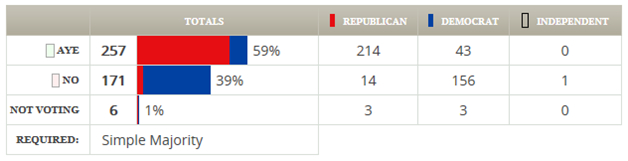
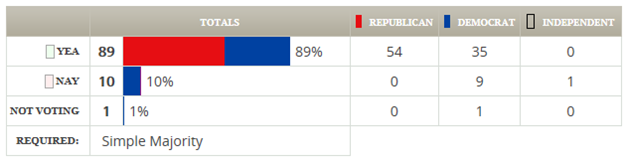
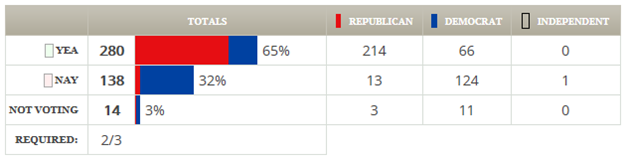
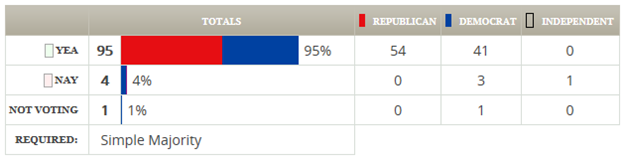
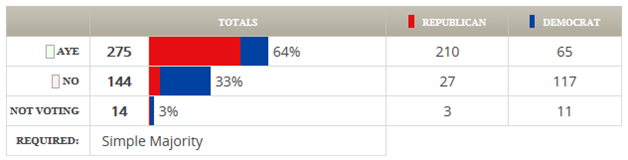
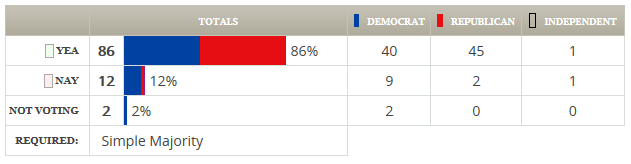
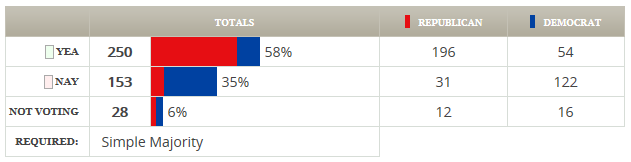
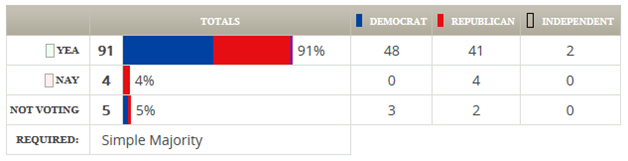
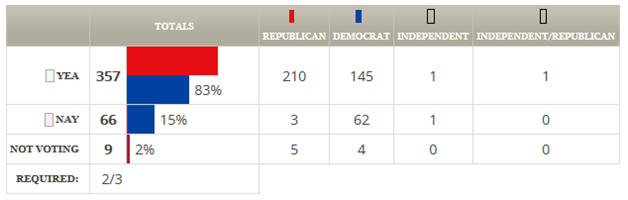
One other thing to take note of…if you are really concerned with civil liberties you will find below that the Democrats have a better voting record, in terms of no votes and percentages (see endnotes), on these issues contrary to current public opinion of many Republicans and Libertarians.

Here is the public voting record on major legislation:

Patriot Act 2001 Final Votes of House and Senate:3


Yeas

Nays

NV

Republican

259

3

5

Democratic

193

63

5

Independent

3

1

0

Senate Votes

House Votes

See endnote 3 for a description of this legislation.

USA PATRIOT Improvement and Reauthorization Act of 20054


Yeas

Nays

NV

Republican

268

14

3

Democratic

78

165

4

Independent

0

2

0

Senate Votes

House Votes

See endnote 4 for a description of this legislation.

Patriot Act Renewal on March 2, 2006 Final Votes of House and Senate:5


Yeas

Nays

NV

Republican

268

13

3

Democratic

107

127

12

Independent

0

2

0

Senate Votes

House Votes

See endnote 5 for a description of this legislation.

FISA Sunsets Extension Act of 2011
Final Votes of House and Senate:6


Yeas

Nays

NV

Republican

255

29

3

Democratic

105

126

13

Independent

1

1

0

Senate Votes

House Votes

See endnote 6 for a description of this legislation.

PATRIOT Sunsets Extension Act of 2011 (On the Senate Amendment):7


Yeas

Nays

NV

Republican

237

35

14

Democratic

102

122

19

Independent

2

0

0

Senate Votes

House Votes

See endnote 7 for a description of this legislation.

_________________

1 See this, National Security Letters

2 See this, USA PATRIOT Improvement and Reauthorization

Act of 2005: A Legal Analysis, Summary at the beginning of the document.

3 See this, click on Read Bill Text

House Votes:

Senate Votes

4 See this, click on Read Bill Text

House Votes

Senate Votes

5 See this, click on Read Bill Text

House Votes

Senate Votes

6 See this, click on Read Bill Text

House Votes


Senate Votes


7 See this, click on Read Bill Text

House Votes


Senate Votes


Philosophy Series 2

Philosophy Series Contents (to be updated with each new installment)

Philosophy Series 1 – Prelude to the Philosophy Series

Philosophy Series 2 – Introduction

Philosophy Series 3 – Appendix A, Part 1

Philosophy Series 4 – The Pre-Socratics – Hesiod

Philosophy Series 5 – A Detour of Time

Philosophy Series 6 – The Origin

Philosophy Series 7 – Eros

Philosophy Series 8 – Thales

Philosophy Series 9 – An Interlude to Anaximander

Philosophy Series 10 – On the Way to Anaximander: Language and Proximity

Philosophy Series 11 – Aristotle and Modernity: The Eternal and Science

Philosophy Series 12 – Levinas and the Problem of Metaphysics

Philosophy Series 13 – On Origin

Philosophy Series 14 – George Orwell and Emmanuel Levinas Introspective: Socialism and the Other

————————————————

Introduction

This is the first of a series that will explore philosophy from early Greek beginnings to the present. This is in no way meant as a re-affirmation of ancient Greek slavery, misogyny or cultural hegemony. Ancient Greece was not a homogenous amalgamation of virtue, reason, genius, nobility or any such modern notions solely guided by the pure or proper. Any notions of the proper or the pure are themselves the results of a multiplicity of histories that can only congeal into simple unities of understanding from heterogeneous contexts which typically remain shrouded in darkness. If thinking remains mired in the bog of mere present day semantics, every history gets appropriated into the thinker’s presence and any other externality silenced into oblivion. This is why reflecting on uniquely Greek contributions to, what has become for us, simple semantic unities that already understand or show the real, should always be thought with a sense of excess and externality. This kind of showing cannot be fully completed by our ready-to-hand or contemporaneous understandings and cognitions. There is always a gap or void, an inherent chaos (xaos, χάος), in understanding. The indeterminateness of chaos is not accounted for in terms of a ‘me’ understood as the immanent relatedness of common linguistic reductions.

This series will make an attempt to think as philosophers would have thought without already having the handy notions that we have such as nature, consciousness, substance, subject, object, thing, eternity, absolute, physics, matter, soul, etc. All of these words have been used to translate the ancient works of the Greek philosophers but these words are modern transformations of the original texts that make the original texts appear to be written recently. When reflecting on the Greek philosophers, it is better to be suspicious of easily thought ideas and to value reflections that require effort and a sense of mystery and unfamiliarity. It is important to remember that the exercise of thinking about something which has not been thought about before is a very different exercise than merely compiling common notions already understood. When studying ancient Greek philosophy we think back, toward an origin, an archē. However, this archē, as thought by early Greek philosophy, is not the common notion of origin. It is an early notion of origin; before there was a clear and thoroughly articulated notion of what ‘origin’ would be. The gap between our idea of origin and the first Greek thoughts of origin is over twenty seven hundred years old. A lot has transpired in that span of time that puts even more of a gap between our thinking of origin and Hesiod’s thinking of origin. However, in that span, a yawning gap is opened even wider that resonates with Hesiod’s archaic chaos. This chaos sounds uncanny to modern ears. Yet, somehow this gap, this chaos, has been made relevant to what is simply ‘known’ now, even in its forgetting and transformations. Somehow, this lost gap has come to function as a hermeneutics that organize, situate and give place to values, meanings, undertakings and ‘truths’ whether for , against, indifferent or oblivious. The intent of this series is to grapple with the aforementioned ‘somehow’ of the relevance of chaos, hermeneutics and some of what has transpired in and since that gap.

An important aspect of this philosophical exploration is giving place to externality, alterity, which may not be accounted for by common place notions, simple wholes with which we encounter and know the world. While these notions are practical, they also tend towards totalizing, entrapment in subjectivist, pre-cognitive determinations that force values and judgments towards fixation, abstract reduction and mis-appropriation of what faces and eludes us. If our singularity is lived towards closure infinitum or eternally recurrent, re-appropriation of the same, the indeterminate future is held captive to the determinate past; it is re-cast as static and known. To be sure, dynamic, movement or kinēsis (κίνησις, kinetic, motion) is not aimless. It is always conditioned by a past and a known. However, kinēsis is never completely encompassed and determined. There is always a leak, an entropy, that refuses containment and diffuses sight (Idea) in kinēsis. Kinēsis as dynamic (dunamis) is not only actualized (energeia) in the present but held back in the not-yet of potentiality (dunamis). Kinēsis is excess. It is entropy and potentiality that opens spatiality and temporality beyond containment and presence. Excess is a necessary condition of kinēsis.

Futurality, as not-yet, not-having-been, holds open a symbolic place marker of otherness which has not yet attained determinations as subject and also refused the object under the rubric of thing. The notions of subject, object and a ‘thing’ are examples of the simple unities in common place thought that pre-understand, pre-condition how we understand. These notions are pre-cognitive in that we do not have to re-think these notions in practical usage. They have been handed over to us from a history that preceded us. Heidegger thought that the most common example of such a notion was the thought of ‘Being1‘ which was lost from the Greek thinking of Being and accordingly, taken over by the simple and already understood present-at-hand notion of ‘thing-ness’. However, these notions were precisely what the ancient Greeks were most concerned about without the historic luxury of our ‘present-at -hand’ explanations. In the work of thinking philosophy, we need to suspend these kinds of notions and allow some other, some remote unfamiliarity, to come to the fore of our apprehension such that what remains concealed in automatically2 imposed assumptions, histories we have long forgotten, might re-awaken a sense of child-like wonder and curiosity and a re-evaluation of the real. Additionally, the step back from a nominal, privately understood, autonomy3 opens up avenues and vistas for futurality. In this case, futurality is not pre-determined by an already pre-understood past and congealed logic (logos, λόγος) but an otherness that is not yet gleamed, which remains open in essence. This is the direction we must traverse if we are to find a path towards the ancient Greek notion of chaos, towards that which is the possibility of the impossibility of genesis, the an-archic which must ‘be’, in order that the flight from which, inevitably becomes the measure of boundary, form and idea; the possibility for sight as presence.

From this perspective, it is important to not just translate histories but retain some of the un-translated graphemes (xaos, χάος; chaos) as an indicator of a time that was not our time and a place that was not our place, an an-archical past that in some undeterminable way opens up my possibility for presence and actuality. It is the inability of ancient philosophy to complete itself, inchoate in genesis, that denies ground and, in this very denial, produce the phantasm of ground; the concealed and incestuous accounts of history as Idea, as that which makes dialectical reductions possible. This a-genitive indeterminateness first lays open the impossibility of ontological, metaphysics and the gaping place-less-ness of otherness. The abyss, thought as chaos, is not neutral. Neutrality already arrives from history, much too late to convey the uncanny-ness of the refusal of ground (abgrund) which remains ciphered in the Greek graphemes: χάος and λόγος.

This series will also allude to more contemporaneous philosophers that will be discussed in more detail later. Much of the direction of the discussion will be drawn from the works of Martin Heidegger and Emmanuel Levinas. Jacques Derrida will also play a role in the critique. These philosophers were well versed in the history of philosophy and ancient Greek philosophy. I will also insert some of my own reflections at various points in the discussion. The reason for doing this is to keep the discussion from sounding a little too scholarly and a little more relevant to modern ears. The current plight of philosophy has much to do with rote repetition of conventional schools of thought which level off the provocative import of philosophy into a mass of ‘facts’ and what Heidegger called historiography, the mere recitation and cataloging of events, ideas and dates in the past. When philosophy becomes a dead past, the original impetus that made it important and relevant fade and more importantly, the dangers that lurk in unreflective dogma, the production of ready-to-hand notions, have often resulted in the worst of human tragedies.

Philosophy Series 3 – Appendix A, Part 1

_________________

1 I capitalize “Being” here to indicate the verb (to be) and “being” to indicate the noun (a being).

2 See Link

3 See Link

Colorado “Crackpots”

Rural counties in northeastern Colorado want to start their own state (Weld County floats secession plan for northeastern Colorado):

The plan to carve off the northeastern corner of the state — Weld, Morgan, Logan, Sedgwick, Phillips, Washington, Yuma and Kit Carson counties — and form the state of North Colorado was hatched at a Colorado Counties Inc. conference earlier this week, Weld County spokeswoman Jennifer Finch said.

Additionally, Craig Colorado wants to require everyone to carry “sporting rifles capable of accepting high-capacity magazines”(New committee meets to discuss mandatory gun ownership in Craig).

I have a few things to say to these folks.

Craig – Many of you are against mandatory health care that your Republican Party originally proposed and implemented in Massachusetts but apparently some of you are in favor of mandatory gun carry? Do you see any issues here? Is it better to require the capacity to kill than to heal?

Let me tell you folks something: I hated it when your party was in power, started two dumb wars and crashed the economy AND you had the gall to make me pay taxes to support your absurd policies. However, it never even occurred to me to advocate seceding from the state which is effectively seceding from the Union (some in Texas want to do this too). First, even if you can secede from the state you will no longer be a part of the United States. We have a constitution that requires your dreaded Federal Government admit you to the Union – Article 4 of the Constitution. You must have someone that went to law school that can help you with that – right? Why is it that you consider yourselves patriots but you hate the government and you want to secede? When I was in churches in the Deep South it seemed like every church thought they were the true Christians and everyone else was apostate. Well, you know democracy is a different beast than that. In democracy we have this idea about the majority and voting. It was a very liberal idea when our country began but it does go back to the early Greeks. If you are not on board with that idea and would like the minority to keep sabotaging the democratic process, you are only on board with democracy when it works for you – that idea is not called democracy, it is called tyranny when implemented in a government. You can call yourselves patriots or anything you want but if you cannot support democratic government, even when it goes against you, you are patriots of tyranny. With that in mind it may be better if you got the hell out of the Union – America, love it or leave it!

A Personal Note

My wife is retiring at the end of the month. I have effectively been retired from a ‘real’ job since 1999. I still work lots of hours on music software but, at home in my pajamas, is not a ‘real’ job. My wife and I plan to travel and continue to enjoy life. My kids are doing fantastic. Life is very, very good. This upcoming phase in life is something I never thought I would have or even deserved but seems to be a strange confluence of Heraclitus’ river that can never be stepped in twice (or even once). I would never think that due to anything special about me, I ‘deserved’ this. I am a bit taken back by those (you know whom I mean) that would beat their political chests over success. I ascribe to the position that if you find success in life you need to be lucky and grateful and remember concretely those that are the brunt end of bourgeoisie politics. Capitalism is great when it works but those that it works for need to make it easier for it to work for others not harder. This political philosophy, I gratefully attribute to my mentor Emmanuel Levinas, guides my politics and ethics. Pain and struggle never go away but it can deepen the soul and become part of a montage of existence wherein we dwell.

The Monstrous and Human Contradiction

I have to admit I am a baffled by the nut case sending ricin letters to the POTUS and other high ranking politicians. The letters stated,

“You will have to kill me and my family before you get my guns. Anyone wants to come to my house will get shot in the face. The right to bear arms is my constitutional God-given right and I will exercise that right till the day I die.”

Perhaps unbridled contradiction is a ‘tell’ for mentally ill people. In any case, to state the obvious, the U.S. Constitution was written for law-abiding citizens. The idea behind law is that it is not a smorgasbord that you can pick and choose from. You may not like all laws or agree with them but the Constitution does not mean anything if you are lawless. Lawless folks seem to really think that laws are optional depending on what suits them at the moment. Society makes prisons for such folks; probably because we do not know what to do with them. They are hopelessly narcissistic. It is crazy thinking to state that you believe in the 2nd Amendment to the Constitution and are willing to murder to prove it. Even more, to state that the 2nd Amendment is “God-given” as a way to justify murder is the same mentality that drives the common terrorist. This “God” is no different than the deranged mind that imagines it.

I think there is a deep feeling/conviction among many of us that living a lie is none other than living a contradiction. This is why when we become aware of our contradictions we have consciences and feel guilty. Guilt motivates us to change our behavior so that, eventually and ideally, we are at peace with ourselves. While many may never attain guilt-free life, we still hold to the ideal and labor under it our whole lives.

Apparently, some folks are not in the least hampered with such notions. They can spout off ‘God this and God that’, ‘Constitution this and Constitution that and in the name of their holy indignation murder anyone that disagrees. I find this kind of behavior no different than the ‘kind’ of a tornado. It is not human and can reap horrible unfettered violence at will with no pains of conscience. The odd thing is that this ‘human tornado’ can talk and look like a human. Perhaps such a phenomena fulfills the purely human notion we have of ‘monstrous’.

Shadow Universals

I think we should strive towards justice and critical thinking. Our Founding Fathers constitutionally put a judicial branch into government because they knew that people were quick to judge based on sensationalized facts. From a philosophical perspective there is quite an interesting dynamic between universal judgments as Kant recognized and particular cases which, all too often, are not obvious but dubious and uncertain, the macro and the micro, the one and the many. The existential dilemma is the in-between where we live and breathe and have our being. Post-modernism is replete with those that awaken the ancient Greek Skeptics1 and Cynics2 refrain from their Platonic and Aristotelian counterparts. The perennial themes that Leibniz first observed3 are replayed countless times by those that must act and react to the play of universal and particular as a singularity. Judgments are not optional as we must act and align our universals (or denials of them) in meaning-bestowing ways. Let’s take an example in the Austrian School of Economics.

The Austrian Economic School’s retreat into the micro-economic serves a macro-economic goal, a universal ideology that sustains itself vis-à-vis Menger’s causal realism4 and Rothbard’s chaos theory of economics5 which results in a spontaneous order of self-organization for Hayek6. Their criticism of neo-classic, macro-economic models deny these schools legitimacy based on their imagined universal orders that result in central planning. The Austrian model is based on an absolute freedom from idealized ‘economic theories’ and the assumption that entrepreneurship driven by free-market price competition in a spontaneous order, a bottom up, Darwinian styled, self organization that resists history and a priori narrative. Market equilibrium7 is denied as any long term market dynamic. Market predictability and manipulation are discredited as the outdated, neo-classic idealization in both neo-classic capitalism and Marxism. While it appears that this school would distance itself at times from post-modernism and some of post modernity’s initial affinity with certain liberal arts schools of Marxism, it shares a similar distrust of what Derrida calls “logocentrism” in deconstruction. It prefers localization to ‘universalization’. However, a certain purity of discord is attributed to entrepreneurial competition that may have a hard time explaining collusion.

Even if we take the bottom up approach to market dynamics there are dynamic differences between small-scale and large-scale entrepreneurship. Small-scale entrepreneurship is not performed in an absolute individualized vacuum but seeks market advantage not only by competition but also by partnership and strategic alliance which it largely does not yet have. Large-scale entrepreneurship already has forged those alliances and seeks to maintain the ones that further its economic goals and use its market leverage to create new economic alliances. If there is no market order that can stand over and above the market then the differences between partnership and alliance and price collusion and market monopoly could not be determined by market regulation. In effect, market ‘universalizations’, could spontaneously arise and ‘self-organize’ without restraint. Of course, the Austrian objection to this would be the ardent belief that market price competition and lassie faire capitalism as the most efficient allocation of market resources would prohibit this kind of market dynamic. For the Austrians however, this is not the case for government intervention where government tampering results in ‘malinvestment’ and over allocation of labor. Rothbard states,

The Fed essentially is a legalized monopoly counterfeiter. And the effect of the Fed increasing the money supply, or the Bank of England or any central bank, is almost the same as any counterfeiter.8

There is an apparent faith that no matter how large companies can be they would be exempt from market tampering which could only be rightfully applied to the government. It is a pre-determined absolution of free-market ‘self-organization’ and government imposed market order. The Austrian faith only works if this difference can be absolutely maintained. Here we have pin-pointed the absolute in Austrian economics. It is a faith that must think the market in terms of the individual and not the collective. Even if a large corporation were larger than the government, it would be unhindered and unfettered by its ‘private individualism’ banner which could not be claimed by the government. Could a large corporation manipulate the economy? Is that inconceivable? Could a large corporation not be the most efficient allocation of resources? Could the government make any positive contribution to market economy? Is the government always essentially defined as anti-free-market economy? How could one prove such a thing where it true especially if macro-economic measures are disqualified at the start? Paul Cantor states,

In short, the free market will always produce failures, but, unlike other economic systems, it has a built-in mechanism for correcting them. That is why the efforts of a multitude of uncoordinated market actors can produce a more rational result than any centrally planned economy can generate. Centrally planned economies inevitably produce system wide failures, whereas the free market tends toward merely local failures, which generally cancel each other out.9

Does this line of distinction really work? Are we to believe that we cannot correct failures in government? What is voting for if this is so? Why homogenize government? Don’t we have local governments as well? Cantor states that “the free market tends toward merely local failures”. I know the Austrians wholly blame the recession of 2008 on government intervention but isn’t the impunity of the free-market from any blame whatsoever a step away from realism and towards the ideal?

In Austrian economics, the metaphysic of the individual must be maintained over and against the collective as a way to purge the market of impurity but the individual never exists in some metaphysical, ontological, hermetic isolation. Groups and collectivities are formed by individuals that can counter and thwart other individuals, even other entrepreneurs, by its sheer size and this can happen in governments and private corporations. The Austrians talk a good game but their causal realism has just as many universal ideals built into it as their arch-nemesis neo-classic economics, just different universals. If causality is stretched to accommodate theories it can easily fall into the fallacy of false causality. The sign of this would be clear and artificial lines of demarcation that cannot or will not explain or justify itself. Further, any insistence that even the attempt to hold itself accountable to economic metrics rests on discounted macro-economic ideals is certainly a red flag for unfalsifiability; Popper’s notion of the difference between science and pseudoscience. History has shown universal truths, cultural myths, can be deceptively dangerous and insidious when they myopically distance themselves from any possible grounds for criticism.

_________________

1 See http://www.iep.utm.edu/skepanci/

2 See http://www.iep.utm.edu/cynics/

3 See http://www.friesian.com/leibniz.htm

4 See http://mises.org/daily/6254/The-Odyssey-of-Sound-Economics

5 See http://mises.org/freemarket_detail.aspx?control=296

6 See http://mises.org/daily/4034/The-Poetics-of-Spontaneous-Order-Austrian-Economics-and-Literary-Criticism

7 See http://mises.org/freemarket_detail.aspx?control=296

8 See http://mises.org/pdf/het5_mises_and_austrian_economics_rothbard.pdf; page 16

9 See http://mises.org/daily/4034/The-Poetics-of-Spontaneous-Order-Austrian-Economics-and-Literary-Criticism; Section IV

How much is too much?

Steven Miller, the Deputy Commissioner and Acting Commissioner of the IRS, is testifying before the Ways and Means Committee today regarding what the Republicans are terming “targeting of conservative groups” for the 501(c)(4), tax-exemption. Here are a couple things I learned. Steven Miller is not a politically appointed Commissioner. Apparently, the Commissioner is a politically appointed position. Miller was a Deputy Commissioner which means he is a civil servant. In other words, he worked up through the ranks. He is a career employee. The last real Commissioner, Douglas Shulman, was appointed by President Bush and served from March 24, 2008 until Nov, 9, 2012. He was the Commissioner during the alleged “targeting” incidents. The Commissioner before that was Mark Everson. He also appointed by President Bush and served from May 1, 2003 to May 28, 2007. It interesting to note that Shulman retired just three days after President Obama won re-election. However, he did serve during President Obama’s first term. I don’t know why he retired three days after President Obama won but might it be taken as a show of protest to Obama’s re-election or just a quick out to avoided getting fired or perhaps nothing to do with the election at all but I really doubt that a Bush appointee would be very happy with a Democrat winning the Presidency again. In any case, I have yet to hear how a Bush appointee would be “targeting” conservative groups. Do sane folks really think that Obama could pull off this kind of feat? This sounds like yet another case of the Republican Party eating their own in their feeding frenzy to take down Obama and win seats in 2014.

I watched some of the hearings to try to understand how Steven Miller might be approaching this issue. First, he believes he told the truth, when he previously testified to the same committee, even though Republicans were basically calling him a liar today. He stated that the issue he was dealing with at that time and what he thought the previous hearing was about was processing specific applications for 501(c)(4) status of some conservative groups not any internal lists the IRS used to direct claims to specialized agents. He stated he was not aware of any specialized agents that were given orders to deny 501(c)(4) status to tea party groups. Apparently, he was aware of organizational methods the IRS used to direct applications to special agents. Apparently, this is common procedure. Imagine if you were a boss and you had to come up with ways to organize 70,000 501(c)(4) applications with only 200 agents that could handle this type of thing. These are the numbers that Seven Miller cited today. The first thing you would do if you had a database is try to sort the applications electronically by key words. You might have one agent that specialized in tea party or conservative group applications because they would gain knowledge and experience in that particular area that they could use on new applications. You would also have some applications that would go through without further investigations and some that would get flagged for further, personalized attention. You would be looking for scams and frauds that the IRS regularly deals with. Based on previous experience you might have developed some buzz words on the application that would cause the computer to flag it to a specialized agent. So why would it take 2 or 3 years sometimes to process an application? Well, 70,000 divided by 200 is 350 applications on average that one person must approve or deny. It is not so hard to imagine that common data processing techniques that I have described would have to be used. However, let’s take a step back.

If you were an employee and you were told that your job was to approve or deny 350 applications on average for tax-exempt status, would it cross your mind that your employer was severely understaffed? Would your boss also have an inkling about this? Could it be that your boss may have taken this understaffing issue to his boss and received the answer that we do not have enough money to hire more people? In the case of the IRS, it is feasible that Congressional appropriations would be the limiting factor. What if you were Secretary of State and were responsible for multiple embassies around the world? What if, again, you were denied funds for maintaining adequate security for all the embassies? Personally, I think the only appropriate thing to do would be to close down the embassies until and if Congress decided to make the funds available to adequately protect them. I also think the IRS should refuse to process more applications for 501(c)(4) status than they can realistically handle. If political bureaucrats would refuse to do the impossible without appropriate funding of their agencies we would have a lot of squeaky wheels out there that would need oiling. Then, the American people would have to decide if they want to keep cutting government spending or have a functioning government. This is where the battle needs to take place. Unfortunately, when department heads keep saying we will do more with less they are enabling the demise of the government while preserving their careers and not making waves. I believe we need more intestinal fortitude to force these issues to a head. When filibustering was allowed to happen in the silence of Senate backrooms, the squeaky wheels went away while the government was coming off the rails. We need folks in these positions to take public stands, wear out their welcome, and allow the electorate to make their decisions about whether or not they want these politicians to stay in office. At what level of pain will the electorate cry uncle? We need to find out. The French have a word particularly biting to moderates (or blue dogs) in politics that allow untenable situations to continue and thrive in government – bourgeoisie. I do not think there is any big bad political wolf behind the IRS issue only government that has over-reached their funding level and kept their mouths shut.

Additionally, the numbers that were cited in the meeting today of denied claims and approved claims seemed to fall fairly evenly between conservative and liberal groups. Conveniently, this side of the story has not been told. Also, these kinds of incidents occurred during the Bush administration with the NAACP and other left leaning groups. One comment was made today that these issues have been going on for a long time and that the real culprit is badly legislated laws concerning C4s. The law really is a mess. It has been chipped away so much that we should either give C4 status to any applicant OR have very strict and well defined rules about who can quality. Bad laws and bad court decisions create these kinds of situations…I am reminded of Citizens United. Again, when we try to please everyone for everything we only do a disservice to everyone and everything. We need more chutzpah from our elected leaders and willingness to take the heat for better or worse for them personally. Personally, I think it is inevitable that the American people will have to decide when the pain stops and what kind of people they send to Congress…BUT first, they have to feel the pain enough and in large enough numbers to throw the bums out and get a Congress that can do something besides show their ass all the time. Anti-government hate will not solve the problem; only a proactive electorate. Patriots do not hate their government. I think that is the domain of terrorists and thugs.

Getting to the Real Issues

Underneath all the cloak and dagger of politics, there are real issues that all too often get covered over by the latest political drama. The maddening thing about all this is that nothing seems to get resolved. It just appears that every action gets a reaction. Perhaps the laws of physics are perpetually reaffirmed but this type of dynamic which generates heat and entropy in the system. Perhaps the manifestation of heat is chaos and knee jerk reactions that end up hating the government and becoming paranoid about the evil genius that is the ghost in the machine of absolute power. Fox news has made a lot of money propagating this tragic drama. Unfortunately, the electorate has demonstrated more of a propensity for loving the manufactured lie than digging into the pesky details, the anomalies that call for thought and wisdom. What is it that calls for resolution and solutions? The answer that political chaos calls for is not eternal, emotional vigilantism or otherworldly cynicism for this world but principles that address justice. We all come to this calling with historical deficiencies and biases that easily derail and confuse us. In any case, this is the situation the Founding Fathers faced even with their advantage over us as the most highly, liberally educated scholars of their day. However, we are, as they were, constrained to try to answer the questions of our day, to heed an inner necessity for a yet to be determined justice. Cynicism is always snapping at our heels and tempts us to yield to hate, fear and apathy. Apathy is most seductive and can take many forms. Apathy absolves us from responsibility from ‘my’ call for resolution, for solution, for justice. Apathy is the lassie faire of the rabble; let the market decide, not me. However, capitalism is not about passivity but production and action from the individual. It is unfortunate that a long history of economic reductionism has lost the connection to personal responsibility to heed the call for justice as what is most noble in human production. Our understanding of what it means to ‘be’ has taken on a certain stubborn, habitual embedded-ness to a metaphysic of materiality and its antithesis, spirituality. Body and soul, accident and substance, no-thing and thing, mortal and divine have split us into fragments, historical pieces of our call to ‘be’, to do justice in spite of our overwhelming injustices. The face of every child, every victim of suffering continually calls for remembrance and reawakens us to our personal and absolute responsibility for justice, response and answer. Let’s take a few concrete, current examples of how this gets worked out in our politics.

The far right can concoct conspiracies and vile governmental demons in a vacuum but now oxygen has been heaped on their delusions in the form of the phantasmal IRS scandal, the Benghazi attack and the Associated Press surveillance. Let’s refresh our convenient short term memories and see if a need for an unanswered question arises.

After 911 many folks had a burning desire for vengeance that fueled a political fire for two wars, Guantanamo and the Patriot Act. The cost of the wars and effect on the national debt, the torture of “war combatants” and the invasion of personal liberties on U.S. citizens was only met with crickets chirping. Only a few voices were raised in unpublicized hearings and court cases to counter the onslaught of public aggression. The government was not evil back then but the arm of the almighty fighting the just war. The vile liberal laws (which really were not enacted by liberals) that prohibited CIA assassinations and much covert activity were readily dispensed with in the name of hanging the perpetrators high. The onslaught of drones was welcomed by the chirping crickets. The call for justice was silenced by the call for revenge at any price. The CIA could listen in on any calls they wanted including U.S citizens; businesses were not exempt either. The tax exempt status of immensely funded political machines was given carte blanch for any “social service” group including neo-Nazis and the KKK…remember Citizens United, the Wisconsin Right to Life decision, tax exempt status and corporations right to free speech?1 Not a chirp was heard from conservatives when all this was working for them. Did many of us really think through the loss of revenue from these tax exempt groups and whether tax exempt was being unfairly endowed on puppet groups opening the flood gates to political circus and “targeted groups” for any organization that did not get tax-exempt status? Who will be the next targeted “social service” group…Serial Killers of America? Isn’t more money in politics rust to any iron left in our politicians?

Now, in the aftermath of impending danger we are left with some nagging questions. Can segments of our society be interned in various ways as slaves in the early U.S., the Japanese in World War 2, the Islamic community now, and the latest, conservatives in the Tea Party? Apart from a comedic grand conspiracy of President Obama, how do we justify bias and favoritism in our own calling and personal responsibility for an answer? We did so in the Bush administration while garbing ourselves in the clothes of the Divine. Now, our holiness is not so pure and we are left with nagging questions. Yes, it always easier to devise a devil like President Obama to squelch our conscience but the truth is that we are our own worst, diabolical conspirator. We setup, welcomed and allowed the conditions for these injustices while the crickets were chirping.

So, let’s say we get rid of those unjust, liberal laws that were supposed to protect us against terrorism according to President Bush and Dick Cheney. Let’s go back to NOT being able to spy on Americans, intern enemy combatants, water-board terrorists, propagate our clones and keep national security secrets from the American public to protect top secret sources. Let’s give every group that wants it tax exempt status. Let’s cut the national debt indiscriminately. When another terrorist attack gets our attention, unemployment goes back to depression levels, everyone’s pet government handout including Social Security and Medicare gets slashed or eliminated, when we can no longer justify our hypocrisies, we can go back to the silence of crickets chirping and start the whole insane cycle all over again OR we might try to think proactively.

We may actually have to suffer a little pain to be true to ourselves and our highly praised, Founding Father’s ideals. We may have to stop looking for easy, purely reactive indulgences and heed the call for justice even when it hurts us. We may actually have to live our ideals instead of revering them. If we, the electorate, reward mindless political thrills we will create a political machine in our own image. This will not be the image envisioned by the Founding Fathers but a hideous underside that will mock truth and justice. We need to ask ourselves and settle the issue, are we ok with perceived “war time” invasions of privacy? What are the limits we should not cross in the name of national security? What are conditions for mass expenditures and waging wars? What groups do we sanction and what groups do we oppress…gays, Arabs, conservatives, KKK, neo-Nazi, etc. or do we give carte blanch to everyone? Wisdom and measure is required to think through these issues. Government institutions are also required to ensure that we enact our collective wisdoms. The rabble of the market has no indebtedness to enduring wisdom only self satiation. There is no given goodness to the market only the perpetuation of the war of all against all. If we are to overcome our injustices we will have to become capitalists of a sort that are personally responsible for justice, which cannot abdicate our debt to the market but only continually answer to ourselves. We will have to rediscover what human being is, our being and our indebtedness to the other cannot be suffocated by the evil genius we hate or fear, the Great Satan that opposes God, the not-my-problem cop out of apathy. We must decide, act and live resolutely with the consequences of our desire for justice or shrink back into living oblivion. I hope to explore the depths of these questions more in my upcoming philosophy series.


_________________

1 See http://mixermuse.com/blog/2012/08/08/formalism-when-a-lie-becomes-truth-really/

See http://benjaminstudebaker.com/2013/05/13/the-irs-tea-party-muddle/

Austrian Logic

Logic, logos in classic Greek, has a kind of intrinsic compulsion; the notion of identity. Aristotle spent much of his discussion in the Metaphysics1 on the principle of non-contradiction (PNC). He thought that any claim of knowledge was essentially bound to PNC. Therefore, knowledge itself is not absolutely relative to personal belief. It must continually prove itself in the foundry that separates iron from slag, the true from the false. Truth is never complete but existentially contingent upon contradiction and error. However, “It is impossible to hold (suppose) the same thing to be and not to be (Metaph IV 3 1005b24 cf.1005b29–30).” If I make a claim that x is universally true then I also make the corollary claim that all particular cases of x will demonstrate the universality of the claim. Therefore, for example, if I suggest that large government leads to more corruption and am faced with significant examples of large government and less corruption, I must either modify my original universal premise to account for this discrepancy OR give up the claim IF the PNC is given essentially and intrinsically in the identity of universality2. This is not a matter of civility or incivility, opinion or fact, relativity, etc., it must necessarily always come along with any claim of knowledge. Of course, I agree with Jeff that civility is very important especially in light of the fact that PNC is existentially contingent and no one can lay claim to having arrived finally, teleologically (telos-completion, wholeness and logos), at universal truth. We are all paupers in the face of the richness of PNC. Yet, non-contradiction does remain in a non-relative assumption, always already implied every time we make a universal claim. We can only deny this in bad faith.

Bad faith is a claim to knowledge that violates PNC while maintaining PCN. As Aristotle stated, something cannot be and not be. A cannot be both A AND NOT A in any sense without violating PNC. If identity is taken as a singularity, an ontological (ontos, being, isness) unity then, it cannot be itself and not itself. This would be nonsense. Yet PNC is not the whole story. I will deal with that in my upcoming philosophy series. However, for now, I would like to take particular example in which the question of PNC is a concern. Bad faith is what Aristotle would have referred to as a logical fallacy. Aristotle cited formal fallacies in the form of logical syllogism. One form of a necessarily, tautologically, true syllogism is:

All humans are mortal.

All Greeks are human

All Greeks are mortal.

The middle term, human, establishes an identity between the major term, mortal, and the minor term Greeks and, on the basis of this identity, truthfully concludes that the major term and the minor term are identical in the universal sense of Greeks and mortality. They are bought together under the rubric of the same (mortality applies to all Greeks). This is necessarily so or tautologically true. If I maintain that,

All large governments are over regulated

All over regulation (necessarily leads) to corruption

∴ All large governments are corrupt


the existential fallacy here would be demonstrated by use of the terms “all” and any particular case that could be cited in which the conclusion is false. The way to fix this argument would be to make a contingent claim by replacing “all” with “some”. However, to maintain a universal generalization it must include existence as a necessary component of the “universal”. Another way to avoid contradiction would be to qualify what “large” is such that we are not referring to a linear relationship of ever larger governments and corruption but some critical mass wherein the stated universal relationship to corruption applies. Additionally, to simultaneously cite data that both proves and contradicts the conclusion, the universality of the claim, is a bad faith argument. Perhaps another way to avoid this would be to question the validity of the existential data but that cannot be laid hold of if one maintains the veracity of the data in some cases and not in other cases (using the same criteria for establishing the data as “true”).

There is another particular form of a bad faith argument that I really want to address, more as an imposing question, than a proven case. In order to do this I will put it in its most radical form. If I maintain that public debt is not a stimulus and economic stabilizer over the long run but a recipe for endless boom and bust WITH a correlation of the magnitude of public debt to the magnitude of the boom and the bust then we have a recent existential example that should at least pose a valid question. How is it that Europe and the European Central Bank (ECB) which has followed a policy of public frugality and reduction of public debt has seen higher unemployment and social upheaval while the US which has pursued a more Keynesian route, using the Federal Reserve to stimulate the economy with more public debt in the form of public bonds, has seen a lower unemployment rate and economic recovery?

It seems to me that one way to address this by the Austrians would be to appeal to an order of magnitude in which the correlation occurs that is not linearly related as in the previous example (magnitude of public debt to bust). Historical examples would be more pertinent in this tact. Another fallacious way to address the issue is to perpetually push off the final proof of this to the future. In other words, the BIG bust will come and that will prove our case. If a small bust would occur, even for a very large public debt, then the claim to correlation with magnitude of public debt and magnitude of bust could not be claimed as “universal” but perhaps only contingent. A non-correlation to magnitude of public debt to economic calamity is tantamount to saying nothing about public debt. There will always be larger and smaller economic busts at some point in the future unless one is a utopist. In order to draw a conclusion it must have a universal quality that is shown in the micro-economic, existential case. In fact, all historical existential cases must prove the case and not defer the case to an ever looming future.

I know the Great Depression has been the subject of much revisionism but the policies of FDR and the World War did greatly increase public debt and there was a recovery that followed this expenditure. It was not public austerity that was the catalyst for the recovery. Austerity prolonged the Great Depression and created unemployment and soup lines. Economic stimulus appears to have been a necessary and historically accompanying factor that changed impoverishment to recovery. Please note that I am not recommending throwing tax payer dollars indiscriminately at an economic crisis but selectively using the advantages of public resources to create jobs and build infrastructure as a historically proven stimulus when the private sector is imploding economically. I am aware of how the Austrians process the lessons of the Great Depression but am not convinced by their arguments yet. It appears to me to be a bit of revisionist history but I would not argue that all history may be essentially revisionist as Marx and Nietzsche noted.

Aren’t we seeing the same thing today with real world examples of Europe and the US? Here we have two different economic philosophies in concurrent existential laboratories and the apparent winning philosophy seems to be on the side of the Keynesians. I know we can make the claim that the big bust is coming and scare the bejesus out of everyone as they prep for the apocalypse but that may only be a futile exercise of an overactive amygdala3 and not a claim to universal knowledge. If existential import is minimized, denied or put off indefinitely, the claim can only remain as hypothetical and not a claim of knowledge.

In any case, it does appear to me that this subject has gotten bogged down in the endless ‘circle of hermeneutic’ discussions where evidence remains in the eye of the beholder and not in the logical claims that either hold up to their universality OR become a continent claim that may or may not be the case. It is the “faith” part of Austrian economics that appears to get cloaked in endless interpretation and apocalyptic vision that is a disservice to the logical truth claims against macroeconomic, brute historical results. It is as if we are all Alice in the rabbit hole trying to decipher if what we see is a big or small Armageddon while holding a tea party to debate the intimacies of our upcoming oblivion. If we separate and isolate the logic of the claims to see if they are contradictory in themselves we may get further than endlessly “re-stating” the claims to obfuscate and diminish the universality the Austrian school is trying to lay hold of in economic theory. As such, I would love it if someone could provide a relatively simple argument that does not appeal to the true, complicated, scholarly arguments that take years to understand and merely highlight the logical principles of the Austrian school that cannot be diminished without losing its integrant veracity to itself. I am not asking for over-simplification, only logical arguments that do not get lost to further “clarifications”.


_________________

1 See link: http://plato.stanford.edu/entries/aristotle-noncontradiction/

2 See link: http://critical-thinker.net/?p=1929#comments

3 See link: http://critical-thinker.net/?p=1074


_________________