The Wood

When I was barely a teenager in the late sixties living on the south side of Baton Rouge, Louisiana, we lived on eight acres. The house my dad built was on the outskirts of, then, Baton Rouge. We had a rather small size of woods on all sides of our house, maybe on the order of tens of acres. However, the woods were big woods in that the trees, many oaks, were very tall at least one hundred feet. In places the underbrush was thick, and the overall effect was that the woods were dark and hidden. I used to go out almost every day after high school with my shotgun to hunt squirrels and rabbits. Yes, we actually ate them in those days – effects of the Great Depression in the Deep South on my parents. Anyway, I did not go out to kill small animals but just to walk in the woods after a stressful day of high school. I have never told anyone this story, but the story has always haunted me to some extent. Not in a bad way, but in an oddly quiet, hurtful but ‘full’ way. Not too far into the woods on the north side of my house was a strange place I would just sit and, I don’t know, feel, think commune with something, someone… The place was a place that, as far as I knew, no one knew anything about except myself.

What was unique about this place in the wood was that there was obviously a small house which had been there at one time. There was no structure there, no rusted tin, no old timber, there was a small, barely visible but distinct outline of a square frame maybe twelve feet by twelve feet. Inside the frame there was fragments of what could have been clay vessels which was probably the kitchen area. Next to the frame was a square pit, about four feet sides, that was around fifteen feet deep. I took this to be an old well. Behind the house frame there were, barely visible, but distinct rows as if a garden was there at one time. Tall trees and shrubs had almost leveled it out, but it was definitely a garden at one time. The garden was more or less visible for about four acres behind the house to the west side. At the end of the garden area was what was obviously some kind of old, highly overgrown, pond with trees which had grown up inside it. It was small, almost like a small, cow watering pond and, while shallow, still had water in it most of the time. To the north of the old house frame was a really odd and old road, more like a wide path, that ran diagonally towards the west. The road was not visible at all near the house frame but picked up a small distance into the wood in a strange way. There were no trees in in the old road, but it was lined with very old, tall trees which made it dark. Along the sides of the road were a flurry of palmetto leaves which were not uncommon for that part pf Louisiana but were configured too symmetrically along the old road path to have been natural.

Slightly to the northeast of the old house frame were two oblong mounds which extended about eight feet in length and three feet wide. There were perfectly parallel and there was a smaller one in parallel that was about four feet long by two feet wide. They were obviously grave sites for two adults and one child. Next to the grave sites was an odd clearing which could have been a very small shallow pond at one time. By the size of the trees, overgrown in the garden, the homesite must have gone back to at least, the civil war days and likely before. There was no way to tell if these folks were white, black or native American, but it was obvious that they lived in isolation from any communities of people.

When I reflect on it, I think these folks left, barely visible, almost erased, traces of a probably short but happy life. They were probably barely known by anyone else – I may have been one of the few that ever picked up on this practically invisible site. They grew their own food, perhaps had a couple livestock but spent some unknown but happy years in that secret paradise. Their life was hard and tragic, but they endured and, for those days, thrived. Their legacy was my secret and private privilege to somehow enjoy for those days when I would just sit and ponder.

From what I know about that area now, it has all been developed and bulldozed over many times, so I was probably the last to know about that trace, that moment, that life-place. As a teenager, which are not known for being the most astute in these kinds of matters, I felt a sadness and a fullness for those phantoms which once were not so. They disappeared into oblivion, but they had their special moment in the sun…and I was there to witness the final gasp in anything we might recognize as their reality. They shared that with me and I with them and quickly thereafter, all vanished.

I do not know why I did not tell others about the place or perhaps inform LSU about a possible archeological site but who knows what teenagers think. I do find that my life, especially after the loss of my dear, twenty-year-old son to suicide recently, has something in common with that quiet, solemn and lost place. I will also go the way of oblivion, my memories, my loves, my desires and my tragic hurts. But I had my life-place and my loves, my time in the sun and I was content in the gardens I toiled with. I have no expectations about exceptionalism or uniqueness, but I do not need or require that – I am content – I simply need make my own ways into my moment in the sun with my loves, my toils, my tragedies. That will be enough, and I, like those bare traces of vanishing sojourners I momentarily met in solitude, will disappear into the night of the living…and whatever else an odd universe may decide or not.

Announcing First Cut of My New Songs

I have posted my first cuts of 10 new songs. They are a rough draft, guitar only cuts with a quick mix. It is mainly conceptual for the latter cuts. I will be adding instrumentation, rearranging and more polished mixes later. Click on the link below to get to the site.

Alterity

The Impossible Possibility of Paradox – Part Two

Chaos Theory is:

“When the present determines the future, but the approximate present does not approximately determine the future.”1

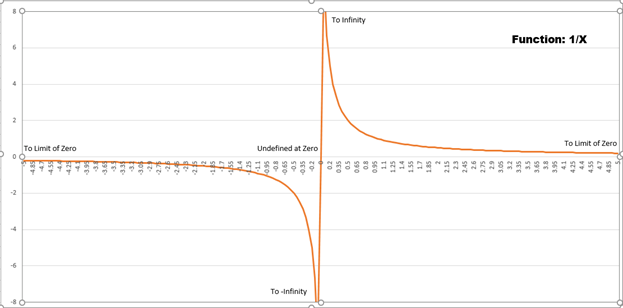
In the Part One discussion we discussed the function 1/X. We saw cases in the function of infinity as X goes to plus and minus infinity. We also saw the case where X = 0 and the result is indeterminate. All the points except zero demonstrate a continuous, nonlinear function. That is, all real numbers in the graph is a smooth curve with no breaks or discontinuities except at zero. At X= 0 the function is discontinuous. This function simply demonstrates how we can get a degree of closure even when we entertain the notions of infinity and indeterminacy. Both infinity and indeterminacy tell us that even in the most banal circumstances such as the function 1/X we have a degree of certainty while at the same time entertaining notions where we can’t get absolute closure. Even more, these odd notions tell us that even such banal certainties are ruptured through and through with exteriorities which cannot remain in themselves but indicate an other which mathematics has no answer. In this part of the discussion we will explore further the complications which can only indicate the limits of our logic and the value of the questions these limits pose.2 The last footnote of my recent post On Origin ask this question:

Does chaos theory in contemporary science relate to radical otherness? If so, how? What about the implications of quantum theory and Schrödinger’s cat in the box? Does the uncertainty principle and the apparent malleability of what ‘is’ determined by observation have anything to do with radical alterity and the retreat from the face of the Other? More succinctly, do we face an ‘Other’, a radical alterity, even in the ‘it’ of physics?

This post will try to address this question and contrast its implications with what I consider to be a formidable philosopher whose influence has become a focal point and an anchor, both in its affirmation and negations, for the retreat from the face of the Other – Georg Wilhelm Friedrich Hegel.

For classic physics most notably represented by Newton, absolute time and absolute space is assumed. Underlying much of classic science and philosophy, causality is absolutely assumed. Causality is often associated with the billiard ball metaphor. When the cue ball hits other balls on the table, geometry and force absolutely determine the path of all the other balls. While causality may provide useful information in our everyday world, these notions have been antiquated by a much more precise understanding that spans phenomena from billiards to cosmological physics. Relativity supersedes Newtonian physics. Relativity is orders of magnitude more accurate even in the specific frame of reference which Newtonian physics works including billiard balls. However, relativity has some limitations. Relativity works extremely well on large scales but not on extremely small scales. For extremely small scales quantum mechanics is highly accurate. In special conditions, Einstein’s equations punched holes in the continuity of time-space. In a similar way that our mundane function of 1/X contains examples of infinity and indeterminacy, Einstein’s findings predicted such phenomenon as black holes and wormholes.

Einstein was responsible for pioneering quantum mechanics when he discovered that light had both the characteristics of a particle and a wave. After all he had already demonstrated that energy and matter, like the particle and the wave, were two different states of the same thing – Emc2 (i.e., think of water as liquid or ice where heat, or the lack thereof, determines the state…for matter and energy the speed of light determines the state). However, when quantum mechanics theorized the phenomenon of entanglement, Einstein called it “spooky action at a distance”. Entanglement happens where one particle influences its twin, irrelevant of the distance between them, instantly (i.e., faster than the speed of light). Einstein’s theory of relativity could not allow anything faster than the speed of light. He thought that everything from the very large to the very small must propagate through fields setup by space-time distortions. The physicists of his day also started discussing the ‘uncertainty principle’ and ‘waves of probability’ which he vehemently disagreed. His lifelong search for a ‘unified field theory’ which would unite electromagnetism (and the strong and weak nuclear forces) and gravity suggests that continuity was paramount for him. In addition, he is famously quoted as disparaging the quantum mechanics of his day suggesting the “God does not place dice with the universe”. However, when the universe plays dice with itself, we call that ‘Chaos Theory’. Chaos as discontinuous and probabilistic, just as the budding of quantum mechanics in is day, was a philosophy Einstein might not have held in high regard. Interesting enough it was Albert Einstein that stated, “As far as the laws of mathematics refer to reality, they are not certain, and as far as they are certain, they do not refer to reality.”

Chaotic systems permeate our everyday world. Weather, turbulent water, health sciences, road traffic, sociology, physics, environmental science, computer science, engineering, economics, biology, ecology, the stock market, our brain states, philosophy and temperature are examples of chaotic systems. Almost everything in nature is a chaotic system. Chaos theory is famous for the ‘butterfly effect’ introduced by one of the founders of chaos theory, Edward Lorenz. The butterfly effect informs us that the exact path and time of a tornado may have been started by the flapping of a butterfly’s wings weeks earlier on the other side of the planet. When initial conditions can be specified to a high degree, Newtonian physics works great on a highly restricted system. As initial conditions become more critical, like the real world, chaotic systems become more prominent in relativity and quantum mechanics. Two black holes orbiting each other exhibit a highly chaotic system. There is even a branch of physics called Quantum Chaos3. Mathematically, chaotic systems are always fractals. Fractals occur when real number math (fractions) feedback into the initial conditions of a system. Fractals are the result of simple patterns being repeated infinitely by positive feedback with ever changing initial conditions. Chaotic systems are not random, but they can predict the relative probability of randomness. Chaotic systems are always non-linear and deterministic. Chaos theory is deterministic in that it surmises that if the exact initial conditions of a chaotic system is known, the exact effect of the system could be known. However, chaotic systems also state that the complexity of a chaotic system makes knowing the exact initial conditions a practical impossibility. In effect, determinism is an ideal of a chaotic system which can never be proven only assumed. As the mathematics of chaotic systems, fractals, tell us, the infinite variation of input conditions provided by positive feedback of the system make practical determinism impossible. Additionally, uncertainty increases over time in a chaotic system. In practice, chaos theory always has a degree of indeterminacy. Additionally, the assumption of cause and effect is inherent in determinism but also remains as an ideal of chaos theory not a practical reality of chaos theory. It is highly likely that quantum mechanics influences chaotic systems. Quantum mechanics is proven to be indeterministic. This is due to Heisenberg’s uncertainty principle which shows that fundamental properties of a particle cannot simultaneously be known like the position and momentum of the particle. Since quantum mechanics certainly plays a role in chaotic systems, we can draw the conclusion that chaos theory is indeterminate in practice. Therefore, chaos theory highlights relative degrees of indeterminacy and infinity while producing useful results in the output of chaotic systems.

Chaos theory is a scientific principle describing the unpredictability of systems. Most fully explored and recognized during the mid-to-late 1980s, its premise is that systems sometimes reside in chaos, generating energy but without any predictability or direction. These complex systems may be weather patterns, ecosystems, water flows, anatomical functions, or organizations. While these system’s chaotic behavior may appear random at first, chaotic systems can be defined by a mathematical formula, and they are not without order or finite boundaries. This theory, in relation to organizational behavior, was somewhat discounted during the 1990s, giving way to the very similar complexity theory.4

The reasons chaotic systems can tend towards more chaos over time or fundamental transformation is due to the ‘strange attractor’. Researchers Briggs and Peat tell us:

Evidently familiar order and chaotic order are laminated like bands of intermittency. Wandering into certain bands, a system is extruded and bent back on itself as it iterates, dragged toward disintegration, transformation, and chaos. Inside other bands, systems cycle dynamically, maintaining their shapes for long periods of time. But eventually all orderly systems will feel the wild, seductive pull of the strange chaotic attractor.5

When a strange attractor encounters another chaotic system, it pulls the chaotic system toward a wildly different result. The strange attractor essentially changes a chaotic system. Thus, butterfly wing turbulence can cause a tornado on the other side of the earth weeks later. The strange attractor transforms the chaotic system into something other than what it could be from its own intrinsic properties. The chaotic system’s self-identity is fundamentally altered by the stranger, the Other.

For Newton, time and space were pre-conditioned by Descartes mind-body split. These notions originated in a particular Latin reading of Aristotle. ‘Body’ was substance in this reading. Over time substance took on the characteristic of mechanism. The universe was thought as a machine. Causality was an important underpinning of a lifeless machine. The universe operated obliviously to mind. Just as the ancient Greeks thought the earth was the center of the universe, mechanical causality taught us the we were immersed in a sea of dead ‘things’. The radical other of Newton was alien and followed its own mechanical rules absolutely. In philosophy we would say that a certain, already understood ontology of the universe (a historic-linguistic understanding of the being of the universe), guided even our possibilities for how we could think of everything not us, not mind. This ontological setting guided science and philosophy for centuries. Even the greatest thinker of German Idealism, Hegel (18th-19th century philosopher) was guided by the notion of mind and object where object was simply thought as an idea of mind. From this discussion, what have we seen about the direction of science since Newton?

Einstein has taught us that the universe is not oblivious to body. Time and space are permeable to an incredibly sensitive degree to the mass and speed of everything from galaxies, our bodies and anything with mass. Each one of us is enveloped in our own time and space given by existence [see On Origin]. If our body does our mind as Nietzsche thought, we find that the metaphor of chaos is closer to life than mechanism. We find on the smallest quantum level that indeterminacy, uncertainty and rupture determine ontology not absolutes (such as time and space). We are not immersed in a sea of ‘things’ but participate in intimate cooperation with a ‘what’ we still do not have the language and history to inform our outdated ontologies, our understanding of what we can only name as ‘Being’ harkening back to a once upon a time which no longer exists. We know that infinity was our historic clue that we covered over with certainties and determinacy. Yet, even as Descartes would tell us the thought of infinity overflows itself, it does not remain in itself, it ruptures even the ‘is’. As far back as Hesiod, we have the trace that the force of our misunderstanding had to covered over.

As I have discussed in On Origin, Hesiod’s chaos cannot even yet think itself to be neutrality, the ‘it’. The anonymous was not as easy to come by in Hesiod’s day. Only with the subsequent weight of a history yet to come after Hesiod, can the rupture take on the neutrality of anonymity. The post On Origin attempts to think through some of the ways the ancient Greeks might have tried to cover over Hesiod’s chaos. It also inquisitively tries to find a placeholder in chaos for what Levinas would tell us is the face of the Other. It seems to me a face of a ‘he’, a ‘she’ and even an ‘it’ does not draw on the history and language which misunderstands chaos as night, void, horror, anonymity, Idea…the ‘otherizing’ of the Other, etc. but can only evoke in proximity to the Other, to an infinite transcendence which faces us, the absolute primacy of Ethics. The universe of the ‘same’ as the other is not a flight from fear but a response to awe and wonder. Not until the absolute, un-determinate, chaos has a face can Ethics take the place the ancient Greeks intuited but relegated to the logos and physics (phusis) as neutered. In the radical rupture of the Other we do not ‘see’, we feel a past which we never knew, a time and space which was never ours. We can only wonder if there was an excess which we never accounted for, saw, or understood when she spoke to us, when he faced us – when it was a place or time that lingered long afterwards. And, instead of letting the retreat to the once ‘said’, the memory understood, the place and time resolved by mere extension and ticks we can choose to place Ethics in the fore as the only remnant of the infinity we never knew but glanced in proximity from an Other not us, not me, not mine…a ‘not’ which can remain indeterminate but cannot be ignored.

Addendum:

Here are the question I would pose to Hegelians:

How is it possible that an “Encyclopedia of Philosophical Sciences” would omit the sciences since Newton’s absolute time and space? How can we suggest that science implies absolute time and space, absolute causality and absolute self-determination? If anything, the sciences since Hegel tell us that the universe is permeable on the most intimate and personal scale. Our very existence as bodies with mass and movement shapes and forms a very personal time and space uniquely ours. The universe intimately dances with us to the point of creating own unique ‘time-space bubble’ [see On Origin]. Not only that, but there are others, strange attractors, which interrupt the chaotic systems of body-doing-mind. How is it possible that Hegel’s Logic would not formally account for the essential, un-mediate-able, idea of uncertainty, indeterminacy and essential rupture of self-determinacy by the Other which is not me, whose temporality is not my time, whose spatiality is not my space? Is it with the skepticism of nothingness?6 Is the evocation of the Other “nothingness”? Does the Idea reduce the Other to “nothingness”? Don’t the sciences counter the ‘Absolute skepticism’ and ‘nothingness’ of the infinite Other thought by Hegel’s Idea? Perhaps ‘nothingness’ is the final solution for anything other than Hegelianism. How does infinity and chaos relate to the hierarchy of the ‘higher standpoint’, the self-identity of the object and absolute knowing? For Hegel, isn’t Being thought in the same ontology as that of an object to Idea? For Hegel isn’t Being ‘pure knowing’ which is ‘pure indeterminateness and emptiness’ and merely thought of as the opposite of ‘pure nothing’ which is ‘complete emptiness, the absence of all determination and content’. Hegel tells us that Being and nothing are identical. The mere thought that Being and nothing are opposites gives rise to becoming but how can ‘thinking’ think the thought of opposites in ‘pure indeterminateness and emptiness’ in the absence of content? What is ‘pure knowing’ without content? Might we think that at the very beginning of the “Logic” thinking has the same invisible inflections bending inward as the thought of a ‘thing’. Isn’t the thought without determinations or content an unspecified filler which functions as the thought of a ‘thing’. As such, don’t we recreate the dilemma of Descartes? Ah, but the Hegelians will surely protest that the ‘Logic’ is actually a circle and there is no starting point or end, but rather a totality. If so, is the starting point irrelevant? Why would Hegel disingenuously start the “Logic” with the ‘thought’ of Being and nothing while telling us the first stage has no content and no determinations but, apparently has the thought that Being and nothing are opposites? Are we to overlook this apparent contradiction for what will come later in the “Logic”? Doesn’t Being ultimately answer to the Idea, the Begriff as the ‘object’ of Begriff? For Hegel, certainly we can’t suggest that the idea of chaos participates at the highest level of absolute knowing as the truth of every mode of consciousness? Can the Hegelian Idea un-fixate its Medusa-like gaze to give the proximity of Ethics an Other which is not an object of Being but an infinitely strange attractor which Idea cannot subsume within itself? What relevance shall we give to the idea which holds itself off, which gives itself its own essential limitation on the possibility that it may not be absolute but self-delusion which has an ultimate, world historical reason, for effacing and fleeing from what it can never ‘know’ but only encounter in the ‘he’, the ‘she’…and the ‘it’ which science informs us is not the ‘it’ we thought as ‘was’. The question is not ‘to be or not to be’ or even ‘why is there something rather than nothing’ but why is there ‘Other rather than nothing’?

Here are my unedited answers:

Thinking for Hegel is existential.7 Thinking is only allowed to think from the structure of his dialectic. Hegelianism is the autopsy of Idea in the region of the absolute. Hegelians seem to have almost have a gym-rat type vibrato about thinking the Thought. What are the building blocks of Hegelianism in the Thought of the Absolute? First, Hegel takes on the mantle of Totality driven by the Absolute – the science of his day. Certainly, the dialectic of Hegel assumes structure – hierarchical structure. Hegel’s claim to the circularity of his hierarchy does not undo the hierarchy but indemnifies it from temporality. In this way, he positions his structure as constitutional, as immortal, the ‘definition’ of human. Determinism is paramount for Hegel. Even the indeterminate must take a back seat to the Idea even at the first movement of the Logic (Being-Nothing previously mentioned). Any exterior to his definitive and determinative structure is relegated to ‘nothingness’ as Hesiod’s chaos was dispensed with the nothing of ‘night’ and ‘void’. Determinism is undergirded by the absolutism of cause and effect, the billiard ball approach, from the science of his day. Absolutism requires certainty. A machine must be capable of reverse engineering. Hegel has disclosed the structure of the human machine. The mechanical metaphor reigns supreme in Newtonian physics. One thing Hegel shares with current science is the assumption of progress. The move of Spirit will eventually unearth the mind of God which will be Hegel’s “Logic”. However, the difference in an absolutist structure and the relativity of uncertainty is the loss of discovery. Hegel has precluded any possibility for essential progress. Sure, work can be done ad infinitum to flesh out his superstructure but the System as ‘almost complete’ is meant with ‘almost’ meaning the perpetual fleshing out of his Idea. We should also notice that Hegel’s structure includes the existential (existentiell). As in Heidegger’s Ontic-Ontological structure, we have Hegel’s idea-Idea. All thinking and thoughts must forever suckle at the Idea. In this dynamic we have uncovered the power structure. Hegel’s master-slave paradigm is the dynamics of power relations. In thinking strictly and totally within the machismo-ridden structure of the Logic we have the master, Hegel, and the slave, his career driven philosophers. Hegel’s devotees are in servitude to the strict demand of obedience to the Logic lest they incur the penalty of falling into nothingness, the heresy of the strict confines of the Logic. Is it inconceivable that the slave could ever claim the right to freedom and cast off the yoke of Logic? Hegel even goes so far as to try to convince us that his Logic cannot be criticized. Since the Logic is absolute in its determinations anyone who criticizes it must be themselves deluded and thus irrelevant. All of this has the effect of isolating the Hegelian academics from any exterior which might try to update ‘The Science’ beyond Newton. The last assumption of Hegel’s super structure is denial of the other. Science is often criticized by philosophers as coming too late with too many assumptions. As such it is relegated to the ‘technician’ level of philosophical science. Hegel’s Logic is built upon the dogma that there is no exterior to the Logic. At least the philosophically deprecated sciences have the foundation of an other which is not understood. In servitude to Hegel the slave cannot admit any exterior. His economy is an absolutely restricted economy dictated by the master and his servitude to the abstraction of his existence. The master-slave dynamic can either break down or the slave can become yet another master with, according to Hegel, the added benefit of concrete existence from having been the slave. However, after a while, wouldn’t the slave forget his ‘authenticity’ and find himself equally abstracted from his existence as is to be expected from the master according to Hegel. The slave can never really escape the master-slave dilemma except in the freedom of abstraction. Thus, exteriority is forever denied. I guess it comes down to an Ethical decision. We can decide to take up the mantle of apostacy and decide that there is exteriority which cannot be subsumed into the totality of the same and thereby, discover an Ethics which is not altruistically derived from duty or Logic. When the radical rupture of the face of the Other is exterior to me, to the ‘said’ of language, Ethics is choice over necessity to the ontological or ‘Logic’al idea even as subjectivity is substitution from infinite responsibly.

_________________

1 Lorenz, Edward Norton (1972). “Predictability: Does the Flap of a Butterfly’s Wings in Brazil Set Off a Tornado in Texas?” Address at the 139th Annual Meeting of the American Association for the Advancement of Science, Sheraton Park Hotel, Boston, Mass., December 29, 1972.

2 In the previous discussion there is a graph which maps out in two dimensions the function 1/X where X varies from minus infinity to plus infinity. We can see from the graph that at the ‘zeros’ of minus infinity and plus infinity the function goes to zero. Note that while the limit of X at both infinities is zero, the function never reaches either zero as infinity is an ‘ideal’ of real numbers not anything which we could call ‘real’. Also, note that as X approaches zero from either zero the graph of 1/X approaches negative infinity to the left of zero and positive infinity to the right of zero. Likewise, in this case, as X approaches zero the result of the function goes to infinity of either side of zero. In either case, the fraction part of these real numbers needs ever arrive at its destination of zero. The approach to plus and minus infinity at zero we call ‘poles’ [See Pole–zero plot for more details]. However, at zero the result of 1/X is called undefined. What this means is the vertical line of the function on the graph at zero does not exist. We have a boundary condition at zero where the function makes no sense [Division by zero]. There is no number that satisfies the result 0 1/0. For example, if you have 1/1 you could think of it as dividing 1 cookie into 1 part which would be the whole cookie. However, in the case of 1/0, the divisor makes no sense if you want to divide one cookie into zero parts. The result of 1/0 cannot result in a number because the question posed by the function makes no sense. The function 1/0 exemplifies what I will call indeterminate or a singularity [See Singularity (mathematics) for more details]. The math makes no sense at zero for the function 1/X. For all X in our function except the point at zero, this is what mathematics calls a continuous function. In relativity, gravity is a continuous field. So, what does this mean for the purpose of this discussion?

What I am trying to flush out of this example is that we have a mathematical ideal which gives us some closure (recall the part 1 discussion about closure) around the function 1/X. We have concrete definition about the ideal behavior of 1/X. We can know much about the function’s behavior around the poles of zero. However, at the boundary condition of zero our ideal mathematical language makes no sense. The ideal language we are using breaks down, almost imperceptivity at an infinitesimally small point where X=0. We could say that the negative of the side where X is less than zero is the right side of the graph because -1 times (1/X) where X is always negative will always be positive like the graph where X > 0. Thus, the negative corresponds to a positive term, i.e., the right side of the graph. In fact, the negative of X< 0 OR X> 0 is simply a restatement of X> 0 OR X< 0 respectively. The negative is an absolutely necessary condition to satisfy the essential requirement of the function. Without the negative the function could not be posited. In this sense, X< 0 and X> 0 are absolute, dialectical opposites. They are absolute as they mirror each other in their opposition, their negation. At the same time, they also categorically define the function on both sides of X = 0. In effect, we have set up an absolute opposition between thesis and its absolute other, the negative, antithesis, and lifted them up as both inclusive and exclusive of each other without reserve…in a hermitically sealed closed relationship. What we have done is asserted a positive term or function X> 0 OR X< 0 and its negative X< 0 OR X> 0 respectively, literally what it is and what it is not. This is a multiplicative inverse or reciprocal relationship. The result of this operation is to deny, by definition, any possible exterior. Since this mathematical example is a very isolated situation by design, I do not want to generalize it as example of all Hegelian dialectics and thereby try to indict Hegel. I have come to see that the triadic (thesis-antithesis-synthesis) is an over simplification of Hegel’s project. However, I do want to pose this very isolated question, is it possible to think the negations discussed above as a specific and formal case of one type of a determinate negation (bestimmte)?

What can we make of the boundary condition of X = 0? We could take advantage of undefined, the absolute rupture at zero, by suggesting the 1/0 = 1 but then, according to division’s inverse property 0 X 1 would have to equal one – a contradiction. Basically, any possible number or relationship can be posited in the boundary condition. At the boundary of zero we could say that the boundary contracts or joins all other values of X OR we could say that the boundary condition alienates or separates all other values of X. Since this mathematical example is a very isolated situation by design, I do not want to generalize it as example of all Hegelian dialectics and thereby try to indict Hegel. However, I do want to pose this very isolated question, is it possible to think the negations discussed above as thesis and antithesis and the boundary condition as a synthesis, what Hegel called aufheben or sublation? Is it possible that the necessity of the dialectic drives the function 1/X?

“Malabou argues, ‘Dialectical sublation proceeds through a movement whereby, at one and the same time, it contracts and alienates the material on which it acts’. The Aufhebung is not simply the one that brings together the one and the multiple, but also the multiple that holds apart the one and the multiple; it is the identity of non-identity and identity and the non-identity of identity and non-identity. In Jameson’s words, ‘dialectics are dialectical’.” Aufhebung and Negativity: A Hegelianism without Transcendence, Ryan Krahn, University of Guelph

If so, the aufheben becomes a restricted economy which ‘contracts’ (combines) and alienates (excludes). By restricted economy I mean sets up all possible conditions under which anything can be said, thought, asserted or denied of the function 1/X. When the boundary is thought as aufheben there is no possible exit from the dialectic. Of course, we could say that the boundary is indeterminate. We could say that the boundary is a rupture, a radical alterity, with regard to the whole system of mathematics. Would these assertions be an escape altogether from the dialectic we have constructed? If we assume that mathematics is the only possible field where any possible objection can occur, then these objections are meaningless. If the notion of rationality as the only possible field is substituted for mathematics, then these questions can only be answered in the restricted economy we have set up. We have set up an absolute, closed system, which can never exceed itself. There can be no radical rupture. The effect of this is to close out all other possibilities in a restricted economy thus absolutely removing the possibility that the boundary is indeterminate. It is an absolute denial of all possibilities for a radical other. However, the denial is not in the asserted boundary condition but in the repetition of the thesis in the antithesis. The other was already made impossible by the repetition not from anything surreptitiously brought in at the boundary, the synthesis. This movement is what we now call totalization.

Let’s think about the approximation we thought about with the ‘tendency towards closure’ and the ‘opens towards an unbridgeable tear’.As opposed to the hermetically sealed which can recognize no other, the ‘tendency towards’ is the empirical. The System is deduction while the ‘tendency towards’ is inductive. It is also the difference between certainty and contingency. In approximation, we discover qualities around infinity which provide a degree of closure. The yawning gap of chaos is smoothed over by the mathematics of infinity, calculus. The radical alterity of the Other is tamed by common sense. We form ideas about the Other. Levinas calls these plastic casts we throw over the face of the Other. We have theories with relative degrees of accuracy for prediction. We think of the Other as the ‘same’ as us as a desirable idea. We think of diversity as a collection of Other’s which is also desirable. When we think conventionally as the other being negative, ‘otherizing the other’, we think of the other as alien and evil. However, the alien and the evil are our idea of the other. The idea of the other is yet not the other even as the idea of Hesiod’s chaos never arrives at its destination. In all these cases we have applied ready-made inductions to level out and retreat from radical rupture…the infinity which looks at us in the face of the Other and in the very notion of infinity.

From Part One of this discussion, let’s recall the paradox. We have the notion of a mathematical point which is infinitesimally small. Therefore, a ‘real’ point is an impossibility. However, relativity physics tell us that a black hole results in a singularity. In addition, according to relativity, if we follow cosmic history back to the big bang, all the matter in the universe coincides into a singularity. It is as if we backed up into the other side of a black hole. A singularity is a radical rupture in time-space. It is also indeterminate. A singularity is in effect a division by zero [Division by zero]. Is the “Beginning of Time” a myth? [The Myth Of The Beginning Of Time, “The Myth of the Beginning of Time”, A Matter of Time, SCIENTIFIC AMERICAN, January 2012, Volume 306, Issue 1s] By ‘myth’ in this discussion we do not mean ‘not ‘true’ we simply mean impossible. The myth is the singularity of the black hole or the big bang that relativity would tell us. For Hesiod, the beginning starts with a myth and a paradox.

Let’s think of Hesiod’s myth as the story we tell ourselves like the story Einstein tells us in relativity (although they are obviously not the same). Let’s think of Hesiod’s chaos as the radical rupture we think in singularity. The story we tell ourselves is quite convincing. However, no matter how carefully we trace our steps back to the origin we find we are left with an indeterminate difference. The difference is demarcated by the myth and the rupture. In fact, might we think that the myth is a retreat from an impossible singularity, an alterity that tears at the nexus of the contradiction of paradox which cannot be true but is true. The myth must be mute with regard to the paradox. The muteness we call indeterminacy. Of course, in our time, physics has competing theories about how Einstein’s singularity can be eliminated. However, none of those theories have the extremely accurate predictability of relativity on a very large scale. They also have their own resurrections of paradox which is not the subject of this discussion. At the same time, quantum theory is highly accurate on a very small scale. To date, we have not found a proven way to unite the very large and the very small. In this discussion I will not attempt to deal with the vast paradox’s which quantum theory intriguingly brings to the fore. Of course, we can always simply ignore the rupture with eternal positivism for a future resolve of the large and the small, a myth that will finally be the “theory of everything” or as Hegel thought, the ‘System’. If the history of myth is any precedent, the promised myth will also arrive with its own tears in the fabric of, shall we suggest, ‘what is’. As Levinas reminds us,

“in thematizing we are synchronizing the terms, forming a system among them, using the verb to be, placing in being [the myth] all signification that allegedly signified beyond being [for the current discussion chaos]? Or must we reinvoke alternation and diachrony as the time of philosophy? … Philosophy is not separable from skepticism, which follows it like a shadow it drives off by refuting it, again at once on its footsteps. Does not the last word belong to philosophy?” [Emmanuel Levinas, Otherwise than Being or Beyond Essence, trans. Alphonso Lingis (Pittsburgh: Duquesne University Press, 1998) , 167, 168, 169. Also Cited by Richard A. Cohen in The Face of the Other, Ethics as First Philosophy: Two Types of Philosophy in the Thought of Emmanuel Levinas , Delivered as keynote address on August 1, 2013, at conference on “Culture and Philosophy as Ways of Life in Times of Global Change,” School of Philosophy, University of Athens, Athens, Greece, pg. 11]

The diachrony of the time of philosophy and history covers over its own ‘geological faults’. It tells us the System is almost complete. Chaos will be discarded, the paradox resolved, the Gordian knot untied. However, every new myth cannot seem to rid itself of the infinites which face us. Skepticism refuses without falling into the void it stares into. Skepticism is the last tragic stand of the hero which can no longer assert anything but its end. In this situation philosophy (and science) must forever drive off the shadow, the night, the void, nothingness to retreat from the abyss. The radical tears in Being and ‘is’ punctuated by death yet, still covers over the absolute intolerability of chaos. Hesiod’s chaos has no face. As such, it is the ‘horror’ of indeterminate-ability of the ‘there is’ which cannot be, the il y a.

“Being, as we noted, also is dark indeterminacy. Having suspended the binaries of de facto inside and outside as part of his own phenomenological bracketing, Levinas will approach this indeterminacy not as objectivity, but as something revealed through mood. Whether it is the dark indeterminacy that besets the insomniac self, or whether it is the rustling of nocturnal space, Being’s dark aspect horrifies us. “The things of the day world then do not in the night become the source of the ‘horror of darkness’ because our look cannot catch them in their ‘unforeseeable plots’; on the contrary, they get their fantastic character from this horror. Darkness…reduces them to undetermined, anonymous being, which they exude”. This anonymous being, also called the il y a [there is], does not ‘give’ the way Heidegger’s Being does. And it is not revealed through mere anxiety. Nevertheless, it is a beginning. Insomniac and in the throes of horror, the hypostasis falls asleep. Or again, it lights a light and reassembles its consciousness. It “sobers up.” Therein lays our first, constitutive escape from neutral Being. But the il y a gives the lie to the question: Why is there Being instead of simply nothing? Nothing, as pure absence, may be thinkable, but it is unimaginable. Indeterminate Being fills in all the gaps, all the temporal intervals, while consciousness arises from it in an act of self-originating concentration. This is the first sketch of Being as totality. The self-‘I’ dyad becomes a limited transcendence arising in the midst of the self’s encompassing horror. It hearkens to a call that comes not from neutral Being but from the Other. The stage is thus set for Totality and Infinity’s elaborate analyses of world, facticity, time as now-moment, transcendence in immanence, and transcendence toward future fecundity. These themes constitute the core of Totality and Infinity: An Essay on Exteriority.” Emmanuel Levinas

3 Quantum chaos

4 CHAOS THEORY

5 Turbulent Mirror: An illustrated Guide to Chaos Theory and the Science of Wholeness, Briggs and Peat, 1989, 76-77

6 “the skepticism which only ever sees pure nothingness in its result and abstracts from the fact that this nothingness is specifically the nothingness of that from which it results.”…”the skepticism that ends up with the bare abstraction of nothingness or emptiness cannot get any further from there, but must wait to see whether something new comes along and what it is, in order to throw it too into the same empty abyss.” Phenomenology of Spirit [Phänomenologie des Geistes], translated by A.V. Miller, Oxford: Oxford University Press, 1977, §79.

7 Thinking is Idea in time. Here is how that works out in Hegel. Space is the negation of Idea as Concept. Concept (Begriff) is not ‘seen’. It does not undergo contingencies. Concept itself has no time or space (external to itself) except in the ‘timeless’ dialectics in which space and time arises. However, the negation of Concept is space. The negation of space is the point. The point is time. Becoming as mentioned in the post is the ‘now’ moment (which oscillates between Being and nothing) where all points in space negate themselves into a single moment, the present. Hegel understands space as three dimensional as Newton also did. Since time negates space, it collapses space into a zero dimensional point. Human time is the negation of the anonymous point (which is nature’s time) and passes into ‘recollection’. Recollection refers to the past and the negation of the past is the future. The now is the in-between, the aufhebung. The time-self’s negation is Concept. This completes the circle where all dialectics are fulfilled in Concept. The dialectical oppositions and sublations are preserved in Concept. Concept is completion and determination. According to Hegelians, Concept is totally within itself, driven from its own dialectics without externality (not already accounted for in its dialectical movements). Thus, the critique of my post with regard to the indeterminate, chaos, uncertainty are reduced to dialectical movements and subsumed by the absolutism of the Newtonian science of Hegel’s own ‘Now’ moments. Understanding Hegel’s Theory on Time Note: It is interesting that Concept itself can be negated. I suppose Concept’s time-space-lessness opposes itself in the other of space opposing itself as time, etc.. In this particular case, Concept, itself has an other (dare we think as externality?) . A Hegelian would probably tell us that the ‘other’ of negation is not an external other but an other driven from within the Concept (in this case) as its depleted mode (in a sense). So, therefore, space is not other except in thought (as was the case with Being and nothing). Can Concept think itself? Wouldn’t that require time? Is this yet another case where thinking is merely assumed as was the case with Being as ‘pure knowing’ which is ‘pure indeterminateness and emptiness’ and ‘pure nothing’ which is ‘complete emptiness, the absence of all determination and content’ that already has the thought of their opposition.

Did Trump Do Democrats a Great Favor?

First let me say emphatically that Trump is a national and historical tragedy which vitally threatens the continuation of our democratic form of government■

Second, I have always been left of many Democratic politicians but have continually voted and worked strategically for Democrats. However, I have been consistently vexed by the apparent inability of rationality, facts and plain common sense to win out over the fear card Republicans have been playing since Barry Goldwater. Fox News amplified and capitalized on the inherit capacity humans have for gossip and drama to overcome reality. Don’t forget Rupert Murdock made his money on a tabloid like our National Enquirer called The Sun. In our country, Murdock was able to eliminate the word ‘tabloid’ from his media enterprise, attach the word ‘News’ to it, eliminate the need to read and made his media absolutely passive. He gave folks the same gossip, the drama, and unlike real gossip he totally controlled the message. He called this enterprise, Fox News. In effect, Murdock made Fox News the World Wide Wrestling of politics. His 24 hour barrage of highly charged negativity fueled with a nostalgia for a non-existent past was a drug for those who needed to make life bigger than reality. Far right dogma was a marriage made in Hell for Fox News. It is hard for people to get worked up over facts and reality.

Since 50% of eligible voters in our country do not vote even in a presidential election, the new right of Barry Goldwater over the decades was able to increasingly dope up enough folks to offset the quarter of folks which like to vote on facts and reality – the non-addicted folks. There actually used to be Republicans like the Rockefeller Republicans which would nowadays be called Democrats by the new right. In any case, this produced a stalemate in elections which kept both parties in reciprocating power over the decades. Democrats from the 60s tend to have real ideals that do not change like diversity, civil rights, equal rights, democracy, etc.. The new right, in spite of their raucous insistence as the Party of Lincoln, increasingly gave up on the Lincoln which opposed slavery and held steadfastly to the U.S. Constitution. Their thin veneer of equality in the ‘inherit justice of capitalism’ increasingly became harder to justify as they pushed harder and harder to maintain their voter equity with Democrats – even as their highly ethnic and aging voter base was shrinking. Democrats always suspected that their intensely defensive protests against racism was more propaganda than sincere. As minorities have inevitably become main stream, Americans have seen more and more attempts by Republicans to suppress the vote, drastically reduce or stop immigration and political asylum guaranteed in the U.S. Constitution and keep control of women and their reproductive choices. Democracy became hostage to the dictates of their rage. With Trump, the value Republicans gave lip service to honesty has become a “well that is just the way he talks” thing. For several years, any sincere Republicans have been dropping off the ranks of the new right thugs. So, how has this desperate, gun toting and violent desperation helped the Democrats?

Fox News controls the message and the ‘truth’ emphatically. However, they cannot control the free press. They can sophistic-ally call the free press ‘fake news’ while they watch their tabloid news but they are frustrated in their desire to autocratically control all media in our country. Trump would have all the media flatter his ego endlessly like any other common dictator but that is where they failed. The fact is there are many folks which do not need the increasingly desperate sugar high of negativity and a nostalgic past that was not their past or even a real past. These folks tend to be just fine with a non-manufactured past, warts and all. Increasingly, the far right screech has become a screed. However, their noxious poison is quickly becoming the antidote for our politician’s hallucinatory machinations. IF our democracy can withstand the current detoxification of the new right, we will proceed to a more mature and functional culture and statehood. If we, as a country of diversity, can allow the dying gasp of what histories have amply demonstrated to be catastrophic and tragic failures, we will have earned the right to grow up; to cast off the all too typical need for autocratic shepherds which end up eating their sheep. There is only one catch, NOW we need the 50% of eligible non-voters to tip the inevitable decline of the delusional and come to the rescue of their own best interests. No eligible voter is excused at this critical time! If Republicans, Independents and Don’t-Cares do not step up and vote on Tuesday to end Trump’s devotee’s raging haze we will all fail together. Trump has taken over the Congressional and the Judicial branches of our government. The checks are all gone except the voters. If you want a future for hope, freedom and democracy get off your ass and vote – wake up please!

On Origin

Philosophy Series Contents (to be updated with each new installment)

Philosophy Series 1 – Prelude to the Philosophy Series

Philosophy Series 2 – Introduction

Philosophy Series 3 – Appendix A, Part 1

Philosophy Series 4 – The Pre-Socratics – Hesiod

Philosophy Series 5 – A Detour of Time

Philosophy Series 6 – The Origin

Philosophy Series 7 – Eros

Philosophy Series 8 – Thales

Philosophy Series 9 – An Interlude to Anaximander

Philosophy Series 10 – On the Way to Anaximander: Language and Proximity

Philosophy Series 11 – Aristotle and Modernity: The Eternal and Science

Philosophy Series 12 – Levinas and the Problem of Metaphysics

Philosophy Series 13 – On Origin

Philosophy Series 14 – George Orwell and Emmanuel Levinas Introspective: Socialism and the Other

————————————————
Philosophy Series 13
On Origin

How can what has not yet begun be continued? Can there be a beginning prior to the origin? If being has an origin, as philosophy has always maintained (regardless of whether philosophy can or cannot discover that origin), then what is the sense of “is” when one says that “there is a beginning prior to the origin”? Such a beginning would already be a challenge to the firstness of first philosophy, would already be a challenge to the “is” that attempts to discover its origin, of itself, by itself, courageously, invoking all of history and nature if that is what it takes to be free of outside help.1

Professor Cohen makes an interesting observation which results in this odd quote. The context of this quote comes from his analysis of the credit Levinas gives to Rosenzweig and Husserl in the preface to Levinas’ masterwork “Totality and Infinity”.2

With regard to the “challenge to the “is””…

I wrote a philosophy series here on my blog where I tried to work through some of the Presocratic philosophers. In particular, Hesiod, a contemporary of Homer, plays an important role in subsequent ancient Greek forging of ideas and language that follow in Occidental history. Hesiod was believed to be influenced by Hittite and Babylonian culture. For a more complete discussion of Hesiod see Philosophy Series 4 – The Pre-Socratics – Hesiod3. However, this quote from Professor Cohen enabled me to understand a link between Hesiod and Levinas I had not explicitly thought of before.

My observation inspired by Professor Cohen’s quote is that before Parmenides and the diachronic move from logos to Hegel and German Idealism, we see in Hesiod the placeholder in chaos (χάος4) for the face of the other. Chaos, the yawning gap, which Hesiod, through the Muses, speaks to us answers the question of origin…

“from the beginning [origin, archê, ἀρχή5], tell who first of them [the gods] came-to-be [genet’6].
First of all Chaos [χάος] came-to-be [genet’]”7

The noun ‘chaos’ indicates a ‘yawning gap’, a radical rupture.

The noun is derived from √χά, meaning ‘gape, gap, yawn’, as
in χαίνειν, χάσκειν, etc.8

The phrase translated ‘came-to-be’ or genet’ is a verb, 3rd person, singular, middle voice. The question asks about origin, the gods and the generation of being. The answer the Muses give certainly addresses the generation of being but also asserts a radical differentiation as ‘chaos’. It is important to note that this radical differentiation is not an ‘eternal’ condition as the notion of eternity was a much later development. Chaos is better thought as a “modification of a radical differentiation”. Even in current physics (from early Greek notion phusis, translated in Latin, natura, as nature) time is a condition of differentiation.

In current physics, time-space is not absolute but arises purely locally as condition of mass and relative to inertial frames of reference. There is no ‘master clock’ in the universe. Absolute time and absolute space are relics of the past. Even on the most minute scale, time is local. Every human has mass. Every human creates their own time by virtue of their speed and mass relative to the earth. Therefore, a human on a mountain further away from the earth lives in a ‘time bubble’ of sorts that objectively and measurably moves faster than a human living in valley closer to the earth. The earth in this case is an ‘inertial frame’. A human, in this case, is a relative frame to the inertial frame of the earth. The earth is a relative frame to the inertial frame of the sun. The solar system is a relative frame to the inertial frame of the galaxy. The galaxy is a relative frame to the inertial frame of the universe. Any mass in the universe can be an inertial frame. Are there other inertial frames to the universe with other universes (multi-versus)? All of these relative frames converge to make a unique time clock for every human.9 Not only this, but we have a number of biological clocks including our circadian clock which converge to create memories of time events and the anticipation of time passing.10 All this is to point out that the differentiation of relative frames of reference creates time (and space) – not universal time which does not exist but time which in each and every case is uniquely mine.11 My time arises from incomprehensible differentiation. Even more, the negative of time is timelessness, no time, or what we might also think as eternity. Physicists from Einstein on have no reason to believe time exists at all according to relativity. Time is no different than a sensation like pleasure which has no root in any absolute ‘thing’ but arises from mind boggling differentiations. Better yet, for Levinas the Other is always diachronous to me, a time not my time.

Just as time has been made into a universal clock, chaos as radical differentiation has historically been reshaped into language as disorder (the negative of order), nothingness (the negative of something), the void (the negative of everything), the night (the negative of light) and neuter (the negative of gender). All of these tactics have given chaos a ready-made answer that cover over the radical notion that would confront us and confronted the Greeks in the time of Hesiod.12 What is more, history and language is our purely human ‘organ’ to create sense and meaning. However, the sense and meaning we are intent on creating wants to cover over and extinguish the ruptures in our language and meaning just as our ‘common sense’ wants to situate us in a Newtonian, absolute time and space. For Levinas the face of the other, the other that faces us, is a radical alterity from which we retreat to our totalizing pre-understanding of the Other, from the rupture of the he or the she or…even the it. What does Levinas mean by this?

Philosophy underestimates the extent of the negation in this ‘not appearing’ which exceeds the logical scope of negation and affirmation. It is the trace of a relationship with illeity *the other as “he” or “it,” i.e., as the moral call to justice] that no unity of apperception grasps, ordering me to responsibility.13

The ‘it’ comes ready-made by history and language. ‘It’ is ‘common sense’. If we want to think philosophically we must understand that these read-made notions were not available to Hesiod. If we simply take over our contemporaneous idea of the ‘it’ when we read Hesiod we do what scholars of ancient Greek literature (called philologists) call anachronistic (belonging to a period other than that being portrayed). In order to understand Hesiod we must let χάος [chaos] speak to us in proximity to what we can gleam from the texts we have and what scholars tell us of their context. We must relieve ourselves of the assumption that chaos was an ‘it’, devoid of life or gender. While the myths of the ancient Greeks indicate a kind of animate vitalization of phusis as we see in the pantheon of gods, the notion of ‘neuter’ in ancient Greek was ‘neither one or the other’ as in ‘not masculine or feminine’.14 The neuter was the ‘not’ in ancient Greek of gender. The negative does not specify a positive term as modern usage does of the ‘it’ (i.e., substance, inanimate objects, not alive, thing, etc.). Furthermore, as we will see later in this text χάος in Ancient Greek can be used in different ways including the feminine gender. What is more, even the idea of χάος as nothing, the void, night or disorder was inferred later.

Kirk and Raven are quick to point out that chaos does not mean void or nothingness. They also thought that “that something more complicated was meant by χάος [chaos] γένετ᾽ [came-to-being] than, simply, ‘sky and earth separated'”.

“In view of the basic meaning of χάος [chaos] (as a gap, i.e. a bounded interval, not ‘ void ‘ or anything like that), and of one certain fifth-century usage as the region between sky and earth, and of another use of the word in the Theogony in which the meaning is probably the same, serious attention must be paid to an interpretation propounded most notably by Cornford”…
“Cornford’s interpretation may be helped by the verb used to describe the first stage of cosmogony: not ἧν but γένετ᾽, perhaps implying that χάος [chaos] was not the eternal precondition of a differentiated world, but a modification of that precondition. (It is out of the question that Hesiod or his source was thinking of the originative substance as coming into being out of nothing.) The idea that earth and sky were originally one mass may have been so common that Hesiod could take it for granted, and begin his account of world-formation at the first stage of differentiation. This would be, undoubtedly, a cryptic and laconic procedure; and it seems probable that something more complicated was meant by χάος [chaos] γένετ᾽ [came-to-being] than, simply, ‘sky and earth separated’ – though I am inclined to accept that this was originally implicit in the phrase. The nature of the gap between sky and earth, after their first separation, may well have been somehow specified in the popular traditions on which Hesiod was presumably drawing.”15

Here is Cornford’s remark:

First of all Chaos came into being.’ There should be no doubt about the meaning of Chaos. Etymologically, the word means a yawning gap; and in the Greek poets, including Hesiod himself (Theog. 700), it denotes the gap or void space between sky and earth.16

Even in scholarship to follow, chaos was wrongly thought to refer to the ‘not’ – void and night. The darkness is thought in these citations as opposite light and thus, taken back into the ontology is what ‘is’. Kirk and Raven note:

“In the original cosmogonical account Night comes at an early and important stage; the tendency to rearrange the Hesiodic figures is already indicated for the sixth century (probably) ; Homer provided one piece of cryptic encouragement for a further elevation of Night; and added elaborations of the Hesiodic picture of the underworld tended to reinterpret Tartaros and Night as local forms of an originative chaos. These factors provide motive enough for Aristotle’s judgement in [Note 1 below]; and there seems to be little indication at present that the idea of an absolute priority of Night occurred early enough, or in a sufficiently independent form, to have had any effect on scientific cosmogonical thought. The isolated Homeric reference, cannot be assessed with any certainty: it may be simply a reference to the power of sleep, or it may be derived from a lost myth in which a personified Night had some special relationship to Zeus.”17

Note 1: “the ancient poets similarly, inasmuch as they say that not the first figures have rule and kingship (Night and Ouranos or Chaos or Okeanos, for example), but Zeus. (Cf. …those writers about the gods who generate from Night.)” Aristotle Met. N4, 1091ib4

Early on, ancient Greeks and more recent “scientific cosmogonical thought” took ‘night’ as the void Hesiod’s Muses were referring to with chaos. This appears to be a later development in the notion of chaos. The false equivalences of chaos with the ‘night’ and the void made possible comparisons with the creation myths in the Hebrew version of Genesis (creation ex-nihilo)18, the Muslim Qur’an19 and the Mesopotamian version of Enuma Elish20.

I take metaphors of the ‘night’ and the void to be the ancient roots of the ‘not’ most clearly worked out by Hegel. The ‘not’ and its mythopoetic ‘night’ are an ingenious tactics to reduce paradox, being and chaos, to what Levinas calls the ‘said’ in “Otherwise than Being or Beyond Essence”. Additionally, the joining of the verb ‘came-to-be’ in both the question and the answer in Hesiod’s mythopoetic cosmogony tell us in a very Muse-like fashion that when the ‘said’ of origin and being is questioned by its at-home-ness in itself, its founding, with ‘chaos’, it has a tendency to ask the question in a fashion that already ‘knows’ and ‘holds on to’ a prior understanding of the tautological necessity of ‘coming-to-be’. Therefore, with regard to chaos, only the Muses were equipped to hold a riddle in an answer which perceives the questioner’s inability to dislodge themselves from origin and being while simultaneously disturbing the essentialist claim to authenticity, the fixation of the ‘said’ in itself. These topics will be dealt with in more detail a little later in this post.

Whether or not chaos was a preexisting condition or a modification of a preexisting condition or whether or not it refers to sky and earth21, nothingness, darkness, etc. as Greek philology has argued, this passage certainly wants to assert a vast differentiation into the question of generation, a radical alterity which does not belong or originate from the verb’s middle voice in the generation to being (came-to-be). Chaos asserts a vast differentiation into the question of generation, a radical alterity which does not belong or originate from being (came-to-be). Drew Hyland tells us:

Difficult as it may be to understand, however counter to our intuitions that if Chaos is a gap or separation it must somehow separate something, I suggest we should take Hesiod’s Greek in the passage under consideration to be indicating this truly remarkable thought: that Chaos, gap, separation, comes before, is prior to, any pairings that it might subsequently separate. Difference precedes and is the condition for sameness or identity. The “between” somehow precedes the binaries that it distinguishes. At work in Hesiod’s words, I suggest, is a thought that goes deeper than the argument over which are the first two entities that in fact get separated and distinguished by Chaos-earth and sky, or earth and Tartaros. At work, in addition, is the crucial if very difficult ontological principle that difference somehow precedes sameness or identity.22

The noun ‘chaos’ (χάος) in the Muse’s answer to Hesiod is neutral. However, there has been discussion by scholars on whether chaos is neutral, male, female, gender-neutral or sexually indeterminate. It seems fitting that chaos as radically differential could not be assigned an ‘it’, a ‘he’, a ‘she’ or something other. This is important because it is common these days to think that neutral, gender neutral, or sexually indeterminate must be an ‘it’. However, an ‘it’ as we understand is already a determination of being which would not be an option to Hesiod. The mythology of Hesiod’s day indicates that what we think as “its” were not dead things but animated with powers and human-like characteristics. In order to understand the setting of Hesiod’s Theogony, it is important to try to pry ourselves away from our modern ‘science’ oriented notions of matter as undergirded by mechanical processes that we understand as a kind of collection of ‘dead’ ‘its’. These easy notions of nature, physics (Φνσις, phusis), were not available in Hesiod’s time. Therefore, the notion of ‘chaos’ had a gender indeterminacy. Kaitlyn Boulding sums it up like this:

On my reading, the most important aspect of Chaos is that it is distinctly nonmale. Although grammatically neuter, Chaos is either characterized as female, a gender-neutral deity,[23] or a “sexually indeterminate figure.”[24] An aspect of Chaos’ gender is its ability to generate offspring through parthenogenesis. Chaos introduces its characteristic indefinable obscurity into the world through its progeny Erebos and Night (Nux), who are begotten through self-differentiation.[25] This parthenogenetic production introduces children that reiterate the features of their parent. In contrast, through sexual union, Night and Erebos produce children who represent a greater degree of definition in the figuration of Brightness (Aither) and Day (Hêmeros),[26] a procreation that points to the way that Hesiod uses sexual generation as a driving force behind the progression of the succession myth, as I expand upon below. I argue that Chaos begins as a disordered force, which contrasts with the ordering male forces that follow and through the introduction of sexual generation it too is responsible for the introduction of an embryonic form of order.27

The subject ‘chaos’ and the verb ‘came-to-be’ may indicate a retreat away from the subject which actually gives rise to being. Could the “modification of that precondition” was “something more complicated” than what “was meant by χάος [chaos] γένετ᾽”? What is meant by the Muses reply of chaos as ‘first’. From my Hesiod discussion previously cited let’s remember this:

“Hesiod asks a question of the Muses. The Muses are female goddesses. They are the birth, origin and keepers of art and knowledge. Hesiod asks which of the gods was the first that “came-to-be”. A conundrum is embedded in Hesiod’s question. Namely, how can the first come to be? The Muses were fond of play and gaiety. As such, they reply in kind to Hesiod that “truly” and “verily” the first, Chaos, came-to-be. In the very first reply to Hesiod, the ‘truth’ is at play in the Muses. The Muses here are speaking as one even though there are nine Muses. Even in this, there is already play of the ‘one and the many’, harmony and cacophony, the doubling of the signature. What is more, Hesiod’s question preconditions the answer given by the ‘one and the many’ Muses. Hesiod asks, “from the beginning [archê, ἀρχῆς], tell who first of them (the gods) came-to-be [genet’, γένετ᾽]”?”…
“The Muses, in notably un-myth like language, do not declare a god as the first. Instead, in one voice they playfully undue their unison by first directly answering Hesiod’s question that chaos was first. The unity of the Muse’s voice is undone in their answer of the first, the primal lack of unity and presence. Chaos in this case is given as differentiation without prerequisite.”…
“The Muses state plainly that the very first was chaos. Then, with deference to the question they add to “First of all Chaos” with “came-to-be”, genet’. Hesiod is asking for the first, how it came-to-be (genet’), and they tell him chaos but with the same supplement in Hesiod’s question, genet’. The wisdom of this statement is along the lines of “First of all Chaos”. How can chaos come-to-be if it was first? Isn’t this a contradiction? Contradiction would not bother a Muse. However, what would bother a Muse is mere contradiction; so boring. Instead, a deeper thread, a secret meaning was always more fun for a Muse.”…
“Instead of the one and many voices of the Muses giving one answer to Hesiod, they give him two in one…now that is more like a Muse. The Muses are not contradicting themselves or giving an infinite regression but giving Hesiod the answer he wants [the only answer he can understand] and more. The answer has exceeded the expectation of the question as it MUST since the question marks a limit to what an answer should be (i.e., does ‘what was the first’ ask for a chicken or an egg and how would the answer ever decide the question?). Instead of a declaratory, apophantic, answer, the Muses transcend the limits of the question with a double answer which the Muses testify to as “now surely, truly, verily” “indeed, of a truth”. Additionally, according to Miller, Hesiod had no way, given the tools of his mythopoeic language, to think the ‘first’ without a coming-to-be. Additionally, the lapse of the mythopoeic style in this one phrase was not a necessary lapse. Hesiod could have written this in a form more true to the overall style of the poem but he didn’t. This can either be ignored as an omission of Hesiod (or an addition of someone else) or intentional and a mark of an emphasis of some type.”28

Before ontology came to be thought as óntōs (ὄντως), before the beginning prior to origin, anarchic to origin, the ancient Greeks left an undoing of the text-to-be in an immeasurable gap. At the preface of Occidental history of logos, the Hegelian Idea and Heideggerian ontology an erasure stands as an undoing of the text to come prioritizing chaos, a gap which being can never bridge or overcome.

It is important that in one of the most important accounts at the dawn of ancient Greek philosophy, how being, came-to-be (genet’), was answered by the jesting Muses in a rare directness, as radical disjuncture, as chaos. Before logos (where we get our word logic) we find the question of origin, of beginning, answered as radical interruption, as anarchy (an-archê, ἀν-αρχία; no origin). Anarchy disrupts origin as the impossibility of origin. Origin must generate being in retreat from the absolute void of chaos, the gap. Coming-to-be is not completed in logos but left open by chaos. Ancient Greek philosophy must ever after be read from the riddle of origin. Origin must be said from logos which, in its fullest moment, undoes and erases itself as chaos, an unbridgeable gap.

It is my conjecture that the yawning gap, prior to origin, is an unaccounted-for excess which I think finds echoes all the way through ancient Greek philosophy. In that erasure before the text is given there is a proxy, a substitute, yet to be spoken for what Levinas thinks as the Other; a past which is not my past or even a past which can find no arche’. Thus much later, ancient Greek chaos can anarchically be maintained as a face, a face in the Other of Levinas. The self’s retreat form the face of the Other is also foreshadowed by the inseparable suggestion from Judaism as wanderer, sojourner, as without a home or dwelling. I would suggest that there are strains all the way through ancient Greek thought which still wrestle with anarchy prior to the beginning, the undoing of the text prior to its unfolding, spoken in Hesiod’s Muses as chaos. The following thoughts are just thinking out loud and would require a lot more work – more like a career.

Perhaps in Heraclitus, there are fundamental critiques of essentialism posed from rivers which cannot be stepped in twice. In contrast to Parmenides, Heraclitus radically questioned any such notion as the same while also not working out his notion of the unity of opposites, at least that we know. He had an early notion of the logos where the idea of paradox seems to apply more than the idea of rationality (ratio) which really had not been worked out yet. Some of his fragments indicate humans ‘hearing’ the logos but failing to notice and forgetting as when they are asleep. His notion of ever new waters seem to have a poet allusion to what cannot be taken up by thought. Yet, later he was made into one of the founders of ontology along with Parmenides as the philosopher of becoming. His idea that we are and are not was criticized by Plato as reality can never be (‘is’) in such a flux. His influence in later Greek thought such as Stoicism cannot be minimized. It seems to me that chaos cannot be far flung in Heraclitus.

In Anaximander,

“Whence things have their origin,
Thence also their destruction happens,
As is the order of things;
For they execute the sentence upon one another
– The condemnation for the crime –
In conformity with the ordinance of Time.”

don’t we have a destruction of origin? We have a crime, could it be a murder, for the “order of things”. We have a condemnation “whence things have their origin” in conformity to [Being and] Time. We also have Diogenes telling us,

Anaximander son of Praxiades, of Miletus: he said that the principle and element is the Indefinite, not distinguishing air or water or anything else…29

The Greek word ‘indefinite’ here is apeiron.30 It means “unlimited,” “boundless”, “infinite”, or “indefinite”. Just as we use the ‘a’ in ‘ahistorical’ to mean not historic or without history, the ‘a’ in apeiron means without form, limit or boundary since peirar (πεῖραρ) means, “end”, “limit” or “boundary”. The Ionic Greek form is peras (πέρας) meaning “end”, “limit” or “boundary”. For Anaximander, apeiron seems to function somewhat as Hesiod’s cosmological notion of ‘chaos’. It generates and destroys the opposites; it differentiates. It has no form as we might think of chaos and somehow makes difference possible. This difference, this yawning gap, is a source (origin) and annihilation of form. Being (came-to-be) is not some eternal, static state but begins and ends with the infinite.

Charles Kahn tells us that for Hesiod and Homer apeiron refers to earth and sea which has limits. Hesiod speaks of “sources and limits” where Earth, Tartarus, Sea, and Heaven converge.

Аπειρος [apeiron] (together with its Homeric equivalents ἀπείρων, ἀπείριτος, απειρέσιος, απερέίσιος) is obviously a compound with a-privative, but the precise form of the simplex is not quite so clear. Is it correct to assume (with LSJ and others) that απειρος is derived from the noun πείραρ, περας, “limit” ? In that case the literal meaning of the adjective would be “devoid of limits, boundless.” But although “boundless” is often a convenient translation for απειρος, it does not really answer to the usage of the term. In the epic, ἀπείρων is the characteristic epithet of earth and sea, particularly the former.’ Neither earth nor sea is devoid of limits, and in fact the poet speaks repeatedly of the πείρατα of both. So Hesiod describes the place where the “sources and limits” (πηγαί καί πείρατα) of Earth, Tartarus, Sea, and Heaven converge {Theog. 736-38 = 807-9), although for him too both Earth and Sea are ἀπείριτος {Theog. 109, 878, etc.).31

Can we think that sources and limits and the boundless have some undeciphered poetic simile to came-to-be [genet’] and chaos [χάος]? Charles Kahn tells us,

In the context of a cosmogony, of course, this idea of “starting point, foundation” has also a direct temporal sense: the ἀρχή [origin, archê (ᾰ̓ρχή) ] the first and eldest of things, from which all others arise in the course of time. …
Many modern interpreters, following a remark of Aristotle, have supposed that these principles must themselves have been present in their source before generation, and that the απειρον [apeiron] was therefore a kind of mixture, similar to the primeval mingling of things in the cosmogony of Anaxagoras. But such a view of Anaximander’s Boundless is basically anachronistic, in that it presupposes the criticism of Parmenides. After him, the generation of something essentially new was considered an impossibility, but in the sixth century γένεοις [origin, source] was taken for granted as an obvious fact of nature. Furthermore, Theophrastus assures us that the απειρον [apeiron] was no mixture, but “one Φνσις [phusis, physics] ” {Phys. Opin. fr. 4, cited under 7). From the Aristotelian viewpoint, the opposites were of course potentially present in their source. But for a Milesian they were no more pre-existent in the απειρον than children pre-exist in the body of their parents before conception.32

Kahn goes on to tell us that perhaps consistency was not a value of the old poets.

Let’s also not forget the “good beyond being” of Plato. Robert Bernasconi tells us,

“Whereas for Heidegger the forgotten experience is that of Being, for Levinas – and he invests Plato’s formula with an anti-Heideggerian ring – it is that of “being” but of “the good beyond being,” which he also calls “metaphysical exteriority,” “transcendence,” and “infinity.” The good surpasses “being,” “objectifying thought,” “objective experience,” “totality,” and history.”33

What other possibilities can we think in Aristotle’s non-being as privation? Could we think a “passivity prior to receptivity” thought as non-being?

We also have these accounts from Aristotle:

Everything has an origin [archê] or is an origin. The Boundless [apeiron] has no origin. For then it would have a limit. Moreover, it is both unborn and immortal, being a kind of origin. For that which has become has also, necessarily, an end, and there is a termination to every process of destruction.34
We cannot say that the apeiron has no effect, and the only effectiveness which we can ascribe to it is that of a principle. Everything is either a source or derived from a source. But there cannot be a source of the apeiron, for that would be a limit of it. Further, as it is a beginning, it is both uncreatable and indestructible. For there must be a point at which what has come to be reaches completion, and also a termination of all passing away. That is why, as we say, there is no principle of this, but it is this which is held to be the principle of other things, and to encompass all and to steer all, as those assert who do not recognize, alongside the infinite, other causes, such as Mind or Friendship. Further they identify it with the Divine, for it is ‘deathless and imperishable’ as Anaximander says, with the majority of the physicists.35

The primacy of ethics in Greek thinking from the Cynics, the Stoics, Socrates, Plato and Aristotle cannot be underestimated. The Cynics were highly influenced by Socratic ignorance. Wisdom is ethics while logic is a tool which can be employed in the service of ethics but not as an end in itself. Virtue was pervasively favored above knowledge. It seems to me the Heideggerian ‘wrong turn’ in logos he thought as presence was missed by Heidegger as the ‘wrong turn’ started much earlier in remnants of chaos which could never come to presence even as the Muses declared anarchically. The impossibility of chaos and ethics could never be brought into the presence. It could not be brought into ontology and early hints would later be discounted as an impossibility which fueled the history of being as retreat. In the history of ontology, chaos and ethics could never be thought with the priority of Ethics for Levinas. Only with the radical alterity of the Other could chaos be de-neutered and the face give way to Ethics.

I am not looking for an essence in these questions only a trace, a hint of a gap which logos cannot envelop. What is metaphysics? Is it Being suspended over nothing? Is it Desire which is not satisfied but deepened? Could it be that totalizing the Other necessarily implies effacing the Other as nothing and non-being? Could nothing and non-being be a confusion which must forever repress the yawning gap which has yet to be given face as the Other? Dare we ask, could this gap which awaited the other be thought in terms of messianic eschatology?

It was said of Levinas that he wanted to translate Hebrew into Greek but I would suggest the possibility that ancient Greek anarchy awaited Hebrew for a face, the Other. What would it mean to dare think the thought – translate Greek into Hebrew?36

Philosophy Series 14 – George Orwell and Emmanuel Levinas Introspective: Socialism and the Other

_________________

1 Philosophy Today

Volume 32, Issue 2, Summer 1988

Richard A. Cohen

Pages 165-178

DOI: 10.5840/philtoday198832222

“LEVINAS, ROSENZWEIG, AND THE PHENOMENOLOGIES OF HUSSERL AND HEIDEGGER”

Richard A. Cohen

2 Professor Cohen notes that already in the preface of “Totality and Infinity”, the credits to Rosenzweig and Husserl are a “corrective” to what inevitably must be “ill understood” in the said which is emphasized in Levinas’ masterwork. In Husserl we see the concrete observation of phenomenology in the intentional adequation of conscious to its objects towards the intentionality of transcendental apperception which breaks up and is founded by the noema of a noesis “by a forgotten experience from which it lives”. Yet, Professor Cohen maintains with Levinas that “By defining consciousness as intentional from top to bottom, from the most transcendent to the most immanent significations, as intentional even in its own self-constitution, phenomenology sees no exit from the circuit of noema and noesis”. Professor Cohen goes on to maintain that Rosenzweig’s “The Star” sets up mercy and justice against the conceptual totalizing of the noetic-noematic totality of phenomenology. In the interruption of conceptualizing by mercy and justice Levinas finds the face of the Other. Professor Cohen sees at the beginning of “Totality and Infinity”, in the preface, an end that announces in advance Levinas’ later work “Otherwise Than Being or Beyond Essence”; a circularity of the text which deepens with every iteration of the reading of the text. Hence, the observation of a “beginning prior to the origin”.

3 Philosophy Series 4 – The Pre-Socratics – Hesiod

4 chaos (χάος)

5 archê (ᾰ̓ρχή)

6 genet’ (γένετ᾽)

7 Hesiod, Theogony, 115

8 G.S. Kirk, J.E. Raven, M. Schofield, “The Presocratic Philosophers: A Critical History”, 1983:31, page 37

9 “Time and the Twin Paradox – Does time tick by at the same rate for everyone?”, A Matter of Time, SCIENTIFIC AMERICAN, January 2012, Volume 306, Issue 1s

10 “Times of Our Lives” and “Remembering When”, A Matter of Time, SCIENTIFIC AMERICAN, January 2012, Volume 306, Issue 1s

11 A Matter of Time, SCIENTIFIC AMERICAN, January 2012, Volume 306, Issue 1s; This whole issue has fantastic articles on Time from many different disciplines. It substantiate the ideas on Time I have discussed here.

12 The Impossible Possibility of Paradox – Part One

13 Emmanuel Levinas, Otherwise than Being or Beyond Essence, trans. Alphonso Lingis (Pittsburgh: Duquesne University Press, 1998) , 167, 168, 169.

Also Cited by Richard A. Cohen in The Face of the Other, Ethics as First Philosophy: Two Types of Philosophy in the Thought of Emmanuel Levinas , Delivered as keynote address on August 1, 2013, at conference on “Culture and Philosophy as Ways of Life in Times of Global Change,” School of Philosophy, University of Athens, Athens, Greece, pg. 11

14 neuter – not either, neither of the two

neuter (adj.) – late 14c., of grammatical gender, “neither masculine nor feminine,” from Latin neuter “of the neuter gender,” literally “neither one nor the other,” from ne- “not, no” (from PIE root *ne- “not”) + uter “either (of two)” (see whether). Probably a loan-translation of Greek oudeteros “neither, neuter.” In 16c., it had the sense of “taking neither side, neutral.”

15 Ibid., 1983:32, page 38, 39

16 “THE UNWRITTEN PHILOSOPHY AND OTHER ESSAYS”, BY F. M. CORNFORD, CAMBRIDGE AT THE UNIVE RSITY PRESS, 1950, pg. 98

17 Ibid., 1983:18, page 20

18 Jewish Encyclopedia, CREATION, By: Kaufmann Kohler, Emil G. Hirsch; The conception of creation ex-nihilo in Genesis has been brought into question as this article points out: “The bringing into existence of the world by the act of God. Most Jewish philosophers find in  (Gen. i. 1) creation ex nihilo (). The etymological meaning of the verb , however, is “to cut out and put into shape,” and thus presupposes the use of material. This fact was recognized by Ibn Ezra and Naḥmanides, for instance (commentaries on Gen. i. 1; see also Maimonides, “Moreh Nebukim,” ii. 30), and constitutes one of the arguments in the discussion of the problem.”

19 Creatio Ex Nihilo and the Literal Qur’an, Abdulla Galadari; “For the purposes of this article, I define Muslim creationism as a belief in God creating things out of nothing (creatio ex nihilo); this belief is held by those who have a literal understanding of the Qur’an. The concept of creation ex nihilo was debated by early Muslim theologians and philosophers with a wide array of views (Fackenheim, 1947;Alusi, 1968). Many Orthodox Muslims today have been influenced by one of the most in influential Islamic philosophical schools, the Ash’ari school, which has long debated the concept of creatio ex nihilo. However, even their rival, the Mu’tazili theological school of thought, equally accepts the concept of creatio ex nihilo, and some of its philosophical stances still exist within some Shi’i schools. These theological (kalam) schools of thought were influenced by Greek philosophy, and the concept of creatio ex nihilo may have come from Greek philosophy, and not from what the Qur’an had initially intended.”

20 “When in the height heaven was not named, And the Earth beneath did not yet bear a name, And the primeval Apsu, who begat them, And chaos, Tiamut, the mother of them both Their waters were mingled together, And no field was formed, no marsh was to be seen; When of the gods none had been called into being, And none bore a name, and no destinies were ordained; Then were created the gods in the midst of heaven, Lahmu and Lahamu were called into being…”

21 Ibid., 1983:32, page 39

“The conception that earth and sky were originally one mass may have been so common (sec pp. 32-4) that Hesiod could take it for granted, and begin his account of world-formation at the first stage of differentiation. This would be, undoubtedly, a cryptic and laconic procedure; and it seems probable that something more complicated was meant by χάος γένετ᾽ than, simply, ‘sky and earth separated ‘

though I am inclined to accept that this was originally implicit in the phrase.”

22 Drew A. Hyland; “First of All Came Chaos”, Heidegger and the Greeks: Interpretive Essays, Kindle Edition, page 13

23 Mondi, Robert. 1989. “ΧΑΟΣ and the Hesiodic Cosmogony.” Harvard Studies in Classical Philology 92: 1-44.

24 Park, Arum. 2014. “Parthenogenesis in Hesiod’s Theogony.” Preternature: Critical and Historical Studies on the Preternatural. 3.2: 261-83.

Philippson, Paula. 1936. Genealogie als mythische Form. Oslo.

Gigon, O. 1945. Der Ursprung der greichischen Philosophie. Basel.

Kaitlyn Boulding: “Park (2014: 268, 280, note 24) notes that it is unclear how gender should be assigned to Chaos as well as the other three abstractions. However, “their relations and interactions with one another identify them as male, female, or neuter beings. The isolation of Chaos confirms its grammatical neutrality: it does not copulate or even interact with any other entity, male or female.” Attributing a neuter reading of Chaos based on parthenogenesis seems strange in an article wherein Park argues that parthenogenesis is a specifically feminine ability. See also P. Philippson 1936: 7–42. = 1966: 651–87 and Gigon 1945: 29–30.”

25 Kaitlyn Boulding : “Hes. Th. 123-125. Park (2014: 267) sees this parthenogenetic reproduction as the development of the same from the same, as opposed to the sexual reproduction between Night and darkness which produces Bright Air and Day (Hes. Th. 124-25). Clay (2003: 27) also notes that this is a more “progressive” generation, which “marks the beginning of time” measurably by the alteration of Night and Day.”

26 Kaitlyn Boulding : “Hes. Th. 211-232. The conceptual children born from Night are black Fate, Death, Sleep, Dreams, Blame, Misery, the Hesperides, the Fates, the Dooms, the Spinners, Resentment, Deceit, Intimacy, Old Age, and Strife. Park (2014: 267) argues that Night’s children, though not generally constructive,”demonstrate the early function of parthenogenesis in establishing the timeless truths of existence, albeit the negative side of it.” Fritz Graf notes that these children are “the destructive powers that lurk in the depths of all being” (1993: 84). Zeus subordinates and sublimates the Fates (Morai) in the conclusion of the Theogony. See below on Hes. Th. 903-904. ”

27 Gastêr, Nêdys, and Thauma: Feminine Sources of Deception and Generation in Hesiod’s Theogony by Kaitlyn Boulding

28 Philosophy Series 4 – The Pre-Socratics – Hesiod

29 Diogenes Laertius n, 1-2 (DKi2Ai]

30 apeiron (ἄπειρον)

31 ANAXIMANDER AND THE ORIGINS OF GREEK COSMOLOGY, By CHARLES H. KAHN, (Hackett Publishing Company 1994), pg. 231, Also see pg.81

32 Ibid., 1994, pg. 236

33 “Levinas and Derrida,” in Richard A. Cohen, ed., Face-to-Face with Levinas (Albany: State University of New York Press, 1986), 185.

34 Aristotle, Physics 203b6-10

35 Aristotle, Physics 3.4; 203b

36 The thesis put forward here raises some more interesting questions which I will attempt to explore further in subsequent posts:

Given the idea that Hesiod’s cosmogony mistook the face of Levinas’ Other for chaos, does this make sense in terms of the later development, not available to Hesiod, of the notions of metaphysics in Aristotle, the Latin world, Descartes, transcendence in Kant and Husserl, Hegel’s absolutism of Idea (Begriff), etc.? In other words, when Hesiod faced the other of his day would chaos be an understandable retreat from the face of the Other just as the subsequent diachronous ventures of history and language produced (e.g., the totalizing of ontology)? Can we assume that the face of the Other for Hesiod was the radical alterity of Levinas? Does mistaking the face of the Other for chaos and the highly prevalent emphasis in ancient Greek and Latin culture on ethics reinforce the idea that Levinasian Ethics may have been at work in mistaking chaos for the Other?

If we take evolution as fact, when did the Other face us in absolute otherness? Were all hominids evoked by the face of the Other or only homosapien? Were other genus’ implicated by the radical alterity of the Other? If so, how?

Does chaos theory in contemporary science relate to radical otherness? If so, how? What about the implications of quantum theory and Schrödinger’s cat in the box? Does the uncertainty principle and the apparent malleability of what ‘is’ determined by observation have anything to do with radical alterity and the retreat from the face of the Other. More succinctly, do we face an other, a radical alterity, even in the ‘it’ of physics?
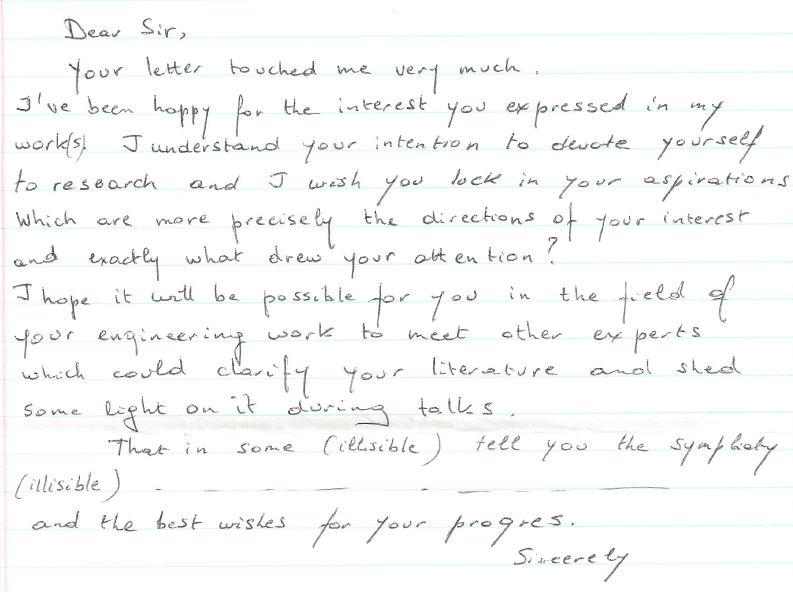
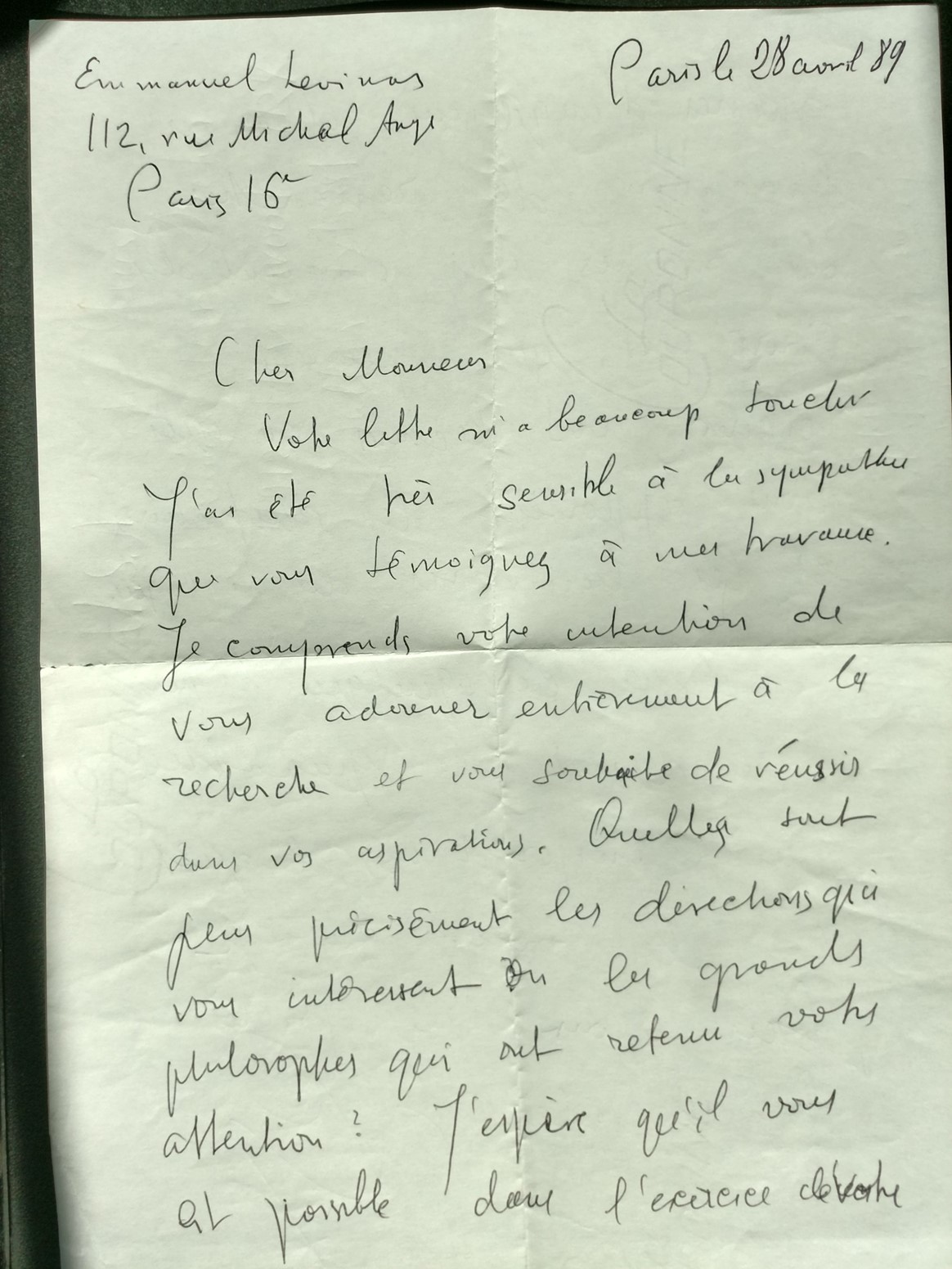
A Letter I Received in 1989 from Emmanuel Levinas

In 1989 I wrote Levinas telling him how much I loved his work. He wrote back with a very touching letter. This February I started a dialog with one of the foremost scholars on Levinas, Richard A. Cohen, to find out if an archive for Levinas’ writing existed. Apparently, there is no archive for scholars, but Professor Cohen suggested that he would be happy to be the caretaker of the letter. Professor Cohen is in the Department of Jewish Thought at the University at Buffalo in New York. On October 4th I sent Professor Cohen the original letter from Levinas, the original envelope from Levinas, my initial letter and the only translation I ever had from French to English of the letter. Some of Levinas’ handwriting is hard to read. I am hoping Dr. Cohen may be able to translate the letter more fully. If anyone can help with this translation I will add it to this post (please, text only in main body of email). I have attached photos of the original letter and envelope, my original letter to Levinas and the only translation I have so far. After I put this post together, I noticed something a bit odd – I originally sent my letter to Levinas on February 28th, 1989. Levinas replied on April 28th, 1989. Quite unintentionally, I first contacted Professor Cohen on February 28, 2018. Interesting…

Here is the only translation I have:

Here is a copy of the original letter in French, Page 1:

    Here is a copy of the original letter in French, Page 2:

Here is the front of the original envelope:

Here is the back of the envelope:

My Original Letter to Levinas – Page 1:

My Original Letter to Levinas – Page 2:

My Original Letter to Levinas – Page 3:

The Impossible Possibility of Paradox – Part One

The fundamental experience which objective experience itself
presupposes is the experience of the Other. It is experience par
excellence. As the idea of the Infinite goes beyond Cartesian
thought, so is the Other out of proportion with the power and
freedom of the I.1

In this discussion I would like to use a rather mundane notion in physics and geometry to try to nuance out what I think is an important difference in common modes of our understanding and orientation to reality. I would like to bring out an equivocation which is a confusion that covers over an essential difference into an abstract habit of thinking. This habit is derived from a dominate, historically conditioned, leveling over of radical breaks in our notions of what ‘is’. The ancient Greeks did not have the modern ‘luxury’ of this imposed abstraction in reflecting on what ‘is’. More to the point, they had the notion of phusis2 which embodied the ancient, archaic notion of ‘growth’ also found in other ancient cultures. In this sense ‘growth’ ranged from what Heidegger phrased ‘what shows itself’ and in my estimation the radical rupture of alterity which imposes necessity from other than its showing. ‘Growth’ in this sense is encounter and exteriority. This approach will try to use some quite rudimentary assumptions in science to tease out these philosophical underpinnings.

In geometry there is the abstract notion of a point. The question which brings existential import to a point (i.e., what ‘is’ a point?), is non-sensical. A point does not exist. We may say that it is infinitesimally small. Perhaps we could say that it has no dimension, zero dimensional. A specific case of a point could be a singularity. From what physicists tell us about a black hole we must concede that it ‘is’ a point in its most extreme form. Physicists are very confident that black holes exist and that they result in a singularity, a radical tear in time-space, an infinitesimally small point. As such, the singularity is a mathematical impossibility. Philosophically, we would say that a black hole is a mathematical contradiction; it is necessarily false. However, let’s notice the shift we have just announced.

We started suggesting that a point is an abstract mathematical concept does not exist empirically; it has no dimension. Zero dimensionality is not conceivable. And yet, we seem to have empirical evidence that a point can exist in a black hole. We may defer this contradiction as a lack of knowledge to be resolved in an unknown, unforeseen, moment in the future. As such, we acknowledge that we must currently leave this matter as a paradox3. Such a point is an argument to ignorance and only defers the immediacy of an answer which now faces us in this discussion. The argument to ignorance does not provide resolution only gives permission to ignore a persistent question.

Let us note that we have attributed qualities to the ‘point’ as “infinitesimally small” and as highly certain that it empirically exists in a black hole. We cannot resolve these conflicting notions in the light of rationality. They must remain ‘infinitely’ recoiled in upon themselves without coming into the light as aufheben (i.e., without being “lifted up”, ” abolished”, “canceled”, “suspended”, or “sublated”). This infinite impossibility can only be preserved in its inability to be able to transcend or exceed itself. It remains as an obligation we cannot refuse in its stark, declarative unmediated, absolute self-contradicted specificity. However, we can ignore it altogether and the direct question it essentially poses to the ‘light’ of knowledge.

In this case ‘light’ is taken hold of by the Latin notion of ratio which was the interpretation of the ancient Greek word logos. Specifically for this treatise, in terms of Heraclitus’ refinement as ‘giving account’, as ‘justice’ and ‘recompense’. ‘Light’ in this sense is the field of sight where idea is nudged towards resolve, towards answer and accountability. Dialectic can only exist in this clearing, this region already ready for an answer. In this sense, idea remains in itself; it encloses itself as Truth. Sight lays hold of its object without referring to abstractions; it simply sees. Therefore, by ‘light’ I mean the Idea as remaining within itself. In analogous terms of physical science, such a notion as Idea remaining in itself might be referred to as an isolated system – no interaction with matter or energy outside of itself. In Hegelian terms we might even venture further that anything ‘outside’ of Idea is still Idea and therefore an absolute impossibility except as yet another idea. It forever must get re-appropriated into the isolation of its Truth.

Additionally, note here that falsity also remains in itself as a deprived mode of Truth often erroneously taken as an opposite. Falsity always resolves itself essentially in contradistinction to Truth. Truth can only assert itself in its privation, its lack as error and thus, remain in itself. For example, light is only known through darkness, good is only known through bad, etc.. Only by the essential ‘not’ can Truth make its eternal claim. Truth remains in logos as an essential condition for sight, for logic to assert its priority in its isolation. Specifically, this condition we refer to as being or ontology as the essential pillar of language, the copula which founds all possibilities of writing. Ontology in this case is what sifts and retains identity from Hesiod’s random chaos (χάος4), what must and can only show itself in the clearing of light.

The notion of singularity, as a mathematical point, cannot be seen or conceived and yet ‘is’. Therefore this notion cannot remain within itself. When taken as ‘sight’ a singularity can only be pushed away from itself such that sight cannot contain or make sense of its object. In distinction to Truth, that which remains in itself as the march of being, we have an absolute paradox which somehow still retains the yawning gap of Hesiod, χάος5. This essential difference should not be lost in the notion of negation. Negation resolves and levels off this difference by virtue of what it negates. It implies a positive term which then must necessarily be what is negated. The difference I am trying to bring out is that lack of a positive term to negate. This paradox, simultaneously ‘is’ and ‘is not’ perhaps gleamed in the ancient Greek notion of chaos. The paradox cannot be contained on the ‘not’ of negation without doing an injustice. We must open the isolation of this logocentric system which only must remain in itself. With this in mind, lets reflect on what we might think of as qualities of an idea which cannot remain within itself but necessarily points to an unseen, essentially undiscoverable, externality.

Of the idea of infinity, Renes Descartes writes:

Nor should I imagine that I do not perceive the infinite by a true idea, but only by the negation of the finite, just as I perceive repose and darkness by the negation of movement and of light; for, on the contrary, I see that there is manifestly more reality in infinite substance than in finite, and therefore that in some way I have in me the notion of the infinite earlier then the finite6

Descartes recognized that the idea of infinity is very different from other ideas. While at times he thought of infinity in terms of negation he also thought of infinity as “manifestly more” and in some way “earlier”. The idea of infinity cannot be shown in the light of the idea of an object like a chair for example. To tease this out further, the idea of infinity cannot rest in itself but can only point away from itself without pointing to a thing, a positive term. The idea overflows itself without resolve, without regard to what it ‘is’.

Calculus is the mathematics of infinity. It can describe infinities in terms of ‘limits’ as infinity approaches a limit. It can describe infinities as ‘converging’ and ‘diverging’. Let’s take the function, ‘1/x’, where x goes from minus infinity to plus infinity (see chart below). You can see on the chart that from -1 to minus infinity the solution reaches a limit of zero. From -1 to just below zero the solution goes to minus infinity. Likewise, from 1 to infinity the solution reaches a limit of zero. From 1 to just above zero the solution goes to infinity. At zero 1/X is undefined.

Therefore, while we have not gained any insight into the notion of infinity, we have described qualities around the, ever exceeding itself, notion of infinity in certain circumstances. Likewise, while we cannot resolve the previously discussed dilemma of the geometrical point as an impossible singularity, we can point out certain behavior around that impossibility. This behavior nevertheless does not undo the Gordian Knot except by leveling it over with negation or ignoring it altogether. This paradox then weaves itself in the field of light without ever being consumed by the light.

From henceforth, we shall we refer to specific reductions such as the function ‘1/x’, converging and diverging on a limit of ‘1’ as providing a degree of diachronic ‘closure’ to the odd idea of infinity; that is, standing alongside the rupture of the idea of infinity without overtaking it. In this type of behavior infinity taken up in history and easily lost in negation and ignore-ance. Likewise, the abstract and inconceivable idea of the point as infinitesimally small, embodied in the impossible contradiction of a black hole, supplements the idea with an existential empiricism that adds a degree of semblance as closure. These further qualifications bring relevance to an inherit excess to the idea of infinity without covering over the radical rupture of the idea. Likewise, we shall refer to qualities which refuse resolution (such as zero dimensional, infinitesimally small, etc.) as moving towards an un-addressable exteriority which opens towards an unbridgeable tear in the interiority of ideas or self-enclosed-ness.

This openness does not open towards a Heideggerian kind of clearing but rather imposes itself in its absolute impossibility which cannot be denied. Interesting enough Heidegger writes:

“Death is the possibility of the absolute impossibility of Dasein [human being, the ‘there’ of being]. Thus death reveals itself as that possibility which is one’s ownmost, which is non-relational, and which is not to be outstripped”.7

In my estimation for example, the absolute impossibility of a point which cannot exist and yet must as a singularity does not belong to Dasein or even Being but to what Levinas refers to as otherwise than Being. The rupture I have spoken of is radical tear which cannot be resolved either in Being or Hegel’s Idea. It cannot be taken hold of but must always remain out of reach, without mediation, without relating in any way to one’s ownmost (which brings into question how death can be related to “one’s ownmost AND non-relational).

The tendency to closure of paradox may provide conditional qualities around which we can, in a limited fashion, provide some resolution around a logical impossibility without abolishing the necessary impossibility it enshrouds. To some extent openness provides us a specificity in the bare name such as the word ‘infinity’ which can be pragmatically useful in service to such qualities previously discussed but ultimately fail in their inability to find any complete closure within themselves with their sheer imposing impossibility. The tear in the fabric of rationality is not overtaken by rationality. It is not snuffed out by the forceful wish of dialectic and aufheben. Nor is it tamed by the totality of Being. For the early Greeks it remained as,

Tell me all of this, you Muses who have your homes on Olympus, from the beginning [archê, ἀρχῆς], tell who first of them (the gods) came-to-be [genet’, γένετ᾽].
First of all Chaos came-to-be [genet’, γένετ᾽]8

…for Levinas and the gift of Judaism, the provocation of the Other.


_________________

1 From “Signature”, an essay in:
“DIFFICULT FREEDOM”
Essays on Judaism
Emmanuel Levinas
Translated by Sean Hand
English translation published 1990 by
The Johns Hopkins University Press
2715 North Charles Street
Baltimore, Maryland 21218-4363
www.press.jhu.edu
Johns Hopkins Paperbacks edition, 1997
9 8 7 6 5 4 3

2 Ancient Greek

From φῠ́ω (phúō, “grow”) +‎ -σῐς (-sis).

Noun: φῠ́σῐς • (phúsis) f (genitive φῠ́σεως); third declension

See also φύσις in Liddell & Scott (1940) A Greek–English Lexicon, Oxford: Clarendon Press

3 paradox – a seemingly absurd or self-contradictory statement or proposition that when investigated or explained may prove to be well founded or true

4 Philosophy Series 4 – The Pre-Socratics – Hesiod

5 Philosophy Series 4 – The Pre-Socratics – Hesiod

6 Renes Descartes, “Meditations on First Philosophy”, Third Meditation

7 Martin Heidegger, “Being and Time”, 53: 307

8 Hesiod, Theogony

The Triumph of Will in Donald Trump

The duplicity of the contemporaneous Republican Party has never been so apparent. On one hand, we see the public carrot of luring their base into ‘free market capitalism’. Aspirations of exorbitant wealth as evidenced in the lavish, luxury clad life of Donald Trump. On the other hand, the real engine of Republican ideology has been shown in the stick. Potency and virility show themselves in the cameo phrase “your fired”. Discussion and cooperation find its limit in the determinative declarative where indeterminacy gives way to sheer unrelenting power. Will overcomes contingency. Here, then, is the gravity which defines all possibility: autocracy.

Donald Trump symbolizes the sheer resolve of Nietzsche’s ‘of the past, I willed it thus’. In Trump, his devotees are freed from their daily tedious lives and vicariously share in the reward of an untethered affirmation of existence. As is always true of the heroic, pay no attention to the man behind the curtain. Never mind his inherited blue blood privileges, he is a business genius. Never mind making sense of his inherit verbal nonsense and contradiction, he is a “stable genius”. Never mind his ‘pussy grabbing’, ethnic posturing xenophobia, he is simply expressing boldly and freely his joyous reign in absolute freedom. The heroic of Nietzsche is reawakened in the existential brut-ness of aspirational phantasma. In Trump, finally, the damned are redeemed and ushered into virginal bliss.

There has never been a time that so clearly exemplifies the gospel of unabashed greed and tyranny. Trump sees friendship, allies and international cooperation as ‘weak’. He sees kleptocracy, dictatorship and authoritarianism as ‘strong’. It is not just Trump; Republicanism since Barry Goldwater has suckled its sweet milk at the nipples of ‘strong leadership’, patriarchal Reagan-ism, the jubilant triumph of ‘supply-side’ massaged, ‘free-market-capitalism’. The ‘good ol boy’ has been elevated to CEO and private ownership. Monopoly and market manipulation have found new owners in government regulation and corporatism. Thus, the burden of inefficiency has been replaced with the bureaucracy of federalism. In all of these subtleties the metaphysic of unhampered will has replaced collectivity, cooperation and even more, language.

Language no longer need be obligated to the oppressive lord of logic, rationality and facts. Facts are free whims and desires of power not symbols which point beyond their sheer signifier. Trump has said the most ludicrous babel which gets re-appropriated as mystic, untethered assertion. Assertion as asserted-ness in itself, sufficient from within, hermetically jubilant in self-same-ness. Identity is finally achieved in ‘nothing but’ tautologies where true is replaced by ‘is’. Sheer-isness is the eternal desire for godhood, released from mortal bonds, and ready to find its fascist moment in history.

The latest refinement of this from Republicanism is Donald Trump. His base has cleverly ascertained the implicit meaning of Republicanism since Goldwater. They are the fulfillment and completion of the promise of the triumph of will over merely-human and all the while they live on the hither side of the moat beside the castle as the grass grows under their feet.

Cory Gardner Votes With Trump 90% of the Time

Check it for yourself. Colorado needs to wake up and smell the coffee – Cory Gardner is as hard right as Trump and all the other clowns running the White House. His real passion which he overtly lies about is anti-abortion. Anti-abortion folks along with the Federalist Society have been organized, subversive and lying to the majority of Americans that have consistently, for decades, been pro-choice. These Trumpsters are the latest manifestation of the strong anti-democracy alliance on the right which finds itself aligned with the likes of Putin and his lynch men. If you are appalled you have not been paying attention. These elitists quit believing in practical democracy decades ago. Oh sure, they try to have the pretty face and the seemingly moderate words but the modern face of totalitarianism started decades ago when the Federalist Society organized a military styled coup against the precedence set by the Supreme Court on the Second Amendment. Not only were Americans duped in the 2016 election but they have been manipulated for decades now by the mainstream, right-wing media-Fox News. The right’s rotten core at the heart of American democracy favoring lies over facts to further their elitist ambitions has now become clearly evident since Helsinki.

Starting with Barry Goldwater and the John Birch Society the Republican Party has increasingly been running away from the cherished ideal as the “Party of Lincoln” towards angry and bitter epithets of disenfranchisement and the perceived loss of aspirational entitlements which has resulted in the resurgence of bigotry and delusional revisionist histories reinforced over and over again by the constant barrage of “fake news” by Fox News. Their giant philosophical “NO” long ago replaced any abhorrence to slavery with the “cultural icons of the pre-Civil war South” and “voter ID” as a thinly veiled pretense given succinctly by: Jonah “Goldberg
has suggested giving new voters the same citizenship test—featuring questions about U.S. history and government—that new citizens must take. “We might get fewer voters, but the voters would be far more likely to appreciate the solemnity of their ballots,” he wrote.
(
The conservative case to limit voting
) Lincoln would be surprised to find the resurgence of Jim Crow laws in the presidential Party that went to war over slavery. When some Republicans finally wake up and realize that their Party died after decades of elitist and authoritarian power grabs based on intentionally manipulated deep rooted resentments which prey on the most selfish and despicable roots of humanity (that also motivated fascism after the German loss of World War 1 and the Versailles Treaty), will the damage be beyond reparation for our once thriving democracy? Right now, the dead weight on our democracy appears overwhelming.

The stunning silence of the Republican Party and Cory Gardner is only the most ugly moment of a movement which has been gaining momentum for decades. Please do not get me wrong, I really wish there was a viable “Party of Lincoln”. While logical and reasonable, fact-based arguments are hard to come by in Conservatism these days we really need that from the right more than ever. However, the paranoid hollow gust of wind-blown rhetoric from cadavers of rotting apoplectic and unabated narcissism is all politicians like Cory Gardner can deliver albeit on a bed of sweet smelling roses.

Just take a look at the 90% voting record with the Trump-King of a megalomaniacal Narcissus as all the proof you will ever need that Colorado can no longer tolerate the “beauty” of Cory Gardner.

Narcissus

In Greek mythology, Narcissus was a hunter from Thespiae in Boeotia who was known for his beauty. He was the son of the river god Cephissus and nymph Liriope. He was proud, in that he disdained those who loved him. Nemesis noticed this behavior and attracted Narcissus to a pool, where he saw his own reflection in the water and fell in love with it, not realizing it was merely an image. Unable to leave the beauty of his reflection, Narcissus lost his will to live. He stared at his reflection until he died. Narcissus is the origin of the term narcissism, a fixation with oneself and one’s physical appearance or public perception.


PS – Cory, Please do not send me yet another ridiculously worded form response which formally finds its way to the trash bin.

Are Liberals Fascists or the Opportunity for Fascism to Flourish? You Decide…

There has been a lot of pure garbage on the net about liberals being fascists of the Nazi variety. People who espouse this nonsense probably took their cues from a very conservative journalist, Jonah Goldberg, in a book called “Liberal Fascism”. Jonah was a journalist for the National Review, originally started by William F. Buckley. Buckley had a show for many years I watched on PBS called, “Firing Line”. Although, I disagreed with many of his arguments based on logical fallacies, I did appreciate a show where arguments could be developed more fully and both sides could get a fair hearing. Buckley died in 2008, the same year Goldberg published “Liberal Fascism”. The book was not written in the style set by Buckley but was very fanciful to the point of not only not giving the history of German fascism a well-researched treatment but to the point where the vast majority of scholars which research that time period in Germany, thought of it as purely fabricated and an intentional gross revision of history. Professor Paul Bookbinder writes this about the liberals and conservatives of this time in Germany:

The parties on the left were strong supporters of progressive taxation, government social welfare programs, labor unions, equality and economic opportunity for women. They were less nationalistic, militaristic and antisemitic than the parties on the right. They favored greater government involvement in—and control of—business and industry and were to varying degrees anti-religious. Still, there were strong differences and major conflicts between the two major leftist parties. The Social Democrats were strong supporters of the Republic and democracy while the Communists were opposed to both, favoring a Russian style communist dictatorship. The parties on the right were strongly nationalistic and supported large military. They were opposed to social welfare programs, labor unions and progressive taxation. They favored an economy directed by industrialists and landowners with large estates. They were antisemitic and favored traditional roles for women. The Nationalists were a more traditional Conservative Party, while the National Socialists were a radical party wanting revolutionary change. Both parties publicly supported the Churches and the role of religion in society but some elements in the Nazi Party harbored hostility to traditional religion.1

I highly recommend this essay on the political parties of that era. In any case, does this description remind you more of Democrats or Republicans? Please, do not get me wrong. I am not suggesting that all Republicans are fascists as that would be ludicrous. I am merely making the point that, historically speaking, the fascists had more in common with what we think of now as conservative ideology than liberal ideology. This directly contradicts Goldberg’s thesis. Those that parrot Goldberg’s fantasies on the web are quite content to ignore much evidence to the contrary. The real problem we are facing is that many on the web do not seem to believe there are facts that may or may not confirm their beliefs. They simply want to emote their beliefs without critical thought or challenge.

Personally, I find this to be a serious and deadly threat to democracy. Once we have a critical mass of people that could care less about any objective reality apart from themselves, we have achieved a fatal blow to democracy itself. Democracy cannot survive on baseless opinions. Democracies were fashioned in the critical kilns of Enlightenment which valued the ability of the individual to think critically and make more sound judgements. Once folks have lost the desire to research facts, they do not put the work into trying to base their opinions on established facts and well-reasoned logic. Additionally, they are susceptible to our highly sophisticated marketing culture which, over time, can reinforce thoughts and beliefs on many subjects combined with group and peer support.

Donald Trump is not a fact-based person. He has contradicted himself and lied so much that the only apparent reason he has for it is manipulation. He, along with Fox News (started by a gossip rag publisher) have effectively created a cult of true believers. Facts mean absolutely nothing to these folks. There have been indictments and guilty pleas which every responsible citizen should read. The bulk of these travesties are yet to come out in the Mueller investigation but there is no doubt, based on the vast wealth of information we now know, that Trump is guilty of obstruction (even Giuliani recently admitted Trump was guilty of obstruction and could be impeached unless they manipulate public opinion to his favor!). And this does not even start on collusion with the Russians. There are many in his campaign and current staff that had complicated business relations and political favors with the Russian government. Trump’s own son has stated that the Russians were very happy to fund his golf courses. How can 75% of Republicans, who in the recent past were highly suspect of the Russians, belittle this and write it off as all lies and Democratic manipulation of the FBI, CIA and, Trumps own high-level, appointments in the Justice Department?

It is obvious. For many years Fox News and politicians have fostered in their viewers the idea that the Federal Government is the source of all their problems. If the only authority which can be trusted is Fox News and far right politicians, then only they can be trusted to be the purveyors of truth. Facts? Research? Other views, simply written off. Hitler called this simply, “propaganda” – everyone should read “Mein Kampf” (translated “My Fight”) lest we repeat the past we forgot. Trump supporters want to physically fight journalists, gays, liberals, blacks, Hispanics, etc. but they consistently do not want to fight me with well-reasoned arguments. I am not a small guy. I have been lifting heavy weights for decades. Yet, I know that a physical fight will solve absolutely nothing. That sentiment would only serve to fester the instability of social cohesion. Even more so, a physical fight over issues of beliefs is a full and complete admonition that one cannot defend their position. It is an arrogant profession of ignorance. It is the mindless act of brute force over everything that brought us out of the caves. I prefer to either: 1) win an argument based on facts and research or 2) learn something I did not know before. However, I am no pushover. If you want to play with me you better be willing to do the same work I will do to get to the real facts of the issue. I have no need to ‘know everything’. I am quite content to profess ignorance and make my sole mission only to learn what I do not know. I know that both participants in a good argument are benefited by the facts and logic exercised in the process.

Why have I made these points? In Nazi Germany there were many conservatives and liberals that kept their mouth shut and allowed Hitler and his assassins to take charge of Germany when there was an opportunity to impact the horrific tragedies to come. I am of the firm opinion that we are starting down the road to the Third Reich2, albeit perhaps only the First Reich at this point. Do yourself a favor and look at the history of the Reich. All of us need to make a concerted effort to get to the facts and create logical consistency in our thinking. This is the most historically pressing need of our time. Those that will not or do not make a stand against what is happening are a fatal part of the problem. There certainly is a time when silence and withholding judgement are important – this is not that time. At some point those that know better and prefer appeasement and silence are just as culpable as the aggressors. If we let this current infection foster, our democracy will be its corpse. Please vote and let others know in no uncertain way that what Trump and his supporters are doing is not only wrong but highly dangerous!

_________________

1 Weimar Political Parties

2 Reich (/ ˈ r aɪ k /; German: (listen) is a German word literally meaning “realm”. The terms Kaiserreich (literally “realm of an emperor”) and Königreich (literally “realm of a king”) are used in German to refer to empires and kingdoms respectively.