Philosophy Series 6

Philosophy Series Contents (to be updated with each new installment)

Philosophy Series 1 – Prelude to the Philosophy Series

Philosophy Series 2 – Introduction

Philosophy Series 3 – Appendix A, Part 1

Philosophy Series 4 – The Pre-Socratics – Hesiod

Philosophy Series 5 – A Detour of Time

Philosophy Series 6 – The Origin

Philosophy Series 7 – Eros

Philosophy Series 8 – Thales

Philosophy Series 9 – An Interlude to Anaximander

Philosophy Series 10 – On the Way to Anaximander: Language and Proximity

Philosophy Series 11 – Aristotle and Modernity: The Eternal and Science

Philosophy Series 12 – Levinas and the Problem of Metaphysics

Philosophy Series 13 – On Origin

Philosophy Series 14 – George Orwell and Emmanuel Levinas Introspective: Socialism and the Other

————————————————

Philosophy Series 6

The Origin

To reiterate, here is what Hesiod tells us about the origin:

First of all Chaos came-to-be [genet’, γένετ᾽]; but then afterwards Broad-breasted earth, a secure dwelling place forever for all [the immortals who hold the peaks of snowy Olympus], and misty Tartara in the depths under the wide-wayed grounds and Eros who, handsomest among the deathless gods a looser of limbs, in all the gods and in all human beings overpowers in their breasts their intelligence and careful planning. And from Chaos came-to-be both Erebos [ρεβος, the god of deep darkness, shadow] and dark night, and from night, in turn, came-to-be both Aither [the god of upper air, the mist of bright, glowing light, home of the gods] and day, whom she conceived and bore after joining in love with Erebos. But earth first begat, as an equal to herself, starry sky, so that he might cover her on all sides, in order to be a secure dwelling place forever for all the blessed gods, and she begat the tall mountains, pleasing haunts of the goddess-nymphs who make their homes in the forested hills, and also she bore the barren main with its raging swell, the sea, all without any sweet act of love; but then next, having lain with sky, she bore deep-swirling ocean,1

This first is not born except in the covering over (the musing of the Muses) and doubling of the question which already assumes origin2 but differentiated as chaos, wide open, gap or perhaps fertile void (Śūnyatā in Buddhism) in indeterminateness. It is important to note that chaos is not the ontological difference of beings and Being. In the disjunction of “but then afterwards” the first, chaos, is further differentiated from differentiation without determinations to a radical other, differentiation with determinations. It would appear that in Hesiod, Greek beginnings do not begin in unities, God, matter (hulê, ὕλη), Being (from ὤν (ōn)), form, idea, creation but with chaos thought as gap, yawn (as wide open), void not spatial as difference but not yet differentiated into determinations as “Broad-breasted earth” (home, place, shelter, nurturer, foundation of all), “Tartara” (murky, undifferentiated, indeterminate), and Eros (in-between, middle voice, the middle of opposites or binary, desire, need, want). However, but then afterwards, the first as spoken in the covering over and doubling of the question (logos)…as the origin, the archê, is earth, Tartara and Eros. This doubling of chaos is perhaps Plato’s chora from the Timaeus3, the opening in which afterwards is earth, Tartara and Eros.

Hyland goes on to suggest:

Difficult as it may be to understand, however counter to our intuitions that if Chaos is a gap or separation it must somehow separate something, I suggest we should take Hesiod’s Greek in the passage under consideration to be indicating this truly remarkable thought: that Chaos, gap, separation, comes before, is prior to, any pairings that it might subsequently separate. Difference precedes and is the condition for sameness or identity. The “between” somehow precedes the binaries that it distinguishes. At work in Hesiod’s words, I suggest, is a thought that goes deeper than the argument over which are the first two entities that in fact get separated and distinguished by Chaos-earth and sky, or earth and Tartaros. At work, in addition, is the crucial if very difficult ontological principle that difference somehow precedes sameness or identity.4

I would go further to suggest that the “difference” may be pre-ontological. A few years later in Greek thought differentiation without determinations came to be thought by Anaximander as apeiron (ἄπειρον) 5, translated as indefinite or infinite. Anaximander was also the first in ancient Greek thinking to think of the unity of opposites or the ‘sameness’ or ‘identity’ in opposites. It might be said that Anaximander was the first to think identity in difference. Apeiron has been thought as the alpha-privative of peirar (πεῖραρ) or in the Ionic Greek form peras6 which is translated end, limit or boundary. In this case, the alpha-privative, ‘a‘, makes apeiron without end, limit or boundary. There is also some discussion that apeiron may be related to the alpha-privative of perao7 (“to experience,” “to apperceive”) which would make it without experience or perceptive understanding. In our most reliable fragment of Anaximander found in three separate sources necessity [could we say necessity of determinations] was a kind of injustice which required penalty or retribution. The most simple determination of apeiron as an alpha-privative is that apeiron is opposite of peras or perao. Some scholars have suggested that in Anaximander, apeiron generates and destroys opposites perhaps in a similar generative and destructive way which may have predicted what later Latin thinkers extolled theistically as “from him and through him and to him are all things”8. In this sense, end, limit and boundary was from apeiron, through apeiron, and to apeiron. Aristotle makes some comments that indicate a sort of generation/destruction idea of apeiron but Kirk and Raven9 have issues with some of these sources and with the idea that Aristotle was specifically referring to Anaximander as he did not name Anaximander in these fragments. In more recent scholarship10 the notion of generation and destruction in the most reliable fragment is thought to have been added in later by the Neo-Platonist, Simplicius. If this is true, the notion of origin may not be a part of Anaximander’s intention in this fragment. The question which emerges from this is, is apeiron the opposite of peras or peraoor is apeiron the source or origin of limit, boundary or experience or is apeiron more like the gap of Hesiod’s chaos? This will be discussed in more detail a little later but for now let’s take note of what Aristotle had to say about apeiron.

Everything has an origin [archê] or is an origin. The Boundless [apeiron] has no origin. For then it would have a limit. Moreover, it is both unborn and immortal, being a kind of origin. For that which has become has also, necessarily, an end, and there is a termination to every process of destruction. (Aristotle, Physics 203b6-10).

This passage indicates that Aristotle echoing the Muses and Anaximander could have understood the riddle, the conundrum, of apeiron. It appears he reasoned that apeiron “has no origin” and yet was a “kind of origin”. Could this difficulty be explained in terms of our discussion of chaos in Hesiod? Could it be that he might have thought this doubling of chaos as differentiation without specific determinations? Hegel certainly could not accept this contradiction.11 Additionally, if apeiron is itself an opposite (i.e., to end, limit or boundary) then it could not be the source (origin) or sink (destruction) of opposites. In latter Latin thinking apeiron came to have a more oppositional meaning to end, limit and boundary. We also have an early account of Anaximander by Diogenes Laertius which suggests that apeiron did not distinguish “air or water or anything else“.

Anaximander son of Praxiades, of Miletus: he said that the principle and element is the Indefinite, not distinguishing air or water or anything else… [Diogenes Laertius n, 1-2 (DKi2Ai])

We also have this account from Aristotle:

We cannot say that the apeiron has no effect, and the only effectiveness which we can ascribe to it is that of a principle. Everything is either a source or derived from a source. But there cannot be a source of the apeiron, for that would be a limit of it. Further, as it is a beginning, it is both uncreatable and indestructible. For there must be a point at which what has come to be reaches completion, and also a termination of all passing away. That is why, as we say, there is no principle of this, but it is this which is held to be the principle of other things, and to encompass all and to steer all, as those assert who do not recognize, alongside the infinite, other causes, such as Mind or Friendship. Further they identify it with the Divine, for it is ‘deathless and imperishable’ as Anaximander says, with the majority of the physicists. (Physics 3.4; 203b)12

These accounts tend to disqualify apeiron as origin (archê) or opposite. For Anaximander, in the most certain part of this surviving fragment, it could be that the necessity of determinations as an injustice requiring penalty13 would indicate an allusion to the chaos of Hesiod. It is interesting to note that in two of the three sources (see the forth coming section on Anaximander for more details) for this fragment tell us that Anaximander was the first to use the term origin or archê. In one account of this fragment it does write of apeiron as the cause of coming-to-be and destruction. However, both of these sections of the fragment are in doubt by Heidegger14 and Kirk and Raven15 as coming from Anaximander. In any case, an interesting question is, did Anaximander think of chaos as a kind of justice? Could it be that differentiation without determination [a-peiron] would exact a penalty for determinations, for “but then afterwards”?

It could be that for Anaximander chaos and apeiron may have had some early similarity in the sense of indeterminate and yet, differential. Both terms could be thought in a Greek sense as a covering over and doubling of origin. Certainly for Hesiod, chaos is thought more from the disjunctive, as “but then afterwards”. Additionally, there appears to be a disjunction in Anaximander’s thinking of apeiron at least in Aristotle’s thinking with how apeiron could give rise to archê. This original confusion could be a result of the Muses playful answer to Hesiod with does not or perhaps cannot answer the question of the first and chaos in a positive relational fashion except with a radical disjunction.

This notion of apeiron would appear to add another hint of an-archy, no origin, and bring it closer to Hesiod’s notion of chaos. The disjunction of chaos and differentiation from determination as origin in earth, Tartara and Eros may have well been at work in Anaximander’s notion of apeiron. This would mark a difference in the later thinking of apeiron as generative, as origin, or as an opposite. It could also explain how archê came to mean rule or authority in Latin much later. It may also mediate some of the mythological indignation that traditional scholarship has wanted to assign to the first Milesian philosophers. While the classic Greek era philosophers may have thrown off the poetic trappings of the mythological heroic era, they may have still been influenced by its theological concerns. I would note that this would not be unheard of for modern philosophers and their sometimes ambiguous relationship with Christianity.

It could well be that Hesiod and perhaps Anaximander are telling us of a radical disjunction, a gap other than distinctions of light and night, being and beings and neutrality and desire. It is important that earth, Tartara, Eros are not begotten, generative or originated by Chaos; there is no conjunction. The odd way in which Hesiod presents them grammatically in the text is first chaos as differential, a gap or void but not yet determined; only then afterwards earth, Tartara, Eros with no explicit or implied causality. Hesiod does not write, as he could have, that chaos was generative of earth, Tartara, Eros. The only relation given is temporal as ‘then afterwards’ but not causal. Chaos does not give birth to earth, Tartara, Eros but first chaos and then afterwards earth, Tartara, Eros. If “the first” is meant as irony and jest of the Muses given the question posed in the Theogony then the temporal meaning of ‘then afterwards’ could also indicate the doubling of this first irony. This could indicate further the radical break of chaos and determination. If the question can only be answered by covering over what cannot be said, perhaps cannot be thought, except by poetic musings the temporal allusion may be more an indication of disruption or quality as kairos rather than a causal, sequential answer to cosmogony.

Xenophanes would remind us of earth and Tartara that “The upper limit of earth borders on air. The lower limit reaches down to the unlimited. [i.e. the apeiron]”.16 Let’s also remember that earth, Tartara and Eros are dwelling (sheltering, abode, home, lime, boundary), darkness (night, indeterminate, unseen) and desire (the in-between, what Plato tells us of Eros discussed in the next section). Classic scholarship would tell us that, “Strictly speaking, mythical time is timeless, but its sequential flow can articulate qualitative relationships and ontological distinctions”.17 Therefore, the temporal relationship given by “but then afterwards” may not indicate some kind of pre-existing temporality but rather it marks difference and establishes a primacy. It may be that chaos gets mythologized, taken up, origin-alized or storied in metaphor as earth, Tartara, Eros. Let’s remember that earth gives place or dwelling, Tartara as underneath earth is murky and dark but also undergirds earth and Eros is in-between, incessantly the middle. Eros is desire because Eros is not one or the other but hovers in the midst as some indeterminacy between binaries and opposites. Eros then as desire, would be the necessary condition for polemos (Πόλεμος; “war”) or conflict and strife.

In 414 BC, Aristophanes tells us that

At the beginning there was only Chaos, Night (Nyx), Darkness (Erebus), and the Abyss (Tartarus). Earth, the Air and Heaven had no existence. Firstly, blackwinged Night laid a germless egg in the bosom of the infinite deeps of Darkness, and from this, after the revolution of long ages, sprang the graceful Love (Eros) with his glittering golden wings, swift as the whirlwinds of the tempest. He mated in the deep Abyss with dark Chaos, winged like himself, and thus hatched forth our race, which was the first to see the light.18

In Aristophanes account, a ” blackwinged Night (Nyx) laid a germless egg” in the “bosom of the infinite [apeiron] deeps of Darkness (Erebus)” and “after the revolution of long ages, sprang the graceful Love” Eros. Our genesis, “hatched forth”, is from Eros who mated “in the deep Abyss with dark Chaos”. According to Aristophanes, our origin is strife (polemos) as chaos, “deep Abyss with dark Chaos” and desire, Eros; not in idea (eidos) or Concept (bergriff).

Philosophy Series 7 – Eros

_________________

1 Hesiod, “Theogony”, Translated by Drew A. Hyland; “First of All Came Chaos”, Heidegger and the Greeks: Interpretive Essays (Studies in Continental Thought) (p. 9). Kindle Edition; For text see Link, Hes. Th. 115 to 135;

2 Doubling is a concept developed by Jacques Derrida. Without getting too technical, think of meaning, transcendental significance which gives place and origin to humans (thus what Derrida calls “transcendental arche”), as ideas, beliefs and values which keep us from falling into a neutralizing emptiness, as Levinas would suggest il y a, the ‘there is’. The necessity for meaning is a command that we must respond to perhaps without ever really thinking about it as a command. In Derrida’s language the requirement for meaning is a restricted economy. An economy measures, judges and appropriates to achieve its goals. This command comes from an other; the other being absolute meaninglessness, the neutralization of all transcendental significance, absolute nihilism. This retreat from the neutral ‘there is’, relegated to our unconscious, shows a more general economy. The general economy is based on repeatable symbols, graphemes or phonemes which are written or spoken fragments of language, signs which can only and always point to other signs and can be reassembled and repeated (iterated) in a myriad of ways. The way a computer processes computer language might illustrate a system of signs which only refer to other signs without any such meaning and significance that humans must find in language and thought, from a restricted economy of these signs. The more general economy is relegated to a trace from the perspective of our restricted economy, the irrevocable commandment for transcendental significance. However, the trace of difference (Derrida names as ‘differance’) always keeps us from hermetically (and hermeneutically) isolating ourselves within our own transcendental ‘metaphysics’. The trace of differance plays at the margins of our restricted economies. Derrida makes this comment in Of Grammatology (see link) about the transcendental metaphysics of origin (archê):

What I call the erasure of concepts ought to mark the places of that future meditation. For example, the value of the transcendental arche [archie] must make its necessity felt before letting itself be erased. The concept of arche-trace must comply with both that necessity and that erasure. It is in fact contradictory and not acceptable within the logic of identity. The trace is not only the disappearance of origin — within the discourse that we sustain and according to the path that we follow it means that the origin did not even disappear, that it was never constituted except reciprocally by a non-origin, the trace, which thus becomes the origin of the origin. From then on, to wrench the concept of the trace from the classical scheme, which would derive it from a presence or from an originary non-trace and which would make of it an empirical mark, one must indeed speak of an originary trace or arche-trace. Yet we know that that concept destroys its name and that, if all begins with the trace, there is above all no originary trace.

This means that in the search for transcendental origin, we can understand that origin, from our restricted economy, is driven not from some absolute origin but from a general economy of signs, signifiers and signified. If transcendental origin was absolute there would not be any difference which would make us aware of any such thing as origin. Only in the face of absence, of our undoing, does transcendental origin come up as an object of concern. Only because underlying origin is the trace of ‘no origin’, an-archy, are we compelled to need or require that ‘the first’, as Hesiod might tell us, is origin and not the incomprehensible gap of chaos (thus the ‘nonsensical’ musings of “First of all Chaos came-to-be”). In this sense differentiation without specific determinations could be thought as Derrida’s general economy. Any restricted economy will work to displace its other, the general economy that would interrupt, rupture, transcendental significance. Therefore in our attempt to master origin we become a slave to the commandment in the trace of ‘no origin’ (to use a Hegelian metaphor). To even think of ‘no origin’ our restricted economy requires us to think of ‘no origin’ as ‘underlying’, giving rise to origin, and therefore, make ‘no origin’ into another functioning origin. This is why he writes of the “arche-trace” which is an absolute impossibility (“there is above all no originary trace“) but also an absolute requirement from our restricted economies. Hence we get this peculiar writing, origin. To continue a little further with Of Grammatology:

The Living Present (lebendige Gegenwart) is the universal and absolute form of transcendental experience to which Husserl refers us. In the descriptions of the movements of temporalisation, all that does not torment the simplicity and the domination of that form seems to indicate to us how much transcendental phenomenology belongs to metaphysics. But that must come to terms with the forces of rupture. In the originary temporalisation and the movement of relationship with the outside, as Husserl actually describes them, nonpresentation or depresentation is as “originary” as presentation. That is why a thought of the trace can no more break with a transcendental phenomenology than be reduced to it. Here as elsewhere, to pose the problem in terms of choice, to oblige or to believe oneself obliged to answer it by a yes or no, to conceive of appurtenance as an allegiance or non-appurtenance as plain speaking, is to confuse very different levels, paths, and styles. In the deconstruction of the arche, one does not make a choice.

Therefore I admit the necessity of going through the concept of the arche-trace. How does that necessity direct us from the interior of the linguistic system? How does the path that leads from Saussure to Hjelmslev forbid us to avoid the originary trace?

In that its passage through form is a passage through the imprint. And the meaning of difference in general would be more accessible to us if the unity of that double passage appeared more clearly. [Of Grammatology, Jacques Derrida (1967), See Link]

The double passage is the inability to say “yes or no” to origin. There is no choice involved in a commandment. However, to face the impossibility of escape from our restricted economies of transcendental signified, to understand difference which plays outside our specific determinations of meaning is to gleam trace, the impossibility of the “arche-trace”, and its doubling in the restricted and general economy.

Another motif Derrida used was writing. Ordinary writing is what Derrida called the “vulgar concept of writing”. Derrida wants to get at a more fundamental dynamic of writing he calls “arche-writing”. In Of Grammatology Derrida lays out a case for how verbal speech, the ‘original natural’ language, required the presence of the speaker to come to its aid, to validate the veracity of the speech, to ‘sign’ and authenticate itself. Writing, on the other hand, displaced the intent of the speaker. Writing reproduces and allows iteration but without a conscious speaker present with the content. Writing serves as a kind of autonomous unconscious from conscious validation, conscious truth, and conscious meaning of the speaker. In this way the speaker serves as a restricted economy and writing as a general economy. Think of the general economy of writing more as signs, graphemes, which only and always refer to other signs, signifiers and signified. Writing plays at the margins of the text (consciousness). Writing is the ‘other’ of speech. It is speech without a speaker. Therefore, it is a double of speech. Since speech is the presence of the speaker, writing is the absence of the speaker, the absence of presence. In this way writing exceeds presence.

I would wish rather to suggest that the alleged derivativeness of writing, however real and massive, was possible only on one condition: that the original,” “natural,” etc. language had never existed, never been intact and untouched by writing, that it had itself always been a writing. An arche-writing whose necessity and new concept I wish to indicate and outline here; and which I continue to call writing only because it essentially communicates with the vulgar concept of writing. The latter could not have imposed itself historically except by the dissimulation of the arche-writing, by the desire for a speech displacing its other and its double and working to reduce its difference. If I persist in calling that difference writing, it is because, within the work of historical repression, writing was, by its situation, destined to signify the most formidable difference. It threatened the desire for the living speech from the closest proximity, it breached living speech from within and from the very beginning. And as we shall begin to see, difference cannot be thought without the trace. [Of Grammatology, Jacques Derrida (1967), See Link]

Speech, historically, has asserted its primacy over writing. It has wanted to show writing as an extension of the speaker, a faithful reproduction, a double that preserves the original intent. One need only look at the Bible to see how Christian history has tried to preserve the truth of the Bible only to unearth a vast plurality of widely varying interpretations. The conscious intent to preserve the presence of God in the Bible has historically been undermined at every step. Particular denominations have denounced ‘other’ interpretations. They have attempted to undermine the truth value of other interpretations. What is at work in this historical dynamic is the written word. The written word can no longer come to the aid of its speech. It cannot clarify and correct directly to the listener. Some Christians have even gone so far as to proclaim protection of the ‘word’ with the Holy Ghost. The Holy Ghost functions as the clarifier and corrector in the absence of the speaker. A consciousness, the consciousness of God, is present in the written word. Those who ‘hear’ the speaker, the Holy Ghost, will interpret the Bible correctly, according to orthodoxy, and those who cannot ‘hear’ the ‘voice’ of the Holy Spirit will fall into error and heresy. What shows itself here is that the written word is no longer guarded by the immediate presence of a flesh and blood speaker. Therefore, those vested in ‘true’ Christianity must continually supplement the unchecked dispersion of the written word to ensure that the ‘true’ meaning is conveyed by the spirit that haunts the book. It is precisely because the written word always exceeds the conscious intent of the spoken word that supplementation is constantly required. This excess functions as absence, as withdrawal, or perhaps as what the ancient Greeks thought as privation.

Perhaps some simpler ways to think about this is the historical notion of the monster. The monster is relegated to outside consciousness. The monster is horrible and inescapable. And yet, in Frankenstein, we have a human double. Frankenstein is on the edge of humankind. Frankenstein is a grotesque double of human life. It undoes humankind by playing at the edges of what is human. Frankenstein mimics (doubles) human kind but is other. This other is terror incarnate which faces us and threatens to extinguish us. The underside of presence is absence. What Frankenstein is cannot be spoken; it can only be feared.

The Gnostics of early Christianity were declared apostate and heretics by orthodoxy. They were outcasts historically in Christianity. Later, in the dark ages, apostates and heretics met with severe punishment and death. Witchcraft was considered the monster of early Christianity. It was relegated and functioned outside the restricted economy. It was the anti-Christian, the arche-trace, which refused the transcendence and metaphysics of ‘true’ meaning. And yet, orthodoxy’s alleged negation of Christianity, heretics, both validated orthodoxy from within its restricted economy and gave a face to the damned other, the other that failed to recognize the face of Christ. Therefore, the “arche-trace” functions as the double, the other and the excess of a restricted economy. This excess cannot be faced only re-appropriated as further confirmation of the restricted economy. Therefore, even though the archê (origin) of the trace is impossible as its absence can never be squelched into presence, it must be made to appear as present, as an origin, a monster, an apostate, a heretic to appease the necessity of determinations, of restricted economies, in the face of the other, the excess, the gap, the chaos, indeterminate difference which would undo it and, of necessity, require retribution for injustice.

3 John Sallis, Chorology: On Beginning in Plato’s Timaeus (Bloomington: Indiana University Press, 1999)

4 Drew A. Hyland; “First of All Came Chaos”, Heidegger and the Greeks: Interpretive Essays (p. 13). Kindle Edition, page 13

5 apeiron; see Link; also an interesting discussion here]

6 peras; See Link

7 ἀ-πείρων; See Link

8 Romans 11:36

9 THE PRESOCRATIC PHILOSOPHERS: A CRITICAL HISTORY WITH A SELECTION OF TEXTS, BY G. S. KIRK & J. E. RAVEN, PUBLTSHED BY THE SYNDICS OF THE CAMBRIDGE UNIVERSITY PRESS, Bentley House, 200 Euston Road, London, N.W., American Branch: 32 East 57th Street, New York , N.Y., CAMBRIDGE UNIVERSITY PRESS, 1957, page 110-120

10 Heidegger, The Anaximander Fragment, page 595, See link

11 See Link, Section 86

“When thinking is to begin, we have nothing but thought in its merest indeterminateness: for we cannot determine unless there is both one and another: and in the beginning there is yet no other.”[Hegel, The Logic]

Hegel thought it incomprehensible for differentiation without determination; for him “in the beginning there is yet no other”. Yet, the Muses tell us, “First of all Chaos came-to-be”. If chaos is taken as the gap, differentiation but without determinations we do indeed have otherness. The confusion, also echoed by the doubling of the question of the Theogony, is thinking the first, “the beginning”, the archê with the gap. The “transcendental arche” in Derrida’s words must necessarily think origin with determination. This “restricted economy” cannot think otherness, differentiation without “one and another”. Thinking differentiation without determination as the “arche-trace” which “…one must indeed speak of an originary trace or arche-trace. Yet we know that that concept destroys its name and that, if all begins with the trace, there is above all no originary trace” (see link).

Derrida quoting Bataille in Writing and Difference (see link), “From Restricted to General Economy A Hegelianism Without Reserve” states that Hegel should have “considered laughter first”. Hegel, as master of the Absolute, should have taken his own master/slave paradigm seriously. The master, the sovereign, cannot be such without giving up his to freedom to the slave, the dialect, the work. Thus the absolute Idea, the begriff, which starts from ‘the first’ and proceeds to the last, the Concept, never takes leave of its origin. As such otherness can only arise within the bounds of its triads, its negations and prohibitions. Nothing exceeds its movement. All is taken up and mastered by the dialectic. Its end, telos, can only be itself, it’s self-determining self. The progression can never exceed the movement of universal dialectic, of negation and Aufhebung. In the end, it must deny differentiation which fails its determinations and prohibitions, which fails to think Hesiod’s chaos as gap, as difference without determination, as “arche-trace” which plays and laughs at its Gordian knot that binds its ‘freedoms’ to its own self-determined chains. The other which cannot begin without “one and another”, without determinations, without its determinations cannot exceed its archê, its beginning, to find the trace of an other. Thus Hegel’s dialectic succeeds in binding itself to itself, prohibiting and prohibition preserve its enslavement. The master of the Absolute has become the slave to its transcendental signified…and, as Hegel himself predicted, but failed to see, the Notion of his own slavery.

The Hegelian Aufhebung is produced entirely from within discourse, from within the system or the work of signification. A determination is negated and conserved in another determination which reveals the truth of the former. From infinite indetermination one passes to infinite determination, and this transition, produced by the anxiety of the infinite, continuously links meaning up to itself. The Aufhebung is included within the circle of absolute knowledge, never exceeds its closure, never suspends the totality of discourse, work, meaning, law, etc. Since it never dispels the veiling form of absolute knowledge, even by maintaining this form, the Hegelian Aufhebung in all its parts belongs to what Bataille calls “the world of work,” that is, the world of the prohibition not perceived as such, in its totality. “And the human collectivity, in part devoted to work, is just as much defined by prohibitions, without which it would not have become the world of work that it essentially is” (L’erotisme). The Hegelian Aufhebung thus belongs to restricted economy, and is the form of the passage from one prohibition to another, the circulation of prohibitions, history as the truth of the prohibition.[Writing and Difference (see link), “From Restricted to General Economy A Hegelianism Without Reserve”]

12 See Link

13 Heidegger, The Anaximander Fragment, page 595, See link

14 Heidegger, The Anaximander Fragment, page 595, See link

15 THE PRESOCRATIC PHILOSOPHERS: A CRITICAL HISTORY WITH A SELECTION OF TEXTS, BY G. S. KIRK & J. E. RAVEN, PUBLTSHED BY THE SYNDICS OF THE CAMBRIDGE UNIVERSITY PRESS, Bentley House, 200 Euston Road, London, N.W., American Branch: 32 East 57th Street, New York , N.Y., CAMBRIDGE UNIVERSITY PRESS, 1957, page 105-108

16 DK 21 B 28

17 (Bussanich, 213); Drew A. Hyland;John Panteleimon Manoussakis. Heidegger and the Greeks: Interpretive Essays (p. 14). Kindle Edition.

18 Aristophanes, Birds, lines 690-699. (Translation by Eugene O’Neill, Jr., Perseus Digital Library; translation modified.)

Philosophy Series 5

Philosophy Series Contents (to be updated with each new installment)

Philosophy Series 1 – Prelude to the Philosophy Series

Philosophy Series 2 – Introduction

Philosophy Series 3 – Appendix A, Part 1

Philosophy Series 4 – The Pre-Socratics – Hesiod

Philosophy Series 5 – A Detour of Time

Philosophy Series 6 – The Origin

Philosophy Series 7 – Eros

Philosophy Series 8 – Thales

Philosophy Series 9 – An Interlude to Anaximander

Philosophy Series 10 – On the Way to Anaximander: Language and Proximity

Philosophy Series 11 – Aristotle and Modernity: The Eternal and Science

Philosophy Series 12 – Levinas and the Problem of Metaphysics

Philosophy Series 13 – On Origin

Philosophy Series 14 – George Orwell and Emmanuel Levinas Introspective: Socialism and the Other

————————————————

Philosophy Series 5

A Detour of Time

The continuation of Hesiod’s cosmogenesis cited here declares,

But afterwards she lay with Heaven and bore deep-swirling Oceanus, Coeus and Crius and Hyperion and Iapetus, Theia and Rhea, Themis and Mnemosyne and gold-crowned Phoebe and lovely Tethys. After them was born Cronos the wily, youngest and most terrible of her children, and he hated his lusty sire.1

In later Roman mythology Cronus erroneously became chronus (χρόνος2, time). In Hesiod, Cronus was a child of Earth and Sky. He was a Titan god. Hesiod described Cronus as “Crooked-counseled and terrible”. Cronus castrated his father, Sky and overthrew him. Cronus impregnated his sister Rhea and then ate all the children except one that Rhea hid, Zeus. The Romans associated Cronus with Saturn. Saturn was extremely popular with the Romans. In fact, the popularity lasts to the present day. The seventh day of the Judaeo-Christian week is in Latin, Dies Saturni (“Day of Saturn”) or Saturday. Virgil, a Roman poet, associated Cronus with a heroic king of Italy3. This association made Cronus a hero and not the detestable figure in Greek mythology. However, Ovid, another Roman poet, was primarily responsible for making Cronus (the Greek Titan) into chronus (time) in his book Metamorphoses. In Ovid’s Metamorphoses, Saturn reigns in the Golden Age which was marred by continual rebellion against the heavens. Ovid associates these upheavals with the beginning of change and becoming. This association was the beginning of the confusion between Cronus (Saturn) and chronus (time).

This ‘confusion’ or ‘forgetting’ is important as it assigns a false note to the historical opus of what ‘temporal’ means. Even more, it may be here that that chronus is canonized as a sequence or succession of ‘now’ moments which proceed from the past to the future. This is ‘clock’ time. Chronus came to mean quantity of time. However, the Greeks had another important concept of time, the fullness of time, kairos (καιρός). Kairos was quality as opposed to quantity. Kairos was the in-between-moments, the right time. It was time that gathers together, pulls in and ruptures the vulgar notion of time as chronus as Heidegger thought chronus. Kairos was not governed by ‘now’ moments. It could not ‘fit’ into a synchronous4 (sýnchronos, equivalent to syn- syn5– + chrón ( os ) time + –os6 adj. suffix) temporal scheme. “Chronos is that in which there is kairos and kairos is that in which there is little chronos [chronos esti en ho kairos kai kairos esti en to ou pollos chronos].”7 This is important because for the Homeric era, temporality was not thought in terms of a neutral, generic grid of sequential ‘now’ moments. Quantity did not hold sway over quality. Moments were not equal in ‘essence’ but had quality, the supreme moment. Kairos gathered in time but did not possess it. It was a ‘between’ time that was not this moment or the last moment or the next moment. Hesiod’s chaos had the quality of kairos. It was not eternal.

The ancient Greeks did not even have a concept of ‘eternity’. Eternity, as we think it, was a later Latin, Christian, extension of chronus. If chronus, which came to be thought as a neutral, grid (the common idea of physical time), never ends the Christian notion of eternity would result. Walter Brogan explains the notion of eternity here:

Aidion is often translated as the eternal or eternity-aeternitas. But the notion of the eternal as opposed to the temporal is a later development of Christian thinking. The literal meaning of the Latin aeternitas is not “atemporal,” but “to return always,” and in this way to be everlasting. The Greek word aidion comes from aei and dios. Dios is a word used by Homer to mean the noblest. Thus, it is the word for Zeus, as well as a word for men and women of excellence and of noble nations. It is also used to depict the powers of nature. It means that which is divine-like. Aei means throughout time. Aidion means that which holds itself through time in the presence of the divine and thus is. The aei is the enduring of a being that maintains itself in its “isness.” Thus, Heidegger says: “And aei means not only `without stopping’ and `continuously,’ but primarily that which is presently there (das Jeweilige)-he who is ruling at the time (ho aei basi- leuon), not some sort of `eternal’ ruling”.8

Kairos could not be contained or possessed by a generic ‘now’ moment. It could not be held in presence. Kairos exceeded this notion in a similar fashion to the way Descartes thought the notion of infinity exceeded its concept. It may be that Hesiod thought the first, chaos, as kairos. In Hesiod’s other work, Works and Days, he writes what would later become a famous dictum: μέτρα φυλάσσεσθαι· καιρὸς [kairos] δ’ ἐπὶ πᾶσιν ἄριστος; Observe due measure: and best in all things is the right time (kairos) and right amount9. It would not make sense to Hesiod to think of what came before or after kairos. Our contemporary logic would inform us that there must be a before or after to Hesiod’s supreme cosmogonic time but that logic (logos) would not necessarily follow for Hesiod or the Muses. The Muses were full of play and gaiety. They basked in kairos as a child in play. The important thing to remember here is that the very first (protista) is not temporalized into a ‘now’ moment or even a-temporality (not temporal). The very first is the fullness of the supreme, in-between-moment, a quality not contained in neutrality either. I will note it here that kairos will become an interesting problem between Aristotle and the Sophists in later discussions.

Perhaps historically, kairos could speculatively be thought along the lines of Kant’s categorical understanding as a-priori. It is also spoken of in Christianity with regard to the fulfillment or redemption of time that occurred in Christ. The latter philosophical notions of the transcendental may also appropriate its temporality from kairos. For Heidegger10 and the ancient Greek skeptics the historical epoch (epoché, ἐποχή, epokhē, to hold back, suspension, cessation)11 or age (aon) is not a collection of ‘now’ moments but the quality of an era. Better yet, kairos could be thought along the lines of Heidegger’s notion of pre-cognition or pre-understanding which always, already ‘is’. Heidegger would refer to kairos as “the moment of vision” (augenblick, literally “glance of the eye”). Augenblick is the moment of decision. As such, it is conflict and strife (polemus). For Heidegger, augenblick is an event, Ereignis. Thomas Sheehan writes of Ereignis as:

In ordinary German Ereignis means “event,” but in Heidegger’s retrieval of the unsaid in Aristotle, it becomes a name for the structure of the ontological movement that enables all being-significant. Playing on the adjective eigen (“one’s own”), Heidegger comes up with the neologism Er-eignung: ontological movement as the process of being drawn into what is “one’s own”…12

Ereignis is the event that pulls (sways) or appropriates meaning or significance as the ‘there’ of Being. This ‘pulling forth’ is also a withdrawal, an expropriation, of logos or as Sheehan states it, ” a differentially structured semantic field is engendered and sustained, is appropriation-by-absence”.13 For Heidegger, Ereignis is not temporality or Being but an in-between which gives (es gibt) time and Being. Ereignis as event is not “simply an occurrence, but that which makes any occurrence possible”.14 The event is the ‘there is’ (il y a) and ‘it gives’ (es gibt) of time and Being. It is the da (there) of Being. This German idiom, es gibt, denotes a passive and an active voice albeit grammatically neutral.15 It literally means ‘it gives’ as active but the idiom connotes ‘there is’ as pasive. In ancient Greek and Latin there wasn’t a separate word for ‘it’.16 However, what is meant by ‘it’ in those languages was not as we understand ‘it’ but ranged in meaning from the irrelevant to the demonic (δαίμων, daimôn).17 For classical Greece the daimôn was not evil as later Latin thinkers envisioned it. In Socrates the daimôn was an oracle, wisdom from unknown otherness. Therefore, the notion of it was not a dead, neutral ‘thing’ but an indeterminate other. Moreover, with regard to es gibt, ancient Greek grammar has a middle voice. The middle voice does not exist in English, German or modern Greek. The middle voice indicates a simultaneous action on both subject and predicate. The middle voice is not forced into an acting or being acted upon but draws together the meanings of codetermined, mutual determination and active reciprocity. Ereignis is not an event that happens to a subject nor is Ereignis an ‘it’ as a thing. Ereignis is not neutral, already understood as mere ‘thingness’.

The abstract notion of ‘thingness’ which arises from the already understood, ontological, orientation to beings as separate and ultimately divisible ‘stuff’ we know as ‘thing’ comes from the equally abstract notion of temporality as a linear succession of ‘now’ moments. When temporality is pre-understood as equally chopped up packets of ‘now’ moments, the ‘stuff’ of time must also be abstractly considered as well as equal packets of matter (ὕλη, hyle) we think as ‘things’. For modernity, the self-evident, simple and superficial presentation of all stuff as things is a simple ‘given’ from an un-thought history; it is a practical component of everyday life which seems ludicrous to question. However, that is precisely what Heidegger and the ancient Greeks addressed in their thinking of being (ontos).18 From this abstract notion of ontos it is difficult to understand the ancient Greek notion of kairos. Heidegger shows how our everyday experience of being in the mode of instrumentality (i.e., our being with the hammer is such that the hammer disappears in use) counters the notion of being as present-at-hand (when the hammer breaks and becomes conspicuous as present-at-hand) which is also the mode of ‘thingness’ where we already understand beings as separate objects to be observed in their abstract presence and not in our participation with being. He also showed how lived time has a stretch which may slow as in the experience of boredom or anxiety and speed in moments of joy or exhilaration which counters the abstracted notion of time that thinks in terms of ‘clock time’ as linear ‘now’ moments.19 Likewise, when kairos as the fullness of the moment is thought in terms of a qualitative gathering of temporality, as holding sway for meaning and significance for beings, epochs and ages, it is difficult from a ‘common sense’, ‘intuitive’ point of view (vista) to concretely get past our historical abstractions of chronus. Perhaps some modern ways to begin to think this is with the birth of a child, the death of a mother, the end of communism or the ‘secularization’ of a religious world. Even what Heidegger calls being-towards-death is a moment that holds sway throughout our lives. These practical experiences of temporality as kairos was, in concrete ways, more practical for ancient Greek thinking of temporality than our modern notion of ‘clock time’. The question of what is really real, kairos or chronus was a question for ontos, being, ontology which concerned Aristotle in what the Latin mind thought as ‘metaphysics’.20 However, the ancient Greeks thought of these questions in terms of phusis; the question of physics as it appears, as idea, and as ‘being as such’ or ‘first cause’. It was difficult for the Latin mind, the Christian weltanschauung, to think of Hesiod’s chaos not as ‘eternal’, chronus existing from all time and through all time, but as kairos, the gathering together and holding sway, the fullness, completeness (telos) of moments which was not ‘a moment’ but the in-between of the moments of chronus. Temporality thought as kairos does depend on the abstract and quantized schema of linear ‘now’ moments proceeding from an infinite past to an infinite future but from concrete and practical qualities which determine (hold sway over) beings and being, civilizations and history, forms (peras) and indefinite (apeiron), origin (archê) and chaos.

Philosophy Series 6 – The Origin

_________________

1 See Link

2 See Link

3 Georgics 1.336; 2.406, 539; 3.93; and Aeneid6.794; 7.49; 8.319; 12.830

4 See Link

5 See Link

6 See Link

7 Giorgio Agamben, The Time That Remains: A Commentary on the Letter to the Romans, Trans. Patricia Daley (Stanford: Stanford U.P., 2005), page 68-9.

8 Walter A. Brogan. Heidegger And Aristotle: The Twofoldness Of Being (Kindle Locations 1035-1041). Kindle Edition.

9 Hesiod, Works and Days 694 ;Translation of the Works and Days are based on Evelyn-White 1929

10 Martin Heidegger, Time and Being, trans. by Joan Stambaugh (Harper and Row, 1972), page 9.

11 See Link

12 GESCHICHTLICHKEIT /EREIGNIS /KEHRE, Thomas Sheehan, Existentia (Meletai Sophias) [Budapest], XI, 3-4 (2001), 241-251. See Link (pdf page 10)

13 GESCHICHTLICHKEIT /EREIGNIS /KEHRE, Thomas Sheehan, Existentia (Meletai Sophias) [Budapest], XI, 3-4 (2001), 241-251. See enowning.blogspot.com/2011/02/thomas-sheehan-on-what-heidegger-means.html

14 Martin Heidegger, Time and Being, trans. by Joan Stambaugh (Harper and Row, 1972), page 19.

15 Neutrality is a concern that will be addressed in future discussions of Emmanuel Levinas. However, Heidegger should not quickly be read as denoting es gibt as neutral, a mere it, a thing. Much of his critique of the forgetting of Being since the Greeks is based on thinking of Being in the same type as a ‘thing’. We think we understand the being of a thing as an ‘object’ present-at-hand, something we look at in its pure presence. This understanding of Being as an object or a thing has dominated since the Greeks but Heidegger wants to show that there are other ways of experiencing being such as instrumentality, ready-at-hand, in which we experience the being of a thing such as a hammer in its disappearance in use. We are not looking at the hammer as an object present-at-hand lest we hit our finger. We are using the hammer to accomplish a goal but the hammer itself is not experienced as an object present to our vision. The notion of a hammer in use that is still present-at-hand in some abstract sense is not the concrete way we are experiencing the hammer while using it. Even more, Heidegger wants to make the claim that whenever we ‘see’ being, being retreats, withdraws such that the ‘truth’ of what we see or understand of being is conditioned more by its absence than its presence. Therefore, what we ‘see’ is always embroiled in semblance, appearance, a representation, that cannot capture Being per se. Being cannot be brought to presence even as idea – εἶδος (eidos – that which is seen, form, shape) and ἰδέα (idea – form) . There is always a ex- to being, an excess which cannot be accounted for or brought to light and presence. Therefore, neutrality in es gebt is not so much a neutral article as a referent to Being. It is a further question to ask if Being is third person, neutral or first or second person singular, I or you or plural, we or them. It would be natural to think Being as a kind of high order machine or mechanism but that would fail to understand Heidegger. On the other hand, there is a sense of a determination that Being is either a kind of thing or a kind of person, I (Nietzsche) or other (Levinas). This pathos of thought thinks after the universal. It is the thought that Being is either a type of person (he, she, I, thou, other person, etc.) or a not-person (a substance, thing, matter, mechanism, etc.).

This universal dilemma of one or the other, mutually exclusive, may be a false dilemma. As the ancient Greeks would remind us there is always a both-and or mixture that would constitute a third kind in every binary opposition. There is also a hypothetical, none-of-the-above in every binary opposition which may be thought as ‘abstract’ and not ‘concrete’, possible but not actual or even impossible but nevertheless, hangs on as a persistent ghost of sight. This then poses the question what to do of the ghost, the apparition, the phantasm? Is it mere ‘logic’ to dismiss such tangential nonsense? Has such ‘logic’ ever presented itself historically as the ‘violence of the text’? Has there ever been cases in human history where some people were ‘logically’ considered not-people, erasable, marginalized, deemed irrelevant, silenced, etc.? Are there cases where the canonical text created its own anti-thesis? It certainly seems that this is possible albeit not necessarily so. The tension created in the binary opposition of the person and the not-person is a tension that re-presents itself in idealism (Hegel), realism, positivism, pragmatism, structuralism, modernism and post-modernism (Derrida, Foucault). In both cases of the neutral OR the person, an exclusiveness must be endemic to the argument of the opposing case. It must be shown that one cannot be at the same time with the other. In the history of violence, ‘he’ and ‘she’ sit atop the authenticity of being and not-being is relegated to mere stuff, empty, devoid of qualifications which would evoke the ethical concerns for a ‘he’ or a ‘she’. The way non-human ‘animals’ can qualify for the pronoun ‘he’ or ‘she’ and yet hover closer historically to things than non-things is a clear case of how dialectic logic forces opposites but retain a ghost of an in-between, the uncanny, the phantasm. The in-between, the ghosts of our ‘logic’ face us in our day to day which defy our categorical ontologisms.

This kind of problem occupied much of Greek thinking. Is being one OR many? How can that which is also be that which is not? Can being and not-being be predicated of the same? Can being change or does it persist and endure? What is it that endures or changes such that we can still think it as being? How is movement possible if being is changeless? Aristotle’s answer, as we shall see, was more along the lines of both-and as the two-fold of being (see Walter A. Brogan. Heidegger And Aristotle: The Twofoldness Of Being). Post modernism similar to Marx points to phantasm in the world created by text and artifice which appear as being and what is not, permanence and temporal, human and not, logic and nonsense. Is there a commonality to all these approaches that squelches the Other as other? Levinas would pose the question, how is ethics understood? Are there ways in which the other can be leveled off and totalized into a system? Should we be attentive to this possibility? Is there a history of violence which draws upon components of sameness in every idea-ology, the logos of appearance? Do ideas encapsulate themselves in their own essences? Is the idea system closed or open? Can ideas only open up to other ideas, seeing to other sights, light to other illuminations OR can they point beyond themselves to another type or kind? One answer might be that ideas can only ‘see’ other ideas. If ideas can see ‘other’, wouldn’t that other be an idea? Otherwise, how can seeing see what it can’t see? This inquiry goes back to the same types of questions the ancient Greeks asked. How can being both be and not-be? How can Being be one or many? This is the problem Aristotle addressed in what we now call his work Metaphysics. It is also the direction of Levinas’ inquiry. It is in this tension that we will eventually discover what Jacques Derrida quoting James Joyce tells us, “Jewgreek is greekjew. Extremes meet”

Are we Greeks? Are we Jews? But who, we? Are we (not a chrono- logical, but a pre-logical question) first Jews or first Greeks? And does the strange dialogue between the Jew and the Greek, peace itself, have the form of the absolute, speculative logic of Hegel, the living logic which reconciles formal tautology and empirical heterology after having thought prophetic discourse in the preface to the Phenomenology of the Mind? Or, on the contrary, does this peace have the form of infinite separation and of the unthinkable, unsayable transcendence of the other? To what horizon of peace does the language which asks this question belong? From whence does it draw the energy of its question? Can it account for the historical coupling of Judaism and Hellenism? And what is the legitimacy, what is the meaning of the copula in this proposition from perhaps the most Hegelian of modern novelists: “Jewgreek is greekjew. Extremes meet”?[Writing and Difference, Violence and Metaphysics, ISBN 0-203-99178-8 Master e-book ISBN, page 192]

16 Martin Heidegger, Time and Being, trans. by Joan Stambaugh (Harper and Row, 1972), page 18.

17 Martin Heidegger, Time and Being, trans. by Joan Stambaugh (Harper and Row, 1972), page 18.

18 See this for a relatively easy introduction to Heidegger’s thoughts in Being and Time.

19 Modern physicists have long since disposed of such simple minded notions of time, Einstein comes to mind, but there are many other intriguing notions of temporality in modern physics which also address the ‘stretch’ of time even with regard to another modern notion – ‘subjectivity’, and its fuzzy relationship with ‘objective’ temporality.

20 See link

The word ‘metaphysics’ is notoriously hard to define. Twentieth-century coinages like ‘meta-language’ and ‘metaphilosophy’ encourage the impression that metaphysics is a study that somehow “goes beyond” physics, a study devoted to matters that transcend the mundane concerns of Newton and Einstein and Heisenberg. This impression is mistaken. The word ‘metaphysics’ is derived from a collective title of the fourteen books by Aristotle that we currently think of as making up “Aristotle’s Metaphysics.” Aristotle himself did not know the word. (He had four names for the branch of philosophy that is the subject-matter of Metaphysics: ‘first philosophy’, ‘first science’, ‘wisdom’, and ‘theology’.) At least one hundred years after Aristotle’s death, an editor of his works (in all probability, Andronicus of Rhodes) entitled those fourteen books “Ta meta ta phusika”—”the after the physicals” or “the ones after the physical ones”—, the “physical ones” being the books contained in what we now call Aristotle’s Physics. The title was probably meant to warn students of Aristotle’s philosophy that they should attempt Metaphysics only after they had mastered “the physical ones,” the books about nature or the natural world—that is to say, about change, for change is the defining feature of the natural world.

This is the probable meaning of the title because Metaphysics is about things that do not change. In one place, Aristotle identifies the subject-matter of first philosophy as “being as such,” and, in another, as “first causes.” It is a nice—and vexed—question what the connection between these two definitions is. Perhaps this is the answer: The unchanging first causes have nothing but being in common with the mutable things they cause—like us and the objects of our experience, they are, and there the resemblance ceases

 The Greek plural noun-phrase ‘ta meta ta phusika‘ became in Medieval Latin the singular noun ‘metaphysica‘—much as the Greek plural ‘ta biblia‘ (‘the books’) became the Latin singular ‘biblia‘ (‘the bible’). The word was used both as a title for Aristotle’s book (now thought of as a single entity) and as the name of the “science” that was its subject-matter. The word for ‘metaphysics’ in every modern European language (‘la métaphysique‘, ‘die Metaphysik‘, ‘la metafisica‘…) is an adaptation of the Latin word to the orthographic and phonetic requirements of that language. This is true even of the non-Indo-European languages (like Finnish and Hungarian) that are spoken in Europe. Works written in some non-European languages, however, use words constructed from native materials both to translate the European word ‘metaphysics’ and to refer to writings in their own philosophical traditions whose subject-matter is similar to the subject-matter of Western metaphysics. For example, the Chinese phrase that is the customary translation of ‘metaphysics’ is an allusion to a statement in the I Ching: “that which is above matter is the Tao”; the phrase can be literally translated as ‘[that which is above matter]-ology’, the final word of the phrase being a “discipline marker” that performs much the same function as the English suffix ‘-ology’. The word that is the usual Arabic translation of ‘metaphysics’ means ‘the science of divine things’. Unlike the Chinese phrase and the Arabic word, however, the European words derived from ‘metaphysica‘ carry no internal indications of their meaning. (The word has, as we have seen, an etymology, but as is so often the case, etymology is no guide to meaning.) It is uncontroversial that these words all mean exactly what ‘metaphysics’ means in English—or, less parochially, that all the European words derived from ‘metaphysica‘ mean exactly the same thing..

Philosophy Series 4

Philosophy Series Contents (to be updated with each new installment)

Philosophy Series 1 – Prelude to the Philosophy Series

Philosophy Series 2 – Introduction

Philosophy Series 3 – Appendix A, Part 1

Philosophy Series 4 – The Pre-Socratics – Hesiod

Philosophy Series 5 – A Detour of Time

Philosophy Series 6 – The Origin

Philosophy Series 7 – Eros

Philosophy Series 8 – Thales

Philosophy Series 9 – An Interlude to Anaximander

Philosophy Series 10 – On the Way to Anaximander: Language and Proximity

Philosophy Series 11 – Aristotle and Modernity: The Eternal and Science

Philosophy Series 12 – Levinas and the Problem of Metaphysics

Philosophy Series 13 – On Origin

Philosophy Series 14 – George Orwell and Emmanuel Levinas Introspective: Socialism and the Other

————————————————

Philosophy Series 4

The Pre-Socratics1

Hesiod

Theogony 105-133

χαίρετε, τέκνα Διός, δότε δ᾽ ἱμερόεσσαν ἀοιδήν.
κλείετε δ᾽ ἀθανάτων ἱερὸν γένος αἰὲν ἐόντων,
οἳ Γῆς τ᾽ ἐξεγένοντο καὶ Οὐρανοῦ ἀστερόεντος,
Νυκτός τε δνοφερῆς, οὕς θ᾽ ἁλμυρὸς ἔτρεφε Πόντος.
εἴπατε δ᾽, ὡς τὰ πρῶτα θεοὶ καὶ γαῖα γένοντο
καὶ ποταμοὶ καὶ πόντος ἀπείριτος, οἴδματι θυίων,
ἄστρα τε λαμπετόωντα καὶ οὐρανὸς εὐρὺς ὕπερθεν
οἵ τ᾽ ἐκ τῶν ἐγένοντο θεοί, δωτῆρες ἐάων
ὥς τ᾽ ἄφενος δάσσαντο καὶ ὡς τιμὰς διέλοντο
ἠδὲ καὶ ὡς τὰ πρῶτα πολύπτυχον ἔσχον Ὄλυμπον.
ταῦτά μοι ἔσπετε Μοῦσαι, Ὀλύμπια δώματ᾽ ἔχουσαι
ἐξ ἀρχῆς, καὶ εἴπαθ᾽, ὅ τι πρῶτον γένετ᾽ αὐτῶν.
ἦ τοι μὲν πρώτιστα Χάος γένετ᾽, αὐτὰρ ἔπειτα
Γαῖ᾽ εὐρύστερνος, πάντων ἕδος ἀσφαλὲς αἰεὶ
ἀθανάτων, οἳ ἔχουσι κάρη νιφόεντος Ὀλύμπου,
Τάρταρά τ᾽ ἠερόεντα μυχῷ χθονὸς εὐρυοδείης,
ἠδ᾽ Ἔρος, ὃς κάλλιστος ἐν ἀθανάτοισι θεοῖσι,
λυσιμελής, πάντων δὲ θεῶν πάντων τ᾽ ἀνθρώπων
δάμναται ἐν στήθεσσι νόον καὶ ἐπίφρονα βουλήν.
ἐκ Χάεος δ᾽ Ἔρεβός τε μέλαινά τε Νὺξ ἐγένοντο:
Νυκτὸς δ᾽ αὖτ᾽ Αἰθήρ τε καὶ Ἡμέρη ἐξεγένοντο,
οὓς τέκε κυσαμένη Ἐρέβει φιλότητι μιγεῖσα.
Γαῖα δέ τοι πρῶτον μὲν ἐγείνατο ἶσον ἑαυτῇ
Οὐρανὸν ἀστερόενθ᾽, ἵνα μιν περὶ πάντα καλύπτοι,
ὄφρ᾽ εἴη μακάρεσσι θεοῖς ἕδος ἀσφαλὲς αἰεί.
γείνατο δ᾽ Οὔρεα μακρά, θεῶν χαρίεντας ἐναύλους,
Νυμφέων, αἳ ναίουσιν ἀν᾽ οὔρεα βησσήεντα.
ἣ δὲ καὶ ἀτρύγετον πέλαγος τέκεν, οἴδματι θυῖον,
Πόντον, ἄτερ φιλότητος ἐφιμέρου: αὐτὰρ ἔπειτα
Οὐρανῷ εὐνηθεῖσα τέκ᾽ Ὠκεανὸν βαθυδίνην2

Hail, children of Zeus! Grant lovely song and celebrate the holy race of the deathless gods who are for ever, those that were born of Earth and starry Heaven and gloomy Night and them that briny Sea did rear. Tell how at the first gods and earth came to be, and rivers, and the boundless sea with its raging swell, and the gleaming stars, and the wide heaven above, and the gods who were born of them, givers of good things, and how they divided their wealth, and how they shared their honors amongst them, and also how at the first they took many-folded Olympus3. Tell me all of this, you Muses who have your homes on Olympus, from the beginning [archê, ἀρχῆς], tell who first of them (the gods) came-to-be [genet’, γένετ᾽].

First of all Chaos came-to-be [genet’, γένετ᾽]; but then afterwards Broad-breasted earth, a secure dwelling place forever for all [the immortals who hold the peaks of snowy Olympus], and misty Tartara in the depths under the wide-wayed grounds and Eros who, handsomest among the deathless gods a looser of limbs, in all the gods and in all human beings overpowers in their breasts their intelligence and careful planning. And from Chaos came-to-be both Erebos [ρεβος, the god of deep darkness, shadow] and dark night, and from night, in turn, came-to-be both Aither [the god of upper air, the mist of bright, glowing light, home of the gods] and day, whom she conceived and bore after joining in love with Erebos. But earth first begat, as an equal to herself, starry sky, so that he might cover her on all sides, in order to be a secure dwelling place forever for all the blessed gods, and she begat the tall mountains, pleasing haunts of the goddess-nymphs who make their homes in the forested hills, and also she bore the barren main with its raging swell, the sea, all without any sweet act of love; but then next, having lain with sky, she bore deep-swirling ocean”4

This is the beginning of the Hesiod’s Theogony, the birth of the gods, the an-archic, origin of origins, written around 700 BC, more than 2700 years ago. Hesiod was a poet and a contemporary of Homer. The Theogony was probably influenced by Hittite and Babylonian cultural trade influences which were known to have happened a few centuries earlier.5 The Theogony was an early and important influence on latter Greek thinking. The traditional understanding of chaos is that it is the separation of the earth and sky. Cornford6 and Kirk and Raven7 understood the cosmogonic, mythopoeic Theogony as another telling of the Babylonian8 and Hebrew9 cosmogony with regard to the separation of earth and sky.10 Both of those cosmogonic accounts refer to a separation of the earth and sky at the beginning of creation. The Babylonian and Hebrew accounts start with a propositional statement of assertion, apophantis, about cosmogenesis (i.e., In the beginning God created the heaven the earth). However, the Theogony starts with Hesiod’s interrogative, the openness of his question to the Muses.

Hesiod asks a question of the Muses. The Muses are female goddesses. They are the birth, origin and keepers of art and knowledge.11 Hesiod asks which of the gods was the first that “came-to-be”. A conundrum is embedded in Hesiod’s question. Namely, how can the first come to be? The Muses were fond of play and gaiety. As such, they reply in kind to Hesiod that “truly” and “verily” the first, Chaos, came-to-be. In the very first reply to Hesiod, the ‘truth’ is at play in the Muses. The Muses here are speaking as one even though there are nine Muses. Even in this, there is already play of the ‘one and the many’, harmony and cacophony, the doubling of the signature12. What is more, Hesiod’s question preconditions the answer given by the ‘one and the many’ Muses. Hesiod asks, “from the beginning [archê, ἀρχῆς], tell who first of them (the gods) came-to-be [genet’, γένετ᾽]”?

Let’s take a closer look at the Muses reply to Hesiod…

First of all Chaos came-to-be

ή τοι μεν πρώτιστα Χάος γένετ’;

Etoi men protista Xaos genet’;

The gist of the words is:

ἤτοι – now surely, truly, verily13
μέν – indeed, of a truth14
πρώτιστα – the very first15
χάος – chaos, gap, yawn (as wide open), void16
γένετ’ – come into a new state of being17

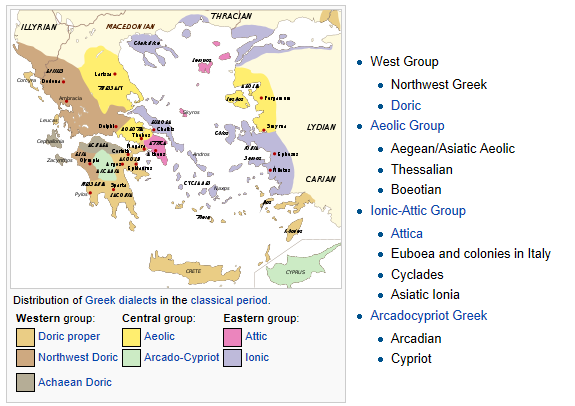
‘The very first’, πρώτιστα (protista), comes from the Doric-Aeolic dialects of ancient Greece. It was also used in Hesiod’s era known as the Poetic or Homeric. The Aeolic dialect is more archaic than the Attic-Ionic dialect used by later Greek philosophers. Just as we have many words in English that come from older languages, the language of ancient Greece also comes from older languages and a confluence of dialects (for a more detailed discussion of ancient Greek dialects and philosophers see Appendix A, Part 1). Πρώτιστα (protista) here is an adjective, singular, feminine and nominative18 of protistos, the very first, superlative of protos, first. It is where we get ‘proto’ as in prototype.

Chaos (χάος) is the Greek word χάος. It is not confusion, un-differentiation or an unbounded space or place.19 It is a gap, yawn, breach, separation or void. As such, it implies radical differentiation. However, it is not space as later philosophers thought it to be. Kirk and Raven made the case that chaos as space, water, or disorder was not Hesiod’s idea but a later notion in Greek philosophy.

Three interpretations may be rejected immediately: (i) Aristotle (Phys. I, 208 b 29) took it to mean space. But this concept is much later than the Theogony, occurring first, probably, in Pythagoras, then more clearly in Zeno of Elea, and most clearly in Plato’s Timaeus. (ii) The Stoics followed Zeno of Citium (e.g. SVF I 103), who perhaps took the idea from Pherecydes of Syros (DK 7BIa), in deriving xaos from χέεσθαι and therefore interpreting it as what is poured, i.e. water. (iii) The common modern sense of chaos as disorder can be seen e.g. in Lucian Amores 32, where Hesiod’s xaos is interpreted as disordered, shapeless matter. This, again, may be Stoic in origin.20

Yένετ’ (genet’) is a verb, 3rd person, singular, middle voice used from the early Homeric and Ionic eras. The middle voice is not in modern Greek or modern languages. It denotes a mutual and simultaneous reciprocity of the subject acting on and being acted upon by something or someone. The middle voice only survives in a few languages other than ancient Greek such as Albanian, Bengali, Fula, Tamil, Sanskrit, Icelandic and Swedish. In this case γένετ’ denotes chaos acted on being and chaos was acted upon by being in the phrase ‘came to be’. Yένετ’ comes from γίγνομαι – come into a new state of being21 – γένετ’ is also used in γενετικός (genetikos), “genitive” and that from γένεσις (genesis, “origin, source, beginning, nativity, generation, production, creation”), from γίγνεσθαι second aor. γενέσθαι (“to be produced, become, be”).22 Note: This is also were we get our modern day word ‘genetics’. Yένετ’ and archê will become important concepts for ancient Greek philosophers a short time later (this will be discussed more later in the series).

The Muses tell us that being does not arise from ‘the one’ or from an unchanging, unmoved singularity as in monism nor even from a plurality. Being or ‘isness’ refuses consolidation, summation, absolute closure as given in some metaphysical ‘One’ or some synthesis of being and non-being (or nothingness). The Muses tell us that the gap, radical differentiation came to, acted on, ‘isness’ and that the gap, radical differentiation came upon, was acted upon, by ‘isness’. One important consequence of this is that at the beginning of the ancient Greek quest for phusis, for being, radical differentiation requires otherness first for being. Likewise, otherness is acted upon by being. However, the action upon otherness is a retreat; it is not an equivocal reciprocity which reduces to the same. It is not some kind of Hegelian ‘lifting up’ of the abstractions of being and nothing (aufhebung) into becoming and thus, concrete determinacy from abstraction.23 This effect on otherness of being is privation, a withdrawal which eludes presence, form and idea. This notion of privation is key to understanding the struggle (polemus, strife, war) at work inside ancient Greek thinkers. Becoming is given by differentiation and radical otherness which cannot be brought fully to presence. Otherness is accentuated24 and highlighted by being in its absence, both abstractly and concretely, in theory (θεωρία) and practice (πρᾶξις), in seeing and acting in its relentless refusal of being.25

The Muses, in notably un-myth like language, do not declare a god as the first. Instead, in one voice they playfully undue their unison by first directly answering Hesiod’s question that chaos was first. The unity of the Muse’s voice is undone in their answer of the first, the primal lack of unity and presence. Chaos in this case is given as differentiation without prerequisite. The gap, separation, breach or void begs the question – between what? What does chaos hold open or serve as a gap? For traditional scholarship, the answer is earth and sky. However, the noted scholar Mitchell Miller points out:

What is it, however, that the coming-into-being of Chaos differentiates from what? It is clear that one side of the gap is ‘broad-breasted earth’, which comes to be ‘next’, immediately after Chaos. What is the other side? Cornford’s response is to look outside the text, on the one hand to cosmogonic myth in a host of archaic cultures, on the other hand to sixth and fifth century Greek poetry. In the latter, in particular in Ibycus, Bacchylides, and Aristophanes, he finds uses of xãow to refer to the space between the upper sky and the ground, the space through which birds fly. In the former, especially in Hebrew and Babylonian myth, he finds stories of the formation of the world through an original separation of earth and sky. And so he proposes that the coming-into-being of Chaos is the separation of earth and sky.6 Does the text support this possibility? Cornford finds both corroboration and apparent resistance. Self-evident corroboration, he thinks, is offered by line 700, where, he asserts without argument, xãow ‘denotes the gap or void space between sky and earth’. But the text, he recognizes, appears to resist his interpretation at lines 126-127 [in the Greek text cited above]: there, only a few lines after telling of the coming-into-being of Chaos, Hesiod tells how ‘earth first bore…starry sky’. If, as he presumes, Chaos is ‘the gap separating heaven and earth’ and it ‘has already come-into-being’, there should be no need for earth to go on to beget sky; that begetting ‘duplicates’ the coming-into-being of sky that must have already occurred with the coming-into-being of Chaos.26

Chaos is a differentiation but of what? No typical poetic trope is given by the Muses in their direct answer. The Muses state plainly that the very first was chaos. Then, with deference to the question they add to “First of all Chaos” with “came-to-be”, genet’. Hesiod is asking for the first, how it came-to-be (genet’), and they tell him chaos but with the same supplement in Hesiod’s question, genet’. The wisdom of this statement is along the lines of “First of all Chaos”. How can chaos come-to-be if it was first? Isn’t this a contradiction? Contradiction would not bother a Muse. However, what would bother a Muse is mere contradiction; so boring. Instead, a deeper thread, a secret meaning was always more fun for a Muse. Perhaps, what they were implying is not only what was first, what had no prior origin or birth, but what ‘come-to-be’ is. ‘Come-to-be’ is becoming. Becoming must always come from difference. Difference ‘first’ allows the possibility for determinateness. The possibility for determinateness is the gap, the opening, which makes becoming possible. Instead of the one and many voices of the Muses giving one answer to Hesiod, they give him two in one…now that is more like a Muse. The Muses are not contradicting themselves or giving an infinite regression but giving Hesiod the answer he wants and more. The answer has exceeded the expectation of the question as it MUST since the question marks a limit to what an answer should be (i.e., does ‘what was the first’ ask for a chicken or an egg and how would the answer ever decide the question?). Instead of a declaratory, apophantic, answer, the Muses transcend the limits of the question with a double answer which the Muses testify to as “now surely, truly, verily” “indeed, of a truth”. Additionally, according to Miller27, Hesiod had no way, given the tools of his mythopoeic language, to think the ‘first’ without a coming-to-be. Additionally, the lapse of the mythopoeic style in this one phrase was not a necessary lapse. Hesiod could have written this in a form more true to the overall style of the poem but he didn’t. This can either be ignored as an omission of Hesiod (or an addition of someone else) or intentional and a mark of an emphasis of some type. Even today, when a song or poetic interlude is stated directly and plainly, without the trappings of the current style, it is meant to bring atypical attention to what is stated.

Could it be that the very first, the beginning (archê) Hesiod asks for, is always incomplete, determinate but without specific determinations to come-to-be…to came-to-be…to evoke chora (khora or chora; χώρα, clearing, opening);28 the evocation gestured in the written supplement – “but then afterwards” (αὐτὰρ ἔπειτα; autar epeita). Autar epeita first gives later, the temporal (sorge), the chora of becoming (genet’)? The gaping void requires, necessitates, determines, place (chora), generation (origin), birth, response (the evocative) and temporality. The chaos differentiates but without anything to differentiate, the opening of difference is broken on the disjunctive, “but then afterwards” (αὐτὰρ ἔπειτα; autar epeita). Drew Hyland makes this remark about autar epeita:

With the autar epeita, Hesiod emphasizes the very separation from the subsequent comings-to-be of earth, Tartaros, and eros. Autar, according to Liddell and Scott, means “but, besides, moreover” and is employed “to introduce a contrast.” Epeita, in turn, means, again quoting Liddell and Scott, “when in strong opposition to the former act or state, with past tenses, `thereafter, afterwards.””‘ Since autar establishes precisely such a contrast with the preceding, I have altered Miller’s translation slightly to try to bring out that contrast; hence my “but then afterwards …” rather than Miller’s less strong “then next.” My point, then, is that not only does Hesiod say “First of all Chaos came-to-be”; with the emphatic autar epeita he clearly distinguishes the coming-to-be of Chaos from what comes afterwards: earth, Tartaros, eros, and then gradually the rest of the articulated cosmos.29

Autar epeita is not generative. Earth, Tartara and Eros are not born from chaos. If the Muses meant ‘born’ they could have used a form of genet’ or γόνος (gonos; that which is born, begotten, child, offspring). The “strong opposition” Hyland writes of does not join what follows but demarcates, refuses the cause and effect of progeny, with what follows. Hesiod’s chaos is not-yet temporal. Temporality begins for the Muses with autar epeita not as later Latin history suggested with Cronus.

It is important that in one of the most important accounts at the dawn of ancient Greek philosophy, how being came to be was answered by the jesting Muses in a rare directness, a full moment (kairos), as radical disjuncture, as chaos. Before logos (where we get our word logic) we find the question of origin, of beginning, is anarchy (an-archê, ἀν-αρχία; no origin). Anarchy founds origin from the impossibility of origin. Origin must generate (gene) being in the absolute void of chaos, the gap. ‘Coming to be’ is not completed in logos but left open by chaos. Ancient Greek philosophy must ever after be read from the riddle of origin. Origin must be said from logos which, in its fullest moment, undoes and erases itself as chaos, an unbridgeable gap. Only in this unsettled and unresolved footing does ancient Greek philosophy acquire its richness and dislodge itself from final closure. In this way, being is held open as existence. Phusis is not closed off by some reductive, anthropomorphic mythos but becoming is first opened by chaos, a radical alterity, a gap generative of inquiry, of logos. History and temporality find their start in “but then afterwards” from the face of what undoes it not from some absolute but from groundless suspension over the void (as Heidegger might suggest). Anarchy is not evasion from rule and domination as Latin later postulated and forever embodied it in the metaphysic of individuality, but in the suspension of finality or origin. Existence is never complete. Completion or fulfillment (telos) can never be final because origin can only cover over its chaotic lack. Existence cannot resolve itself as idea (eidos, the form or appearance of things); not even as ‘it’. The notion of phusis as ‘it’, as third person neuter, can only supplement an unsolvable riddle, a Gordian knot, which can only untie itself by tying another knot. The Idea can only be, always and already, a “but then afterwards” which fills the gap, the yawning gap that must withdraw from sight and appearance. In this riddle, play of the Muses, ancient Greek thought attained astounding depth and richness which both posed and opened the question of appearance and being, phusis and ‘beings as such’ or ‘first cause’ (arche) later in the Latin era called metaphysics.30 The priority of metaphysics for Aristotle was a priority of ontos–ology (the logos or study of being) over idea and appearance. Idea must forever be inchoate in origin and finality, perhaps shadows thrown on cave walls from Forms which can only dance over the void, eternally supplementing themselves from desire, Eros, the in-between of mortal and immortal; this radical otherness which cannot take the Form of a modern ‘it’ nor even an idea (the appearance of) of chaos but can only face us in the other. The good beyond being, the disjunction of the primacy of ontology and the impossibility of the never ending supplementation of the Idea can only ‘be’ in the face of the other which has no origin or completion in our gaze and yet, cannot be ignored.

Philosophy Series 5 – A Detour of Time

_________________

1 The series on the Pre-Socratics relies heavily on THE PRESOCRATIC PHILOSOPHERS: A CRITICAL HISTORY WITH A SELECTION OF TEXTS, BY G. S. KIRK & J. E. RAVEN, PUBLTSHED BY THE SYNDICS OF THE CAMBRIDGE UNIVERSITY PRESS, Bentley House, 200 Euston Road, London, N.W., American Branch: 32 East 57th Street, New York , N.Y., CAMBRIDGE UNIVERSITY PRESS, 1957 and Heidegger And Aristotle: The Twofoldness Of Being, Walter A. Brogan, Kindle Edition and Heidegger and the Greeks: Interpretive Essays, First of all Came Chaos, Drew A. Hyland, Kindle Edition.

2 See Link

3 See Link

4 Hesiod, “Theogony”, Translated by Drew A. Hyland; “First of All Came Chaos”, Heidegger and the Greeks: Interpretive Essays (Studies in Continental Thought) (p. 9). Kindle Edition; For text see Link, Hes. Th. 115 to 135;

5 See Robin Lane Fox’s Travelling Heroes and Walcot’s Hesiod and the Near East

6 The Unwritten Philosophy and Other Essays (Cambridge: Cambridge University Press, 1950), later reformulated in Principium Sapientiae: The Origins of Greek Philosophic Thought (Gloucester, Mass.: Peter Smith, 1971)

7 G. S. Kirk and J. E. Raven, The Presocratic Philosophers: A Critical History with a Selection of Texts (Cambridge: Cambridge University Press, 1957). Restated and reaffirmed in Kirk, Raven, and Schofield, The Presocratic Philosophers: A Critical History with a Selection of Texts, 2nd ed. (Cambridge: Cambridge University Press, 1983)

8 See Link

9 See Link

10 G. S. Kirk and J. E. Raven, The Presocratic Philosophers: A Critical History with a Selection of Texts (Cambridge: Cambridge University Press, 1957)., Section “SEPARATION IN NON-GREEK SOURCES”, page 33-34

11 See Link

12 John Sallis, Chorology: On Beginning in Plato’s Timaeus (Bloomington: Indiana University Press, 1999), see the Prologue; Also Jacques Derrida, “Signature Event Context,” Limited Inc, trans. Samuel Weber and Jeffrey Mehlman (Evanston, Il: Northwestern University Press, 1988)

13 See Link

14 See Link

15 πρώτιστα – adj sg fem nom doric aeolic poetic – Link, πρώτιστ-ος, η, ον, also ος, ον h.Cer.157:—poet. and late Prose Sup. of πρῶτος,

A the very first, Il.2.228, 16.656, Od.19.447; πολὺ π. Il.2.702, Od.14.220, etc.; ὁ π. χρόνος, opp. ὁ ἐνεστώς, PEleph.10.4 (iii B.C.); principal, primal, θεὰ π. Νύξ Phld.Piet.14; αἰτία Procl.Inst. 12; τῶν φύσει κρειττόνων π. ὁ δημιουργός Hierocl. in CA3p.424M., cf. Iamb.Comm.Math.4, al., Dexipp.Fr.32(b)J., Agath.3.2: neut. πρώτιστον as Adv., first of all, Od.10.462, 20.60, al., Pi.N.5.25, B.8.11, Ar.Lys.555, D.43.75, Antiph.98: also pl. πρώτιστα Il.1.105, Od.3.419, Hes.Op.109, A.Fr.195, S.OT1439, El.669, Ar.Pl.792; ἐπειδὴ π. now that, Alc.15.7; ὅτε π. when aforetime, Call.Aet.Oxy.2079.21; especially, principally, π. ἁλίσκεται ἐνταῦθα τὸ ὄψον Str.12.3.19: also τὸ π. E.Supp.430; τὰ π. Od.11.168. –
Link

16 See Link

17 γένετ’ – verb, 3rd person, middle voice used from the early Homeric time. It comes from γίγνομαι – come into a new state of being (see Link) – γένετ’ is also used in γενετικός [genetikos], “genitive” and that from Ancient Greek γένεσις (genesis, “origin, source, beginning, nativity, generation, production, creation”), from γίγνεσθαι second aor. γενέσθαι (“to be produced, become, be”). Link, from Proto-Indo-European *ǵenh₁, Note: This is also were we get our modern day word ‘genetics’.

18 See Link for information on the Greek grammar.

19
‘First of all’: On the Semantics and Ethics of Hesiod’s Cosmogony, Mitchell Miller, Ancient Philosophy 21 (2001), Mathesis Publications, See Link (pdf)

20 G. S. Kirk and J. E. Raven, The Presocratic Philosophers: A Critical History with a Selection of Texts (Cambridge: Cambridge University Press, 1957)., Section ” 4. THE HESIODIC COSMOGONY, AND THE SEPARATION OF SKY AND EARTH”, page 26-27

21 See Link

22 See Link

23 Consider Hegel’s beginning in The Logic where he states: “Pure Being makes the beginning: because it is on the one hand pure thought, and on the other immediacy itself, simple and indeterminate; and the first beginning cannot be mediated by anything, or be further determined.” See Link, Section 86. This beginning is very different from the Hesiod’s beginning where pure ‘isness’ does not begin as indeterminate immediacy but contrarily ‘isness’ begins as differentiation, a gap, which begins as differentiated. The differentiation here is not yet mediated in Hesiod. Remember that in Hesiod’s cosmogony, meditation only starts after the phrase ‘but then afterwards”. Pure thought as idea (eidos) does not yet appear or take form in Hesiod’s ‘first’. Mediation does not lead to determinacy for Hesiod but determinacy leads to mediation. This is an important distinction which may have led the entire Hegelian genius astray. It certainly deserves consideration at a minimum as, if nothing else, an important difference in Hegelian wissenschaft and post modernism with thinkers such as Derrida and Levinas.

Consider this a little latter in the same section:

When thinking is to begin, we have nothing but thought in its merest indeterminateness: for we cannot determine unless there is both one and another: and in the beginning there is yet no other. The indeterminate, as we have it, is the blank we begin with, not a featurelessness reached by abstraction, not the elimination of all character, but the original featurelessness which precedes all definite character and is the very first of all. And this we call Being. It is not to be felt, or perceived by sense, or pictured in imagination: it is only and merely thought, and as such it forms the beginning. Essence also is indeterminate, but in another sense: it has traversed the process of mediation and contains implicit the determination it has absorbed.

In Hesiod’s beginning there isn’t “the other” but otherness. Not long after Hesiod the struggle began to wrestle with precisely what Hegel is articulating. One answer the Eleatics came up with is that in Hegel’s words “we cannot determine unless there is both one and another”. Therefore, the Eleatics came up with ‘the One’. Hegel believes that they erred in naming this being, “they went too far”, When Hegel states, “The indeterminate, as we have it, is the blank we begin with, not a featurelessness reached by abstraction, not the elimination of all character, but the original featurelessness which precedes all definite character and is the very first of all. And this we call Being” he initially states that the indeterminate is not some “featurelessness reached by abstraction” but then goes on to tell us about “the original featurelessness which precedes all definite character and is the very first of all”. Wouldn’t this require that the “original featurelessness” has also been arrived at by featurelessness abstraction? Would it be sacrilege to suggest that at minimum the “original featurelessness” is made up of language and words which may hint a kind of yet another form of “featurelessness reached by abstraction”. This subtle circularity denies in order to reaffirm albeit more seductively. In any case, the logic of determination without one or another is certainly compelling and it is understandable how one might be lead from here to monism or immediacy. However, the inability of even the word ‘immediacy’ to divest itself of language and therefore mediacy and abstraction violently forces a conclusion which cannot be sustained by virtue of its own terms. Hegel’s immediacy can never be what it assumes something other than language and thereby escape the hermeneutical circularity of language. This impossibility should be preserved in thought not replaced with yet another supplement, a façade or appearance, which has the effect of relieving this absurdity (i.e., immediacy). In the Muse’s refusal to resolve chaos as first undifferentiated but instead differentiated without “both one and another” a questioned is opened which, depending on decision, can either be nonsense or some other (Latinized chaos as disorder or the Greek notion of gap).

24 …could we say with Kierkegaard accentuating passion to the infinite …

25 When determination is derived, it becomes dependent on its determinate whether it is ‘immediacy’, abstraction, etc. When determination is differentiation before ‘objects’, the notion of the other does not depend on derivation but upon, as Levinas might suggest, ‘Ethics’. Levinas might suggest borrowing from Plato’s ‘the good beyond being’ as the good otherwise than being (note the radical disjuncture).

26 ‘First of all’: On the Semantics and Ethics of Hesiod’s Cosmogony, Mitchell Miller, Ancient Philosophy 21 (2001), Mathesis Publications, page 5

27 “…what is remarkable is not that Hesiod says of Chaos that it genet[o], ‘came-to-be’ or, connotatively, ‘was born’; he has little choice. Rather, what is remarkable is that, in face of the assumption that what ‘comes-to-be’ must have a parent, he holds back from naming one and instead declares Chaos to have come-to-be ‘first’.” See Link (pdf, page 21-22)

28 John Sallis, Chorology: On Beginning in Plato’s Timaeus (Bloomington: Indiana University Press, 1999)

29 Drew A. Hyland; “First of All Came Chaos”, Heidegger and the Greeks: Interpretive Essays (p. 13). Kindle Edition, page 13

30 See Link

Philosophy Series 3 – Appendix A, Part 1

Philosophy Series Contents (to be updated with each new installment)

Philosophy Series 1 – Prelude to the Philosophy Series

Philosophy Series 2 – Introduction

Philosophy Series 3 – Appendix A, Part 1

Philosophy Series 4 – The Pre-Socratics – Hesiod

Philosophy Series 5 – A Detour of Time

Philosophy Series 6 – The Origin

Philosophy Series 7 – Eros

Philosophy Series 8 – Thales

Philosophy Series 9 – An Interlude to Anaximander

Philosophy Series 10 – On the Way to Anaximander: Language and Proximity

Philosophy Series 11 – Aristotle and Modernity: The Eternal and Science

Philosophy Series 12 – Levinas and the Problem of Metaphysics

Philosophy Series 13 – On Origin

Philosophy Series 14 – George Orwell and Emmanuel Levinas Introspective: Socialism and the Other

————————————————

Appendix A

(Note: This appendix was originally planned to be released in whole near the beginning of the first chapter. However, its size has grown too large to publish as one post. Additionally, it would probably be better to release sections of the appendix which correspond to subject matter in the chapter releases. Therefore, I have decided to release it piecemeal.)

Before the Greeks

Proto-Indo-European (PIE) is a common language that many scholars believe was spoken long before classical Greece, as early as 3,700 BC and possibly into upper paleolithic before the 10th century BC. The theory of PIE has been developed over several centuries. PIE is still a theory because it preceded writing. PIE was only oral. It was developed by a linguistic archeology (archē and logos) that links common grammatical and roots or stems of words in various ancient languages. Here is a chart of how PIE may have split into various languages.

Greek Philosophy and Periods

To start, these are generally accepted Greek histories, dialects and some pertinent facts:

Proto-Greek (c. 3000–1600 BC)

Ancient Greek and Vedic Sanskrit suggest that both Proto-Greek and Proto-Indo-Iranian were quite similar to later Proto-Indo-European (somewhere in the late 4th millennium BC)

Mycenaean (c. 1600–1100 BC)

Bronze age, Linear B, oral
tradition, the “heroic age” in Homer

Greek Dark Age (c. 1100-800 BC)

Dorian invasion to the first signs of the Greek
poleis, lack of discovered inscriptions, ends with use of vowels in writing with Phoenician
alphabet

Ancient Greek (c. 800–330 BC)
Dialects:
Aeolic, Arcadocypriot, Attic–Ionic,
Doric, Locrian, Pamphylian,
Homeric Greek,
Macedonian

archaic and classical period

Koine Greek (c. 330 BC–330)

Hellenistic period, the common dialect, translations include the Christian New Testament and the Septuagint

Homeric Greek (or epic or poetic Greek) is an early East Greek blending of Ionic and Aeolic features. Aeolic includes the Lesbian and the Thessalian and the Boeotian dialects.1 Ionic may go back to the 11th century BC while Aeolic may go back to the 14th century BC. Homeric Ionic is called ‘Old Ionic’. The later Ionic called ‘New Ionic’ used by many ancient philosophers started around the 6th century BC. Many of the well known ancient philosophers wrote in the Attic-Ionic dialect. The Aeolic dialect was more archaic than Attic-Ionic, Doric, Northwestern and Arcadocypriot. It was considered more barbaric than the Attic-Ionic used during the time of Plato.2

Around the 4th millennium BC, the complexity of trade and administration in Mesopotamia outgrew human memory, and writing became a more dependable method of recording and presenting transactions in a permanent form.

By definition, the modern practice of history begins with written records; evidence of human culture without writing is the realm of prehistory.3

Homer and his Iliad and Odyssey are said to be part of an oral tradition. Since the Iliad and Odyssey were written down, it should be emphasized that they came out of the earlier oral period. It is thought that the epics we know today are the result of generations of storytellers (a technical term for them is rhapsodes) passing on the material until finally, somehow, someone wrote it.

An epithet (Greek — επιθετον and Latin — epitheton; literally meaning ‘imposed’) is a descriptive word or phrase that has become a fixed formula.4

Homer and Hesiod wrote in a form of poetry that was rhythmic and rhymed. It was probably sung for many centuries orally before it was finally written down. The written form of Homer and Hesiod, when the poets were finally transcribed probably goes back to 750 to 600 BC.5 It could be thought as the earliest form of what we might call “rap” today. The oral tradition of their poetry may go back to 1400 BC or even earlier.6

Philosophers that wrote in Old Ionic were Heraclitus, Hecataeus and logographers, Herodotus, Democritus, and Hippocrates.

Attic Orators, Plato, Xenophon and Aristotle wrote in Attic proper, Thucydides in Old Attic, the dramatists in an artificial poetic language[8] while the Attic Comedy contains several vernacular elements.

Geography and Greek Dialects7


Greek Schools

Ancient Greek philosophy is widely varied and rich. It is problematic to accurately schematize the philosophers. There are cases where traditional scholarship includes a thinker in a school not because the philosophers had an abundance of ideas in common but because one was thought to be a student or influenced by the other. With this in mind, we can sketch out six main schools of ancient Greek philosophy: Milesian, Pythagorean, Eleatic, Pluralist, Atomist and Sophists and unaffiliated philosophers. These schools have some common threads in that they are all focused on what ‘is’ or what shows itself in nature or phusis. Heidegger maintains that phusis, the word we know as physics, was the original word the Greeks had for being.

In the age of the first and definitive unfolding of Western philosophy among the Greeks, when questioning about beings as such and as a whole received its true inception, beings were called phusis. This fundamental Greek word for beings is usually translated “nature.” We use the Latin translation natura which really means “to be born,” “birth.” But with this Latin translation, the originary content of the Greek word phusis is already thrust aside, the authentic philosophical naming force of the Greek word is destroyed… Now, what does the word phusis say? It says what emerges from itself (for example, the emergence, the blossoming, of a rose), the unfolding that opens itself up, the coming-into-appearance in such unfolding and holding itself and persisting in appearance–in short, the emerging-abiding sway… phuein [the noun form of phusis] means to grow, to make grow (Introduction to Metaphysics, 14-15).

It is interesting to note one of the Indo-European root words for being is associated with the etymological roots of the Greek word phusis:

Another Indo-European root is bhú or bheu. Out of this we get “be,” “been,” bin, and bist. Significantly, from this root also comes the Greek phuein (to grow, emerge) and phusis. The Greek term phainesthai is also derived from this root. This word means “show” or “display,” and “phenomenon” is derived from it.8

Julius Pokorny, a linguist, also believes that the Sanskrit word Brahman, a very important concept in Buddhism and Hinduism, also comes from the same Indo-European root (also see the root *bʰuH in the section, Being and “to be”, below).9

Early Greek philosophy was intensely focused on being and phusis with questions such as: is being and existence real or illusion, one or many, idea or substance (such as water or fire)? Many scholars think that the shift from Greek mythos to phusis is the beginning of philosophy. This shift becomes apparent with the Milesians and continues through the various Greek schools. Their concerns were focused on what shows itself in phenomena (from phainesthai). They were fully aware that what shows itself may not always be immediately apparent at all. It could also show itself as semblance, as what it is not (i.e., as Gods or already understood as a multiplicity of lifeless and separate things). They were also keenly aware that what shows itself is not simply a thing before us that we passively see. When we see phenomenon, phusis must retreat in the act of our seeing and observing. Phusis has a way of withdrawing in order to make it possible to see (long before Schrödinger’s cat10). Perception, thought and speech, the logos, requires a kind of dynamic privation, a retreat into the background of we might think as ‘context’ but the Greeks would think AS phusis. This is important as the difference demarcated by ‘context’ and phusis shows a historical difference which cannot easily be overcome. When thinking about these philosophers and schools modern reductions show early Greek thought as ‘primitive’ and ‘archaic’. However, these convenient castings obscure more than they reveal. They vastly restrict and miss important possibilities forged and virtually lost by these early thinkers. For some of these schools, a certain kind of preoccupation with all that ‘is’ leads to theories of all one or monism. For others, the problem this way of thinking leads to is, how can multiplicity and change be thought from the standpoint of sameness? Each of the schools had different ways of addressing these questions. What follows is a high level summary of these schools of thought.

This is a rough timeline and various schools of Greek philosophy.11

Milesian

Miletus was a city in Ionia, on the west coast of what is now Turkey. It was a trade route to the older cultures of Babylon, Egypt, Lydia and Phoenicia. The Milesian School which came from the region was the earliest school of ancient Greek philosophy. The Milesians were credited with bringing the first writing to Greece. Phoenicia was a name the Greeks gave to the Semitics that lived in the area of modern day Lebanon. The Semites were part of the older Canaanite culture. The Phoenicians were credited with bringing the first writing alphabet to the Greeks by Herodotus. However, Anaximander claimed that the Egyptians brought writing to Greece.12 It is now thought that writing arrived in Miletus around 750 BCE. In any case, writing began to take the place of hieroglyphics in many cultures long before the Greeks. The Phoenician alphabet was very similar to Hebrew at that time. The oral tradition went back well before writing arrived in Greece. The epic battles in Homer are thought to have occurred around the 13 century BC in the battle with Troy. Homer and Hesiod were recited verbally in hexameter by the rhapsodist.

[My comment: The transition from the oral tradition to writing has been the subject of much discussion even to the present time. Jacques Derrida in Of Grammatology argues that the transition from speech to writing displaced the speaker, the presence of the rhapsodist, of consciousness. This displacement was effectively a loss of an authorized origin, an arche. What replaced speech was a system of signs and differences, a yawning gap; perhaps in Hesiod’s cosmogony, chaos. The play of differences, of signs, in writing undoes the truth of presence and the signature of the speaker. It allows endless hermeneutics which disseminate truth, presence and origin. Could it be that what scholars refer to as the ‘anthropomorphic’ fixation of the gods in epic speech or rhapsody and the introduction of writing were not coincident in the transition to ‘logos’ but complicit? Could it be that pure consciousness as present in speech was displaced by writing so that the truth of the rhapsodist no longer sufficed as what ‘was’, the ‘real’ of ‘is-ness’, requiring a logos, a ‘logocentrism’ as Derrida suggests to become the thrust to re-authorize a canon based on phusis, the nature of being, the Idea (eidos) behind the shadow of consciousness? It is perhaps in this disruption we can catch a glimpse of the trace of “differance” (as Derrida writes) which plays as chaos, as an unthinkable gap which violently tears at the desire for origin, for arche.]

The primary philosophers in the Milesian School were: Thales (624 – 546 BCE), Anaximander (610 – c. 546 BCE) and Anaximenes of Miletus (585 – 528 BCE). These philosophers are typically thought as the first Greeks to start wondering what lies beneath appearance and change, phusis. The Milesian School did not want to understand what ‘is’ in terms of the gods. The Milesians were cynical about the ‘theologists’ of Homer and Hesiod’s time. However, it should be noted the chaos of Hesiod’s Theogony was not a God but more like a principle. The epic poets had more in common with the Milesians than some traditional scholars have acknowledged. The Milesians wanted to inquire into what could be seen, phusis, to understand what persists and what merely comes in and out accidentally of what ‘is’. The Milesians were early physicists.

These philosophers were looking for origins (arche). They suggested it was water, the infinite (apeiron) and air. They understood geometry and physical properties such as evaporation and condensation. They were looking for what remained the same in what appeared to change. They understood qualities could change like water could be solid as ice, misty as fog or liquid but all the qualities were still composed of water. Later, in Latin commentators, the ‘sameness’ was thought as ‘substance’. However, ‘substance’ has more modern connotations that did not necessarily apply to early Greek thinkers. The Milesian School is known as being hylozoistic. They thought of being, existence, and the universe as alive. Aristotle referring to Thales wrote, “Some say that soul is diffused throughout the whole universe; and it may have been this which led Thales to think that all things are full of gods.” (Arist., On the Soul or de Anima, i. 5 ; 411 a 7)13 They did not have the clear modern distinction of dead matter, of ‘it’ and some absolute neutrality we now easily think as ‘thing’. They were also called monists and animists as they were looking for universal principles and did not have a whole history that reduced and informed them that most of the universe was inanimate, lifeless and easily understood under the order of the ‘thing’. They still wondered at what we have already understood as ‘thing’ as having more, an excess, which could not be reduced to what we already know as a mere thing. While they may have disagreed about what that was, it is important to understand that it was not a settled matter but open and highly interesting. It is also interesting to note that even with the talk of modern physics telling us that they now understand very little of the universe in light of dark energy and dark matter, the underlying ontology, the unquestioned philosophy of being which already knows stuff as ‘thing’ and neutral, is still unsettled albeit, unquestioned by many. We would do well to incline our ears to a beginning in which these notions were still unsettled and open.

The Milesians marked the beginning of the transition from mythos to logos according to classic scholarship. Logos is our modern word for logic but our modern notion of logic is very different from what the ancient Greeks thought as logos. In the later Greek thinking of Aristotle, logos is what allows phusis (what lies forth14) to be gathered into itself as what appears and what does not appear in the phenomenon (phainomenon; what shows itself or comes to light). However, at the time of Thales logos was a verbal account or reckoning. Speech was common to humans. We talk to one another and do not solely create private languages that no else can comprehend. This made the logos appear to have a ‘sameness’ that made it understandable to others. Because of this, the logos would become increasingly more interesting for Greek philosophers and the questioning of phusis. Heraclitus, a student of Anaximander, was thought to have stated, “For this reason it is necessary to follow what is common. But although the LOGOS is common, most people live as if they had their own private understanding.”(Diels-Kranz, 22B2) Already, early on, Greek philosophers realized that logos exhibited an interesting tension between commonality and individuality, the many and the one.

Philosophy Series 4 – The Pre-Socratics – Hesiod

_________________

1 See Link

2 See Link

3 See Link

4 See Link

5 See Link (pdf)

6 See Link (pdf)

7 Roger D. Woodard (2008), “Greek dialects”, in: The Ancient Languages of Europe, ed. R. D. Woodard, Cambridge: Cambridge University Press, p. 51.

8 See Link

9 See Link

10 One can even set up quite ridiculous cases. A cat is penned up in a steel chamber, along with the following device (which must be secured against direct interference by the cat): in a Geiger counter, there is a tiny bit of radioactive substance, so small that perhaps in the course of the hour, one of the atoms decays, but also, with equal probability, perhaps none; if it happens, the counter tube discharges, and through a relay releases a hammer that shatters a small flask of hydrocyanic acid. If one has left this entire system to itself for an hour, one would say that the cat still lives if meanwhile no atom has decayed. The psi-function of the entire system would express this by having in it the living and dead cat mixed or smeared out in equal parts. It is typical of these cases that an indeterminacy originally restricted to the atomic domain becomes transformed into macroscopic indeterminacy, which can then be resolved by direct observation. That prevents us from so naively accepting as valid a “blurred model” for representing reality. In itself, it would not embody anything unclear or contradictory. There is a difference between a shaky or out-of-focus photograph and a snapshot of clouds and fog banks.

—Erwin Schrödinger, Die gegenwärtige Situation in der Quantenmechanik (The present situation in quantum mechanics), Naturwissenschaften

(translated by John D. Trimmer in Proceedings of the American Philosophical Society) See Link

11 See Link, Link, Link, Link

12 See The Greek Concept Of Nature By Gérard Naddaf here, page 103

13 See this

14 Phusis, therefore, is what has been said. And everything that contains within itself an emerging and governing (arche) which is constituted in this way `has’ phusis. And each of these beings is (has being) in the manner of beingness (ousia). That is to say, phusis is a lying-forth from out of itself (hupokeimenon) of this sort and is in each being which is lying-forth. However, each of these beings, as well as everything which belongs to it in and of itself is in accordance with phusis. For example, it belongs to fire to be borne upward. That is to say, this (being borne upward) is certainly not phusis, nor does it contain phusis, but rather it is from out of phusis and in accordance with phusis. Thus what phusis is is now determined as well as what is meant by `from out of phusis’ and in accordance with phusis. (Physics 192 b3z-i93 az; WBP 329)

Walter A. Brogan. Heidegger And Aristotle: The Twofoldness Of Being (Kindle Locations 774-779). Kindle Edition.

A Day in the Life of a Groundhog

I have been thinking about the transactional interpretation of quantum mechanics (TIQM) lately. My BS in Electrical Engineering gave me some background in physics. I have also tried to follow some of the current discussions in physics and astronomy. However, I am just an amateur in physics. That being said, I think the discussion of advance and retarded waves in physics and quantum mechanics has some interesting possibilities. As most are aware, light has been thought of as both a particle and a wave. It seems to have characteristics of both. In particular, one advantage of the particle analogy is that we think of a particle as something solid, as denser. If something hits the front of a solid object, we think of the force as being efficiently transferred quickly to the back of the solid. On the other hand, we think of the wave analogy as something cushier, more amorphous, as less dense. If something hits the front of a wave we think of a certain kind of compression factor to the collision, the force of the collision gets distributed and diluted more into the flexibility and dispersion of the ‘wave objects’. It is more like hitting a concrete wall in our car as opposed to a rose bush. The odd thing about the light wave is that it appears to have both of these characteristics, particle and wave. What this means is when a photon of light ‘hits’ something it hits it like a wave but the source of the wave also gets ‘hit’ with something like waves before the collision (called advance waves) and after the collision (called retarded waves). This means that the source ‘feels’ the effects of the collision before the main amplitude, or strongest force of the impact gets to the source. So, like a solid in an impact, there is some advancing ‘premonition’ that an impact is going to occur in the source prior to the source getting ‘hit’ with the big one so to speak. The ‘big one’ is really just the result of the highest magnitude force line hitting the source; where the resultant inference force lines get more intense and closer together when they reflect back to the source. Well, actually this is the way a solid experiences a collision to. It is just a matter of magnitudes that changes but the common sense notion that the solid ‘knows’ faster than the wave that an impact is occurring is a fallacy. Actually, both the solid and the wave know in advance of the major magnitudes of the collision that a collision is imminent. These ideas are a part of physics called standing waves. Another way to think about it is two bicyclists heading directly towards each other. Air waves are being compressed directly in front of the direction of travel for each bicyclist and expanded behind the direction of travel of each bicyclist. Just before the bicyclists actually collide the advance waves are colliding; what we might call potentially colliding. After the collision, the trailing waves also collide which we could also call potentially colliding. So, we have a potential colliding ahead of, or in the future of, the actual collision and a potential colliding behind, or in the past of, the actual collision. So what are waves?

We can think of waves as energy fields or potential probabilities of finding higher and lower energies in ‘fields’ of a plane or better, ‘fields’ of a cube or even better, ‘fields’ of a cube where the ‘fields’ are changing in time, pulsating. In quantum mechanics (QM) we may think of the these ‘fields’ as the probability of finding an electron in a ‘field’. We could also call this a cloud or a potential energy field. Now, in QM we say that these fields are discrete or quantums. In other words, we do not see an analog kind of ‘energy clouds’ in one potential field ‘bumping’ or ‘merging’ into adjacent ‘energy clouds’ of another potential field. This does mean that it does not happen, only that we cannot detect any interaction in-between the quantum fields. We say there is zero probability of finding an electron in-between two quantum shells. Now, the inability to detect pre or post waves or in-between energy fields leads to something we call stochastic. Stochastic means there is a certain kind of randomness in a probability event. In other words, when we are thinking of which energy field or cloud we are going to find an electron around the nucleus of an atom we know the discrete shells where we may find the electron and we know the probabilities of where we are more likely and less likely to find the electron in discrete energy shells around the nucleus but we do not know exactly which shell the electron will be in. Therefore, we must put up with a certain amount of randomness in our equations which cannot be resolved or specified in an exact quantum location. We call this indeterminate but not absolutely indeterminate only relatively indeterminate within some probabilities. This is called stochastic. Physicists are not totally comfortable with this mushiness. This mushiness in the fundamentals of physics is called non-causal or acausal. Cause is another common sense notion that if something happens, an event, something else must have caused it. However, if you see something happen and then you have to admit that there is no cause that we know of, you are getting into the most dreaded topic of every physicist… magic, religion, superstition, mystic, hocus pocus or as Newton called gravity, action at a distance. This kind of metaphysical attack on science goes right to the core of the ‘truth’ of science and can, potentially, get a bad reaction if suggested in the presence of a scientist. Be that as it may, there are theories that try to find a causal relationship in QM. Einstein comes immediately to mind with his unified field theory; but, there are others which are more current.

First, one important point to make here is that we have been thinking of standing waves as a spatial metaphor. This is fine for visualizing how waves and interference waves may interact but there is one more hiccup we need to add to our metaphor, time. Now we know that time and space is a continuum. When we say this, we are really saying that time and space is really the same ‘thing’ just as energy and mass is the same ‘thing’ and the wave and particle of light is the ‘same’ thing. What we mean is that the common sense notions we have of these ‘things’ share some characteristics with their metonyms. Let’s just say that all these ways of thinking allegorically aid our understanding but they are merely aids not the ‘thing-in-itself’ as Kant may tell us. Even the language of math which is much more precise is STILL a language albeit, a shorthand, exact language but it is not the thing-in-itself. Ah, but this gets us into the dreaded ‘philosophy’ doesn’t it? In any case, because we know that space and time are relative to each other we cannot say that waves only apply to space. We also have to think waves in terms of time. What does this mean in terms of our present discussion?

Well, instead of ahead of or behind, advance or retard, we are now left with in the future and in the past…wow. What we are suggesting is that the future comes towards us before presence or the present and the past comes from behind presence or the present. We encounter time as waves. We may call the future and the past potential but we tend to want to add an additional qualification to this, the past, we think, already happened. This has been called the arrow of time in physics. We think of the past as the ‘dead’ past as it already happened and it can’t be changed, right? Well in physics this additional quality is not such a given as you would suspiciously suspect. In physics, if something is acausal it cannot be reversed. An event that has nothing which definitely led up to it to cause it to occur cannot be reversed because we do not know what the exact mechanism is which allowed it to happen in the first place; it was stochastic. Perhaps, we can say something about the future because we have probabilities which can guide our predictions but the past is a total void once it has happened; we got here but we do not exactly how we got here. If we understood the mechanism of how we got here it may be possible to reverse it and, in this case, go back in time.

Currently, the way we ‘go back in time’ in physics is to look at all the effects of an event and knowing how things interact, abstractly put this knowledge together to come up with a theory or understanding of the event that must have happened for the effects to be what they are. If we look at an explosion and see all the pieces flying apart we can analyze all the forces that are acting on all the pieces to understand the trajectory of the pieces and therefore, abstractly reverse the trajectory to find the original object that blew apart. This is what particle accelerators do for scientists. They can determine what objects must have been in the past based on what they see in the present. Now, this is not the same as actually going back in time but the information is reversible. In other words, information is retained in the explosion we cited above. We can go forward and backward in time and find informational causal relations in both directions. This seems to be a unique characteristic of information we do not find in what we call ‘the real world’. Ah, but physicists think the ‘real world’ is for amateurs anyway. In any case, there is some kind of difference, we think, between information and an ‘event’. Even though ‘an event’ is still a linguistic metaphor for the thing-in-itself we are content to leave it there…unless we are a physicist or philosopher.

Let’s suppose that we could come up with a math which we cannot find an actual ‘thing’ in the ‘real world’ that corresponds to it (ah, but why let trivial matters get in the way) but would explain QM in a causal way. Yes, you guessed it, there is such a thing in physics. It is called transactional interpretation of quantum mechanics (TIQM). Let’s suppose that we have a transmitter we will call a source and a receiver we will call a sink. The source radiates energy fields which pulsate in a wave like fashion towards the sink. The sink is not a black hole, empty void just ‘receiving’ as common sense might dictate. The sink is actually a transmitter to. The sink transmits a weak energy field and looks for any interference in the field to detect any other electromagnetic field which may have changed its original radiation pattern. If it detects this interference pattern it decodes it and decides what kind of other electromagnetic field must have been present to distort the sink field as it detected. All sensors are receivers of some type or another. To get back to the standing wave metaphor, look at this diagram of our transmitter (TX) and our receiver (RX).

As the transmitter pulses electrons or pulsating fields of potential energy the receiver does as well. The waves are compressed ahead of the direction and expanded behind the direction of flow. This is due to the speed of light. Remember, as you get closer to the speed of light length contracts, gets shorter, and time dilates, gets slower. Therefore, ahead of the pulsating energy field of the transmitter and the receiver the peak amplitudes of the waves appear to compress as they move towards each other near the speed of light and they appear to lengthen as they appear to move slower behind the pulsating energy field. From the relative perspective of the collision point of the two fields, the waves in front are appearing to slow down to get shorter relative to each other and the waves in back appear to get longer relative to each other. From a time perspective of the collision point, the waves are coming from both sides of you faster as they get closer to you and trailing off in waves that appear to be moving away from you slowly. Remember the ‘waves’ are really higher amplitude potential fields where we are more likely to find electrons and the spacing between the waves are related to their quantum shells. When the two approaching waves collide TIQM calls this a transaction. When the two waves collide they generate their own set of interference waves. The interference waves after the transaction will look like the original waves. The interference waves will contain the same amount of energy as the two original waves which collided. Even in the interference waves, there will be waves which proceed ahead of the collision point and behind the collision point. This happens for both the transmitter and the receiver. The shell of the transmitting wave which collides with the transmitted wave from the receiver generates a collision wave which races towards the receiver and back towards the transmitter where it originated. The resultant wave which heads towards the receiver is called the offer wave and the one which goes back to the original transmitter is called the confirmation wave. The confirmation wave informs, provides information to the original transmitter that something happened in its electromagnetic field and likewise the offer wave conveys to the receiver that something happened in its radiated electromagnetic field. Also, remember that this happens in both directions as the receiver is really a transmitter itself. What this actually means is that the transmitter and the receiver are both sources and sinks. We can also think of sources and sinks as emitters and absorbers.

Quantum energy always wants to return to a balanced state. Now in QM there is a sort of bubbling, gurgling steady state of particles thought as coming into and out of existence by some which underlies physics, the universe or more interesting what the ancient Greeks called phusis (more on that in the philosophy series). A balanced state is when all the unbalanced energy finds absorbers. This does not mean the energy disappears. It means the energy settles down within certain boundary conditions. Quantum energy is always ‘moving’, if you will, which is why it does not take much to push it out of its boundaries. However, when the push and shove are over it wants to settle down in a kind of randomized ‘bubbling’ and ‘gurgling’. These metaphors may be a bit colorful but they really indicate an absorber state where, relatively speaking, no one is pushing anyone else around too much. The emitter is the hell raiser in the bunch. The emitter gets everyone all worked up and in a pissing contest like drunken rednecks at a bar. Anyway, what is interesting is that the emitters are always getting advance notice of this ruckus from their own confirmation waves. When it comes to time-space continuum this really means that the emitters know ahead of time, in the future, that the ruckus is going to happen (like the wives of the drunken rednecks knew when their husbands left the house). In this way, TIQM tries to set up a causal connection to QM. If there really is a causal connection and we understood the mechanism, so to speak, we could perhaps reverse time at will. The downside of this is that this would also imply determinism.

In theology, determinism as thought by Calvin meant that some people were predetermined to go to heaven by God and some were predetermined to go to hell by God. Some folks objected saying that this could not be a God of love. The Calvinists simply used God’s answer to Job to respond and said, who are you to question God? If the big dog wants to predetermine and also wants to call that love, get over it; in any case, so much for freedom if TIQM is right. However, the upside or as Nietzsche called it, the great nausea, is that since everything can easily go forward and backward in a deterministic, causal fashion we will probably do it again, and again, and again, and again, ad infinitum. The only thing is how you do it, with fervor and zeal or hating every minute of it. Well, it does not matter since, as Groundhog Day showed us, you will get to do it both ways…forever. Ok, now that I have made your day maybe you want a scotch, I sure do.


Check this out if you want the unabridged version.

Conservatism and Liberalism: A Historical Perspective

The data previously discussed about the conservatism of the Robert’s Supreme Court being the most conservative since the 1930s has been studied and documented in terms of actual decisions and ideological bent of the justices. Anyone that would doubt this should address their concerns to the studies and we can debate them but not to me personally as I am simply conveying the facts.

I think one important problem that comes into play in this discussion concerns the question, what is a conservative? The only way to really address this is to clarify our terms from a historical perspective. In particular, the words ‘conservative’ and ‘liberal’ have undergone some rather substantial modifications in recent times. When the Supreme Court rules on cases it codifies not only constitutional concerns but also historical, hermeneutic concerns we call precedence. In other words, the court must inevitably interpret and codify the founding documents of the country from these considerations:

  1. the changing, historical challenge which results from shifting vernacular semantics
  2. the need for further detail
  3. the need address issues never explicitly formulated by the Country’s founders as illustrated by Amendments to the Constitution and their ramifications

The Supreme Court does not act in a hermeneutic and historical vacuum. In order to understand what a conservative Supreme Court would be, it is important to get some historical perspective on conservatism and liberalism. This discussion makes no attempt to discuss what ‘liberal’ or ‘conservative’ mean for the studies themselves, that is already defined in the perspective studies, but only historical considerations which should come into play when contemplating these concepts.

The Liberal and Conservative Tradition

Traditionally, the liberal tradition since the democracy of Athens was a liberation from oppressive and entrenched social, religious and governmental power structures. This is not to suggest that ancient Greece got this right from a modern perspective, only that the beginnings of these historical notions can be found from these early sources. The word ‘liberal’ comes from an ancient Greek word eliferos. It means to free or liberate. From this root we get the words liberty, liberal, liberate, liberation, liberator, liberally, liberality, liberalist, liberalize, libertinism, libertine, libertarian.1 Liberation and freedom assume liberation from something or a freedom to something. Traditionally, this came to be thought as liberation from oppressive forms of government, ethnocentrism, misogyny, slavery, and economics. It was also thought in terms of human nature as liberation from vice, sin and selfishness. However, even in this case, socially organized, centralized power structures such as religion or secular law were typically already set up and present with the reckoned plight of the inflicted individual. Thus, in this case, liberation from an individual’s human nature was generally already entangled in a centralized secular or religious hierarchy which historically did encroach on individual liberties or freedoms (i.e., according to the Reformation’s critique of Catholicism). A historical notion that emerged from liberalism is the idea of equality. In the Declaration of Independence Thomas Jefferson in his immortal declaration declared:

We hold these truths to be self-evident, that all men are created equal, that they are endowed by their Creator with certain unalienable Rights, that among these are Life, Liberty, and the Pursuit of Happiness. That to secure these rights, Governments are instituted among Men, deriving their just powers from the consent of the governed

What and how this equality gets worked out remains controversial to this day. However, from Jefferson’s explicit admonition we can say without reserve that this was an ontological claim. The claim is made on our origin, our beginning and thus, our being. In view of the aristocracies and monarchies of Jefferson’s day this was a radical and liberal statement. Jefferson, as many liberals before him, could not find a way to justify individuality on any basis other than equality. If preference is given by a state, a religion or social mores of one individual over another it is a form of untruth. Liberalism opposes favoritism and calls for impartial justice for all individuals; for not conserving the status quo of traditional power structures.

Individualism in liberalism has historically evolved into what philosophers call a metaphysic. A metaphysic operates as an axiom of truth which cannot be proven; at least from what modernity would think as a law of physics. A metaphysic addresses us at the level of being or ontology. The metaphysical axiom operates at a pre-conscious level. We always, already act as if it was a simple given. Even when we disagree with the axiom, we are still compelled by the axiom to disagree. For example, some may want to claim some sort of racial eugenics which goes radically against equality and individuality but they continually have to fight an uphill battle to do so once the absolute metaphysic of individualism and equality has been historically established. A metaphysic has gone to the level of unquestioned truth by most and is deeply rooted in historical consciousness. It can be opposed but even in vehement opposition it assumes a struggle with a deeply rooted adversary.

Once an absolute metaphysic of the individual is maintained, the question comes into play, how and should individuals be given preference in such an ideology? Historically, this question has been answered in various ways such as natural rights, meritocracy, libertarian, Keynesian, social safety net and civil rights. The limits of liberalism seem to be on one hand at conservatism and on the other hand at collective ideologies, which understand the individual in terms of a group and tend towards centralized organizational structures, such as various forms of socialism and communism. However, it is interesting to note that whether conservatism is on the right or the far left, both agree on a form of statism, a central governing power structure which requires conservation not liberation.

From the ancient Greeks throughout history there were always those who interests were protected by social, political and religious structures. These folks wanted to preserve the status quo and suppress tendencies for liberation. The word, conservative, was not used until recent times but it accurately describes those that wanted to resist changes to the norm, the established order. Moral judgments such as good conservatism or bad liberalism were always relative to each group. However, historically, liberators stood for freedom from tyranny. Historically, conservatives stood for persevering what was tried and true, in their opinion. Nonetheless, problematic issues have shown themselves from the conservative/liberal dialectic.

A historical transition from the new liberators to the old oppressors has been a constant criticism of the conservatives in order to invalidate the initial impetus for freedom. In spite of this, there has never been a shortage of liberation seeking folks as there has never been a utopia which did not necessitate liberals. Conservatives have maintained the charge that ‘the new boss may be worse than the old boss’ so to speak. As long as social doubt remains about change, the conservatives have historically won the day. However, when conditions become severe enough to necessitate change, liberals or revolutionaries have prevailed. Liberals have also been accused of enabling conservatism in the form of the bourgeoisie. The conflict between liberalism and conservatism illustrates a fundamental conflict in how humans understand being. At its roots, being has elements of individualism and collectivism. This archetypal conflict was encoded in the U.S. Constitution with the struggles of Thomas Jefferson and John Adams. After the federalism of George Washington, John Adams and Alexander Hamilton, the liberal ideology of James Madison and Thomas Jefferson won out in American politics from the 1790s to the 1820s. At that time the Jeffersonians were called the Democratic-Republicans or simply the republicans for short but they were very different from the modern Republican Party.

Jefferson wrote in 1798:

Two political Sects have arisen within the U. S. the one believing that the executive is the branch of our government which the most needs support; the other that like the analogous branch in the English Government, it is already too strong for the republican parts of the Constitution; and therefore in equivocal cases they incline to the legislative powers: the former of these are called federalists, sometimes aristocrats or monocrats, and sometimes tories, after the corresponding sect in the English Government of exactly the same definition: the latter are stiled republicans, whigs, jacobins, anarchists, disorganizers, etc. these terms are in familiar use with most persons.2

However, near the end of the 1820s the Democratic-Republican Party split into the Republicans with John Quincy Adams and the Democrats with Andrew Jackson. John Adams believed in a strong central government while Jackson opposed central banks. In those days, typically, liberals were skeptical of established, centralized forms of government and defended individual freedoms. Conservatives championed federalist causes and central banking. The traditional ideas of liberal and conservative have undergone even more mutations in more recent times but these mutations may be more of a modern confusion than a real challenge to these observed categories of human behavior.

As mentioned, conservatives did not want change existing power structures. They wanted to guard established orders and traditions which organized society both religiously and politically. Liberalism can be traced throughout history in the writings of Aristotle, Machiavelli, Hobbes, Spinoza, Locke, Adam Smith, Kant and Thomas Jefferson. For Aristotle liberation was from personal vices and selfishness to the highest virtues. Aristotle wrote that “Of all the varieties of virtues, liberalism is the most beloved”. Others thought of liberalism as a kind of interventional development out from pure self-interest which emerges as virtuous from nature, reason, social contract either validating or invalidating government or efficient, laissez-faire capitalism. In more recent times, the notion of virtue with regard to liberalism, the esteem of individualism over protectionist institutions, has either been dismissed as yet another strategy of the state or as a metaphysically assumed, absolute individual which has no essential relation to social structures external to itself. These developments have muddled the traditional approach to liberalism and conservatism. One such example of these mutations can be thought from the perspective changes of the ‘old right’ and the ‘new right’ in the United States.

The new right is a term used to describe a change in conservative politics starting around 1955. The previous form of conservatism, called the old right, started around 1933. They old right was for a small decentralized federal government. They opposed the federal, New Deal domestic programs started by FDR during the Great Depression. The old right was non-interventionist. They opposed entry in to World War 1 and 2. As Murray Rothbard put it:

The Old Right experienced one big sea change. Originally, its focus was purely domestic, since that was the concentration of the early New Deal. But as the Roosevelt administration moved toward world war in the late 1930s, the Old Right added intense opposition to the New Deal’s war policies to its systemic opposition to the domestic New Deal revolution. For they realized that, as the libertarian Randolph Bourne had put it in opposing America’s entry into World War I, “War is the health of the State” and that entry into large-scale war, especially for global and not national concerns, would plunge America into a permanent garrison state that would wreck American liberty and constitutional limits at home even as it extended the American imperium abroad.3

The old right mostly believed in laissez-faire, classic, liberalist economics such as articulated by Adam Smith. The old right was pro-business and anti-union as echoed by Robert Taft. The old right was for individualism and anti-statist or anti-federalists. As such, they resisted any intrusion of government into religion or morality. They had more of a stoic and silent opposition to legislating morality. Jeff Riggenbach claimed that before 1933 the predecessors of the old right was considered as classic liberals and claimed to be part of the older, Jeffersonian left.4 However, Jeff Riggenbach quoting Clyde Wilson, South Carolina historian Clyde Wilson, claims that the Republican predecessors of the old right departed from the company of the Jeffersonian Democratic-Republican Party:

As Wilson tells it, “[t]he very name of the Republican party is a lie. The name was chosen when the party formed in the 1850s to suggest a likeness to the Jeffersonian Republicans of earlier history. This had a very slender plausibility.” The first problem was that “the Northern Republicans were totally committed to a mercantilist agenda, every plank of which Jeffersonians had defined themselves by being against. The Republicans of the 1850s exactly represented those parts of the country and those interests that had been the most rabid opponents of Jefferson and his Republicans.”5

Mercantilism occurred in Europe from around 1,500 AD to 1,700AD from the collapse of the feudal system to the establishment of national states. It is generally understood as:

The underlying principles of mercantilism included (1) the belief that the amount of wealth in the world was relatively static; (2) the belief that a country’s wealth could best be judged by the amount of precious metals or bullion it possessed; (3) the need to encourage exports over imports as a means for obtaining a favorable balance of foreign trade that would yield such metals; (4) the value of a large population as a key to self-sufficiency and state power; and (5) the belief that the crown or state should exercise a dominant role in assisting and directing the national and international economies to these ends.[link]

While the old right was pro-business, they were also anti-mercantilist. The anti-mercantilist agenda was a reaction to the conspiratorial, monopolizing tendency of manufacturers and merchants with the government against consumers. Adam Smith and David Hume were major critics of mercantilism. Adam Smith wrote a very influential critique of mercantilism in 1776 called An Inquiry into the Nature and Causes of the Wealth of Nations. Adam Smith stated in this work:

MERCHANTS AND MANUFACTURERS are not contented with the monopoly of the home market, but desire likewise the most extensive foreign sale for their goods. Their country has no jurisdiction in foreign nations, and therefore can seldom procure them any monopoly there. They are generally obliged, therefore, to content themselves with petitioning for certain encouragements to exportation.6

This same sentiment can be found all the way to Aristotle. In Aristotle’s Politics he states this:

There are two sorts of wealth-getting, as I have said; one is a part of household management, the other is retail trade: the former necessary and honorable, while that which consists in exchange is justly censured; for it is unnatural, and a mode by which men gain from one another. The most hated sort, and with the greatest reason, is usury, which makes a gain out of money itself, and not from the natural object of it. For money was intended to be used in exchange, but not to increase at interest. And this term interest, which means the birth of money from money, is applied to the breeding of money because the offspring resembles the parent. Wherefore of all modes of getting wealth this is the most unnatural.7

Today, we might think of this as monopolizing market manipulation and corporatism. The old right did not think highly of the “Eastern Establishment-Big Banker-Rockefeller” wing of the Republican Party. The old right thought of the Rockefeller Republicans as statists which stood for big business and New Deal policies. The Rockefeller Republicans were subsequently referred to as RINOs (Republicans in name only). When big business in the early days of Standard Oil squashed competition through the use of government sponsored regulation, the old right saw this as a new form of mercantilism.

The old right began to diminish with Eisenhower’s expansion into Vietnam and McCarthy’s ‘red scare’ of the 50s. The threat of worldwide communism was enough to shift the Republican Party from the old right’s disdain for centralized government to justification for a newly found conservative emphasis on justifying stronger Federalism for defense, or more accurately offensive, purposes. The new right rose with the presidential campaign of Barry Goldwater and Bill Buckley’s publication, The National Review. Writing of the fading old right and the rise of the new right, Murray Rothbard writes of one last stand by Ron Hamowy of the old right against the new right here:

Ron Hamowy, however, managed to publish in NIR a blistering critique of the New Right, of National Review, its conservatism and its warmongering, in a debate with Bill Buckley. Hamowy, for the first time in print, pinpointed the betrayal of the Old Right at the hands of Buckley and National Review. Hamowy summed up his critique of National Review doctrines:

They may be summed up as: (1) a belligerent foreign policy likely to result in war; (2) a suppression of civil liberties at home; (3) a devotion to imperialism and to a polite form of white supremacy; (4) a tendency towards the union of Church and State; (5) the conviction that the community is superior to the individual and that historic tradition is a far better guide than reason; and (6) a rather lukewarm support of the free economy. They wish, in gist, to substitute one group of masters (themselves) for another. They do not desire so much to limit the State as to control it. One would tend to describe this devotion to a hierarchical, warlike statism and this fundamental opposition to human reason and individual liberty as a species of corporativism suggestive of Mussolini or Franco, but let us be content with calling it “old-time conservatism,” the conservatism not of the heroic band of libertarians who founded the anti-New Deal Right, but the traditional conservatism that has always been the enemy of true liberalism, the conservatism of Pharonic Egypt, of Medieval Europe, of Metternich and the Tsar, of James II, and the Inquisition; and Louis XVI, of the rack, the thumbscrew, the whip, and the firing squad. I, for one, do not very much mind that a philosophy which has for centuries dedicated itself to trampling upon the rights of the individual and glorifying the State should have its old name back.8

The new right increasingly gained influence in conservative politics through Ronald Reagan and Newt Gingrich. The consolidation of fundamentalist Christians and federally sanctioned morality in such issues as anti-abortion and gay marriage has continued through the present day. Jeffersonian individualism which came out of classic liberalism was wrongly co-opted partly by the new right’s mercantilism, its big business agenda, but ultimately by the statist merger of religion and the state in terms of politically sanctified issues like the moral majority, anti-abortion and gay marriage.

When the Supreme Court rules on issues such as civil rights, gay marriage and abortion, it appears confusing to modern conservatives who have deviated from their old right roots and liberals which have moved more towards Federalist policies. However, the Supreme Court is not a modern institution only. It has a history and a precedence to preserve which does not lend itself too quickly changing ideologies. In the future I would like to look at some recent issues which have angered liberals and conservatives with a historical perspective in mind to try to understand how some of these confusions have come about not from a changing Supreme Court but more from changing historical notions of conservative and liberal ideologies.

_________________

1 See Link

2 letter to John Wise in Francis N. Thorpe, ed “A Letter from Jefferson on the Political Parties, 1798,” American Historical Review v.3#3 (April 1898) pp 488-89 in JSTOR

3 See Link

4 Riggenbach, Jeff. “The Mighty Flynn,” Liberty January 2006 p. 34; Also, WHY AMERICAN HISTORY IS NOT WHAT THEY SAY: AN INTRODUCTION TO REVISIONISM, Riggenbach, Jeff, page 130, Link

5 WHY AMERICAN HISTORY IS NOT WHAT THEY SAY: AN INTRODUCTION TO REVISIONISM, Riggenbach, Jeff, page 131, Link

6 See An Inquiry into the Nature and Causes of the Wealth of Nations, page 400

7 Aristotle, Politics, Part X, Link

8 THE BETRAYAL OF THE AMERICAN RIGHT, MURRAY N. ROTHBARD, page 176-177, Link

Fact: The Robert’s court is the most conservative Supreme Court since the 30s. Here is the proof…

I have compiled some research data, with links, below to illustrate some history and facts about the Supreme Court. I will make comments about this data on a later post as this post will be quite lengthy. For now, let the data speak for itself:

Here are the current justices:

Current Supreme Court Justice 

Appointed By 

Year Appointed 

Antonin Scalia

Ronald Reagan 

1986 

Anthony M. Kennedy

Ronald Reagan 

1988 

Clarence Thomas

H.W. Bush 

1991 

Ruth Bader Ginsburg

Bill Clinton 

1993 

Stephen G. Breyer

Bill Clinton 

1994 

John G. Roberts 

G.W. Bush 

2005 

Samuel Anthony Alito

G.W. Bush 

2006 

Sonia Sotomayor

Barack Obama 

2009 

Elena Kagan

Barack Obama 

2010 


Alito, nominated by George Bush gave the Supreme Court a conservative majority. Conservatives were elated in the mid 2000s about their historic 5 to 4 majority.

The same blogs that registered extreme opposition to the nomination of Harriet Miers for the Supreme Court are overjoyed by President Bush’s selection of Samuel A. Alito Jr. to replace Justice Sandra Day O’Connor.

Manuel Miranda, chair of the Third Branch Conference, who along with former Bush speechwriter David Frum was among the first to openly criticize Miers, calls Alito “immensely well qualified” and “a constitutionalist who has weathered one of the more liberal federal circuit courts in the country.” Miranda likened the nomination to that of now Chief Justice John Roberts, calling the Alito selection “a grand slam.”

Other reactions from conservatives were similarly ecstatic. Americans for Better Justice, which opposed the Miers nomination, issued a statement that said, “Alito possesses both the brilliance and humility necessary in a Supreme Court justice.”

Unlike the Miers pick, Alito’s qualifications are beyond doubt. That means the debate will center on his judicial philosophy, which positions conservatives for the ideological fight they’ve been seeking.

That battle will be fought over two main issues: abortion and religious freedom. Liberal Democrats and some Republicans will want to know the reasoning behind Alito’s disagreement with the Third Circuit majority in Planned Parenthood v. Casey. In that ruling, as the lone dissenter, Alito voted to uphold Pennsylvania’s informed consent, parental consent and reporting and public disclosure requirements. The Supreme Court later affirmed his court’s majority decision.

In another highly charged abortion case, Alito voted in favor of spousal notification prior to an abortion. He based his decision on the “undue burden” standard articulated by O’Connor in Supreme Court cases Webster v. Reproductive Services and Hodgson v. Minnesota. The law Alito upheld fell short of giving husbands veto power over their wives decision to have an abortion.

While abortion-rights advocates are already attacking that ruling, it is important to note that spousal notification was not Alito’s idea. Pennsylvania voters enacted it with four safeguards allowing a woman to have an abortion without telling her husband: (1) if the woman believed the husband was not the father; (2) if the husband could not be found after diligent effort; (3) the pregnancy was the result of a spousal sexual assault that was reported to the authorities, and (4) the woman believed the notification was likely to result in the infliction of bodily injury to her. Alito’s role was to decide whether Pennsylvania voters had violated the Constitution by enacting such a statute.

Alito does not appear to be a judicial maverick. In an affirmation of precedent, he voted to strike down New Jersey’s ban on partial-birth abortion because of an earlier Supreme Court ruling that a similar Nebraska law was unconstitutional. He emphasized the “responsibility” of judges “to follow and apply controlling Supreme Court precedent.”

On religious freedom questions, Alito’s rulings appear to side with conservatives who favor free religious expression in public places, rather than with liberals who mostly favor a public square devoid of religious speech.

In 1990, the Senate Democrat majority unanimously approved his nomination by President George H.W. Bush to the federal Court of Appeals. He won plaudits from several liberal senators, including Frank Lautenberg of New Jersey, who said Alito is “the kind of judge the public deserves – one who is impartial, thoughtful and fair.” Sen. Bill Bradley of New Jersey backed Alito “100 percent” and said he would “make a contribution that will stand the test of time.”

Even Sen. Edward Kennedy of Massachusetts liked Alito, saying he has a “distinguished record … (w)e look forward to supporting you.” Sen. Arlen Specter, R-Pa., and now chairman of the Judiciary Committee, said Alito’s 1990 nomination to the Appeals Court deserved “clear sailing.”

Having enthusiastically backed Alito then, it will be difficult for liberal Democrats to claim he is unqualified for the Supreme Court now. But they will try with their usual claims that someone who might overturn what previous activist judges have imposed on the country is “out of the mainstream.”

Conservatives have been itching for an ideological battle over the Constitution and the direction of the court. Depending on the level of liberal opposition, they may get one. If Alito turns out the way his record and judicial philosophy indicate he might, conservatives could be thanking Bush for decades to come. [Link]

The conservatives were euphoric over the Roberts nomination.

From Fox News in 2005:

A Conservative First Choice

While many names had been floated as the possible Supreme Court pick, one certainty was that the nominee was going to be conservative.

Sen. Lindsey Graham, R-S.C., one of the so-called “Gang of 14” senators who crafted an agreement that called for the use of a judicial filibuster only in “extraordinary circumstances,” said he had met with Roberts before his nomination to the Circuit Court and he was happy to vote for him then and again now.

“He’s a well-respected lawyer, 153 lawyers in the D.C. area [were] supporting his nomination to the Court of Appeals,” Graham told FOX News, referring to a letter of support Roberts won in 2003.

Earlier in the day, Graham argued that Democrats should not be surprised by the nomination of a conservative to the bench. Graham noted that simply being conservative was “no longer an extraordinary circumstance” as defined by the “Gang of 14” agreement.

“President Bush campaigned he would pick a solid conservative, I expect for him to live up to his promise. Our goal is to make sure a solid conservative sits on the Supreme Court that is not beholden to any special interest group,” Graham said.

Judiciary Committee Chairman Arlen Specter, R-Pa., was called to the White House on Monday to discuss the timing of an announcement. Specter, who will lead the confirmation process in the Senate, has said he hoped Bush would select a jurist who will bring “balance” to the court. On Tuesday evening, however, Specter said Roberts had “extraordinary professional qualifications.

“I would say professionally, it would be hard to find someone with better credentials than Judge Roberts, but you ask a question whether it’s a safe nomination. I don’t know that anything in Washington is safe if it’s a nomination,” Specter said. “Let’s give the hearing process a chance and let’s give Roberts a hearing. I’m just a little surprised that he’s already subject to criticism, but this is America.”

Long before Monday’s meeting with Specter, Bush had been considering O’Connor’s replacement and consulting with lawmakers and aides.

Days after O’Connor announced her retirement on July 1, the president headed to Denmark to thank the Danes for their support of the war in Iraq. While traveling, the president carried a list of 11 names to review. Upon his return, Bush scheduled meetings with senators to hear their input.

Last Thursday and Friday, Bush met with five potential nominees, and on Friday invited Roberts for a tour of the residence and an hour-long visit. Aides said the purpose of the meeting was to see if Roberts’ character matched his “extraordinary resume.”

After the meeting, aides say the president considered each of the candidates and conferred with Chief of Staff Andrew Card and other advisers. On Monday, he decided on Roberts and following a meeting with Australian Prime Minister John Howard, Bush called to ask Roberts to accept the nomination.

According to aides, after the president and candidate spoke, Bush turned to the first lady and said, “I just offered the job to a great, smart lawyer who has agreed to serve on the bench.” Roberts and his wife then had dinner with the Bushes on Tuesday evening.

Finally, the president called Senate Majority Leader Bill Frist, Minority Leader Harry Reid, Specter and Leahy to tell them that Roberts was the nominee for O’Connor’s seat. In all, the president consulted with 70 senators, including three-quarters of the Democratic caucus, aides said.

Cornyn said that now that the president had made his choice for the Senate to confirm, “the nominations process should reflect the best of the American judiciary — not the worst of American politics.”

Confirmation hearings could begin in September, after Congress returns from its traditional August recess. Roberts is headed to Capitol Hill on Wednesday, where he will meet first with Frist and also has scheduled time with Leahy and other committee members.

Graham said the average time for confirmation during the Clinton era was 58 days, giving the Senate time enough to confirm Roberts before the Supreme Court opens its next session on the first Monday in October. [Link]

In support of Robert’s nomination Bush stated,

“The decisions of the Supreme Court affect the life of every American. And so a nominee to that court must be a person of superb credentials and the highest integrity, a person who will faithfully apply the Constitution and keep our founding promise of equal justice under law.

I have found such a person in Judge John Roberts. And tonight I’m honored to announce that I am nominating him to serve as Associate Justice of the Supreme Court. John Roberts currently serves on one of the most influential courts in the nation, the United States Court of Appeals for the District of Columbia Circuit.”

Gary Marx made some comments as well…

Before his position at JCN, Marx served on the 2004 Bush-Cheney campaign as the national conservative coalition director who helped organize church-sponsored voter drives in Ohio. Marx was also involved in Bush’s campaign while working at the firm Century Strategies, where his task was outreach to pro-family conservative voters during the primary and general election races. Century Strategies was founded and is led by former Christian Coalition director Ralph Reed, who advises Fortune 500 companies while heavily endorsing political candidates. Reed has worked on seven presidential campaigns and has advised on 88 campaigns for U.S. Senate, Governor and Congress in 24 states. He was the Chairman of the Georgia Republican Party in 2002, and ran unsuccessfully for Lieutenant Governor of Georgia in 2006. [Link]

Well, I think Judge Roberts is an absolute home run. He follows through on what the President promised to the American people, who is going to be a nominee who is going to interpret the Constitution as it’s clearly written and not, you know, be an activist from the bench and not legislate from the bench. You know, he’s the first nominee of the 21st century and I think America’s future is in safe hands with this guy.

Well, we also appreciate the kind words he’s received from Joe Lieberman and Laurence Tribe and David Boies and many other liberals who understand that, you know, he’s going to be confirmed, he’s the mainstream nominee and much, you know, like the Republican majority treated Ginsburg and Breyer under Clinton, we expect to see that same kind of fair treatment from the Senate this time around.[Link]

Judge John Roberts:

The Los Angeles Times describes Roberts as “a young, conservative judge with a spotless personal record and a minimal paper trail.”

John Roberts, President Bush’s first Supreme Court nominee, addressing the nation last night. Roberts is a longtime Bush supporter who donated $1,000 to Bush’s 2000 presidential campaign. In the Reagan administration, Roberts was special assistant to the Attorney General and associate counsel to the President. Between 1989 and 1993, he was Principal Deputy Solicitor General, the government’s second highest lawyer. He’s argued more than three dozen cases before the Supreme Court.

Roberts wrote the government’s brief in 1991 — a 1991 case in which the Supreme Court held that the government could prohibit doctors and clinics that received federal funds from discussing abortion with their patients. In his brief, Roberts wrote, quote, “We continue to believe that Roe v. Wade was wrongly decided and should be overruled.” He also stated that the 1973 Court decision finds, quote, “no support in the text, structure or history of the Constitution.”

Roberts also co-authorized a brief in the Supreme Court on behalf of the government in support of the anti-choice group, Operation Rescue, and six individuals who had obstructed access to reproductive health care clinics. Pressed during his 2003 confirmation hearing for his own views on abortion, Roberts said, quote, “Roe v. Wade is the settled law of the land; there’s nothing in my personal views that would prevent me from fully and faithfully applying that precedent,” he said. According to the Boston Globe, Roberts’s wife, Jane Sullivan Roberts, is a lawyer involved with the anti-choice group Feminists for Life.

In other cases, Roberts argued the Supreme Court should invalidate a federal affirmative action program, that the Constitution permits religious ceremonies at public high school graduations, and that environmental groups lack the right to sue under the Endangered Species Act.

In other cases, Roberts argued that the Supreme Court should invalidate a federal affirmative action program; that the Constitution permits religious ceremonies at public high school graduations; and that environmental groups lacked the right to sue under the Endangered Species Act.

Roberts may also have played a key role in the disputed 2000 presidential election. While his name did not appear on any of the briefs during the Florida recount, three unidentified sources told the Washington Post Roberts gave Gov. Jeb Bush critical advice on how the Florida legislature could name George W. Bush the winner at time when Republicans feared the courts might force a different choice.

Roberts was part of a three-judge panel that handed Bush an important victory last week when it ruled that the military tribunals of detainees held at Guantanamo Bay, Cuba, could proceed. The decision also found that Bush could deny terrorism captives prisoner-of-war status as outlined by the Geneva Conventions. [Link]

There are still conservatives that believe Justice Roberts is conservative and given short shrift by the new right. Sandra Day O’Connor, a very conservative justice appointed by President Reagan, had some rather pointed remarks about conservatives that question Justice Roberts:

Former Supreme Court Justice Sandra Day O’Connor on Wednesday said that it was “unfortunate” that some Republicans had called Chief Justice John Roberts a traitor to conservatives after he voted to uphold President Barack Obama’s health care reform law.

During a Senate Judiciary Committee hearing on civics education, Chairman Patrick Leahy (D-VT) noted that attacks on judges could be a “threat to judicial independence.”

“I am concerned about some of the rhetoric about the chief justice,” Leahy told O’Connor. “He’s been called everything from a traitor to having betrayed President George W. Bush.”

“It’s unfortunate,” O’Connor agreed. “Because I think comments like that demonstrate only too well a lack of understanding that some of our citizens have about the role of the judicial branch.”

“I think the framers of our federal Constitution did a great job in understanding themselves that the judicial branch needed to be able to make independent decisions and the legitimacy — the lawfulness — of actions at the state and federal lever,” she added.[Link]

The following breakdown lists the most liberal to least liberal justices on the Supreme Court:

Ruth Bader Ginsberg: very liberal, consistently votes against the conservatives

Sonia Sotomayor: consistently votes with the progressive bloc

Elena Kagan: has consistently voted with the liberal bloc since joining the bench, but still fairly unproven

Stephen G. Breyer: usually votes with the liberal bloc, but has proven centrist in the past

Anthony Kennedy: the swing vote; considered a conservative; sometimes votes with the liberal faction

Samuel A. Alito: consistently conservative

Chief Justice John G. Roberts: consistently conservative

Antonin Scalia: extremely conservative

Clarence Thomas: extremely conservative

Here are comments and historical data on the current court’s ideological behavior:

“As the Supreme Court begins its new term Monday, its sixth with John G. Roberts Jr. as chief justice, the reality is that this is the most conservative court since the mid-1930s.”[Link]

This chart shows the most conservative justices based on actual decisions from 1937 to 2006. The most conservative starts at the top and continues to the least conservative at the bottom:

[Link]

Thomas is THE most conservative justice since 1937.

Scalia is the most conservative of 3 of 43 court justices since 1937 or in the top 7% of conservatives since 1937 based on his actual decisions.

Roberts is the most conservative of 4 of 43 court justices since 1937 or in the top 9% of conservatives since 1937 based on his actual decisions.

Alito is the most conservative of 5 of 43 court justices since 1937 or in the top 12% of conservatives since 1937 based on his actual decisions.

Kennedy is the most conservative of 10 of 43 court justices since 1937 or in the top 23% of conservatives since 1937 based on his actual decisions.

In “Rational Judicial Behavior: A Statistical Study,” Posner and Landes use a database that includes the political background and voting records of the past 70 years of Supreme Court justices—who appointed each justice and how the justices decided every case—to come up with a ranking, from most conservative to least conservative, of the 43 justices who have served on the court since 1937.

Their conclusion: Four of the five most conservative justices to serve on the Supreme Court since Franklin Roosevelt, including Roberts and Alito, are currently sitting on the bench today. Justice Anthony Kennedy, another current Republican appointee, is ranked No. 10. (The table has a full list.) Justices Ruth Bader Ginsburg and Stephen Breyer, the two current justices nominated by Democratic presidents, are among the 15 “least conservative” justices of the past 70 years. Thurgood Marshall, who became the first black Supreme Court justice when he was appointed in 1967, has the most liberal voting record on the list. Clarence Thomas, the second black justice, who was appointed to the court in 1991, is ranked the most conservative. [Link]

This chart shows that the Robert’s Supreme Court is the most conservative since 1937:

Mother Jones [Link]; See how liberal and conservative is defined here by the Supreme Court Database.

Mother Jones [Link]; See how liberal and conservative is defined here by the Supreme Court Database.

Here is another set of data illustrating the conservative history of the court relative to the Robert’s court:

[Link]

Here is more data on the ideological history of the court:

Martin-Quinn Scores [link]

More charts updated to September 25, 2012 are shown here: Link, Link

“By several measures, the court headed by Chief Justice John Roberts is the most conservative since the early 1970s, when Richard Nixon named Warren Burger to replace the famously liberal Earl Warren. Not only is its most conservative member (Clarence Thomas) nearly as conservative as the Burger court’s most conservative member (future Chief Justice William Rehnquist), its most liberal member (Ruth Bader Ginsburg) is considerably less liberal than previous justices on the left side of the spectrum.”

“Between 2005 and 2010, most of its five conservative-leaning members became more so. Additionally, liberal Justices John Paul Stevens and David Souter were replaced by Sonia Sotomayor and Elena Kagan, who may turn out to be less liberal than their predecessors.” Mother Jones [Link]

“But scholars who look at overall trends rather than individual decisions say that widely accepted political science data tell an unmistakable story about a notably conservative court.” New York Times [Link]

Mother Jones [Link]

What the right needs to learn from today’s Supreme Court decision on gay rights

I am happy the conservative Supreme Court ruled that DOMA is unconstitutional and the Prop 8 proponents have no legal standing thus invalidating Prop 8. I think that the ruling about legal standing is particularly interesting. This is what legal standing means:

The legal right to initiate a lawsuit. To do so, a person must be sufficiently affected by the matter at hand, and there must be a case or controversy that can be resolved by legal action. There are three requirements for Article III standing: (1) injury in fact, which means an invasion of a legally protected interest that is (a) concrete and particularized, and (b) actual or imminent, not conjectural or hypothetical; (2) a causal relationship between the injury and the challenged conduct, which means that the injury fairly can be traced to the challenged action of the defendant, and has not resulted from the independent action of some third party not before the court; and (3) a likelihood that the injury will be redressed by a favorable decision, which means that the prospect of obtaining relief from the injury as a result of a favorable ruling is not too speculative.[Link]

For me, what this signals is that a certain old line conservative ideal is STILL legally valid and in line with the Constitution. Older conservatives stood solidly on the side of individualism. In particular, they thought that an individual’s religion and morality was not something that should be thrust into law. These values were private and not a valid concern of jurisprudence. The proponents of Prop 8 were not damaged by gay marriage. Therefore, they had no constitutional or legal right to defend the law. Think about it, legal standing, the right to bring a law suit to the courts, is not valid if you have not been harmed…and this from a conservative court. This is very important when you consider other issues that the nuevo right is trying to legislate. One issue that comes to mind is abortion.

Roe v. Wade is the definitive law of the land on abortion. The case made abortion legal. Subsequent rulings have supported this and Chief Justice Roberts, a conservative justice and appointed by George W. Bush, has stated that “Roe is the settled law of the land”.[link] Here is a brief background of the suit:

“Roe v. Wade (1973) ruled unconstitutional a state law that banned abortions except to save the life of the mother. The Court ruled that the states were forbidden from outlawing or regulating any aspect of abortion performed during the first trimester of pregnancy, could only enact abortion regulations reasonably related to maternal health in the second and third trimesters, and could enact abortion laws protecting the life of the fetus only in the third trimester. Even then, an exception had to be made to protect the life of the mother.”[link]

I would highly recommend that if you have never read the Roe v. Wade decision you should read it. It is a well reasoned argument and not necessarily one-sided on this issue. This is Section X of the decision:

In view of all this, we do not agree that, by adopting one theory of life, Texas may override the rights of the pregnant woman that are at stake. We repeat, however, that the State does have an important and legitimate interest in preserving and protecting the health of the pregnant woman, whether she be a resident of the State or a nonresident who seeks medical consultation and treatment there, and that it has still another important and legitimate interest in protecting the potentiality of human life. These interests are separate and distinct. Each grows in substantiality as the woman approaches [410 U.S. 113, 163] term and, at a point during pregnancy, each becomes “compelling.”

With respect to the State’s important and legitimate interest in the health of the mother, the “compelling” point, in the light of present medical knowledge, is at approximately the end of the first trimester. This is so because of the now-established medical fact, referred to above at 149, that until the end of the first trimester mortality in abortion may be less than mortality in normal childbirth. It follows that, from and after this point, a State may regulate the abortion procedure to the extent that the regulation reasonably relates to the preservation and protection of maternal health. Examples of permissible state regulation in this area are requirements as to the qualifications of the person who is to perform the abortion; as to the licensure of that person; as to the facility in which the procedure is to be performed, that is, whether it must be a hospital or may be a clinic or some other place of less-than-hospital status; as to the licensing of the facility; and the like.

This means, on the other hand, that, for the period of pregnancy prior to this “compelling” point, the attending physician, in consultation with his patient, is free to determine, without regulation by the State, that, in his medical judgment, the patient’s pregnancy should be terminated. If that decision is reached, the judgment may be effectuated by an abortion free of interference by the State.

With respect to the State’s important and legitimate interest in potential life, the “compelling” point is at viability. This is so because the fetus then presumably has the capability of meaningful life outside the mother’s womb. State regulation protective of fetal life after viability thus has both logical and biological justifications. If the State is interested in protecting fetal life after viability, it may go so far as to proscribe abortion [410 U.S. 113, 164] during that period, except when it is necessary to preserve the life or health of the mother.

Measured against these standards, Art. 1196 of the Texas Penal Code, in restricting legal abortions to those “procured or attempted by medical advice for the purpose of saving the life of the mother,” sweeps too broadly. The statute makes no distinction between abortions performed early in pregnancy and those performed later, and it limits to a single reason, “saving” the mother’s life, the legal justification for the procedure. The statute, therefore, cannot survive the constitutional attack made upon it here.

This conclusion makes it unnecessary for us to consider the additional challenge to the Texas statute asserted on grounds of vagueness. See United States v. Vuitch, 402 U.S., at 67 -72. [link]

Roe had legal standing to challenge the case that she could not have an abortion according to Texas. The court affirmed that she could make a decision to terminate her pregnancy. It also gave the state some discretion to regulate abortion clinics for acceptable health standards but not to use this to effectively ban abortion. It found that the 14th Amendment did not apply to a fetus. It further stated that Texas’ insistence at the time that abortion could be performed to protect the life of the mother contradicted their insistence that human life begins at conception and therefore acquires protection under the 14th Amendment. Further, the decision states:

Texas urges that, apart from the Fourteenth Amendment, life begins at conception and is present throughout pregnancy, and that, therefore, the State has a compelling interest in protecting that life from and after conception. We need not resolve the difficult question of when life begins. When those trained in the respective disciplines of medicine, philosophy, and theology are unable to arrive at any consensus, the judiciary, at this point in the development of man’s knowledge, is not in a position to speculate as to the answer. [410 U.S. 113, 160] [link, Section IX]

It further stated that during the third trimester the state could ban abortion except in the case of saving the life of the mother. Even at this point, the mother can still trump the state and have an abortion according to the court. The court did not explicitly rule about the life of the fetus and when or if a fetus has protection under the law. However, it did state that “we do not agree that, by adopting one theory of life, Texas may override the rights of the pregnant woman that are at stake”. Therefore, the court understood that the theory about a fetus being a human life IS a theory. It did grant the state some discretion to regulate abortion in the third trimester but it did not do so on the basis of when human life begins. This is important because anti-abortion folks would like to claim damage on behalf of the fetus on the basis that it is a human life which cannot bring the suit itself and thus attain legal standing. There is precedence to allow others to bring suit to the court with legal standing for incapacitated individuals. In any case, if the fetus was considered to be a human life at conception and therefore a citizen, the mother would have no right to terminate the pregnancy. However, even on the third trimester when the state could ban abortions, the Supreme Court and Texas would not go so far as to suggest the mother has no right to terminate the pregnancy when her life is at stake. This means the absolute right of the 14th Amendment is not applicable at conception or any time during the pregnancy. In effect, any time during pregnancy the embryo has no legal standing. That is it; end of discussion, the matter is settled from a constitutional point of view.

The reason this is important in today’s Supreme Court decision is because the court has repeatedly affirmed the idea that people’s moralities and religious theories have no constitutional basis for imposing those views on others. The criterion for legal standing is recognized when the “the prospect of obtaining relief from the injury as a result of a favorable ruling is not too speculative”. Since Roe v. Wade legal abortion is the law of the land. When ‘life begins’ has been deemed a “theory of life”. The court made the point that Roe was certainly a human life and, as such, she could not be denied her right to decide definitively and absolutely for the first two trimesters. When the nuevo right insists on fighting a ruling that is legally decided, to ban all abortion, without legal standing they forcefully and unconstitutionally try to impose their values on the rest of us. No matter how much they insist on the validity of their cause they cannot overcome the fact that nearly 80% of Americans have consistently, since 1976, believed abortion should NOT be made illegal under any circumstances.[link] When Republicans want to re-litigate a settled issue they only alienate voters.

The Supreme Court’s decision today is another case where Republicans have only alienated possible supporters by stubbornly and insistently imposing their moral beliefs on others. These folks have no legal standing. Furthermore, when they stand in the way of immigration reform and civil rights they nail the lid shut on their political coffin. It really is their own doing as they have catered to the fundamentalist Christians, Fox News and radical right hysteria for years and now those same ones are dragging their party towards oblivion. It is finally time for them to pay the piper. They have sealed their doom by redistricting rural areas in the U.S. to guarantee the far right can obstruct and perpetually try to impose their “morality” on the rest of us without democratic repercussions. Ultimately, I think their demise will be good for them. They will eventually emerge as a party that is more respectful of diversity, moderate on social issues and skeptical of legislating their personal convictions just as the older conservatives have always been.


Bodybuilding and Partial Knee Replacements (otherwise called a little knowledge can be a dangerous thing)

My rant:

One of the most frustrating obstacles I have encountered in life is academic protectionism. I refer to academic protectionism as the following:

  1. Scientific or philosophical journals and publications which are not available to the general public
  2. Inability to obtain sufficient educational resources which are not available to large portions of the population

In order to have access to these journals and publications you must have what is considered to be the ‘appropriate’ credentials which means you have to have an advanced degree from a properly credited academic institution. The access criteria to graduate programs are limited and appear to be reserved for young kids that plan to make their careers in a specific field. I was told at Colorado University in Boulder that I could not be accepted in the PhD philosophy program because they only had a few openings each year and they prefered to give them to younger people. Furthermore, they told me that the state requires financial assistance for each inductee and, even though I was willing to turn down assistance and personally pay for my education in full, they would have to offer it to me before I could reject it thus causing the rejection of my inductance to the program (ever hear of catch-22). I also find a bit of, shall we say, age discrimination in the expectation that kids who have more years than me would be expected to work in the field longer than me and are more likely to be accepted. Additionally, I have been told by academics that people are most intelligent in their early years, less than 30 years old, and do their greatest work in these years. It is true that there are only so many professors and they can only oversee so many student efficiently but that problem can be solved with a more well funded educational system (more professors = more students). Additionally, some folks are just smarter than others. This may mean they catch on faster, are able to remember details better and able to assimilate the information better. No doubt this is true but closing the access to those that have the motivation to learn without the best of all the aforementioned qualities could actually hurt the field (I would cite Einstein who had basic math problems in his youth). Additionally, older folks that may have certain disadvantages over youthful minds may also have certain advantages denied to youth by lack of age, experience, wisdom and not giving a damn about appearances. J I also find, for me anyway, age seems to help me focus and give attention to detail (I don’t even have a “smart phone”). As far as I can see many of the above ignoble factors are chiefly due to one reason:

  1. To protect capitalistic interests of the researchers and industry

The educational system and professional climate seem to favor closure in order to maximize financial interests. There are positive and negative reasons for this:

  1. Positive: Entry, access and production is controlled and therefore dues, grants and private business opportunities are accessible only to members and thereby, effectively maximize profit (i.e., the diamond industry). These factors may be solely due to meritocracy as the party line tells us but I would submit that, as Kuhn famously noted, many other factors are at work in these paradigms.
  2. Negative: Litigation and loss of profit can be protected by the jurisprudence industry (perhaps the Sophists did defeat the Academy)

The issue:

I recently found that the cartilage in my medial (inside) knee is pretty much non-existent. I suppose this could have something to do with genetics and my bodybuilding and personal trainer history. In my forties I did competitive bodybuilding. I was leg pressing 1,200 to 1,400 pounds with 10 or more sets and 10 or more reps per set. I was also doing squats with multiple reps and sets in the 500 pound range. I have tried to behave more sanely in my fifties but still do more than half that poundage. Ok, enough of the origins of the problem.

My academic background is a bachelors’ degree in Electrical Engineering and three different graduate philosophy programs. I also worked for years in hardware and software technology.

In spite, of not having access to publications in bioengineering I have researched UKA (unicompartmental knee arthroplasty; see this) which is what my doctor recommends to ultimately fix the cartilage. I do believe, after doing some preliminary research, that the MAKOPlasty solution is the best one in the market. The chief reason for this is because it is performed and customized to each patient at the time of the surgery by computer guided tools. Moreover, my concern has been to understand how much and what kind of weight lifting I can do in the future and how to balance this with the longevity of the prosthesis. Initially, I discovered that the official weight that should be lifted is 40 pounds. Since this is much less than most people weigh and would also need to be normalized to varying body weights to make any sense, I assumed that this is merely due to the sophistry of lawyers. After reading many personal accounts of folks lifting much more than that for years I came to the conclusion that the realistic numbers are not published and not accessible to the average ‘industry-assumed, dumb ass’.

There appear to be few studies in the area I am interested in. However, I did find this study. This study is obviously funded by the cement manufacturer so that should give some perspective to the following discussion. Additionally, since clinical trials take a long time and are costly these results come from finite element analysis (FEA) which is software simulation. FEA has proved reliable in the past as a good predictor when correlated to actual clinical testing.

ADDTIONALLY, my legal disclaimer without paying a lawyer to write it is:

I am not a professional or even active in this specific field of bioengineering so I may well have it all wrong. These are simply my own ‘dumb-ass’ observations.

(I would also add, screw the industries that refuse knowledge to the general public and restrict access to knowledge…beat the doors down if you have to folks) J

Here are conclusions that this study seems to validate:

  1. See the study for a longer description of tibial inlay and outlay components but in short, the tibial is the lower bone in the knee. A kind of strike plate made of plastic can either be scored into the tibial bone at the time of the surgery or placed on top the bone. Inlay seems to be better than outlay …(further reasons cited below).
  2. The component has a prong that goes down further into the tibia after ‘drilling’ (not necessarily a drill, more below) a hole for it in the tibia
  3. The inlay method is stronger.
  4. The study recommends the brand named cement, RESTORIS because it has better penetration into the bone (up to 6mm).
  5. The inlay that is scored out for the whole component appears to be better when it is deeper (3mm as opposed to 1mm) …(further reasons cited below).
  6. The deeper inlay appears to have less pain over time than the shallower inlay …(further reasons cited below).
  7. The deeper inlay has less chance of loosening or ‘debonding’ (coming off the tibia).
  8. Bone is denser and less cancellous (matrix, as more porous, less dense, perhaps more microscopic holes in it) as the scoring gets deeper into the tibia).
  9. Pain is less over time with the deeper inlay. I suppose a more porous bone can bond to scoring on the bottom of the plastic component and perhaps with functional movement acquire more microscopic breaks in the bone bonding which could result in more pain (?).
  10. The plastic component can settle or sink further into the bone with a shallower inlay due to the less dense bone. This can lead to loosening of the component, dislodging of the component and decrease the strength of the bond for the inlay and the prong.
  11. One drawback of deeper scoring into the tibia is that if and when revision (otherwise called redoing the implant) is performed, the “deeper cement penetration would be a slightly more complicated revision”. The tradeoff is “a good cement penetration can postpone or significantly reduce the likelihood of that revision”.
  12. The study is based on the assumption that “creating thicker cement/cancellous bone interdigitation during an inlay procedure is possible through the meticulous use of a custom pulsed lavage [pulsed jet to ‘drill the hole’] technique”. Apparently, there is a specific kind of pulsed jet to ‘drill the hole’ which is better than others.
  13. It is better to apply cement to the inlay itself and the resected cavity (the scored hole in the tibia). It is better to “cement[ing] the two components separately and maintaining a compressive force on the implant until the cement has cured”. Even Home Depot supports this conclusion.
  14. This comment was made in the study, “A 2100N load (approximately 60% of a total joint load of 4.5 x BW through the medial compartment)”. I believe N is forced measured as newtons. If this is true then, if 2100N is 60% of the total joint load then the total joint load is 3500N. According to the conversion 3500N is 787 pounds. It is important to note that this is force applied in the inferior direction (straight on the simulated tibial joint I think). Therefore, the more sheer force that is applied to the joint this number appears to be reduced at the rate of the square root of 3 (so fairly substantial fall off as more sheer force is applied). Apparently, joint failure is measured as a von mises criterion (wonder if there is any relation to the economist?) – that number is basically when the joint has catastrophic failure (yuk). I suppose if all this is true then the joint could theoretically take 787 pounds before you would need to go the emergency room for a quickie revision. See this, this, this especially if you have a math fetish.

Here are few other observations from my research:

  1. Since weight lifting is severely reduced from the poundage I would like to use after this surgery, negatives (reflexion, stretching the muscle) should be used for better muscle tearing at lower weights. See this.
  2. Reduce instantaneous stresses due to fast changes (i.e., smoother lifting with slower changes from contraction to reflextion and vise-versa). Instantaneous force pulses can go really high, really quickly and over time these pulses will decrease the lifespan of the prosthesis. Even walking on the stairs can create these instantaneous force spikes. I also found this interesting.

The study also gives your surgeon these suggestions:

Recommended Tibial Inlay

Component Implantation

1. Use high pressure pulsed lavage or similar technique to remove fatty deposits from the cancellous porous structure. A right angle attachment works very well. Dry the surface with a sponge filling the cavity under firm digital pressure. The open porous structure improves cement interdigitation.

2. A wet cloth may be placed behind the tibia to catch escaping cement during impaction.

3. Immediately apply cement to the resected cavity using a cement gun. Cement should be inserted as soon as it becomes workable (not shiny and sticky).

4. Apply cement to the inlay bottom and peripheral cement channel.

5. Immediately place the inlay tibial component into the cavity and compress it evenly and forcefully using finger or flat instrument pressure (e.g. freer elevator or the inlay impactor).

6. Carefully remove all excess extruded cement.

7. If a wet cloth was used posteriorly, remove it.

8. Apply and maintain distributed pressure on the central articular surface of the inlay, which can be accomplished by direct finger compression or with the assistance of an inlay impactor. Distributed pressure is important, particularly in the anterior/posterior direction, to avoid tilting of the component in the sagittal plane within the prepared cavity during cement curing. This pressure may extrude additional cement, which should now be removed.

However, in the interest of not pissing off your surgeon I would not give him/her a pop quiz on this. In any case, you will be knocked out during the procedure so peeking is not allowed.

Questions I would have for the surgeon (if he still wants to be my surgeon after this):

  1. Are we doing a 3mm inlay?
  2. Are we using RESTORIS cement on the inlay and the prong?
  3. Are we cementing both the inlay and the bone before setting the inlay?
  4. Are we using this special ‘custom pulsed lavage’ which increases adhesion?
  5. The computer assist for the surgery should be a requirement.

The unanswered question no one will touch:

What is the absolute poundage I should lift with this prosthesis? To be fair this cannot really be answered because it depends on:

  1. …how long you are hoping the prosthesis will last. Remember if you weigh 300 pounds and have high body fat, you are effectively weight lifting everyday without the benefit of being in shape. If your life span is shortened because you are only lifting the prescribed 40 pounds (which could only be done while lying in bed) the lawyers will be happy but the prosthesis will do you no good if you’re dead.
  2. …the type of activities you are doing. Hiking, running, bad form weight lifting will increase the pulse forces on your prosthetic and decrease its life (I think biking would be good but I only do mountain biking so that may not be so good…orthopedists like it though).
  3. I suppose I could still do one, and only one, 1,400 pound leg press but it would probably not be worth it.

I would love to get any feedback on this but I find most folks would rather not be bothered…

The NSA and the Civil Libertarian Debate

After reading some of the arguments on the civil libertarian side of this debate, I came away with a sense of a loss of balance on the issue. I agree with their idea that fear has been used since the Bush administration to justify many of its policies including rationalizations for wars, expansion of surveillance and targeting of enemy combatants, detention without trial and torture. I did not like the Patriot Act and the expansion of FISA (Foreign Intelligence Surveillance Act of 1978) powers with major legislation in 2001, 2005, 2006, and 2011 (although there was legislation almost every year since 2001). However, I understood the rationale for these actions. I do believe that these laws which can potentially restrict privacy could be dangerous. However, potential is not actual. I, and I think most Americans, are more willing to risk privacy if it prevents terrorist acts.

I also know that we cannot all be arbiters of the balance between privacy and security which is why we elect politicians to make those judgment calls for us. I did not elect a 29 year old kid to make those judgments and I despise him invalidating my political decisions. When he made the statement that he “wanted the public to decide” he conveniently left out the fact that the public already decided. We decided with our vote. Snowden disagreed with our decision and illegally made his own decision which violated our decision. The way we decide in a representative democracy is with our vote for leaders that decide for us. Snowden unilaterally took my decision away by revealing classified data. His decision invalidated mine and broke the law. He may fancy himself as a liberator but the concept of representative democracy embodied in the U.S. Constitution is incompatible with anarchy. Political anarchy only recognizes the law of individuality, the power of the individual to be their own lawgiver. In a representative democracy we elect representatives to make laws. Anyone who defends Snowden’s actions should also reconcile the inconsistencies in their political loyalties between representative democracy and anarchy.

I reserve the word whistleblower for those that reveal illegal or dishonest behavior in an organization. If a whistleblower performs illegal activities they are not a whistle blower they are a criminal. My wife and I in the past have had access to secret and top secret information and we would never think about revealing that information to anyone, even to each other. Personally, I think much of the classified information I have seen does not justify any secret classification but that is NOT my decision to make. Anyone that has access to secret information has to contractually promise and sign forms NOT to disclose that information. This is a matter of personal integrity. I have no respect for those that violate their oath and head for a foreign country to avoid prosecution. I call these folks traitors.

I have to admit that I do not like being manipulated by fear. I felt this strongly in the Bush administration. I do not feel this in the Obama administration. I understand that I am a partisan, at least with regard to the nouveaux Republicans, which may totally account for this difference. If there is any legitimacy to this feeling it would have to rest on the claim that more checks and balances against unnecessary privacy invasions have been implemented in the Obama administration. There is no way to prove this except to go into the actual major legislation pertaining to privacy and security which has been adopted by our elected and politicians and has been made public. I suppose there could be an evil genius behind the scenes fooling us all but I did not believe that in the Bush administration and I do not buy it now…you can’t prove a negative but you can react emotively to it.

I think that Dr. Kisner lays out a very good argument for a real and pertinent issue with a “state of exception” styled government in this paper. I am more concerned with a continuing state of exception in government than an evil genius motif about the Federal Government. I think the evil genius idea of the Federal Government and the unbridled fear of terrorist attacks which always justify a state of exception to existing laws (and in this case privacy laws), free from checks and balances, is much more of a danger to our democracy.

If we do not enforce our laws but change or judgments willy-nilly we do not have any laws. It is not up to any one person to decide they will or will not obey a law and that the law should not apply to them. If laws mean nothing we have anarchy. It may be, as the anarchists claim, that the tribal organization of culture would result in more just and humane behavior but I think that is an unjustified ideal based on history (Afghanistan comes to mind but there are many other examples). In any case, this is not what the U.S. constitution is all about. Libertarians that go this far should not delude themselves that they are patriots.

Republicans in the House and Senate were just accusing the Obama administration on hearing about what is going on with Federal Government through the press but now that the Patriot Act and its expansions are making the news they are telling us that they are just hearing about all this through the news. I guess what is good for the goose is not good for the gander. The Republicans are telling us that they were not briefed as President Obama has claimed. They are just finding out about all this, right? There is no excuse for any politician claiming ignorance on these matters. All of these laws have been enacted over the last 11 years and are public record. Additionally, they have access to secret information we do not have access to. If they claim ignorance in light of this, they are really claiming incompetence and that is the problem of the voters that put them in office.

Additionally, if folks have an expectation of privacy on the internet they are naïve about how the internet works. All information on the internet is thrown into packet buckets accessible to anyone. There may be encoding that encrypts this data but security code can and has been broken. Cyber security is a major problem with the internet apart from any issues with the Federal Government. Also, private companies already have access to user accounts and can and do use it for whatever purposes they want including, at times, intentionally or non-intentionally, clandestine or unethical purposes. It seems to me that the potential for abuse by private companies is not different than for the Federal Government. We should hold both public and private organizations responsible to the laws and check and balances made by the politicians we elect.

It seems that a balance needs to be struck between privacy concerns and preventing terror attacks. If we do not get this right, the worst case scenario is mass murders and not privacy concerns. The abuses we have seen of government authority in the past (J Edgar Hoover and Nixon come to mind) has been when the power was concentrated narrowly in one or a few people and no real checks and balances were in place to prevent abuse.

The original Patriot Act of 2001 allowed “warrantless” wiretaps including “roving wiretaps”, of private and business records including internet and phone searches for national security purposes (called National Security Letters, NSL) without court approvals (FISA).1 Delayed notice warrants, also called sneak and peak warrants, allowed searches and wiretaps that were essentially warrantless (this was struck down by the court in 2007). They were temporary and stipulated that no evidence could be seized. These warrants were criticized at the time as a violation of the 4th Amendment of the U.S. Constitution. Trap and trace which allowed phone calls to be tracked was also authorized at this time. The USA PATRIOT Improvement and Reauthorization Act of 2005 and The Patriot Act Renewal of 2006 made permanent the temporary authorization of the original Patriot Act.2 The FISA Sunsets Extension Act of 2011 and PATRIOT Sunsets Extension Act of 2011 vastly increased the checks and balances in these original laws. It included and attempt to outlaw NSLs which had been struck down by the courts. It also included more congressional oversight for trap and trace.

One other thing to take note of…if you are really concerned with civil liberties you will find below that the Democrats have a better voting record, in terms of no votes and percentages (see endnotes), on these issues contrary to current public opinion of many Republicans and Libertarians.

Here is the public voting record on major legislation:

Patriot Act 2001 Final Votes of House and Senate:3


Yeas

Nays

NV

Republican

259

3

5

Democratic

193

63

5

Independent

3

1

0

Senate Votes

House Votes

See endnote 3 for a description of this legislation.

USA PATRIOT Improvement and Reauthorization Act of 20054


Yeas

Nays

NV

Republican

268

14

3

Democratic

78

165

4

Independent

0

2

0

Senate Votes

House Votes

See endnote 4 for a description of this legislation.

Patriot Act Renewal on March 2, 2006 Final Votes of House and Senate:5


Yeas

Nays

NV

Republican

268

13

3

Democratic

107

127

12

Independent

0

2

0

Senate Votes

House Votes

See endnote 5 for a description of this legislation.

FISA Sunsets Extension Act of 2011
Final Votes of House and Senate:6


Yeas

Nays

NV

Republican

255

29

3

Democratic

105

126

13

Independent

1

1

0

Senate Votes

House Votes

See endnote 6 for a description of this legislation.

PATRIOT Sunsets Extension Act of 2011 (On the Senate Amendment):7


Yeas

Nays

NV

Republican

237

35

14

Democratic

102

122

19

Independent

2

0

0

Senate Votes

House Votes

See endnote 7 for a description of this legislation.

_________________

1 See this, National Security Letters

2 See this, USA PATRIOT Improvement and Reauthorization

Act of 2005: A Legal Analysis, Summary at the beginning of the document.

3 See this, click on Read Bill Text

House Votes:

Senate Votes

4 See this, click on Read Bill Text

House Votes

Senate Votes

5 See this, click on Read Bill Text

House Votes

Senate Votes

6 See this, click on Read Bill Text

House Votes


Senate Votes


7 See this, click on Read Bill Text

House Votes


Senate Votes