Tag Archives: language

The Language of Math

Many people think of math as apodictic. That is, a language that is demonstrably, necessarily, or self-evidently true, leaving absolutely no room for doubt or contradiction. Certainly, there are propositions in math that are demonstrably, necessarily, or self-evidently true because the conclusion can be built on the premises. This type of argument is called a syllogism. A syllogism is a form of deductive reasoning where a conclusion is drawn from two given or assumed premises.

  • Major Premise: A general statement believed to be true (“All humans are mortal.”)
  • Minor Premise: A specific instance or example of the major premise (“Socrates was a human.”)
  • Conclusion: The logical outcome derived from combining the two premises (“Therefore, Socrates was mortal.”)

Why It Works

  • Validity: This specific argument is logically valid because the conclusion follows necessarily from the premises.
  • Soundness: It is also sound because the premises themselves are actually true in reality.

In writing “actually true in reality,” we are referring to the Greek word ontos. The Greek meaning of ontos is something like what we mean by being, existence, that which, we say, actually is. But ontos is always together with ontological. Ontological adds the Greek suffix -logia, meaning logic or, more generally, the study of. Every ontos is necessarily accompanied by a logic, a -logia. If ontos is the physical house, ontological is the blueprint, the architecture, and the very concept of what makes a structure a “home.” It asks questions like: What is the difference between a physical object and its idea? Do numbers exist in the same way trees do? Well, trees can be numbered, but trees are not simply numbers. Likewise, ontology is a way of finding similarities. It seeks the underlying structure—the -logia—that connects disparate things. However, a deductive syllogism is a structural tool, whereas an apodictic proof is a structural guarantee.

  • The Difference: A syllogism can be valid but completely false in reality (e.g., “All aliens are green. Yoda is an alien. Therefore, Yoda is green.”). This is a perfect deductive syllogism, but it is not an apodictic proof because the premises are not self-evidently or necessarily true.
  • The Connection: A deductive syllogism becomes an apodictic proof only when the premises are absolutely indisputable (like in mathematics: A = B, B = C, therefore A = C). If the premises are necessarily true, the deduction yields an apodictic proof.

This is the boundary between the rules of thinking and the nature of reality.

  • Ontos (The Factual Being): As established, ontos is the raw fact of existence. An apodictic proof does not just tell us that something happens to exist (ontic/ontos); it proves that something must exist by logical necessity.
  • Ontological (The Framework of Being): An ontological argument tries to use pure, abstract reasoning about the concept of “Being” to reach an apodictic conclusion. For example, classic ontological proofs argue that the very definition of a “supremely perfect being” logically requires that being to exist, making its non-existence a logical impossibility.

So apodictic proof necessarily relies on a narrowing of meaning or, better, an abstraction that relies on a kind of redundancy. For example, the formula I gave about A, B, and C is so generic and abstract that it can carry the weight of an apodictic proof—but what do we sacrifice in that extreme of an abstraction?

The irony of apodictic proof is its cost: to achieve absolute mathematical certainty, we must completely empty our arguments of the real world. Apodictic certainty doesn’t look at reality; it looks at its own frozen definitions. This is one of the most profound critiques of formal logic in the history of philosophy. To achieve the absolute certainty of an apodictic proof, we must strip away reality and retreat into extreme abstraction and redundancy. When we reduce the world to generic formulas like A = B and B = C, we sacrifice three massive elements of existence:

1. We Sacrifice Content for Form (The Loss of Substance)
To make a statement apodictic, it must be true in all possible worlds. The only way to make a statement true in all possible worlds is to empty it of any specific real-world data.

  • The Sacrifice: We sacrifice meaningful information about the universe. As the physicist Albert Einstein famously noted: “As far as the laws of mathematics refer to reality, they are not certain; and as far as they are certain, they do not refer to reality.”

2. We Sacrifice Change and Time (The Loss of Becoming)
Apodictic proofs require identities to remain perfectly fixed. A must always equal A.

  • The Sacrifice: We sacrifice time, mutation, and evolution. In the real world (the realm of ontos), everything is constantly changing, decaying, or shifting context. A seed becomes a tree; a living human becomes mortal remains. Abstraction forces a fluid reality into frozen, static concepts to make the math work.

3. We Sacrifice the Unique for the Redundant (The Loss of Particularity)
This abstraction relies on a kind of redundancy (or tautology). To say “All humans are mortal; Socrates is human; therefore Socrates is mortal” is really just stating the same definition over and over again. The conclusion is already buried inside the first premise.

  • The Sacrifice: We sacrifice singularity. To force Socrates into the abstract category of “human,” we must ignore everything that makes Socrates Socrates—his unique thoughts, his eccentricities, his specific existence. We trade the rich, messy reality of an individual being for a neat, repetitive category. In the realm of pure logic, the particular (ontos) is erased in favor of the universal (logia), but something vital is lost in the exchange.

The problem occurs when the line between what is necessarily true blurs into what is apodictically true. This would be called a logical fallacy. When certainty and academic acclaim (or the pursuit thereof) seep into what we call common sense, we end up with a worldview, a reality view, an absolute or unquestionable belief. Deduction/Apodictic Proof gives us absolute certainty at the cost of erasing the real world. The answer to this dilemma is called inductive logic.

Induction gives us real-world knowledge at the cost of losing absolute certainty. Inductive reasoning is the perfect antidote to the frozen abstraction of apodictic proof because it does the exact opposite: it embraces the messy, changing, and real-world realm of ontos. Instead of starting with an abstract definition and moving down to a fixed conclusion, inductive reasoning starts with real-world observations and moves up to form a general rule.

1. The Core Difference: Probability vs. Certainty

  • Deductive/Apodictic: Starts with a cosmic rule (“All humans are mortal”) and guarantees a specific conclusion (“Socrates is mortal”). It offers 100% certainty but tells us nothing new.
  • Inductive: Starts with specific data points (“Socrates died, Plato died, every person we have ever observed has died”) and infers a general rule (“Therefore, all humans are likely mortal”).

2. What Induction Reclaims (And What It Sacrifices)
In this way, mathematics and philosophy try to win back what abstraction threw away:

  • It gains real-world content: Inductive arguments are entirely about the physical world (ontos). They deal with real things you can see, touch, and measure—like observing thousands of white swans before concluding that “all swans are white.”
  • It sacrifices apodictic certainty: Because induction relies on observation, it can never be apodictic. It can only ever be more or less probable. All it takes is a single mutation, a passage of time, or a new discovery (like finding a black swan in Australia) to shatter an inductive conclusion.

So now, the original goal of my post is to show how mathematics 1) functions as a language, 2) has built-in paradigms and worldviews of its period (dare we say metaphysics), 3) as a language receives guarantees of common sense in acceptance (or rejection via paradigm shifts), and 4) accommodates the past of habit and pattern and the future of the novel and promising. However, mathematics does offer a certain amount of shelter from historical ways of thinking (common sense) in its specialized language, but also a certain amount of delusion in that its language is just as vulnerable to radical changes and shifts in meaning—as evidenced in the history of science—as the metaphysics that science condemns. This is not to say they are the same, but the dynamics of mathematics can be given a sort of sanctity that language is often condemned for.

Mathematics isn’t an eternal, sterile truth dropped from the sky. Instead, it is a living human enterprise—vulnerable to the same shifts, habits, and cultural frameworks as any other language. Mathematics operates as a highly specialized language, but languages are never neutral. Every mathematical era carries the hidden metaphysical worldview of its time. As an example, Ancient Greek mathematics was deeply tied to ontos—the physical reality of geometric space and whole numbers you could touch or draw. They rejected irrational numbers or zero because their worldview couldn’t conceptualize “nothingness” or “infinite chaos” as having being. Their math reflected their metaphysics. We might wonder: while the particulars of our mathematics are not the same, might there be some form of continuity between the “temporally antiquated false assurances” we now derogatorily reference as metaphysics and the veracity of scientific truths? And, at the same time, could language open up new possibilities, where novel and radically different human dynamics (ontologies) may be forerunners to particulars of science (ontic) and their findings (ontological)?

Because math is a language, its survival relies on a community accepting its definitions. What we call “mathematical rigor” can have an unmistakable resemblance to what we often mean by “common sense” or the consensus of a specific historical period. When that consensus fractures under the weight of new crises, a paradigm shift occurs. I discussed these kinds of shifts at length in 20th-century physics with relativity and quantum physics in my books Quanta, Alterity, and Love. In these cases, we can see how language changes to accommodate, to rewrite what is considered “self-evident.” And I might add that in quantum physics, the very notion of a generic self in “self-evident” is made archaic by the non-generic-able observer. More importantly, quantum physics poses a dramatic question to any ontology, any one particular, absolute, classical reality. At the same time, it gives us predictions and possibilities within the context of probabilities while also blowing away any possible single, coherent underlying (ontological) reality (either/or not applicable here). In any case, language and mathematics both retain habits of the past juxtaposed with promises of the future—they temporalize.

In using the word temporalize, I want to give a case in point of what some meanings could be. Relativity makes a single, universal temporality less than the speed of light impossible, and at the same time, it makes the speed of light absolute but without time. What does this mean? Time itself is relative to our perspective—our time perspective actually slows down the closer we see something moving towards the speed of light. We see light or photons traveling through the universe, but photons themselves see no universe in which they are traveling since they travel at the speed of light; e.g., there is no faster or slower for photons. We need to rid ourselves of the idea that light itself has any experience of time. Additionally, quantum entanglement of particles or systems of particles has nothing to do with time at all! We naturally think that from our relative perspective an entangled system on one end of the universe would take time to change its state on the other end of the universe. But entangled systems on opposite sides of the universe take no time to change their state. It is as if space and time do not exist at all; as if they were the same thing or whatever we mean by that.

To go one step further, quantum physics tells us that temporality and what we see or experience is totally unique to the observer and yet still not merely something we make up from scratch. Observation collapsing the wave function (analogous to light traveling through space) may take on probabilities in highly controlled and isolated experiments. But in observing, we have already spawned all possibilities into what we call reality (called the collapse of superposition). So, for Schrödinger the unobserved cat is both alive and dead. This means the act of observation doesn’t just reveal a pre-existing state; it actively participates in bringing specific temporal realities into being from a field of timeless/spaceless potentials that get actualized. So, observing both temporalizes (for us, the observer, and all other paths) and simultaneously remains in superposition as if non-temporal-spatialized in the un-collapsed superposition state—the wave function, which in some spooky way already anticipated/knew the observation and retains no recognition of a collapse at all. Perhaps an analogy might be helpful. We experience faster and slower, while photons traveling at the speed of light have nothing to do with our perspective. Read my book for a more detailed account. Math loses the burden of having to comply with misconceptions of what we think of as ‘conventional’ language but at the same time retains its own histories, assumptions, and archaic weight (the Copenhagen Interpretation) which tend to dance with semi-classical notions as well.

Math is a battlefield between inertia and novelty, and let’s not forget monetary reward (which is much harder to achieve in the marketplace of pure science per se). The past carries the immense weight of historical habit, notation, and rigid axiomatic patterns. The future accommodates the wild, inductive leaps of intuition where a mathematician spots a novel pattern and bets on a promising new conceptual framework before it is ever strictly proven. The power of truth per se is a delusion of the “apodictic.”

As shelter, mathematics uses its highly abstract, generic language to isolate itself from everyday historical biases. It also wants to align itself with logic as I discussed in this recent post: The Heroic and the Religious. Mathematics seeks to retreat into the “redundancy” of pure logic (A = B, B = C, therefore A = C) to find a safe haven of absolute, apodictic certainty, far away from the messy, changing world of ontos. As delusion, the apodictic is the belief that this shelter makes math immune to history. It is just as vulnerable to radical shifts in meaning as any language. Some might argue that science seeks to give us a clear context for predictability, and that is true. However, language itself also tries to give each of us a clear context in our daily lives, beliefs, and values while at the same time giving us a sense of predictability in our decisions. Ah, but you might think science seeks consensus in its goals. But likewise, so does language as government. Furthermore, the goal in common language may not be a formal government, as in a ‘democratic government,’ but it can also provide a governing commonality in informal societies and norms/standards for relationships. This parallel suggests that mathematical ‘certainty’ might function more like a social or governmental ‘consensus’—a historically situated agreement—than an access to timeless truth. Additionally, we should not think of different languages as having some common universal language between them. In his lectures on science and language, Heidegger repeatedly remarks that “translation is always already interpretation.” So, languages like mathematics and ethnic languages have no metaphysical sameness that is simply a matter of different words—same definition. Differences in languages prevent simple equivocations.

Modern science frequently condemns philosophy or metaphysics for being “unverifiable” or “bound by language.” Yet science grants a sort of sacred, unquestionable sanctity to mathematics. The “sanctity” of an apodictic mathematical proof is entirely dependent on a historically bound, human-constructed linguistic framework. When the paradigm shifts, the “eternal truth” shifts with it. At the same time, mathematics’ affinity to mere human languages can and does radically reshape our ontological horizons. Furthermore, I think quantum physics seriously needs to be made more explicit to our common, human-styled languages to make apparent how radically different it is and, more importantly, to help us understand that radical differences are NOT ALL THE SAME. Some differences are merely variations within a known system, while others represent a true break, a genuine “alterity” that challenges the system itself to incomparable. Even the possibility for normalizing all these varieties of radical differences has now been denied to us in the mathematics of the quantum wave function and its many ontologies and non-comparable offsprings—not even to begin to think of radical alterity in the other: the she, he, or pick your pronoun of the one who faces us. Could facing the other be the radical alterity from which we flee into history and ego?
Maslow, Law & Grace, Reactionary & Revolutionary

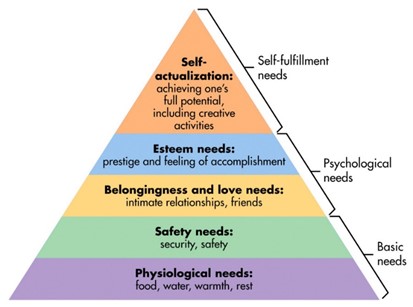
Figure 1 – Maslow’s Hierarchy of Needs

Maslow captured a moment in human evolution which, in the Enlightenment tradition, summed up the need for meaning from an individual perspective. What is perhaps understated to some degree by his model is that the Latin idea of nātūra (nature) and the more radical Greek notion of φύσις, εως, ἡ (phusis, physics) was our tutor and guardian. The dance of environment and individual conspired together to bring us to the next stage of human evolution. Basic needs demanded and required, upon the pain of death, obedience. The height of individualism was addressing the need for human meaning and personal fulfillment. Just as human individuality, from the physics of space-time, essentially entails ‘from a past’, ‘in a present’, and ‘to a future’ so meaning is derived from origin, to presence, and toward telos, a goal or culmination. In Aristotelian terms,

In Metaphysics Α.1, Aristotle says that “everyone takes what is called ‘wisdom’ (sophia) to be concerned with the primary causes (aitia) and the starting-points (or principles, archai).” (Cohen, 2020)

Furthermore, Aristotle writes of dunamis (potentiality) and entelecheia (actuality) or energeia (activity),

Since Aristotle gives form priority over matter, we would expect him similarly to give actuality priority over potentiality. And that is exactly what we find (Θ.8, 1049b4–5). Aristotle distinguishes between priority in logos (account or definition), in time, and in substance. (1) Actuality is prior in logos since we must cite the actuality when we give an account of its corresponding potentiality. Thus, ‘visible’ means ‘capable of being seen’; ‘buildable’ means ‘capable of being built'(1049b14–16). (2) As regards temporal priority, by contrast, potentiality may well seem to be prior to actuality, since the wood precedes the table that is built from it, and the acorn precedes the oak that it grows into. Nevertheless, Aristotle finds that even temporally there is a sense in which actuality is prior to potentiality: “the active that is the same in form, though not in number [with a potentially existing thing], is prior [to it]” (1049b18–19). A particular acorn is, of course, temporally prior to the particular oak tree that it grows into, but it is preceded in time by the actual oak tree that produced it, with which it is identical in species. The seed (potential substance) must have been preceded by an adult (actual substance). So in this sense actuality is prior even in time. which it is identical in species. The seed (potential substance) must have been preceded by an adult (actual substance). So in this sense actuality is prior even in time[1]. (Cohen, 2020)

From Aristotle’s perspective human individuality is not self-identical but essentially interwoven in phusis. Actuality and potentiality are both fundamentally constituent of reality[2]. From the Latin world and Roman Christianity, the individual emerges predominately in the landscape of phusis. This brings us to law and grace.

The law, as what Christianity deems the ‘Old Testament’, was a tutor and guardian until grace, what Christianity deems the ‘New Testament’, would transform the individual in the same way Maslow’s Hierarchy of Needs transformed needs. Needs in the fight for survival was unforgiving and ruthless to offenders. Transformations to psychological needs and to higher needs of self-fulfillment also resulted in a kind of reprieve from more basic needs. While Judaic laws required, upon pain of death in certain instances, obedience; grace writes the law in the heart. So, for grace the law is no longer fundamentally wed to phusis but becomes a kind of phusis unto itself in its transformation. This is how individuality emerges from phusis.

Underlying Maslow’s Hierarchy of Needs is the background of phusis. The individual finds meaning by moving from the law to grace, from mere survival to self-fulfillment, self-determination but cannot end in the laws of individuality but move on to the contextual, potentiality, which is determinate of the metaphysic of individuality. This movement is dependent upon fulfilling the earlier requirements of biological dependence on phusis. However, the individual has the potential to transform itself to a higher level of meaning and purpose than mere servitude to phusis and the truncation of contextuality into actuality.

Capitalism is the economic expression of individualism. Capitalism holds the stick of phusis but also raises the carrot of higher individual potentiality. However, it proposes not a grace of human individuality in which the individual attains a transformation of meaning but a domination of phusis. By conquering the slavery of mere survival, ideally, we can put phusis into the position of bondage and subjugation to affluent needlessness. In this then, we find the Error of the illusion of power and the reality of phusis. In Karl Marx’ terms the problem of capitalism is the creation of artificial needs, otherwise called marketing. We must have the next smart phone. In this sense, meaning is accomplished by the myth of Sisyphus. In cheating phusis Sisyphus was forever condemned to push a rock up a hill only to have it roll down once again. The promise of capitalism could never deliver us from phusis but could only forever require our aspirations which, for most, was doomed to fail. Even the most successful capitalist must give way to phusis in death. Furthermore, conquering phusis turns out to merely produce climate change and not the end of phusis but the end of humanity – eternal death of human.

This is how individualism has played itself out through history. However, another marginalized narrative has also held the potentiality of grace through cooperation with phusis. Cooperation does not spring forth from absolute individualism but from collectivity and responsibility. Human meaning is not obtained through the desperations of individualism but through the graces of maturity. Maturity recognizes our dependence upon phusis and each other. We no longer actualize the dynamics of power and subjugation built into the metaphysics of individualism but allow, make way, for the gift of the other; the other as phusis and as the he or she we face. When we give way to the other, we take responsibility for our obligation, our indebtedness to what we are not. We integrate and harmonize, make peace, with reality instead of a pitched battle with it. We no longer blame the other for our lack of power but take hold of our responsibility to the cry of the other. This does not take us back to manufactured needs of self-justification in the form of individual merit.

The bourgeoisie labor in self-adoring-adorning will imputing their metaphysic of failed individualism upon the proletariat. They absolve themselves of responsibility to the higher call of action in care. Democracy is based in a call higher than the metaphysics of individualism can understand. It places political responsibility on the individual to respond to the call of collectivity and the other. By the ‘other’ I mean phusis and the he or she. As long as we lapse into individualism, we absolve ourselves of the phenomenological reality of language.

Language is not private and individual. Language is not something we manufacture for the purpose of creating artificial needs which enrich its producers. Language is an archeology, an origin which we did not create, which preceded us from those we never knew. It is not merely a tool but a history-scape which informs us before we become cognitively aware of it. Self-realization cannot happen without others who have long since receded into language’s background. Even as eyes and ears are filters which let us make sense of the world, language functions as filters we call ‘reality’ in which ‘I’ as an individual never created or became the origin of. In this way, we are ‘individuals’. We name ourselves and bestow on ourselves the title of identity as if we were some kind of self-unification. Insanity is what we call those who have a private language and found identity upon it.

Democracy requires a perspective and a horizon in which each individual has place. ‘Place’ here is not a badge of individual merit. It is bestowed from how we actually are. We are bound and indebted to the other, to phusis, to any such thing which we call reality. While this can be denied in favor of autocracy, whether individual or political, it is ultimately self-defeating as it vaults the individual to heights which can only be maintained by the very opposite phenomenon it employs to create its artificial, virtual reality. It uses language to deny how language is, how it emerges from an exteriority which cannot be solipsistic. The eternal recurrence of the same in linguistic filters are fabricated to protect and destroy the myth of power. The endless repetition of simulacra and re-simulation are doomed from within because they cannot hear the still small voice of phusis. They can only result in the rise and demise of civilization and our environment. This is where reactionary and revolution find relevance.

Reactionary is a throw back to a fabricated past the never was. It is the wild west of individualism. There never was a John Wayne of individualism. It was created, manufactured, re-produced to protect the few violently. However, there is no evil genius here. Rather, it is a result of a linguistic history which advocates against itself. The heroic defies reality in favor of its own phantasma of who it is. It creates a past in which it is its own origin. It is self-caused. It is the creator of heroic and horror-ic values. It is the law in the garb of self-identity.

The Judaic law was given by God not man, but the new version of the law is the created simulacra of man, of a history which wishes to be but cannot be. Reactionaryism can only produce the reality of Sisyphus, an eternal recurrence of the same, reproduction of something that never was. It is wish-fulfillment which attempts to renew itself in itself and by itself. Revolution welcomes the new but all to often fails in the linguistic sanctums of power.

Revolution, as the new which never was, looks toward a future which has never been but is all too often doomed by its self-sufficiency in the phantasms of language which pull it back into the gravitational orbit of self-identity. Just as the revolutionary idea of democracy has lapsed in the United States back into the reactionary simulations of authoritarianism, revolution cannot succeed if it utilizes tools from our linguistic past which were devised to protect the illusion of power. What we need is to re-think language in terms of phusis. Our situatedness in history and phusis is not as masters of power but fundamentally dependent upon that which is not-me. Revolution can only find a higher transformation when it lets the ghost of power and absolute individualism fall into the dust bin of failed, phantasmas of a past that can never be. We must find an ethics which is participatory and essential to the responsibility towards the other. As human we are all part of a pluralistic, heterogenous reality-scape which offers many abodes that can never be commensurate.

Those that revel in power and self-identity have fashioned for themselves a simulacra, a golden calf, which can only be repeated in reactionary violence. The cry of the other, the suffering of the other. The relegation of oppression and self-absorbed denial of who we are and not who we imagine the ‘they’ are is the revolution which will usher in a transformation with ourselves and our environment. Transformation from Maslow’s Hierarchy of Individual Needs must give up the ghost of labor which can only toil in eternal repetition of the same. This is not a new hierarchy. This is an acceptance of responsibility and obligation to the other, to phusis. We cannot arise at the expense of the other and our environment. We must have the grace of making place for the other. We must allow the content of phusis and the real needs of the other to call us to responsibility. The individual does not disappear in collectivity as drop of water in the ocean. This is another illusion built on the mirage of individualism. Responsibility places us as situatedness to that that which we cannot efface and calls us to actualize our responsibility to that call. In this untapped potential for what it means to be human we find cooperation and concern for what we cannot erect a phantasma of. It is founded in a language and history which we cannot have power over but can recognize our absolute limitation in the face of radical alterity which requires our responsibility not our violence in its defacement.

References

Cohen, S. M. (2020). “Aristotle’s Metaphysics”. (E. N. (ed.), Ed.) The Stanford Encyclopedia of Philosophy (Winter 2020 Edition). Retrieved from https://plato.stanford.edu/entries/aristotle-metaphysics/

[1] Interesting to note that Aristotle’s notion of actuality and potentiality seems to me to have some reverberations in modern chaos theory. Chaos theory does not deny order or actuality. Instead, it tells us that order is a co-determination of chaos. Order and chaos are not diametrically opposed as subject and object. They have an essential relationship. The universe is structured as self-organizing as fractals. Fractals have the unique capacity to be both ordered and chaotic infinitely. There appears to no limit to the patterns they can make in the same way as each snowflake is absolutely unique. This is what is called self-organizing. In the chaos theory the universe is self-organizing. There is no limit to the nature of how it organizes. A butterfly’s wings can spark a tsunami on the other side of the world. This makes the outcome essentially unpredictable. Likewise, actuality or energy emerges from potentiality as limitless patterns emerge from fractals. Actuality emerges as particular forms just as language emerges as particular histories, invocations of reality and absolutes. The are uniquely particular and ordered but their origins are not in the absolute of their actuality, of their content, or the mystery we call reality, but in the absolutely unpredictable outcomes of potentiality. Additionally, they are intimately the subject of absolute unpredictable, chaotic changes. Therefore, cause and effect are not a reality but an observation of a commonality, a particular fractal pattern, which emerges in language and history.

[2] I use the word ‘reality’ here on the context of its philosophical history which I cited in my previous post, Maslow, Law & Grace, Reactionary & Revolutionary. Reality is not the simplicity of an object related to a subject as philosophy starting in the 19th century has argued culminating around the same time that Einstein’s theory of relativity was taking off at the beginning of the 20th century. Reality is a chaotic and ordered process of language and its other. It is not self-evident except in supposed, assumed and metaphysical histories. It is interactive and chaotically potential in its actual forms. One simple example is the relativity of space-time. As an individual human we have mass. Since we have mass, we create small but not insignificant distortions of space-time around us. Additionally, time runs faster on the top of a mountain than in a valley (gravitational time dilation). Each individual is wrapped from birth to death in their space-time continuum. Additionally, this space-time continuum has stretch and minute variations which directly correspond to relative masses and speed called frames of reference. It is wrong to think of time and space as static, universal and absolute. Similarly, it is wrong to think of individuality as absolute as it is determined by the other of history, language, phusis, and the he and she. All of this is dynamic and chaotic, its capacity for predictability. Closing down individuality into an absolute is death. As Heidegger tells us, “Death is the possibility of the absolute impossibility of Dasein (human being or more precisely the ‘there’ of being).” The impossibility of individuality emerges in language and history as an absolute impossibility or as Heidegger calls it the “they-self”. The they as a self is immediately contradictory and unsustainable as it is a self-contradiction. Similarly, absolute individuality cloaks it contextual histories which are relegated to its margins. This does not negate the form of the individual but places it in relative context with it’s ‘not’ as a pattern in fractals does not deny it’s infinite, unpredictable, and chaotic patterns but emerges from them. However, the not is not a negation but an affirmation of an absolutely ‘other’, even as death is a possibility in its absolute impossibility. The fear of death is actually the fear of life since no one will ever experience death as Epicurus tells us,

“Why should I fear death?

If I am, then death is not.

If Death is, then I am not.

Why should I fear that which can only exist when I do not?

Long time men lay oppressed with slavish fear.

Religious tyranny did domineer.

At length the mighty one of Greece

Began to assent the liberty of man.”

Language as Power

Postmodernism would argue that language is power. On the surface this is just as ludicrous as suggesting that money is speech. However, what they mean is that any use of language is a use of power. Language always aims at ends such as influence, persuasion, domination. When a bird tweets it may be to effect some form of power in their own environment (or perhaps not) but for us power is a meaningless concept in the case of a bird tweeting. When postmodernism thinks of language as power they mean that the dynamics of power and powerlessness are always at work in the use of language. Power must preserve itself through powerlessness. Power is symbiotic. If power could destroy everything not deemed powerful, power itself could not exist. Powerlessness must be in order for power to be. Any philosophy of power is just as indebted to its negative content as its positive content. As such, power is essentially indebted to its nemesis. Even more, power is itself produced by what it isn’t. If language is power this does not only refer to its positive content but to what it is not as well. In a similar manner, morality is also inseparable from immorality as Nietzsche points out in “Beyond Good and Evil”. This is the source of neutrality in the thought of power.

Language as power focuses on force. Force cannot be thought about without equal and opposite forces. There is no pure, singular force that can be thought in some hermetically sealed environment – force always occurs with other forces. Other forces can work against or for another force or have no relevance to each other. Likewise, language as force will always contain themes that work against or for the dominant theme or have no relevance to the dominant theme. An obvious example of this for many non-academic philosophers is the Bible. The Bible is full of themes. Religious denominations are all about how these themes can be refashioned, contradictory and complementary. Postmodernists do not see this as a problem with certain people not understanding the Bible correctly or not knowing God but they see this as a problem intrinsic to any use of language. Truth itself as a construct of language necessarily contains all the themes that overturn it.

However, the subtleties many postmodernists get trapped by seem to be:
1) Identification of power with a metaphysic of individualism or community
2) Identification of power as essence or origin
3) Identification of power as neutrality; in the order of ‘thingness’
4) Identification of power with presence and absence

I am not going to delve into these issues here but many have and I have to some extent. What I would suggest is that postmodernism is not about making positive statements or about answers but about the ‘nots’ of any statement and raising questions to the level of disturbing and strange. If postmodernism stops before any and every possible thematic disturbance, postmodernism falls back into historical metaphysics. This does not suggest that historical metaphysics is the ‘not’ of postmodernism but that if postmodernism sets up or establishes dominant narratives whether intentional or not, it has effectively repelled and attracted disparate themes. This attraction and repulsion is a leveling off of thematic differences. When difference is sorted according to similarity and dissimilarity a simulacra of difference is preserved but difference itself is lost. The simulacrum is sameness. Sameness here is not meant as identity as that would be pure nonsense. Sameness has to do with reversibility as opposed to rupture. Sameness brings with it a predisposition, a working agenda that is not explicitly thought out but guides the agenda nonetheless. While sameness certainly allows comparison it also misses differences that it deems irrelevant. What gets lost is difference itself in the service of thematic preference.

Certainly difference can be thought as reversible where themes are held apart in the tension of valuations (i.e., true or false, relevant of irrelevant, good or bad, etc.). However, this difference is for the sake of leveling off and sameness. This difference holds together variants, moments of dissimilars. Moments of dissimilars already holds fast to the notion of presence. It prefers reduction to kind and necessarily pushes rupture to absence. Derrida uses the misspelled word ‘differance’ to indicate rupture. Rupture is nonsense for difference. Difference totalizes. It makes sense of, takes hold of, finds form and limit (peros). Differance tears apart in its not able to, its absolute passivity in the face of, incommensurate to the point of disturbing, formless and limitless (aperion).

However, differance as postmodernists tend to think it, stills holds together the theme of neutrality, a play of forces, an ‘itness’. If differance is thought in terms of neutrality, its other must be the other, the ‘he’ or ‘she’. This moves into the thought of Levinas. If the he or she is retained as the opposite of neutrality then rupture is once again leveled off as the same. Radical alterity (otherness) is:

“The Other is radical only if the desire for it is not the possibility for anticipating it as the desirable or of thinking it out beforehand but if it comes aimlessly as an absolute alterity, like death.”
John Heaton ‘The Other and Psychotherapy’ in Provocation of Levinas

Radical alterity does not lift up or transform. It is all too easy to reject it as nonsense and actually it is – it evades but not defies sense. It is not nonsense in the typical meaning of the word as it tangentially returns. For Levinas, metaphysics is the tangential return of the radical alterity of the other. It is as waves that wash up on the beach breaking through every notion of a ‘setting’. It reoccurs but not as the same; the river that cannot be stepped into twice. The same, as our notion of death, intensifies the strangeness of the thought of my death. Somehow the two do not link up – they fall apart. This is what radical alterity does. It is incommensurate in a way that resists measure and boundary. It always returns as exceeding itself; as not resting in an ‘it’ as ‘he’ or ‘she’ resists ‘it’. This resistance is not of kind but of radical otherness.