Breaking News From Fox News

Hillary Clinton’s charity foundation took money from bad guys to help children. The bad guys could have spent the money on bad deeds so it was wrong that Hillary took that money to help kids. Also, her foundation took money from foreign countries that discriminate against women to fund programs that reduce discrimination against women. “That is just wrong” a Fox News spokesman told us.

Additionally, Fox News reports that while Hillary may ‘say’ she is for the lower 90% and against the upper 10% of income earners she is really part of the upper 10% herself so “how in the world could she ever understand the plight of the lower 90% as Fox News, the Republican Party and the upper 10% which makes up the most of the financial support of the Republican Party do”?

Fox News also reports that the total mess the Democrats have made of foreign policy and the economy is not how the former President left it when he left the office. It was the leadership of the former President that let the world know the United States is in charge as Afghanistan and Iraq proved. Also, the top 10% actually made more income during the Great Recession that was started during the Bush administration and the trickle down jobs started by the job creators simply made the current President look good but was really a direct result of successful wall street, free market, policies advocated by the Republican Party. They also went on to say that on their watch they proved that they would go up against corporations to big to fail as Lehman Brothers, Goldman Sachs and Bear Stearns discovered before they were bailed out. It just so happened that the former President’s policies to help poor folks get houses bankrupted the world with wacky financial tools that the Republicans pushed through Congress in financial deregulation during the Clinton years.

An unofficial spokesman for Fox News who did not want to be disclosed told us that thanks to the Citizens United Decision of the Supreme Court, wealthy Republicans have secretly converged to finance the campaigns of all the Republican Candidates to make the public think all the conservative voices are being heeded by the Republican Party but their plan is to strategically pull the funding so their candidate of choice, as yet undisclosed, can sail through their primary process and win in the general election with more moderate claims and high indebtedness to their benefactors.

Note: In the interest of fair and accurate reporting all the news above was really fabricated by a commy, liberal unless you think it actually made Republicans look good in which case it was totally true.

An Interlude to Anaximander

Philosophy Series Contents (to be updated with each new installment)

Philosophy Series 1 – Prelude to the Philosophy Series

Philosophy Series 2 – Introduction

Philosophy Series 3 – Appendix A, Part 1

Philosophy Series 4 – The Pre-Socratics – Hesiod

Philosophy Series 5 – A Detour of Time

Philosophy Series 6 – The Origin

Philosophy Series 7 – Eros

Philosophy Series 8 – Thales

Philosophy Series 9 – An Interlude to Anaximander

Philosophy Series 10 – On the Way to Anaximander: Language and Proximity

Philosophy Series 11 – Aristotle and Modernity: The Eternal and Science

Philosophy Series 12 – Levinas and the Problem of Metaphysics

Philosophy Series 13 – On Origin

Philosophy Series 14 – George Orwell and Emmanuel Levinas Introspective: Socialism and the Other

————————————————
An Interlude to Anaximander

Someone must have already stated this elsewhere so for lack of citation let me reiterate, there are many academics but few scholars. Scholars attain a breadth of mastery that few academics ever realize. Analogously, most folks are philosophers in one way or another but few find concrete paths from philosophy to existentia, actual existence. This why philosophers in modernity from existentialists to post-existentialism has focused philosophy on the concrete fact of death. Of course, death, itself, also holds the possibility for abstraction. This is why Heidegger, for example, is swift to frame death in terms of “my death”. Death is not just an end but in non-negotiable ways “my end”. When limit is thought in terms of ‘mineness’, something passionate and irreplaceable comes to the fore. Religions are also able to harness this ‘something’ in concrete displays of passion and ‘faith’. For Kierkegaard, faith is the absolute passion of existence. While academic philosophers, spurred on by the quest for recognition and therefore, economic reward, are goaded by the continuing requirement for sustenance, they are also pricked by the constraints of their specific traditions. Their freedom must end in the horizon of other’s genius. Thus, the academic is born. However, existence persists and places on each the necessity of an existential answer. However, this ‘answer’ takes form, as religion, science, morality or polis/political, denial, it must be responded to, existence therefore evokes. Evocation has long fascinated the phantasma of human imagination as magic, sorcery, desire, wish-fulfillment and even love.

In undertaking this philosophy series, I am continually facing the prospects of pure academia or existentialism. For me, philosophy dies in pure academia. Philosophy finds value and virtue in its fundamental evocation. Whenever philosophy becomes instantiated in ‘isness’ or perhaps as Levinas might sway us to, il ya, it can become obsession or insomniac. It loses a certain kind of weightiness, a certain kind of necessary ‘evocativeness’ is deferred. In the loss of limit, the bounds of ‘mineness’ can be displaced, and thus, the possibility for radical alterity. The ‘end’, this peras, was also noted by Anaximander and many before including Hesiod. Peras, simply translated as end or limit is only the beginning of its etymological intonations. The early Greeks as many archaic traditions recognized change, transition, mutation of form. The Ionians were fascinated with the notion that transitions were not magical apparitions, popping in and out of existence but had some substratum, some basis of mutability. Science and religion have been intrigued ever since. Anaximander, perceptively enough also echoing other archaic traditions thought of these limitations as intensified by re-occurrence of some sense of the same, the dissolution and reemergence of like forms. Iteration, when amplified infinitely by a notion of the same, persistence and unity through time, becomes a-peras (apeiron), the negation of limitation. It becomes intense, imposing, non-negotiable…existential as my being-towards-an-end which cannot grab hold of what this means. This inability to be able is cast without limit, without understanding in the midst of understanding. This type of overflowing itself could be thought as a beckoning of exteriority. This intensity thought in Greek terms is kairos. Kairos as the beckoning moment of answer, necessitates and requires, completion, finality, condensation, movement and action. As such, it is qualitative. It overflows itself as qualitative. In this moment, existence is borne and born.

The urgency and necessity of this evocation did not escape the keen observations of the Greeks. Nor has it yet escaped the gaze of science’s Orphic vision. Necessity is certainly embodied in biological evolution. Survival, as utmost, is dependent on successful adaptations. Could it be that habit as specific to an individual organism, the repetition of successfully completed iterations where ‘success’ is thought in terms of survival, of tarrying to the next iteration, can find some genetic bridge over successive generations of ritualistic practice into what we think as ‘instinct’. Can ‘instinct’ be ingested into DNA? Just as Nobel Prize winner Barbara Mcclintock found the cellular reflection of environment into itself as equally primordial to the cells’ internal structure, could it be that ‘adaptation’ is the innate struggle (polemus) of the internal and the external to come to stasis, to a temporal completion of ‘moment’ when neither impose its form on the other but mutually respond and co-habitat with the other. In genetic encoding then this moment becomes ‘physical’, ‘biological’ and ‘chemical’. It also becomes ‘physics’ as atomic or better sub-atomic.

In modern physics we have the notions of isolated, closed and open systems. Isolated systems can neither pass energy or matter. Closed systems can pass energy but not matter. Closed systems in classic mechanics would be considered an isolated system in thermodynamics. Isolated systems do not exist in actuality. Open systems can pass both energy and matter. In isolated physical systems we say that momentum is conserved. In an isolated system we can account for change, transition, mutation and thus energy is conserved. However, in an open systems we have a loss of accountability we call entropy that shows itself as error. The isolated system is thought yet again as the Hegelian dialectic of internal and external, the particular and the universal. The isolated system demonstrates a kind of respite, a cessation of strife, of the temporal tearing, incessant bubbling of sub-atomic particles, a transformation (aufhebung), where, what Hesiod termed, a ‘yawning gap’, chaos, subsides and the moment of archy, of origin, of birth, opens up genesis, genetics, genet’. This moment is a kind of equilateral-ism, congruency, a pause thought as stasis. Aristotle’s discussions of actuality (actualitas Latin, energeia Greek) or work as what persists and potential (potentia Latin, dunamis Greek) or possibility as what could be, find their stasis in motion or kinetic (kinesis) as the actuality of potentiality, as the persistence of possibility. Temporality and motion, known in Classic Greece, is conserved and preserved by persisting through time by limitation, by form. A temporal wholeness or completion as ousia, being, is evoked from apeiron, perhaps Hesiod’s ‘before the gods’ of chaos. Of necessity, this temporal pause to the incessant change of form, is first made possible by a terminus, a telos, a limit or boundary. The existential weight of evocation, the ‘must’ of action, cannot be ignored or denied without only re-affirming it. Any turning away is yet again a turning towards as the existential moment of existence must obey a call from without as a singularity, as a persisting form cast upon the void, the yawning gap.

The isolated system in physics is always a kind of existence creating moment. It is imposed by boundary and limit, arrangement and designation. However, closed systems, as the perfect triangle, are idealizations. Any isolated system in reality leak and absorb information in the larger context of an open system. Isolated systems in the real world are intrinsically and essentially effected by externality, they have entropy. Information cannot be completely recovered in an isolated system. Information must be truncated in the idealization of an isolated system. The loss is irretrievable in an isolated system context. Typically, the universe is thought in the motif of a closed system. A closed system universe could interact with other energies, perhaps from bubbling multi-verses or multi-dimensional factors but not with any ability to transfer mass. This then gives rise to a metaphysical question, is the notion of the absolute open, closed or isolated? Or, could it be that, the notion of the absolute is an iteration, a singularity, a tautology of a primordial limit in an isolated system context? Some might say this question, devoid of existential import, may as well ask how many angels can dance on the head of a pin?

In modern physics, a singularity such as the infamous ‘black hole’ is a margin from the isolated system con-text. It is a parenthesis, a deferment until logos, understanding, can finally recover its enigma. Is information conserved or lost in a black hole? Has physics reached an absolute limit in a black hole? The black hole is a unity. It is not a solely a swarming buzz of sub-atomic particles popping in and out of existence. It is not a formless chaos. It is in stasis, driven by necessity to be, and yet it’s being is an absolute limit in a multitude of ways…more importantly, to understanding, the very possibility of understanding. Physics has in recent times brought to the fore more and more staggering limitations of itself with the ‘God Particle’, super-symmetry, multi-verses, higher order dimensions, dark matter and dark energy and brought with these, reflective questions of knowledge itself. Not that there is an alternative to knowledge but it has brought to the fore the necessity of knowledge and at the same time it’s absolute limit. Absolute limitation in physics mathematically become singularities. Singularities are nonsensical, Alice in Wonderland. While ‘bad science’ is thought to end in a proliferation of singularities, they cannot be ignored as they pose fundamental questions which defy ‘reality’, the light of, even the possibility of, knowledge and as such convey an unsettling existential angst.

Mass and energy are inextricably linked just as Aristotle’s thinking of actuality and potentiality are linked. Now with the proof of the Higgs Boson we have a particle ‘field’ whose origin appears in the first moments of the Big Bang which determines and necessitates mass. It transforms massless energy to relative degrees of stickiness, of clumping, of resistance, weightiness; mass. This boson imposes an ir-refusable limit to matter. Thus, the name ‘God Particle’.

The point of this divergence into modern phusis is to show that the import of ‘my death’ never achieves an ‘outside’. It can only converge in upon itself into a singularity. It cannot retain information without irretrievable loss. Even more so, we see this phenomena everywhere we look in phusis. This is the setting in essence of ancient Greek inquiry. The Greeks did not have the apathy of centuries of abstractions into being. They felt the import originally with other archaic cultures and the interruption of the raw gap, the chaos, not yet historically named but recognized in imposing enigma. They understood the transformations of forms as mutations of hot and cold, damp and dry, atom and void. They thought with resoluteness and determination the absolute connotations of limitation, of death, of knowledge. These differences could not easily rest in stasis as being and nothingness, self and other, as pure, self-determining Idea. These differences brought them to the abyss that looks back into our souls, beyond Dread to a gap, an otherness not captured by thought but intensified as the moment of dissolution and birth, of limit in which even light cannot penetrate or escape.1

Philosophy Series 10 – On the Way to Anaximander: Language and Proximity

_________________

1 The next installment in this series will probably take some more time for research and thought as the topic of Anaximander brings with it enormous scholarly attention and far reaching possibilities for departure. There may be more preliminary discussions before I really start with the textual, philological and canonical discussion.

The Big Picture: Facts Concerning History, Politics and the Economy

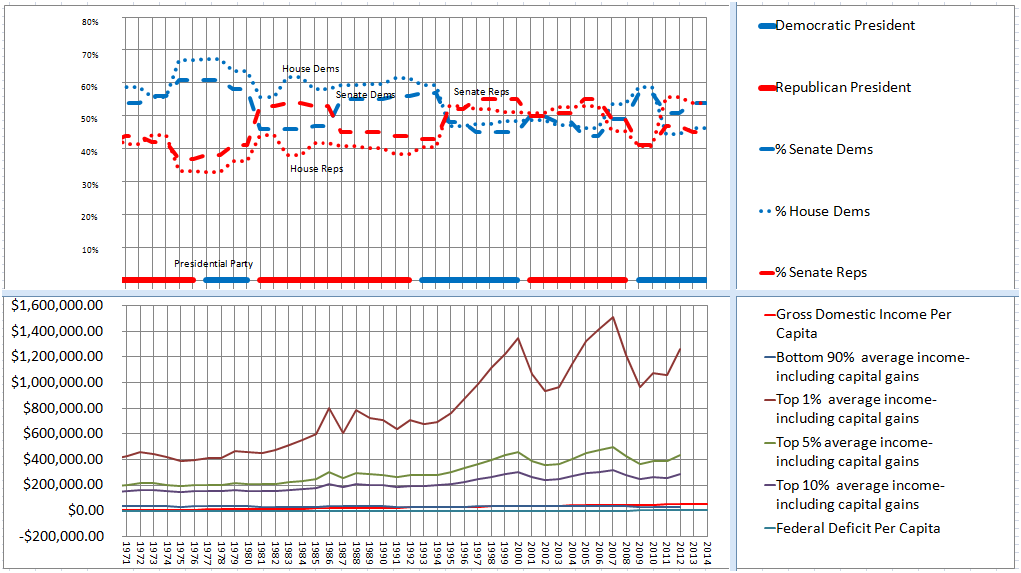
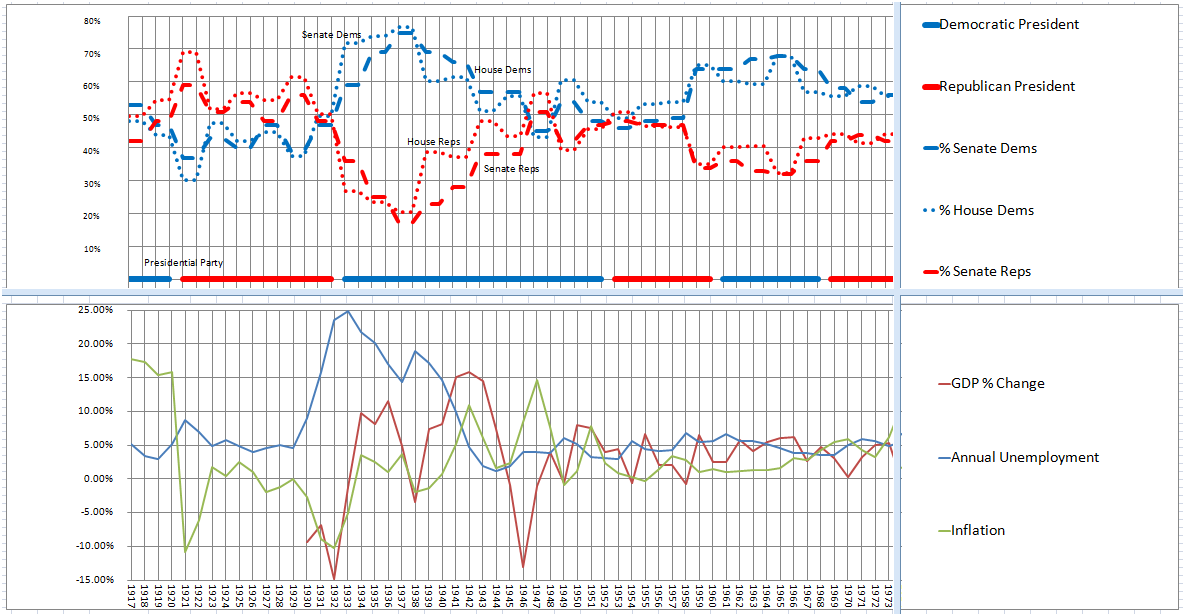
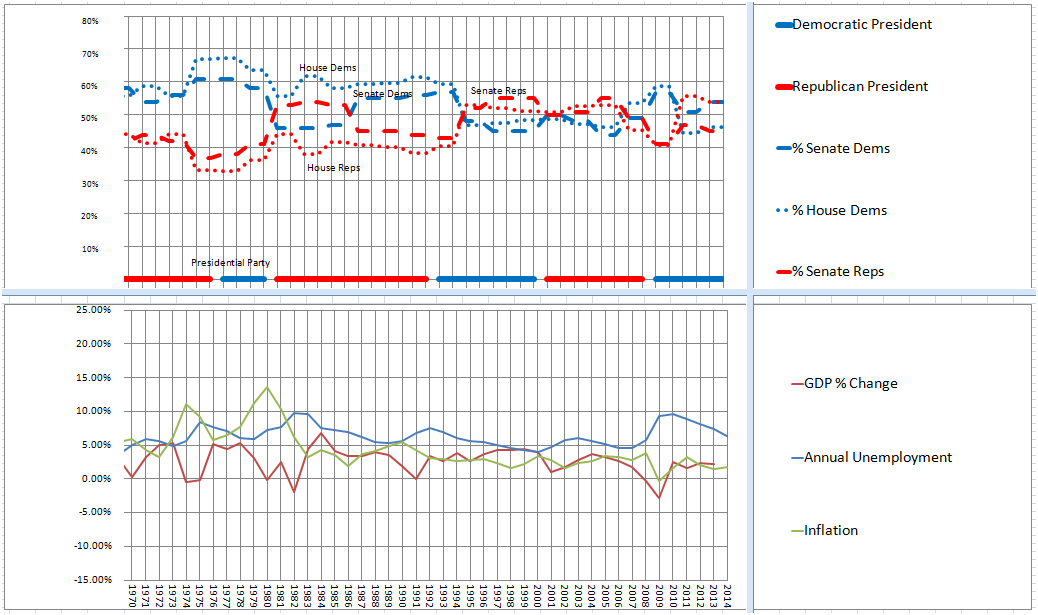
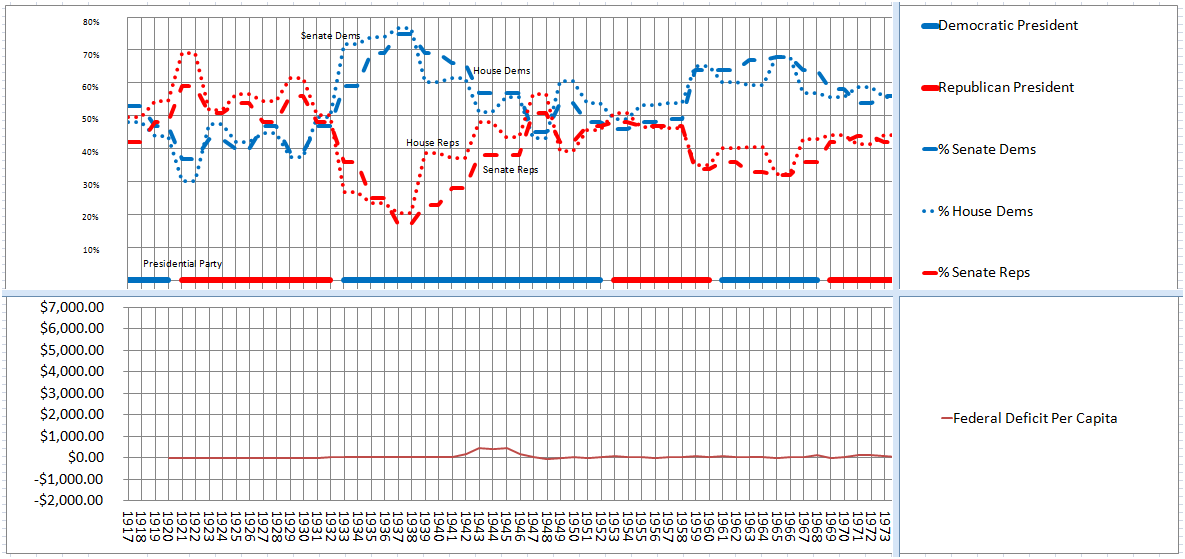
The historical data below shows important U.S. political and economic factors from 1917 to 2014. The charts were made in an Excel 2007 spreadsheet. The spreadsheet with the data tables and charts can be downloaded here. For each chart, the charts shows the Republican and Democratic makeup of the U.S. Congress, the Republican or Democratic President and the following data:

Chart 1

Bottom 90% annual income share in percentage of total income including capital gains1

Top 1% annual income share in percentage of total income including capital gains 2

Top 5% annual income share in percentage of total income including capital gains 3

Top 10% annual income share in percentage of total income including capital gains 4

Chart 2

Annual Gross Domestic Income (GDI) per capita5

Bottom 90% average income in dollars including capital gains6

Top 1% average annual income in dollars including capital gains 7

Top 5% average annual income in dollars including capital gains 8

Top 10% average annual income in dollars including capital gains 9

Annual Federal deficit per capita10

Chart 3

Annual GDP % change11

Annual Unemployment rate12

Annual Inflation as a percentage13

Chart 4

Annual Federal deficit per capita14

The purpose of these charts is to layout the full political and economic facts to get a sense of perspective based on solid sources detailed below in the endnotes. I always approach this type of data as ‘come what may’. Of course, I have opinions and conclusions as we all do. However, I really believe in letting the facts speak for themselves. If the facts show I am wrong about an opinion I will, and historically have, changed my opinion to suit the facts. I do not have that high a degree of personal stake in my opinions which would override whatever truth may come from the facts. There is a degree of truth that can be ascertained by well sourced facts about politics and the economy. However, it takes continual work to try to accommodate opinions and conclusions to reality.

There are way too many fanciful ‘facts’ flippantly tossed about that result in erroneous conclusions. Conclusions based on mere opinion with little or no underlying facts allow perceptions to rule in elections. Perceptions are the only concern of political commercials. Truth, to whatever degree it can factually be ascertained, is fundamental to a working democracy. I have included some conclusions I think can or cannot be drawn from the data below. I would welcome any further comments pro or con as well.

The charts, as shown below, are too large in a web format to see details adequately. However, there are some things seen below that immediately jumped out at me. First, notice the squeeze in the 1920 to 1940 and 1980 to the present, income levels in the United States on Chart 1. What this tells us is that the bottom 90% of income share in the United States came down around the Great Depression and started coming down in Reagan years until the Great Recession of the 2008. Also, notice that the top 10%, 5% and 1% of income share rose during those years resulting in what I term the Great Crunch.

Chart 2 shows the dollar amount of the Great Crunch. The gross domestic income per capita was relatively flat during the Great Depression years and rose slightly from the Reagan years to the present. This was probably the effect of the upper income bracket’s large rise in income share during those years. After the Great Depression, the upper income brackets were taxed in the 90+ percentile tax bracket after a certain amount of income was obtained. Ronald Reagan cut those large taxes on the wealthy and they continued to pay lower and lower taxes from then to the Clinton years when their taxes went up. In the Bush years their taxes went down again. They also accrued more and more tax shelters during these years. If the claim of the right that lower taxes create jobs is correct, we should have seen unemployment go down in the Reagan years. However, the data actually shows that unemployment actually went up in the Reagan years. Conversely, President Clinton raised taxes on the very rich in the 90s and employment went up.15 If the claim of the right is correct, where is the proof? The proof goes counter to their claim.

Chart 2 also shows the bottom 90% average income going down slightly from the gross domestic income per capita and can be seen better in the more detailed view of Chart 2 further below. The spreadsheet tables show the actual dollar amounts started at around $11,000 annually in 1917, went to a low of about $7,500 in the Great Depression, started rising to about $36,500 in 2000 and declined from there to about $31,000 in 2012. The upper 10% income brackets did bump up some just before the Great Depression years in real 2012 dollars but in recent decades since Reagan those brackets rose tremendously with the upper 1% rising 300% to 400% in the decade of 2000 and more than doubling for the top 5% and top 1%.

Another claim of the right is that all the meddling of the Federal Reserve results in inflation, boom and busts and unemployment. Chart 3 does not validate this claim. Inflation, unemployment and GDP have been tamed much more since Franklin Delano Roosevelt’s administration greatly empowered the Federal Reserve, created depository insurance and financial regulatory requirements. Inflation, unemployment and GDP were much more erratic from 1917 through the Great Depression (and even before 1917). Do we really want to get rid of the Federal Reserve, depository insurance and financial regulatory requirements as the Austrian Economists suggest and go back to those days?

The charts also show that Democratic Presidents and Democratic Congress’ presided over the recovery from the Great Depression and the Great Recession of 2008. It also shows that Republican Presidents and Republican Congress’ presided just before these economic catastrophes. However, much to my surprise, mixed parties controlled the Congress and the Presidency over much of the more economically stable period from the recovery of the Great Depression to the Reagan years. My personal opinion is that the Old Right16 was much more sympathetic to the bottom 90% than the new right of recent years. Democrats and Republicans were able to pass bills which actually benefitted the middle class in those years and spread the income share between the bottom 90% and the top 10% as evidenced by Chart 1.

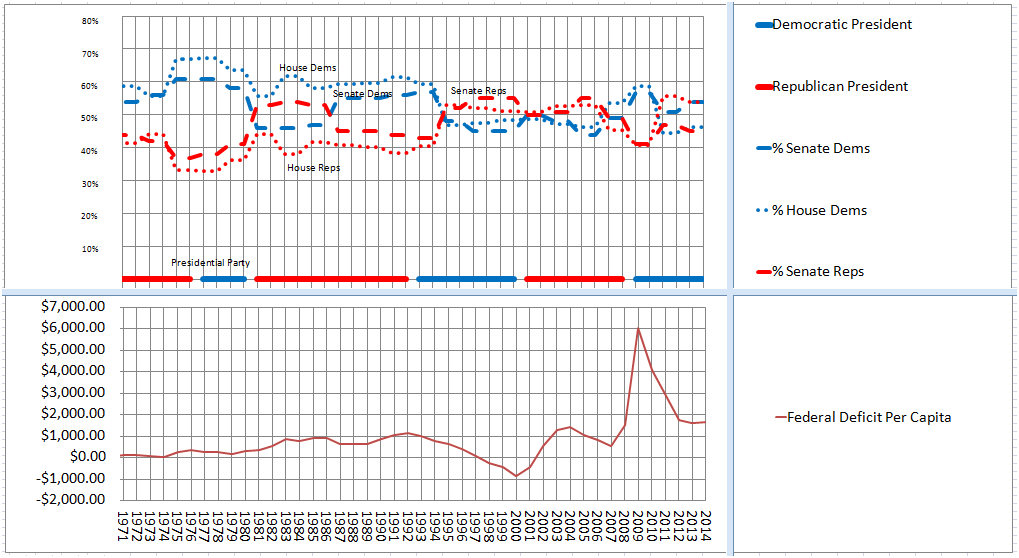
Chart 4 shows the Federal deficit per capita. The right has made much of Obama Care and the Federal Government’s hit on the national debt. The national debt is fueled by the annual deficit. While the deficit per capita bumped up slightly during the Great Depression recovery, it had a surplus of $1,000 per person in 2000 under President Clinton and a debt of $6,000 per person in 2009 under President George W. Bush until President Obama was inaugurated. Since then it has gone down to less than $2,000 per person of debt. This is obviously not what the right has been telling us. The facts actually tell us that the right has told us a blatant lie. The deficit did spike up from the social safety net set in place by Democrats and Republicans over the decades under mandatory spending requirements which no president could unilaterally change; only an act of Congress can change mandatory spending. The social “safety net” as, President Reagan called it, did exactly what is was suppose to do. If it had not done its job, the Great Recession of 2008 would have had a much more severe impact on average working families and probably would have prolonged the effects of the recession. However, the deficit immediately start coming down under President Obama; again, contrary to the blatant lies of the new right.

I believe that the 2014 elections were rigged, thanks to the narrative paid for by virtue of the Citizens United Decision,17 by lies which obviously benefit the wealthy not the working class. There was a right at one time that did care about the middle class and proved it with facts. However, the new right does not resemble that party in reality and the economy. It is high time that the old notion that Republicans are better for the economy get updated to reflect reality and not aspirational nostalgia. I would also add a word of caution I see in the data that the worst may not be over yet. The Great Crunch does not look like it is receding yet. Economists have told us for many years that the engine of the economy is the consumer not the wealthy. The consumer spreads out the risks of the economy and thus minimizes the chance of economic catastrophe. The facts bear this out. If we continue down the path which rewards wealth and punishes the consumer we may not have seen the ‘big one’ yet. A mixed party of Executive and Congressional branches of government may not fan the flames of the Great Crunch but we need to move away from the precipice of decreasing the income of the bottom 90% and increasing the income of the top 10% or we may find ourselves in a depression that will make the Great Depression look like a dress rehearsal.18 If a Republican is elected as President in 2016 with the new majorities of Republicans in the Congress, we could be well on our way to economic catastrophe as history is the witness.
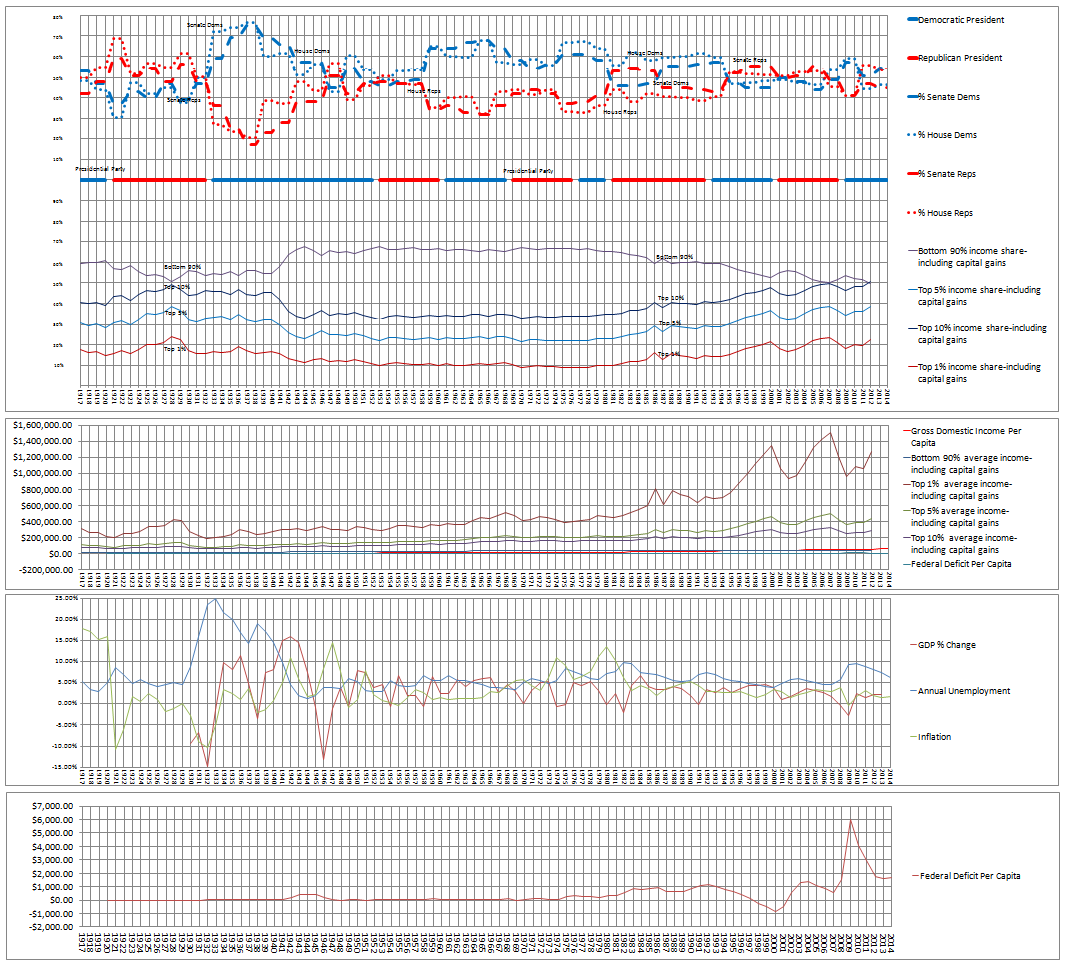
The charts below are the same as the charts above but with more detail. In order to do this, the timelines have been split. Note that not all the data fields are fully filled out due to the lack of earlier reliable data. The top of each chart shows the percentage of Democrat and Republican, U.S. Senators and Representatives. The solid horizontal colored bars shows the presidential party in power at the time. Democrats are displayed in blue and Republicans are displayed in red.

Here are the dates from 1917 to 1971 for Chart 1.
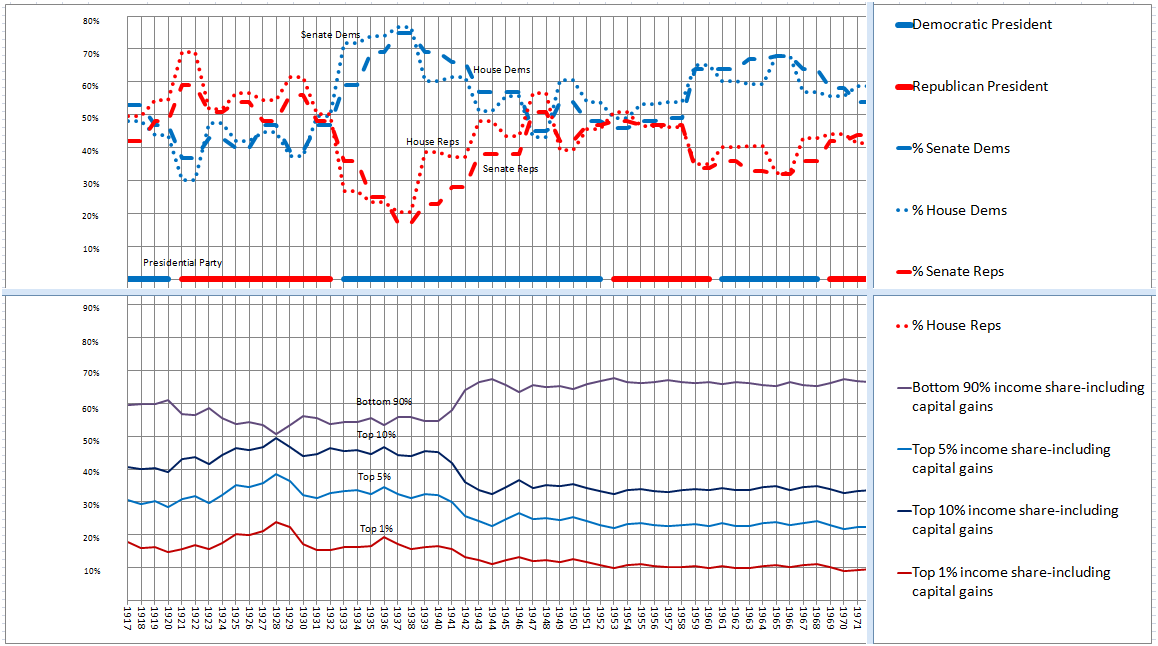
Here are the dates from 1971 to 2014 for Chart 1.
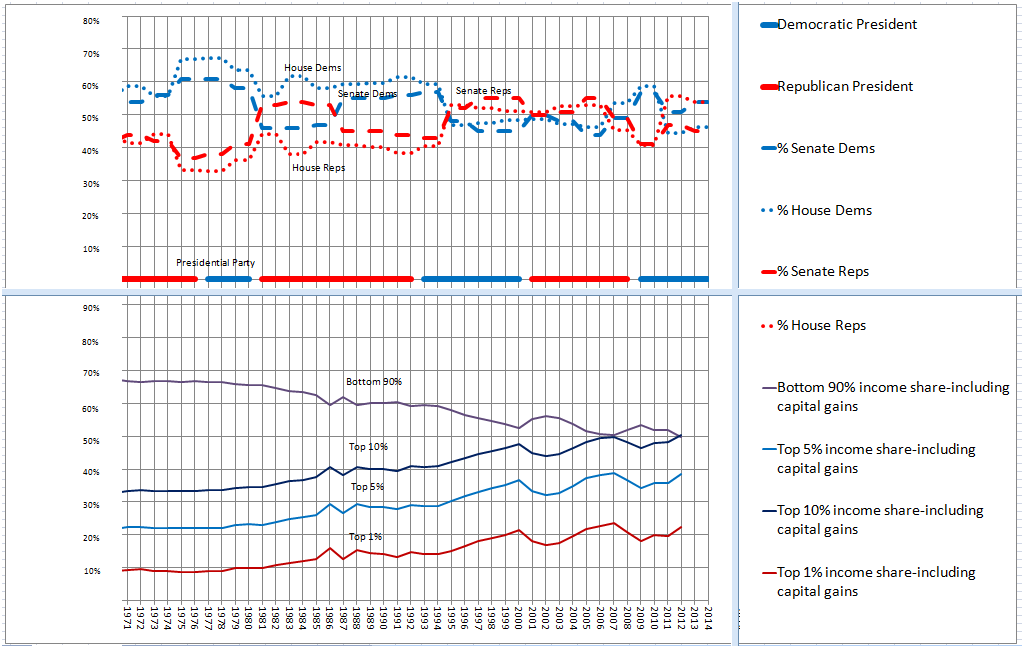
Here are the dates from 1917 to 1973 for Chart 2.
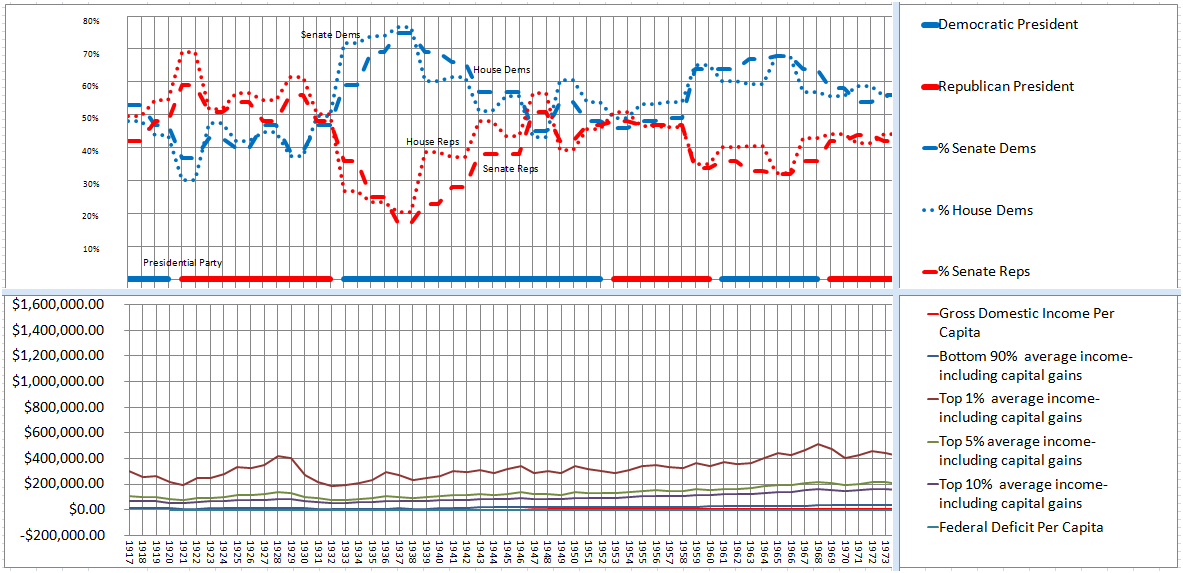
Here are the dates from 1971 to 2014 for Chart 2.
Here are the dates from 1917 to 1973 for Chart 3.
Here are the dates from 1970 to 2014 for Chart 3.
Here are the dates from 1917 to 1973 for Chart 4.
Here are the dates from 1971 to 2014 for Chart 4.
_________________

1 Alvaredo, Facundo, Anthony B. Atkinson, Thomas Piketty and Emmanuel Saez, The World Top Incomes Database, http://topincomes.g-mond.parisschoolofeconomics.eu/, 11/12/2014, See The World Top Incomes Database, real 2012 US Dollars, gross income before taxes, fractiles defined by total income including capital gains; income includes capital gains, the income share is the percentage share of annual income of the bottom 10% in the United States

2 Alvaredo, Facundo, Anthony B. Atkinson, Thomas Piketty and Emmanuel Saez, The World Top Incomes Database, http://topincomes.g-mond.parisschoolofeconomics.eu/, 11/12/2014, See The World Top Incomes Database, real 2012 US Dollars, gross income before taxes, fractiles defined by total income including capital gains; income includes capital gains, the income share is the percentage share of annual income of the top 1% in the United States

3 Alvaredo, Facundo, Anthony B. Atkinson, Thomas Piketty and Emmanuel Saez, The World Top Incomes Database, http://topincomes.g-mond.parisschoolofeconomics.eu/, 11/12/2014, See The World Top Incomes Database, real 2012 US Dollars, gross income before taxes, fractiles defined by total income including capital gains; income includes capital gains, the income share is the percentage share of annual income of the top 5% in the United States

4 Alvaredo, Facundo, Anthony B. Atkinson, Thomas Piketty and Emmanuel Saez, The World Top Incomes Database, http://topincomes.g-mond.parisschoolofeconomics.eu/, 11/12/2014, See The World Top Incomes Database, real 2012 US Dollars, gross income before taxes, fractiles defined by total income including capital gains; income includes capital gains, the income share is the percentage share of annual income of the top 10% in the United States

5 See Gross Domestic Income per capita, FRED Graph Observations, Federal Reserve Economic Data, Economic Research Division, Federal Reserve Bank of St. Louis, Gross Domestic Income (GDI), dollars per person, annual, not seasonally adjusted, the dollar amount is found by dividing each annual GDI by the population for that year as defined by the Census Bureau

6 Alvaredo, Facundo, Anthony B. Atkinson, Thomas Piketty and Emmanuel Saez, The World Top Incomes Database, http://topincomes.g-mond.parisschoolofeconomics.eu/, 11/12/2014, See The World Top Incomes Database, real 2012 US Dollars, gross income before taxes, fractiles defined by total income including capital gains; income includes capital gains, average income-including capital gains

7 Alvaredo, Facundo, Anthony B. Atkinson, Thomas Piketty and Emmanuel Saez, The World Top Incomes Database, http://topincomes.g-mond.parisschoolofeconomics.eu/, 11/12/2014, See The World Top Incomes Database, real 2012 US Dollars, gross income before taxes, fractiles defined by total income including capital gains; income includes capital gains, average income-including capital gains

8 Alvaredo, Facundo, Anthony B. Atkinson, Thomas Piketty and Emmanuel Saez, The World Top Incomes Database, http://topincomes.g-mond.parisschoolofeconomics.eu/, 11/12/2014, See The World Top Incomes Database, real 2012 US Dollars, gross income before taxes, fractiles defined by total income including capital gains; income includes capital gains, average income-including capital gains

9 Alvaredo, Facundo, Anthony B. Atkinson, Thomas Piketty and Emmanuel Saez, The World Top Incomes Database, http://topincomes.g-mond.parisschoolofeconomics.eu/, 11/12/2014, See The World Top Incomes Database, real 2012 US Dollars, gross income before taxes, fractiles defined by total income including capital gains; income includes capital gains, average income-including capital gains

10 See Federal Deficit per capita, the dollar amount is found by dividing each annual deficit by the population for that year as defined by the Census Bureau

11 See GDP from 1929 to the present(xls), U.S. Bureau of Economic Analysis, GDP in billions of chained 2009 dollars

12 See Bureau of Labor Statistics, Unemployment Rate

13 See Inflation

14 See Federal Deficit per capita, the dollar amount is found by dividing each annual deficit by the population for that year as defined by the Census Bureau

15 See THE TRUTH ABOUT TAXES: History Suggests High Tax Rates On Rich People Do Not Hurt The Economy, See The Numbers Don’t Lie-Why Lowering Taxes For The Rich No Longer Works To Grow The Economy

16 See Conservatism and Liberalism: A Historical Perspective

17 See Formalism: When a Lie Becomes Truth (really)

18 See Plutocracy and Democracy: A Credit Suisse Report


From this site:

Financial Great Depression Facts

* In the 1920s, the wealthiest one percent owned more than a third of American assets.

* When stock speculator was a prominent practice, banks lent money to investors to buy stock. Nearly $4.00 out of every $10.00 borrowed from the banks was used to buy stock

* The average income of the American family dropped by 40 percent from 1929 to 1932. Income fell from $2,300 to $1,500 per year.

* During the 1930s, manufacturing employees earned about $17 per week. Doctors earned $61 per week.

* The stock market didn’t return to pre-depression levels until 1954.

– See more at: http://great-depression-facts.com/#sthash.2qT5aOAn.dpuf

Marriner S. Eccles, who served as Franklin D. Roosevelt’s Chairman of the Federal Reserve from November 1934 to February 1948, detailed what he believed caused the Depression in his memoirs, Beckoning Frontiers (New York, Alfred A. Knopf, 1951).

As mass production has to be accompanied by mass consumption, mass consumption, in turn, implies a distribution of wealth — not of existing wealth, but of wealth as it is currently produced — to provide men with buying power equal to the amount of goods and services offered by the nation’s economic machinery. [Emphasis in original.]

Instead of achieving that kind of distribution, a giant suction pump had by 1929-30 drawn into a few hands an increasing portion of currently produced wealth. This served them as capital accumulations. But by taking purchasing power out of the hands of mass consumers, the savers denied to themselves the kind of effective demand for their products that would justify a reinvestment of their capital accumulations in new plants. In consequence, as in a poker game where the chips were concentrated in fewer and fewer hands, the other fellows could stay in the game only by borrowing. When their credit ran out, the game stopped.

That is what happened to us in the twenties. We sustained high levels of employment in that period with the aid of an exceptional expansion of debt outside of the banking system. This debt was provided by the large growth of business savings as well as savings by individuals, particularly in the upper-income groups where taxes were relatively low. Private debt outside of the banking system increased about fifty per cent. This debt, which was at high interest rates, largely took the form of mortgage debt on housing, office, and hotel structures, consumer installment debt, brokers’ loans, and foreign debt. The stimulation to spend by debt-creation of this sort was short-lived and could not be counted on to sustain high levels of employment for long periods of time. Had there been a better distribution of the current income from the national product — in other words, had there been less savings by business and the higher-income groups and more income in the lower groups — we should have had far greater stability in our economy. Had the six billion dollars, for instance, that were loaned by corporations and wealthy individuals for stock-market speculation been distributed to the public as lower prices or higher wages and with less profits to the corporations and the well-to-do, it would have prevented or greatly moderated the economic collapse that began at the end of 1929.

The time came when there were no more poker chips to be loaned on credit. Debtors thereupon were forced to curtail their consumption in an effort to create a margin that could be applied to the reduction of outstanding debts. This naturally reduced the demand for goods of all kinds and brought on what seemed to be overproduction, but was in reality underconsumption when judged in terms of the real world instead of the money world. This, in turn, brought about a fall in prices and employment.

Unemployment further decreased the consumption of goods, which further increased unemployment, thus closing the circle in a continuing decline of prices. Earnings began to disappear, requiring economies of all kinds in the wages, salaries, and time of those employed. And thus again the vicious circle of deflation was closed until one third of the entire working population was unemployed, with our national income reduced by fifty per cent, and with the aggregate debt burden greater than ever before, not in dollars, but measured by current values and income that represented the ability to pay. Fixed charges, such as taxes, railroad and other utility rates, insurance and interest charges, clung close to the 1929 level and required such a portion of the national income to meet them that the amount left for consumption of goods was not sufficient to support the population.

This then, was my reading of what brought on the depression.
 

Republicans are free marketers…when convenient

“LET THE MARKET DECIDE” is the battle cry of Republicans except when they do not like what the market decided.

Republicans want to blame President Obama and the Democrats for interfering with oil company profits. Writing of energy production, they tell us “Democrats Should Join the Revolution“. The Republicans have conveniently ignored the fact that oil production in the Obama administration has increased to the point where we are predicted to be energy independent by 2015.1 CNBC’s Michelle Caruso-Cabrera, a Republican free marketer advocate, recently stated concerning gas price caps in “China, India and all of the Middle East”, “Now personally I think they should get rid of price caps completely.”2 Well, now that the Saudis have cut oil prices, Michelle Caruso-Cabrera stated this morning on MSNBC’s Morning Joe show that the Saudis are trying to drive U.S. shale production out of business. She also stated the Saudis are trying to hurt the Russian oil market too. Hey Republican’s, try not to contradict yourself! You claim we should live and die by the prices set by the market but when the market is killing your oil production buddies you start squealing and complaining? It seems that the Democrats are not your biggest enemy but the free market. Maybe you should just shut up and take your medicine. After all, you are the ones that prescribed it.

_________________

1 See IEA Predicts the U.S. Will Be the World’s Largest Oil Producer by 2015

2 See Caruso-Cabrera’s Snowball in Hades: ‘Europe’s High Gas Taxes Pay for Outdated Socialist Programs’

The problems with the Democrat’s campaign strategy…

In Colorado we have been beaten to death with commercials on both sides of the political spectrum which assume everyone listening is an absolute idiot. At the least, they think enough people out there are idiots enough to get swayed by these ridiculous commercials to put millions of dollars in them. I do not know how these strategists come up with their strategies but here is my two cents:

Don’t let the other side set the narrative. The Republicans have totally set the narrative for the 2014 elections. The Democrats are constantly caving, placating and playing defense. You do not get ahead by playing defense in politics, you only minimize your loses. In the long run, negativity and fear based propaganda tire folks out, discourage them and make them apathetic. That strategy is not the strategy that works for the Democrats. Even the smartest Republicans have figured out that happy, smiling, ‘apparent’ non-nut-case-politicians go further than gun totting, ethnic and government hating, religious fanatics. Make no mistake, Cory Gardner is as right as they come and will vote Republican 99.999% of the time but he plays a good happy, go-lucky optimist. No matter, the Koch brothers own him lock stock and barrel. He has obviously been groomed very well to portray the image that Democrats find most natural, happy and positive. Why are our strategists thinking they can play the Republican game and win. Hey guys, go to the other side if that is how you want to play. You are not playing to our strengths as Democrats as the current election cycle should tell you.

Democrats have a positive agenda unlike the other side and need to set that agenda. Many Republicans tend to vote because they hate Democrats not because they have a positive agenda. They do not have any social answers except let the market decide. The market decided not to do a damn thing about health care for decades and that was ok for the Republicans but not for us. Many of our Democratic members vote because we have positive ideas for helping the country like health care, economics which help the middle class, address poverty in a way that stimulates the economy, improve our infrastructure and make education better and more accessible. I have done lots of hard core research and written lots of posts on this blog and I know that Democrats have the facts on our side. We do not need negativity, lies or apologies. We have the facts and the results. We actually accomplished something historic in health care on the heels of one of the worst presidencies in our history, George W. Bush. Bush crashed the economy started two absurd wars with the help of the war hawk, neocons in his party and what do the Democrats have to say about it now?…We are sorry. We did not like Obama or health care. We apologize that the economy is much better. You would never know that Colorado has the best recovering economy of any state by listening to political commercials. Are we sorry we got our country out of massive wars and massive national deficits. This strategic response has to go down as the most idiotic, cynical, sniveling, gutless campaign in history. Democrats, please let these spineless strategists go to the other side. Get some folks in there that will be proud of what we have done and advertise the hell out it. We will not win over the cynical Republicans. Cynicism is their game not ours. We own the long term in this country so start acting like winners not losers . Conservative white guys are dying off. We have an evolving electorate that will go for us but we need to show them how we have earned their vote not play the fright night game on them. Our message is positive and has a truthful, solid record of accomplishment. We do not get our jollies off watching all the fear and negative crap on Fox news. Watch Fox and then watch MSNBC. Look on their faces for the sneers, half smiles, one squinted eye, dogged sternness. Look for round faces, proportional smiles, relaxed and unstrained facial muscles. The difference you see will tell you something about who we are and who we are not. Folks that are not in either camp will not get converted no matter how alarming and negative the TV ads are. They are probably not that interested in politics and trying to figure out who is right or wrong, fact based or not. These are not the apathetics. They do not vote anyway. These are the folks that care more about the demeanor than the ideas. They want to see genuine, relaxed faces which exude confidence and positivity. They want to see ‘can do’ not ‘screw you’. They do not like sniveling, apologetic wimps. Don’t cower, tower. People like people that are genuine, never lie or exaggerate, do your homework on the facts, use credible unaffiliated sources. If you are wrong, apologize directly and get back on the horse. Don’t sit in the dust and snivel and cry. Take some pride in yourself. Whatever you do, do not listen to the strategists that want you to be fake and phony and soften the truth. You end up looking like a despicable clown and don’t think people can’t see right though you, they absolutely can. Strategists, if you can’t take pride in what Democrats have done, we do not need or want you. Do us a favor and get another job. You really don’t have a clue.


The Work of Days (revisited)

This started as a footnote to the previous post but ‘grew’…

I would also suggest that this ‘stuff’ we call ‘matter’ may have an exteriority which, as the history of science demonstrates, resists our most concerted efforts to finally understand it, to know it in totality. Could it be that we can learn something about ‘knowing’ from this observation? ‘Knowing’ tends toward totalizing. In the Greek sense of telos, knowing aims and is directed in advance by the desire to understand. Under-standing is desire for arche, for origin. It seeks foundation, founded-ness, to arrive and yet, in view of the history of science or metaphysics, never arrives.

Never arriving is an exteriority to the desire for knowing. Never arriving is an essential teleological characteristic of knowing. Thus, the desire and the impossibility of the desire generate anxiety. Anxiety results in totality and historical metaphysics. Historical metaphysics’ telos aims at first philosophy. However, its history shows us much unapologetic failure. Totality is permeated by historical metaphysics just as historical metaphysics is permeated by totality. Thus knowing wants to ‘take account’ of exteriority, of error, and exteriority is violently appropriated by knowing. In both cases totality desires to take precedence, to understand, to rest. However, for desire to be desire it can never terminate; it can never complete itself in its object. Thus, desire is endless by necessity. The ancient Greeks called this struggle peras and apeiron, simplistically translated form and chaos (void).

Peiron in ‘a-peiron’ is the Ionic Greek for boundary or limit. The older form of this, peras, meant ‘beyond’ or ‘further’. Thus, a-peiron in Ionic Greek from Anaximander is the alpha privative, the privation of boundary and limit or without boundary or limit. Even in the much earlier archaic period of the Greeks, in Hesiod, we have Uranus (father sky) and Gaia (mother earth). Sky suspends, stands off, provides perspective. Sky is the son and husband of earth. Therefore, earth is generative. As the first of the gods, Earth is yet to be differentiated, it is undifferentiated.1 Earth is the origin of sky. Thus, Earth is arche. In Hesiod, Earth, what we now call ‘matter’, was the first of the gods. Yet, Hesiod’s Muses tells us that first of all was khaos, chaos. Chaos means the ‘yawning gap’, a void. Thus, chaos differentiates and separates (the heaven and the earth). Earth is permeated through and through with chaos, undifferentiated but fertile and generative.

The Ionic Greeks further refined this notion to what post modernism might call the “play of difference” (differance [sic] in Derrida). The play of differentiation and a-differentiation, without difference, is not a confusion of differences or a tautological identity of sameness but an exterior to difference. According to Heidegger Phusis, through Latin, got translated as natura (or the modern word nature) and lost the original meaning of the word which is to grow, to emerge, to unfold. Phusis is generative. Heidegger calls this emerging-abiding sway. He maintains that phusis was the original Greek idea of being. Thus, differentiation, the earliest beginnings of science, of phusis (later physis, later physics) gives context to the already understood (pre-cognitive) notion of ‘is’. Yet, even earlier, we have chaos which is the necessary condition, “first of all”, and by absolute exteriority conditions and generates growth, differentiation and physics by chaos, a yawning gap. What was lost from the archaic period of Hesiod was the gap, the anarchy, which cannot be captured, totalized, brought into the light of knowledge or, as Plato may have written, “the good beyond being”.

In meta-physics we do not have the beyond as later Latin thinkers would have us believe. Aristotle does not use that title since it came much latter. His work currently titled and typically understood by the Latin word Metaphysics is really τὰ μετὰ τὰ φυσικά” and may have been added by an editor. Aristotle claims the work was about “first philosophy”.2 Heidegger thought it was Aristotle’s exploration into Being, ontology. It was not beyond or contrary to phusis but an inquiry into the ‘first’ of phusis. Perhaps we could think it as the great question of Hesiod, “what came first”. As such, the depth and richness of this question begins science; it begins physics, not transcends it. Earth generates sky but undifferentiating does not generate differentiation, it separates it. This separation or gap excludes a middle, an ever mediated in-between. This suggests that what always and ever grows seeks it telos, its completion, in bridging the gap, completing the difference, the error, in a unified totality. However, it can only ever, like Sisyphus push the rock uphill to have it roll down again. The Desire cannot be complete as it would no longer be Desire but the loss of Desire as sameness, totality and Error.

When the place of absolute exteriority is lost in totality and interruption of the other is taken as the same, as the already understood of ‘is’ (materialism, dualism, pluralism, stuff, thing, substance, atom, etc.), the otherness of the other, radical exteriority, can only be effaced. The effacement of the other in its most radical form is genocide. Ethics leaves the gap, the first as other and has always been at work in metaphysics, in the notion of God and gods. The problem is that so has the work of totality. Metaphysics errs by assuming the other as substance just as science can err. However, the virtue found in science is the deference to error, the possibility of falsifiability. To be sure, science can also be defiant and dogmatic as well but its health comes from its recognition of error. Metaphysics as religion has a tendency to forget its propensity for error. Its error then seems to be the error of dogmatism and denial, of another substance called God. The play of alterity in the history of science and metaphysics is what validates or what fails to validate particular differentiations.

The endless play of difference as Desire can never end in totality, the Truth. It can only bridge the yawning gap in violence, in totality and thus fail to achieve ethics. Desire as Eros can never find completion but it can find work. The work of physics-first philosophy as differentiation and the telos of differentiation as completion, fulfillment and wholeness desire finality. Ethics resists finality as totality. Only death as the possibility of the impossible can finalize Desire. Death as the radical alterity of the other overtakes us from without, from an exterior which can never be conquered. We can never have power over death. We can only be absolutely passive beyond all passivity in the face of death. Death is the answer to phusis not totality. Our telos is not in power or truth but in absolute exteriority. As such exteriority is the ethic of Desire. Since finality can never achieve totality, ‘archy’ (arche; origin) can never achieve an-archy. Arche can never find light, meaning, logic or value in anarchy. Anarchy can never ‘make sense’ to arche but it can always interrupt arche and provide the gap which keeps arche from totality, science from absolute knowledge, religion from false god-hood (idolatry). Anarchy is the openness of phusis which comes from without. It makes science and religion possible.

Ethics as Desire is the embodied of work. The work of days achieves value and meaning in ethics. Ethics in this sense stands back from purity or the proper, the achievement of totality. It recognizes limit and boundary. It grows from error and does not die in dogmatism. Totality is the premature termination of Desire, the facade, the semblance. In the play of Desire, what the Greeks termed Eros, we encounter the gap, the absolutely excluded in-between, which is neither mortal or divine. The work of Ethics gives value, meaning and place to the stranger, the wanderer, the homeless, the errant with dignity which can only be reserved for the gods.

_________________

1 See Reading Hesiod’s Theogony (with Notes and Questions)

“But I want to ask again, do we need to make this assumption of such a “pre-existing undifferentiated field”? I do think it is called for by Hesiod’s words.” Page 13, Heidegger and the Greeks: Interpretive Essays, Drew A. Hyland, ‎John Panteleimon Manoussakis – 2006, See this

2 τὰ μετὰ [in the midst of, among, after] τὰ φυσικά [physics] If the editor, Andronicus of Rhodes [50 BC], placed this title on Aristotle’s work, it may simply have meant that he physically placed the material after Aristotle’s books, the Physics. See this and this.

In Metaphysics A.1, “Aristotle says that “all men suppose what is called wisdom (sophia) to deal with the first causes (aitia) and the principles (archai) of things”” (981b28), and it is these causes and principles that he proposes to study in this work. Aristotle’s Metaphysics, First published Sun Oct 8, 2000; substantive revision Mon Jun 11, 2012


Philosophy, Evolution, Chris Hayes and Punk Rock

Last night on the MSNBC program “All In with Chris Hayes” he had an interesting discussion with Gregg Graffin, punk rocker of Bad Religion and PhD in Zoology.1 He thinks of himself as a naturalist. He has written books concerning evolution, God and atheism. Last night he was discussing what he termed “dualism” and “materialism”. The initial story on MSNBC was about some comments the Pope had made reconciling evolution and the big bang to Christianity. Gregg thought that folks that did this were dualists. He made the claim that scientists were materialists. While I am sympathetic with his views on evolution and science, I found the discussion in terms of dualism and materialism to be very anachronistic. These terms have been discussed in philosophy for hundreds of years. These terms have been retrofitted as far back as Plato and Aristotle. While they may oversimplify and fail to capture the Greek differences in Plato and Aristotle, they probably started coming into their own in Neo-Platonism in Rome, Constantinople and Christian Scholasticism. These modern philosophical notions really came into play with Rene Descartes in terms of Cartesian Dualism. They were in vogue in the days of Charles Darwin and most recently for Karl Marx and historical materialism. However, with regard to contemporary philosophy, the use of these terms reflect a kind of naiveté of where philosophy has subsequently traversed. Of course, in the history of philosophy they are still discussed just as medieval literature, Robert Boyle and Isaac Newton’s “aethereal medium” for the transmission of light, along with the struggle of the Royal Society with alchemy are still discussed in academia.

Framing contemporary arguments with these historical motifs is tantamount to trying to talk to a physicist in terms of atoms. Of course, the atom has a historical paradigm and certainly is useful for teaching students new to physics but physics has traversed quite a ways from the Greek notion of Democritus’ atom. Likewise casting the net of dualism and materialism over science and theism forces the discussion into anachronistic dispersions. The fact is, just as science has paradigm shifts as Thomas Kuhn discussed in the sixties in “The Structures of Scientific Revolutions” so does philosophy. As Kuhn points out, the semantic certainties of science are not some kind of self-evident, a priori, ‘truth’ content but have roots in history, politics, economics as well as accuracy, consistency, scope, simplicity, and ‘fruitfulness’. Contemporary philosophy has long since left the binary oppositions of dualism and materialism. These concepts may have historical significances and utilitarian virtues but they also fail to convey richness, value and truth just as Nietzsche’s aphoristically declared “God is Dead” and ether was finally dismissed in Einstein.

The error in dualism or materialism is in the metaphysic of ‘substance’. In the notion of substance a whole history of what philosophy calls ‘ontology’, being-logos or the study of being, is already understood and assumed. The assumption cannot help but think2 of what ‘is’ is, is-ness, in terms of ‘thing’ or what Heidegger termed ‘thing-ness’. So ontologically synonymous terms such as ‘reality’, matter, mind, spirit and even ‘is’ equivocally and already (pre-cognitively) understand what ‘is’ in easy terms of stuff, thing and substance. All that is required after that is to categorize this stuff in terms of one (materialism or idealism), two (dualism) or more (pluralism). In the modern occident, materialism and dualism are most prominent. In 20th century phenomenology, what this capacity for en-framing shows is not what it pretends, the actual stuff of ‘is’, but a certain capacity of who we are as ‘historical’. We cannot help but think in these historical motifs because our language, our thinking, is already formed by a certain history of ontology. In the 20th century, philosophy has reawakened the thought of being, what was thought in the Pre-Socratics as phusis, from where we get our modern word physics. Just as sub-particle physics now thinks the atom in terms of quanta, current philosophy has tried to stratify content and ‘meaning’ in historical terms. What this does is open up a kind of externality to the already understood notion we have of being, existence, substance, matter, etc. and asks if the notion we have of the early Greeks is really the sealed, hermetic space, classical philology imagines or if there is an excess that has been overlooked in what those early Greeks were asking.

Once ‘is’ has been incased in terms such as ‘matter’ a whole history comes along with that which even the history of science has abundantly demonstrated cannot be what it appears as. Simplistically, the ‘scientific method’ makes claims to a certain kind of anarchy (without origin) of the direction of thought. It claims to be guided by whatever ‘truth’ may come along to upset current convention. Sure enough, the history of science is replete with such examples or what Kuhn terms ‘paradigm shifts’. However, as he also shows, that movement is not simply a movement of ‘truth’ guided by mere materiality but also brings with it histories of content not merely reducible to ‘matter’ but essentially dependent on politics, economy, culture, etc. Likewise, a certain kind of anarchy also betrays the common notions of philosophy and I would dare say theology as well (but that is another topic). What betrays us is a certain kind of myopia or what Socrates characterized as shadows cast on a cave wall. Rather than deny or affirm the individual tenants of our sight, in contemporary philosophy, we should turn the question towards what is it about us that conditions us for such wanderlust? What shows itself in the unimpeachable certainties of our determinations? How is it we can encapsulate entire histories with widely varied, forgotten and even undiscovered possibilities in such as simple word as “is”? What can this capacity tell us about language, about truth, about matter? On the apex of dark energy and dark matter where physics itself has put its truths in essential question how can we not be thrown back on the anarchy of thought, a radical exteriority which must always remain a ‘yet’? What is more, in physics as in philosophy the whole question of temporality has once again been brought to the fore.

Heidegger calls the notion of sequential, linear ‘now’ moments the vulgar notion of time. For Heidegger it is an abstraction. It may have pragmatic and utilitarian advantages but as we know in Einstein such a notion was essentially made relative to the speed of light and thus the notion of time was entangled in the permeability and contingency of matter and energy. Time, in physics, is no longer understood in Newtonian absolute categories but as having stretch and even termination. Likewise, Heidegger recognizes a stretch in the way we experience temporality where, for example, anxiety or boredom may slow down time and exhilaration or joy may make time fly by. Of course, our history has once again given us convenient categories for explaining this in terms of ‘subjective’ and ‘objective’ but as we have seen, the historical capacities we have may cover over as much as we think they reveal. For example, now we think time in physics as relative and with a stretch which we put in categories of matter. When we think time in terms of the human experience of time we put that in categories of subjectivity. However, for both the dynamic is very similar and we supplement that dynamic with convenient historical categories of matter and subjectivity.

This detour into current philosophy was to make apparent underlying metaphysics of such easily tossed about notions as dualism and materialism where ‘is’ has already been explained and understood in terms of substance, matter, ‘thing-ness’. It was also to show a kind of philosophical contemporaneousness where the alternative to endlessly debating the merits of dualism and materialism gets enveloped in a certain way in which we ‘are’ or what Heidegger called ‘da-sein’ (the ‘there’ of being). Finally, the allusions to radical exteriority discussed in Emmanuel Levinas and highlighted here in the radical contingency of science, of ‘truth’, even of ontology would bring us full circle to an anarchic origin of a possible notion of God and the absolutely suspended and founding place of metaphysics. The negation of knowledge or ‘truth’ stops short of the alterity of excess, of otherness, as it agnostically decries the possibility of alterity whereas in Levinas the anarchical beginning, the origin of all our meanings is in the face of an unbridgeable, untraceable disruption of the other. This he terms anarchic3, without origin, which also finds a voice in the earliest Greek writings of Hesiod:

Tell me all of this, you Muses who have your homes on Olympus, from the beginning, tell who first of them (the gods) came-to-be.

First of all Chaos came-to-be; but then afterwards…4

_________________

1 Talking God and evolution with a punk legend

2 An assumption which we ‘cannot help but think’ could otherwise be known as ‘truth’.

3 See The Work of Days (revisited)

4 Hesiod, Theogony. See my yet to be completed philosophy series starting here, Prelude to the Philosophy Series.

The Big, Bad Boogie Man: Regulation

It is not uncommon to hear the right complaining about the “government controlling their lives”. Most are not talking about radio transmitters being planted in the their brains (yet ) but their proof invariably hinges on regulation. If you listen to them, regulation is controlling them from morning ’till night. We rarely hear what regulations are making them so miserable. If you cannot understand their dilemma in the simple recognition which comes with the word ‘regulation’ then you are not one of them. The assumption they have seems to be that regulation comes from the big, bad, bureaucratic, government man from above. This boogie man has the same position as Satan in Christianity. He is responsible for all ills in human society. He has nothing better to do than torture all the hapless creatures on earth. There actually is a medical condition for these folks caused by an overactive amygdale.1

The truth is that regulation does not fall from heaven or ascend from hell. Regulation bubbles up from the electorate and corporations.

A plane crashes. People fly on planes. People want some assurance that their plane will not crash so we get the FAA.

Pollution starts giving people cancer in a highly industrial region. People do not want cancer. People do not trust the corporations telling them not to worry because it is not the corporation’s fault. People want assurance that someone else more objective is looking out for them so we get the EPA.

The banking industry starts making risky loans. The bank fails. People do not want to show up at the bank only to see that the doors are locked, the lights are off and there is no one to call to get their deposited money back. This is why we have banking regulation.

De-regulated financial markets start bundling up packages of people’s home mortgages into bonds. The whiz kids doing this figure out that they can get more money for these packages if their bond rating is higher. They come up with some fancy math no one understands to show that the risk for losing money on these packages is small, even though there are seemly larger and larger numbers of risky loans making up these packages. They also figure out that wining and dining these private rating agencies goes a long way towards getting them better bond ratings. Before long these seemingly fantastic, low risk, high yield packages are running out of mortgages needed to create them. The whiz kids get another idea, “let’s create a market that will make getting mortgages easier than getting candy out of a vending machines…folks can get mortgages to get money to do whatever they want to do…who can turn down free money?” When the market blows up and causes a deep recession people want someone to keep it from happening again, to do something about it, so we get financial regulation, again. The whiz kids get bonuses for their hard work crashing the economy and their last great idea is to blame the government for causing the recession in the first place.

Kids get a new toy. The put the toy in their mouth. They get lead poisoning. People do not want their kids to get lead poisoning so they demand a Consumer Product Safety Commission.

People get Ebola. People do not want to get Ebola. People demand that the CDC do something about it. They even demand that the government regulate the people coming from those Ebola countries by isolating them for weeks.

Regulation also comes from large and powerful companies that want to reduce competition, drive others out of their market, keep prices and margins high and also, at times, to keep substandard or dangerous products out of the market. The companies have deep pockets. They fund political campaigns. When their candidates get in office they expect payback. They get the regulations they want . This is called cronyism or corporatism.2 Some economic whiz kids come along and tell us that the government is the one that made cronyism possible. If the government were not around to interfere with the workings of the ‘free’ market there would be no corporatism. Well, that is ostensibly true since corporatism is defined as,

a system of running a state using the power of organizations such as businesses and labor unions that act, or claim to act, for large numbers of people3

It does not take a whiz kid to know, no government – no corporatism. However, a couple problems arise after this: 1) It is not possible to have a government which in no way interacts with the market 2) If the market did not have a government it would have to create one. Of course, the whiz kids, with dubious motives, assure us that the closer we come to an ineffective, non-infringing government on the market, the more the market will take cares of us…sort of like evolution where, you know, the strong survive. What they are really telling us is that the new government, the laissez-faire (fancy French name for let the market decide) government will do a much better job at taking care of us. Trust the market to keep planes from crashing, pollution from killing us, bankers from stealing our hard earned money, financial whiz kids from wizzing all over us, kids from eating lead, people from getting Ebola or any of the nasty viruses and bacteria. Oh, and we all know corporations would have no capability to manipulate the market like in the Gilded Age, monopolies, etc. because the market would decide not to let them do that – right?

Well, now that we have established the fact the government is the big, bad, boogie man otherwise known as Satan and the ‘free’ market is the saint of evolution, I guess we can go vote for…you know who!

_________________

1 See The Conservative and Liberal Brain

2 See Formalism: When a Lie Becomes Truth (really)

3 Encarta Dictionary: English (North America)

Plutocracy and Democracy: A Credit Suisse Report (Update 10/22/14)

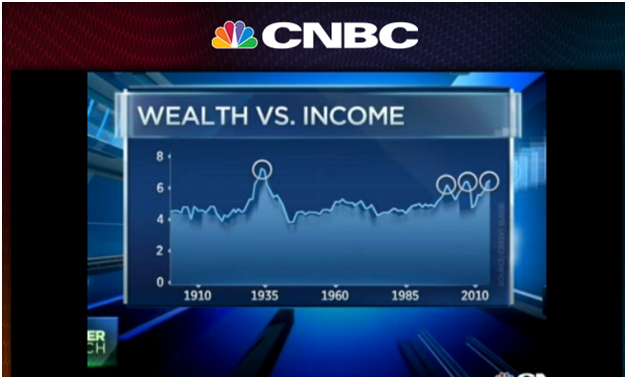
According to a report just release entitled, “Credit Suisse : The wealth gap is starting to worry the arch-capitalists1, the wealth to income gap is the largest it has been since 1929. If 1929 rings a bell it is because it was the start of the Great Depression. Credit Suisse is by no means a left leaning group. They provide advisory services for private banking, wealth management and investment banking (ticker CSGN).

Every time we have had a spike in this benchmark we have had a severe depression or recession. The folks at Credit Suisse are arch-capitalists. In the report they state:

Curiously, the Marxist view that the unequal distribution of capitalism’s rewards creates a potentially catastrophic drag on the economy has lately become conventional wisdom among such deeply capitalist institutions as the IMF and ratings agency Standard & Poor’s.

They go on to state that the reason for this is that rich people do not buy enough. Also, credit has tightened a lot for average folks in the last decade. They further state:

The problem of depressed demand is unlikely to be resolved at all by the workings of the market, which left to its own logic will continue to concentrate most wealth in the hands of a tiny few.

The movement towards flat income and incredible gains by the wealthy is called plutocracy. Plutocracy leaves the legitimate realm of a capitalist meritocracy and not only brings us closer to another economic depression but, as history has abundantly demonstrated, will eventually make a violent revolution more likely. As I stated in my recent post “Modernity and the Contradiction of Values Dilemma“, the lack of viable checks and balances in laissez-faire capitalism, intelligent regulation, is a contradiction of the values of modernity. Elitism has always been the direct outcome of plutocracy as the Gilded Age readily shows. It seems that there are trends in post-modernity that are again tugging at the reins of elitism. Anyone that advocates the principles that lead us back to plutocracy and elitism also must silence the bodies of modernity which advocated democracy, the common folk, and was embodied in the U.S. Constitution.

In this election season, each voter should ask themselves which political party would bring us closer to de-regulation, lower taxes for the wealthy and large corporations, and cutting and eliminating social programs that put money into the hands of the poor which get spent much more readily that in the hands of the wealthy. The Republicans have been slashing government funding and housing programs (NGOs) which benefit the poor and middle class. Now, they even have the nerve to bash the Democrats for the lack of affordable housing and blame the government for ignorantly turning Ebola away in the emergency rooms of their De facto health care plan2.

Please ask yourself which party is more likely to support checks and balances in the market, find ways to get cash into the hands of those that will spend it, solve long term health care issues or at least make an attempt. It is also commonly known even among the most conservative economists that our economy has always done better under Democratic administrations than Republican administrations3. Also, when you think of political attempts at solutions versus road blocks and naysayers what political parties come to mind?

Look at where Austrian styled economics got us with radical financial de-regulation. Credit default swaps fueled the fires of a private mortgage wildfire. NGO’s loan failures were very small compared to private mortgage company failures. The bi-partisan FCIC report on the Housing Crisis of 2008 concludes:

The Commission also probed the performance of the loans purchased or guaranteed by Fannie and Freddie. While they generated substantial losses, delinquency rates for GSE loans were substantially lower than loans securitized by other financial firms. For example, data compiled by the Commission for a subset of borrowers with similar credit scores—scores below 660—show that by the end of 2008, GSE mortgages were far less likely to be seriously delinquent than were non-GSE securitized mortgages: 6.2% versus 28.3%.4

President Bush admitted the ‘mistake’ which put ‘boots on the ground” in Iraq and cost taxpayers trillions of dollars in foreign wars. Yet, the current political narrative has lost the perspective of the cost of those wars, in lives and capital, relative to the much lower cost of foreign involvements during the Obama administration.

Austrians take government austerity to an extreme. The difference between the U.S. recovery and European economic stagnation are commonly known to be the intervention of the Federal Reserve here and the tightening of fiscal policy by the German central bank. The Austrians would eliminate the Federal Reserve. They think the Federal Reserve “prints money”. The fact is the Fed sells government bonds through the Treasury department just as a private corporation sells bonds to raise money. “Printing money” would mean we would simply make the currency with no intention of paying it back. This type of narrative hides the basic function of a Treasury bond to manipulate the naive.

In keeping with their ‘selective’ austerity ideal, Republicans in Congress continually target government programs they oppose. They were not in favor of cutting the Medicare Advantage program they started which was a boondoggle for private insurance companies but cost the taxpayer 12% more for the same programs under traditional Medicare5 They would not cut the bloated defense budget without having too under budget sequestration in 2013. They refused to let the prescription drug plan, started under Bush 43, negotiate cost with insurance companies for bulk purchases as any private company would do. This has and will continue to cost the taxpayer billions of dollars. Due to this, the prescription drug program will cost as much as ObamaCare did over 10 years. No Republican has ever tried to repeal the prescription drug plan or change the law to save the taxpayer billions while providing the same services.

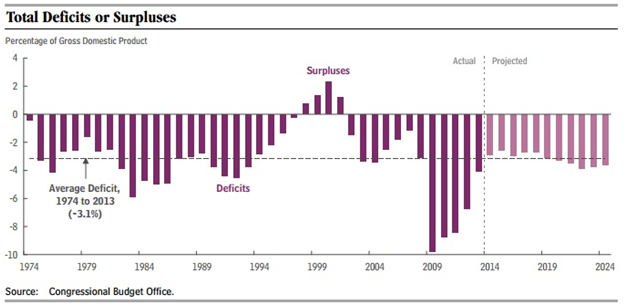
Republicans only favor cutting government programs they deem as wasteful such as education, environmental, food stamps which helps farmers as much as it helps the hungry. Republican cutting has hit many government department budgets including the CDC, embassy security, blocking infrastructure bills, cutting taxes on the wealthy while making sure that the poor masses would find it much harder to vote. In spite of their pet programs, under President Obama, the deficit has come down dramatically.

6

The spike at the beginning of the Obama administration had nothing to do with ObamaCare which had not even hit the budget in those years. The spike was a result of the great recession started by the Bush administration which controlled both Houses of the Congress for six years and had a conservative majority in the Supreme Court. It reflects decades of congressional mandated spending under both parties and had absolutely nothing to do with anything the Obama Administration did. You would never know that by listening to popular rhetoric. The economic recovery since then and reduced deficit spending should have been a high credit to the Obama administration but the narrative has been turned upside down by big money political marketing in large part thanks to the Citizens United decision.7

Did we gain oil independence in the Bush administration? The International Energy Agency (EIA) predicts we will by 2015.8 If you listen to Republican rhetoric funded by the oil industry you would think that the EPA and President Obama has cripple energy oil production. The opposite is actually true.

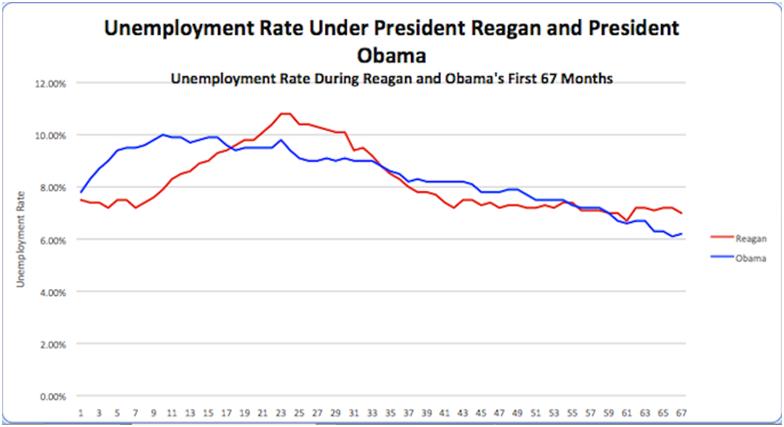
Forbes recently published an article entitled “Obama Outperforms Reagan On Jobs, Growth And Investing”.9 The data shows that while Reagan was considered the best economic president in recent history he lags Obama in “all commonly watched categories”:

Economically, President Obama’s administration has outperformed President Reagan’s in all commonly watched categories. Simultaneously the current administration has reduced the deficit, which skyrocketed under Reagan. Additionally, Obama has reduced federal employment, which grew under Reagan (especially when including military personnel,) and truly delivered a “smaller government.” Additionally, the current administration has kept inflation low, even during extreme international upheaval, failure of foreign economies (Greece) and a dramatic slowdown in the European economy.

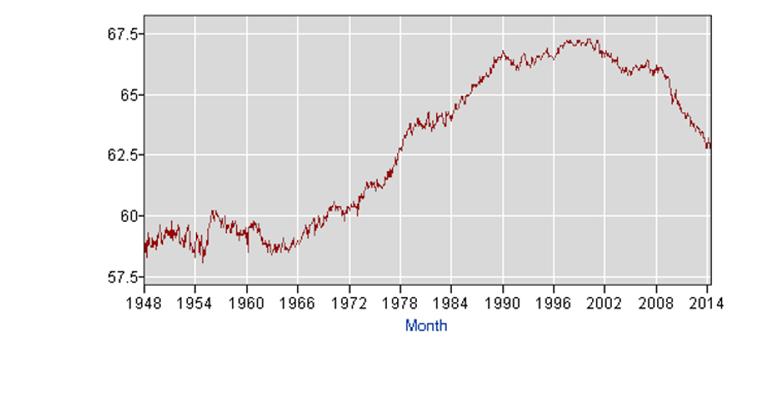
While job participation, what the Republicans call “real unemployment”, has remained relatively flat since 1994, there was a rise in job participation during the baby boom years under Reagan and a decrease under Obama as baby boomers retire. This chart shows the difference between reported unemployment and all unemployment, including those no longer looking (called U6, it has been tracked since 1900). It has “remained pretty constant since 1994”.

Here is a comparison of unemployment under President Obama and Reagan:

It shows unemployment did not peak as high as it did for Reagan and recovered faster under Obama. Is this the message most folks are hearing? The current perceptions of President Obama are produced by those who could care less about the real facts.

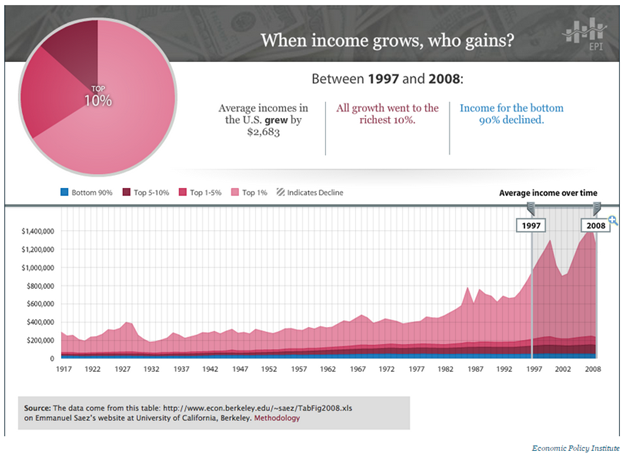
When Republicans defend the wealth factor they often tell us that wealthy people create jobs. While only a small percentage of wealthy people actually finance start ups directly, their defenders suggest that stock investments indirectly finance companies that do create jobs. So who gains when jobs are created:

10

While rich folks may create some jobs they pale in job creation when it comes to a healthy middle class. It is really simple: the rich may create a job but the economy’s job creation engine is from the consumer who spends and thus creates multiple jobs. The rich will thrive whether the economy is good or not as the graph above shows. The referenced “Business Insider” article from the graph above goes on to state:

Now, again, entrepreneurs are an important part of the company-creation process. And so are investors, who risk capital in the hope of earning returns. But, ultimately, whether a new company continues growing and creates self-sustaining jobs is a function of the company’s customers’ ability and willingness to pay for the company’s products, not the entrepreneur or the investor capital. Suggesting that “rich entrepreneurs and investors” create the jobs, therefore, Hanauer observes, is like suggesting that squirrels create evolution.

Even more so, the great Reagan litmus test of “are you better off now than you were” at the end of the Republican’s great recession of 2008 has been completely ignored. Do we really want to go back there? Are the Republicans the ones that are going rally behind the middle class and their incomes? In spite of the doomsday sayers about Obama, where is the hard evidence that his administration will end worse than the previous Republican administration did? Are folks so gullible that they cannot remember recent history over the continual, highly financed squeals of rhetorical propaganda? I sincerely hope not. In any case, all I can say is that If the Republicans get back into office in 2014, we will all get what we deserve.

“Those who cannot remember the past are condemned to repeat it.” George Santayana

_________________

1 Here is a video about this shown on CNBC today.

2 Ebola, Texas and ObamaCare

3 See The Great Lie: The Great Depression and Recessions of the United States

4 See THE FINANCIAL CRISIS INQUIRY REPORT, page xxvi

5 See Extra Payments to Medicare Advantage Plans Totaled $5.2 Billion Over Fee-For-Service Costs in 2005, Also The Ryan Plan: Part 1

6 See CBO An Update to the Budget and Economic Outlook: 2014 to 2024, page 8.

7 See Formalism: When a Lie Becomes Truth (really)

8 See IEA Predicts the U.S. Will Be the World’s Largest Oil Producer by 2015

9 See Obama Outperforms Reagan On Jobs, Growth And Investing

10 See Sorry, Folks, Rich People Actually Don’t ‘Create The Jobs’ in Business Insider.

Ebola, Texas and ObamaCare

Governor Perry and many of the extreme right-wing Republicans in Texas including Ted Cruz are extremely proud of their efforts to repeal affordable health care in Texas. They have proven by their actions that they favor the old ’emergency room’ health care system.

Texas Governor Rick Perry has joined the ranks of other GOP governors eager to assert the sovereignty of their states by nullifying the ObamaCare law. Perry announced on Monday that the Lone Star State will not be expanding the Medicaid program or creating the necessary healthcare exchange to implement the president’s signature legislation. As noted by Reuters, “The announcement makes Texas the most populous state that has rejected the provisions.”1

One thing that history has abundantly demonstrated to us about the ’emergency room’ plan is that low income folks and folks without health insurance are routinely turned away from hospitals as Mr. Duncan was recently or wait for hours in the waiting rooms while sharing any opportunist germs with each other. This is not the fault of the hospitals. It is the fault of reckless and opportunist politicians which are content to manipulate the public using highly funded and deep pockets, thanks to the Citizens United decision2, into believing that they will not be directly affected by opposing ObamaCare. However, in the case of recent Ebola infections in Texas, it should be clear that the more folks of low income or no health insurance are ignored by the ’emergency room’ status quo, the more hospitals are forced to be lax with their admissions due to lack of adequate resources. See this chart below to see how Texas fares with the rest of the country. Note that these statistics even factor in the other conservative states which also refused the federal aid for Medicaid as “U.S. Uninsured”. The tragic difference is much more apparent in Texas when those conservative states are factored out from this data.

Texas Uninsured

U.S. Uninsured

Uninsured total population

24%

15%

Uninsured children

16%

9%

All adults uninsured, 19-64 years of age

32%

21%

Uninsured women
19-64

30%

19%

Uninsured men
19-64

33%

23%

Nonelderly uninsured- at least one full-time worker

24%

15%

Nonelderly uninsured by gender

Male – 52%
Female – 48%

Male – 53%
Female – 47%

Nonelderly uninsured by race/ethnicity

White – 24%
Black – 10%
Hispanic – 62%
Other – 4%

White – 45%
Black – 15%
Hispanic – 32%
Other – 8%

Uninsured rates for the nonelderly by age

Children 18 and under – 16%
Adults 19-64 – 32%

Children 18 and under – 9%
Adults 19-64 – 21%

Distribution of the nonelderly with employer coverage by age

Children 18 and under – 18%
Adults 19-64 – 81%

Children 18 and under – 15%
Adults 19-64 – 85%

Source: Kaiser State Health Facts, 2012

– See more at: http://www.texmed.org/Template.aspx?id=5519#sthash.HL3MzX1Q.dpuf

What is lost in the right’s rhetoric is the vested interest that we all have in making sure that the U.S. has adequate health care. When the poor and uninsured are no longer the ‘they that can be conveniently ignored’ but the ‘they’ that can spread Ebola to the wealthy and insured, the political landscape changes. If hospitals are underfunded and under staffed thanks to the law signed by Ronal Reagan requiring hospitals to take care of the indigent3 they will not be able to adequately screen for conditions like Ebola. This is no longer a ‘bleeding heart liberal’ problem but a problem that threatens even the most red states. I have always maintained that you can be a very selfish, ‘me only’ voter and still have valid reasons, your own interest, for providing a “safety net” as Reagan called it for the less fortunate. It is unfortunate the even Democrats are running away from these principles in their local elections after the brutal beating from the right on ObamaCare. If we as Americans do not learn from the Ebola incident, we fully deserve everything that will come from our convenient ignorance.

_________________

1 See Texas Refuses to Implement ObamaCare

2 See Money is Free Speech?

3 See Simpson-Bowles Revisited

Also, see this column by Duncan’s nephew:

Exclusive: Ebola didn’t have to kill Thomas Eric Duncan, nephew says